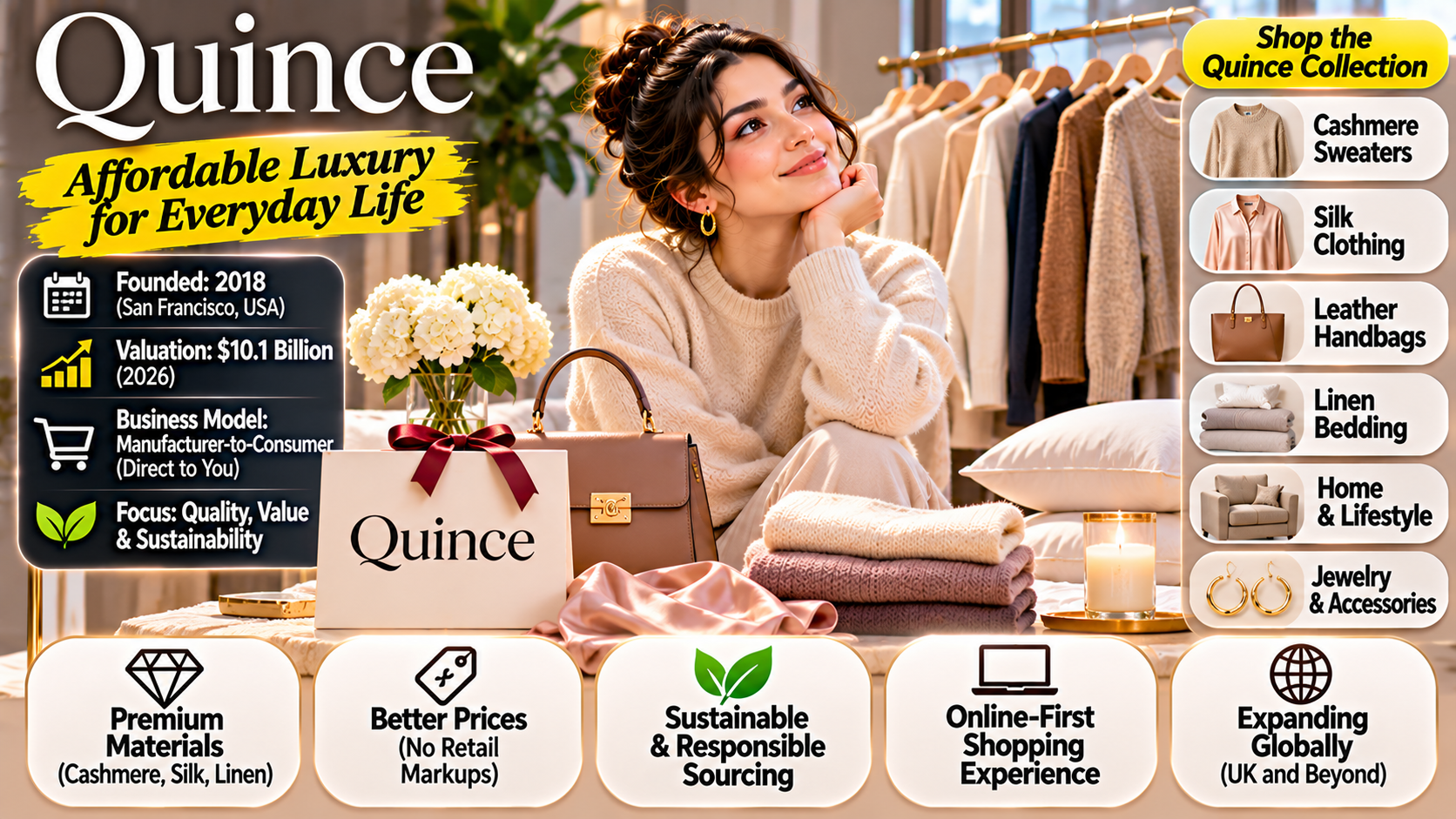
The fashion and lifestyle retail industry is experiencing a major shift. Consumers increasingly want premium materials, timeless designs, and quality products without paying extremely high luxury prices. One brand that has attracted significant attention through this approach is Quince.
Quince has built its reputation around an appealing idea: high-quality everyday essentials should be accessible to more people. Its product range includes cashmere sweaters, silk clothing, linen bedding, leather accessories, jewelry, furniture, and other lifestyle products.
Unlike traditional luxury retailers, Quince uses a manufacturer-to-consumer business model designed to reduce supply-chain costs and unnecessary retail markups. This strategy has helped the company develop a strong presence in online shopping and attract customers looking for affordable alternatives to expensive lifestyle brands.
In 2026, Quince is gaining further attention through international expansion, substantial investment, product diversification, and a growing customer base.
This article explores Quince's history, popular products, pricing strategy, business model, sustainability approach, competition, and future opportunities.
1. What Is Quince?
<Entity value="Quince" category="brand" disambig="American direct-to-consumer affordable luxury clothing and lifestyle retailer"/> is an American fashion and lifestyle retailer headquartered in San Francisco, California.
The company focuses on producing and selling premium-inspired everyday products at accessible prices. Its collections cover multiple categories, allowing customers to purchase clothing, accessories, and home essentials through one online shopping platform.
Popular product categories include:
Cashmere sweaters and clothing
Silk dresses, shirts, and sleepwear
Linen clothing and bedding
Leather handbags and accessories
Jewelry and watches
Men's and women's fashion
Home furniture and décor
Kitchen and dining products
Beauty and wellness products
Travel essentials
Quince's central business philosophy is that product quality and materials should matter more than expensive branding and traditional retail markups.
2. The History of Quince
Quince was founded in 2018 by Sid Gupta, Zunu Mittal, and other members of its founding team.
The company emerged from a simple observation: many premium products carry prices influenced by sourcing agents, wholesalers, distributors, physical stores, marketing expenses, and brand positioning.
Its founders believed that a different retail structure could make quality products more affordable.
Instead of following the traditional retail model, Quince developed a manufacturer-to-consumer approach. It works with manufacturing partners and sells products directly through its online platform.
Important milestones
Period | Development |
|---|---|
2018 | Quince was founded in the United States |
2019–2020 | The business developed its direct-to-consumer identity and expanded its product offering |
2021–2023 | The brand increased its visibility through online marketing and new product categories |
2024–2025 | Expansion across apparel, home products, accessories, and lifestyle categories accelerated |
March 2026 | Quince completed a reported $500 million Series E funding round at a $10.1 billion valuation |
2026 | The company continued international expansion and reported sales growth exceeding $2 billion over the previous 12 months |
The company's rapid development demonstrates how a focused retail concept can expand into a broader lifestyle business.
Recent reporting describes Quince as a rapidly growing company with ambitions beyond affordable fashion. <Cite refs={["turn668172search6","turn668172search10","turn668172news13"]}/>
3. Who Owns Quince?
Quince is a privately held company headquartered in San Francisco.
Its leadership includes co-founder Sid Gupta, who serves as CEO. The company has attracted investment from major venture capital and institutional investors as it has expanded its operations.
In March 2026, Quince reportedly raised $500 million in Series E funding, reaching a valuation of approximately $10.1 billion.
This investment reflects growing investor interest in technology-enabled retail companies that combine direct manufacturing relationships, digital distribution, and competitive pricing. <Cite refs={["turn668172search6","turn668172search10"]}/>
4. What Makes Quince Different?
Quince's business model is built around three central ideas: affordability, quality, and supply-chain efficiency.
A. Manufacturer-to-consumer model
Traditional retail often involves several stages between the factory and the final customer.
These may include:
Manufacturers
Sourcing agents
Wholesalers
Distributors
Retail stores
Customers
Each stage can add costs to the final selling price.
Quince aims to reduce these layers by working directly with manufacturing partners and selling through its online platform.
This approach allows the company to maintain greater control over product development, pricing, and customer demand.
B. Premium materials at accessible prices
Quince offers products made from materials associated with premium fashion and home goods.
Examples include:
Mongolian cashmere
Mulberry silk
Italian leather
European linen
Organic cotton
Wool and alpaca
The brand's appeal comes from combining recognizable materials with comparatively accessible pricing.
However, material type alone does not guarantee that two products have identical quality. Construction, fabric weight, finishing, durability, and manufacturing standards also matter.
C. Minimal branding
Many Quince products feature simple designs without prominent logos.
This creates a minimalist aesthetic that appeals to customers who prefer understated fashion and timeless wardrobe essentials.
D. Online-first shopping
Quince primarily operates through its digital platform, allowing customers to browse products, compare materials, and place orders online.
Its online-first strategy also reduces the need for a large traditional retail-store network.
The company's own description of its model emphasizes direct manufacturing relationships, reduced retail complexity, and technology-supported demand planning. <Cite refs={["turn668172search0","turn668172search2"]}/>
5. Popular Quince Product Categories
Quince has expanded beyond its original clothing assortment into a broad lifestyle collection.
Women's clothing
<IMAGE_PLACEHOLDER>
Women's fashion is an important part of the Quince brand.
Popular product types include:
Cashmere sweaters
Silk blouses
Linen dresses
Everyday trousers
Comfortable tops
Matching clothing sets
Outerwear
Sleepwear
The designs generally emphasize neutral colors, practical silhouettes, and versatile styling.
Men's clothing
The men's collection includes everyday essentials and premium-inspired wardrobe pieces.
Examples include:
Cashmere sweaters
Cotton shirts
Linen clothing
Casual trousers
Jackets
Everyday basics
Cashmere collection
<IMAGE_PLACEHOLDER>
Cashmere is one of Quince's best-known product categories.
The company offers cashmere sweaters and other garments designed for customers who want a soft, premium-feeling material without paying traditional luxury-brand prices.
Customers should compare fiber composition, garment weight, construction, care requirements, and product reviews before purchasing.
Silk clothing
Quince also offers silk garments and accessories.
Common products include:
Silk dresses
Silk shirts
Silk pillowcases
Silk sleepwear
Silk accessories
Silk appeals to consumers looking for a smooth texture, lightweight feel, and elegant appearance.
Home and lifestyle products
<IMAGE_PLACEHOLDER>
Quince has expanded into home products, creating opportunities to serve customers beyond the fashion market.
Its home categories include:
Linen bedding
Towels
Furniture
Rugs
Kitchen essentials
Home décor
Dining products
Candles and other lifestyle accessories
This diversification helps the company position itself as an affordable luxury lifestyle destination rather than simply a clothing retailer.
6. Why Is Quince So Popular?
Quince's popularity is connected to changing consumer expectations and its approach to online retail.
Affordable luxury positioning
Many consumers want premium-looking products but do not want to spend luxury-brand prices.
Quince targets this audience with comparatively accessible prices and simple designs.
Transparent pricing
The brand explains its pricing philosophy and provides product information intended to help customers understand the value behind its offerings.
Its website also presents examples of traditional retail pricing compared with its own pricing approach.
These comparisons are part of its marketing strategy and should not automatically be interpreted as proof that every compared product is identical.
Social media visibility
Fashion creators and lifestyle influencers have helped introduce Quince products to broader audiences.
Product reviews, outfit videos, home styling content, and recommendations can influence shopping decisions.
Versatile products
Neutral colors, minimalist designs, and classic silhouettes make many Quince products easy to incorporate into everyday wardrobes and homes.
Expanding product range
Customers can shop across multiple categories without visiting separate specialist retailers.
7. Quince's Manufacturer-to-Consumer Business Model
One of the most interesting aspects of Quince is its approach to retail operations.
The company describes its business as manufacturer-to-consumer, or M2C.
Instead of relying entirely on the traditional wholesale and retail distribution system, it works directly with partner factories.
How the model works
Step 1: Identify customer demand
Quince studies consumer preferences, product searches, and shopping activity to understand which products customers want.
Step 2: Develop product designs
The company develops its own products and selects materials, specifications, and manufacturing partners.
Step 3: Work with manufacturing partners
Products are produced through a network of factories specializing in different materials and categories.
Step 4: Sell through digital channels
Customers browse and purchase products through the company's online platform.
Step 5: Use demand information
Customer demand data can inform production decisions, inventory planning, and future product development.
Quince says it uses technology and AI-supported planning to connect demand signals with production decisions. <Cite refs={["turn668172search0","turn668172search6"]}/>
Advantages of the model
Fewer traditional retail layers
Greater control over product development
Direct access to customer demand information
Opportunities to reduce unnecessary inventory
Competitive pricing potential
Faster feedback on product performance
Challenges of the model
Dependence on manufacturing partners
International shipping complexity
Quality-control requirements
Returns and customer-service costs
Supply-chain disruption risks
Maintaining customer trust as the company grows
The model can create cost efficiencies, but its success depends on strong supplier relationships and consistent product quality.
8. Quince vs. Traditional Luxury Brands
Quince competes in a market where consumers compare materials, quality, style, and prices across different brands.
The following comparison illustrates the different positioning strategies.
Feature | Quince | Traditional Luxury Brands |
|---|---|---|
Pricing | More accessible positioning | Often premium pricing |
Branding | Minimalist and understated | Often stronger brand identity |
Distribution | Primarily online | Online and physical retail |
Product focus | Everyday premium-inspired essentials | Broad luxury collections |
Marketing | Digital, creators, and value messaging | Brand heritage and luxury positioning |
Customer appeal | Value-conscious premium shoppers | Luxury and brand-conscious shoppers |
This is a general comparison. Product quality, craftsmanship, and customer experience differ between individual brands and products.
9. Quince and Sustainability
Sustainability has become an important subject in the global fashion industry.
Quince states that it aims to use responsible materials, reduce unnecessary packaging, and work with manufacturing partners that follow workplace and safety standards.
Its sustainability-related initiatives include:
Organic cotton where available
Recycled polyester
Linen and natural fibers
Reduced packaging
Direct shipping strategies
Responsible manufacturing partnerships
Timeless product designs intended for repeated use
The company also describes its approach to reducing waste through demand-informed production and inventory planning. <Cite refs={["turn668172search2","turn668172search4"]}/>
However, sustainability claims should be assessed carefully. A company's stated goals are not the same as independently verified environmental performance.
Customers and industry analysts should consider factory audits, material certifications, labor practices, product durability, shipping emissions, and transparent reporting.
10. Quince's Growth and International Expansion in 2026
Quince's expansion has become one of the most notable developments in the affordable luxury retail market.
In March 2026, the company raised $500 million in a funding round that valued it at approximately $10.1 billion, according to business reporting.
In July 2026, reporting indicated that the company had surpassed $2 billion in sales over the previous 12 months.
The company has also expanded into additional product categories, including furniture, travel, wellness, and food. <Cite refs={["turn668172search6","turn668172search10"]}/>
Expansion into the United Kingdom
In October 2026, Quince entered the UK market, marking an important step in its international growth beyond North America.
This expansion creates an opportunity to introduce its manufacturer-to-consumer proposition to a new audience of shoppers seeking premium products at more accessible prices. <Cite refs={["turn668172news13"]}/>
Why international expansion matters
International growth can help Quince:
Reach new customer segments
Increase brand recognition
Expand its sales opportunities
Diversify its geographic markets
Build stronger global manufacturing and logistics operations
However, entering new markets also requires adapting to local customer preferences, delivery expectations, taxes, regulations, and return policies.
11. Competition and Legal Challenges
Quince operates in a competitive market that includes premium fashion brands, direct-to-consumer retailers, and established lifestyle companies.
Its pricing and product-comparison strategy has also attracted controversy.
In 2026, reporting discussed legal disputes involving companies including Coach's parent company, Deckers Brands, and Williams-Sonoma. The issues included allegations concerning product design similarities and comparative advertising practices.
These matters illustrate the legal and reputational risks that can arise when a company competes by offering products positioned against established brands. Allegations and lawsuits should not be treated as final court findings. <Cite refs={["turn668172search6","turn668172news13"]}/>
Major competitive challenges
Established luxury-brand recognition
Consumer concerns about product originality
Maintaining quality during rapid expansion
Protecting intellectual property
Building a distinct brand identity
Managing customer expectations
Maintaining competitive pricing
For Quince, long-term success will require more than offering affordable alternatives. It will also depend on developing a recognizable identity and maintaining customer confidence.
12. The Future of Quince: What to Expect Beyond 2026
The future of Quince will likely depend on its ability to balance rapid growth with product quality and brand differentiation.
Several developments could shape its next stage.
Technology-driven retail
AI and demand analytics may help the company improve product planning, forecasting, and inventory management.
Global expansion
New markets can increase customer reach and strengthen the brand's international presence.
More product categories
Quince may continue developing additional lifestyle categories, creating a broader shopping experience.
Stronger brand identity
As the company grows, building a distinct identity beyond affordable alternatives will become increasingly important.
Supply-chain responsibility
Transparent sourcing, reliable manufacturing partners, and measurable sustainability improvements will matter to customers and regulators.
Customer loyalty
Long-term growth depends on customers returning because they trust the quality, service, and value of the products.
13. Is Quince Worth Shopping At?
Quince may be worth considering for customers who want minimalist clothing, premium-inspired materials, and home products at more accessible prices.
However, customers should evaluate each product individually.
Before purchasing, consider:
Material composition
Fabric weight and construction
Product measurements
Customer reviews
Care instructions
Shipping charges and delivery estimates
Return eligibility
Country-specific availability
A cashmere sweater, silk blouse, and linen bedsheet have different quality considerations. Comparing products within the same category is more useful than relying only on the brand name.
Frequently Asked Questions About Quince
1. What is Quince known for?
Quince is known for affordable luxury-inspired clothing, cashmere sweaters, silk garments, linen bedding, leather accessories, and home products.
2. When was Quince founded?
Quince was founded in 2018 in the United States.
3. Who owns Quince?
Quince is a privately held company. Its co-founder Sid Gupta serves as CEO.
4. Why are Quince products comparatively affordable?
The company uses a manufacturer-to-consumer model intended to reduce traditional retail costs and supply-chain intermediaries.
5. Does Quince sell only clothing?
No. Its product range also includes accessories, jewelry, home goods, furniture, travel products, and other lifestyle categories.
6. Is Quince a luxury brand?
Quince positions itself as an affordable luxury brand. Its products use premium-inspired materials and minimalist designs, but it does not follow the same pricing and brand-positioning model as traditional luxury houses.
7. Is Quince sustainable?
The company describes several sustainability initiatives, including responsible material sourcing, reduced packaging, and manufacturing standards. Consumers should review available certifications and independently verified information when assessing specific environmental claims.
8. Does Quince have physical stores?
Quince has historically operated primarily as an online retailer. Customers should check its official website for the latest market-specific shopping and retail information.
9. How much is Quince worth in 2026?
A March 2026 funding round reportedly valued Quince at approximately $10.1 billion.
10. Where is Quince based?
Quince is headquartered in San Francisco, California, in the United States.
Conclusion
Quince has emerged as an influential name in the affordable luxury retail market by challenging traditional pricing and distribution structures.
Its manufacturer-to-consumer business model, minimalist product designs, premium-inspired materials, and online-first approach have helped it expand beyond clothing into a broader lifestyle business.
In 2026, major investment, reported sales growth, international expansion, and technology-driven operations have strengthened its position in the global retail conversation.
However, its long-term success will depend on maintaining product quality, managing supply-chain complexity, addressing legal and reputational challenges, and building a distinctive brand identity.
For consumers, Quince represents an alternative way to shop for everyday fashion and lifestyle products: one that places greater emphasis on materials, value, and practical design.