Human resources leadership has become one of the most important parts of modern business strategy. Organizations increasingly recognize that attracting skilled employees, developing talent, improving workplace culture, and retaining high-performing teams are essential for long-term success.
At the center of these responsibilities is the Chief Human Resources Officer (CHRO).
Modern CHROs are responsible for much more than recruitment, employee records, and workplace policies. They contribute to organizational strategy, leadership development, workforce planning, employee experience, diversity and inclusion initiatives, and digital transformation.
However, managing these responsibilities can be challenging, particularly as businesses adapt to artificial intelligence, remote work, changing employee expectations, and evolving labor markets.
This is where CHRO networks become valuable.
CHRO networks are professional communities that connect senior human resources executives, HR directors, people leaders, and workforce strategy professionals. They provide opportunities to exchange knowledge, discuss workplace challenges, share successful practices, and develop meaningful professional relationships.
In 2026, these communities are especially relevant as organizations rethink how they recruit, manage, develop, and support employees.
This guide explains what CHRO networks are, how they work, their benefits, popular HR leadership communities, and practical strategies for building valuable professional connections.
What Are CHRO Networks?
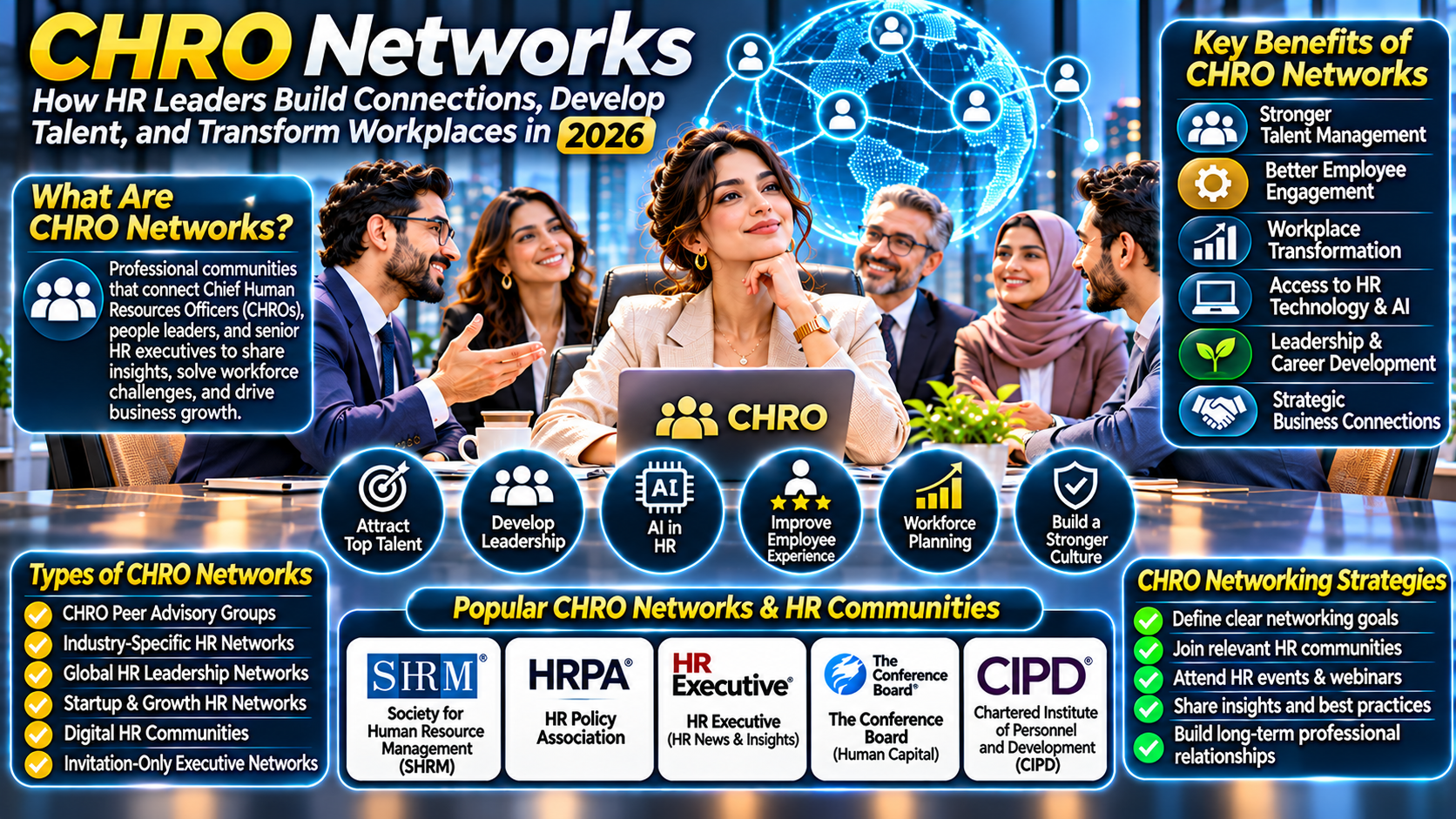
CHRO networks are professional communities designed to connect Chief Human Resources Officers and other senior HR professionals.
Members commonly include:
Chief Human Resources Officers (CHROs).
Chief People Officers (CPOs).
Human Resources Directors.
HR Vice Presidents.
Talent Acquisition Leaders.
People and Culture Executives.
Workforce Planning Professionals.
Organizational Development Leaders.
Employee Experience Executives.
These networks provide a platform for professionals to exchange experiences, discuss workforce challenges, explore HR technology, and learn from other business leaders.
Unlike general professional networking groups, CHRO networks focus specifically on the responsibilities of senior human resources leadership.
Common discussion topics include:
Talent acquisition and recruitment.
Employee retention.
Leadership development.
Workforce planning.
Organizational culture.
Employee engagement.
Compensation and benefits.
HR technology and automation.
Artificial intelligence in human resources.
Remote and hybrid work.
Workplace compliance.
Diversity, equity, and inclusion.
CHRO networks can operate through professional associations, executive forums, peer advisory groups, online communities, conferences, and invitation-only leadership circles.
Some are free to access, while others require membership fees, professional experience, or specific eligibility criteria.
Why Are CHRO Networks Important in 2026?
The workplace is changing rapidly. Businesses are dealing with new technologies, evolving employee expectations, skills shortages, and increasing competition for talented professionals.
CHRO networks help HR executives understand these changes and learn how other organizations are responding.
1. Access to HR Leadership Knowledge
CHROs regularly face complex decisions involving recruitment, compensation, workforce planning, employee relations, and organizational development.
Connecting with experienced HR leaders provides opportunities to exchange knowledge and discuss practical solutions.
2. Better Talent Management Strategies
Professional networking helps HR executives learn about new recruitment methods, employee retention practices, leadership programs, and workforce development strategies.
3. Understanding Workplace Trends
Employee expectations, labor markets, and workplace technologies continue to evolve.
CHRO communities provide opportunities to discuss remote work, flexible employment, employee well-being, and emerging workforce trends.
4. Professional Development
Networking exposes HR leaders to different management approaches, organizational strategies, and leadership experiences.
These discussions can strengthen communication, strategic thinking, and executive decision-making.
5. Strategic Business Relationships
CHRO networks may introduce members to HR consultants, technology providers, recruitment specialists, executive coaches, and potential business partners.
6. Support During Organizational Challenges
HR executives often handle sensitive situations involving restructuring, employee conflicts, organizational change, and workforce uncertainty.
Peer communities provide opportunities to discuss challenges with professionals who understand the responsibilities of senior HR leadership.
Major Types of CHRO Networks
Different HR communities serve different professional objectives.
1. CHRO Peer Advisory Groups
Peer advisory groups bring together senior HR executives who meet regularly to discuss workplace challenges and share professional experiences.
Members may discuss recruitment strategies, leadership development, employee engagement, and organizational transformation.
Common benefits:
Confidential peer discussions.
Shared HR leadership knowledge.
Practical problem-solving.
Professional accountability.
Executive development.
2. Industry-Specific HR Networks
These communities connect HR executives working in similar industries.
Examples include:
Technology HR networks.
Healthcare HR communities.
Manufacturing HR associations.
Financial services HR groups.
Retail workforce leadership networks.
Hospitality and tourism HR communities.
Industry-focused networking helps members discuss sector-specific workforce requirements, recruitment challenges, regulations, and employee development.
3. Global HR Leadership Networks
Global HR networks connect senior human resources professionals across countries and regions.
They help members understand international workforce trends, cross-border employment challenges, and different approaches to talent management.
4. Startup and Entrepreneurial HR Networks
These communities connect HR professionals, startup founders, and people leaders working in growing businesses.
Common discussion topics include building HR departments, recruiting early employees, establishing workplace policies, managing compensation, and developing organizational culture.
5. Digital HR Communities
Online CHRO networks allow professionals to participate in discussions, attend webinars, share resources, and build relationships without geographical limitations.
6. Invitation-Only Executive Networks
Some HR leadership communities require applications, recommendations, or specific professional qualifications.
They may focus on experienced CHROs and senior executives managing large organizations or complex workforce operations.
Popular CHRO Networks and HR Leadership Communities
Several established organizations support HR professional development, leadership education, research, and networking.
1. SHRM (Society for Human Resource Management)
<Entity value="Society for Human Resource Management" category="organization" disambig="Professional association for human resource management"/> is a major professional association serving HR professionals and business leaders.
It provides HR resources, professional education, research, events, and opportunities to connect with other human resources professionals.
Official website: https://www.shrm.org/
2. HR Policy Association
<Entity value="HR Policy Association" category="organization" disambig="Association representing senior human resources executives at major employers"/> is an organization focused on major employer and workforce policy issues.
It provides a platform for senior HR executives to discuss employment policy, workforce developments, and organizational challenges.
Official website: https://www.hrpolicy.org/
3. HR Executive
<Entity value="HR Executive" category="organization" disambig="Human resources industry publication and executive information platform"/> provides industry news, research, insights, and professional content for HR leaders.
Its resources help executives follow developments in talent management, HR technology, and workplace strategy.
Official website: https://hrexecutive.com/
4. The Conference Board
<Entity value="The Conference Board" category="organization" disambig="Business research and executive membership organization"/> offers executive communities, research, leadership events, and business insights.
Its human capital and leadership resources are relevant to senior HR executives.
Official website: https://www.conference-board.org/
5. CIPD (Chartered Institute of Personnel and Development)
<Entity value="Chartered Institute of Personnel and Development" category="organization" disambig="Professional body for human resources and people development"/> is a professional body focused on people management and organizational development.
It offers research, professional learning, qualifications, and resources for HR and workplace professionals.
Official website: https://www.cipd.org/
6. LinkedIn HR Communities
<Entity value="LinkedIn" category="software" disambig="Professional networking and business social media platform"/> allows CHROs and HR professionals to connect with industry leaders, participate in workplace discussions, share professional insights, and discover relevant events.
Official website: https://www.linkedin.com/
Membership criteria, pricing, available programs, and geographical coverage vary across these organizations.
Key Benefits of Joining a CHRO Network
Joining a suitable HR leadership community can create valuable professional and organizational advantages.
1. Improved Talent Management
CHRO networks allow HR leaders to exchange ideas about recruitment, employee development, retention, and workforce planning.
2. Better Employee Engagement Strategies
Members can discuss approaches to employee communication, workplace recognition, professional development, and organizational culture.
3. Access to HR Technology Insights
Networking can help CHROs learn about new HR software, recruitment platforms, workforce analytics, and AI-powered HR tools.
4. Leadership Development
Peer discussions, mentorship, workshops, and executive events can help HR leaders improve strategic thinking and decision-making.
5. Understanding Employment Trends
CHRO communities provide opportunities to discuss changing workforce expectations, skills requirements, flexible work, and labor market developments.
6. Strategic Business Connections
Professional relationships may lead to partnerships with HR technology companies, recruitment firms, executive coaches, consultants, and other organizations.
7. Global Workforce Perspectives
International communities help HR leaders understand different employment environments, workplace practices, and workforce challenges.
How CHROs Can Build a Strong Professional Network
Effective networking is about building trusted professional relationships rather than simply increasing the number of contacts.
Step 1: Define Your Networking Goals
Identify what you want to achieve through professional networking.
Your objectives might include:
Improving talent acquisition strategies.
Learning about HR technology.
Developing leadership capabilities.
Understanding global workforce trends.
Finding professional mentors.
Exploring career opportunities.
Building relationships with HR consultants.
Discovering innovative employee engagement practices.
Clear goals help you select relevant communities.
Step 2: Choose the Right HR Communities
Select networks that match your professional experience, industry, organization size, geographical focus, and career objectives.
A CHRO at a technology startup may benefit from different communities than an HR executive at a multinational manufacturing company.
Step 3: Develop a Strong Professional Profile
Your professional profile should clearly communicate:
Your current executive position.
Your HR experience.
Your industry expertise.
Your leadership responsibilities.
Your professional achievements.
Your areas of interest.
Your networking objectives.
A complete LinkedIn profile can help other HR executives understand your background.
Step 4: Attend HR Conferences and Events
HR conferences, leadership seminars, people management workshops, and executive roundtables provide opportunities to meet other professionals.
Prepare a brief introduction explaining your role, organization, and professional interests.
Step 5: Share Useful Knowledge
Professional networking should involve contributing value.
Share relevant workplace insights, discuss recruitment experiences, and exchange practical lessons about employee development and organizational improvement.
Step 6: Maintain Professional Relationships
Follow up after meeting other HR executives.
Maintain contact by sharing relevant research, arranging discussions, and participating in professional activities.
Step 7: Build Trust and Confidentiality
HR professionals frequently work with sensitive employee information.
Respect confidentiality, protect personal information, and avoid discussing identifiable employee matters without proper authorization.
How Technology Is Transforming CHRO Networks
Technology is changing how HR departments operate and how people leaders connect with one another.
Digital tools allow CHROs to participate in professional communities, access research, and exchange ideas across geographical boundaries.
1. AI-Powered HR Networking
AI tools can help HR professionals organize research, summarize meeting notes, prepare learning materials, and identify relevant industry information.
However, confidential employee information should only be used with AI systems under appropriate security, privacy, and organizational policies.
2. Virtual Executive Meetings
Video conferencing makes it easier for HR executives to participate in peer discussions, leadership workshops, and professional events without extensive travel.
3. Digital HR Communities
Private online communities allow members to share resources, discuss workplace developments, ask questions, and maintain professional relationships.
4. HR Technology Discussions
CHRO networks increasingly discuss technologies such as:
Human Resource Information Systems (HRIS).
Applicant Tracking Systems (ATS).
Learning Management Systems (LMS).
Workforce analytics platforms.
Employee engagement software.
Payroll automation systems.
AI-powered recruitment tools.
Digital performance management platforms.
5. Digital Thought Leadership
CHROs can publish professional articles, share workplace research, participate in webinars, and contribute to industry discussions.
This can strengthen their professional reputation and increase visibility within the HR community.
CHRO Networking Strategies for Growing Businesses
Startups and growing organizations often face different HR challenges from large corporations.
They may need to recruit quickly, develop workplace policies, establish company culture, and manage limited resources.
1. Connect With Experienced HR Leaders
Experienced CHROs can share practical insights into recruitment, employee retention, compensation, and workforce development.
2. Develop Talent Acquisition Relationships
Networking with recruitment specialists and talent acquisition professionals can help businesses understand hiring trends and access specialized skills.
3. Learn About HR Technology
Growing businesses can explore affordable HR platforms that support recruitment, payroll, employee records, and performance management.
4. Establish Workplace Policies
HR leaders can exchange ideas about employee handbooks, performance expectations, leave policies, workplace conduct, and compliance.
5. Build Employee Development Programs
Professional relationships can introduce organizations to training providers, leadership coaches, and learning platforms.
6. Create a Positive Workplace Culture
Networking provides opportunities to learn how other companies support communication, collaboration, employee recognition, and professional development.
The Role of CHRO Networks in Digital HR Transformation
Digital transformation is changing how organizations recruit, manage, develop, and support employees.
CHRO networks can help HR executives understand how other organizations approach these developments.
Artificial Intelligence in Human Resources
AI tools are being explored for recruitment support, workforce planning, employee service delivery, learning recommendations, and HR analytics.
However, organizations must consider bias, transparency, privacy, accuracy, and human oversight.
Important employment decisions should not rely blindly on automated recommendations.
Cloud-Based HR Systems
Cloud HR platforms can help organizations manage employee records, payroll, recruitment, leave management, and performance information.
HR Process Automation
Automation can reduce repetitive administrative work involving onboarding, document processing, scheduling, and employee requests.
Workforce Analytics
Workforce analytics helps organizations evaluate recruitment performance, employee turnover, skills gaps, engagement indicators, and workforce requirements.
Employee Data Protection
HR systems contain sensitive personal and employment information.
CHROs should collaborate with IT and security teams to establish appropriate access controls, data retention policies, encryption, and incident response procedures.
Common CHRO Networking Mistakes to Avoid
Networking can provide significant professional value, but certain mistakes may weaken relationships.
1. Focusing Only on Recruitment
Professional networking should not be limited to finding candidates or filling vacancies.
Build relationships through knowledge sharing, leadership discussions, and genuine professional interest.
2. Joining Too Many Communities
Participating in too many groups can reduce the time available for meaningful engagement.
Choose a smaller number of communities that support your professional objectives.
3. Ignoring Follow-Ups
Failing to maintain contact after meetings and events can prevent professional relationships from developing.
4. Sharing Confidential Employee Information
Never disclose private employee records, compensation information, performance reviews, or sensitive workplace matters without appropriate authorization.
5. Neglecting Professional Reputation
Communicate respectfully, maintain accurate professional profiles, and share useful information.
6. Expecting Immediate Results
Networking is a long-term investment.
Some relationships may create opportunities quickly, while others become valuable through consistent engagement over time.
How to Measure the Value of a CHRO Network
HR executives can evaluate their networking activities through professional and organizational outcomes.
Performance Indicator | What It Measures |
|---|---|
Relevant connections | Quality of HR professional relationships |
Knowledge gained | Useful workforce and HR insights |
Professional development | Growth in leadership and HR skills |
Strategic partnerships | Relationships developed through networking |
Talent opportunities | Access to recruitment knowledge and contacts |
Event participation | Engagement in HR leadership activities |
Mentorship opportunities | Access to experienced HR professionals |
Workforce improvements | Practical outcomes from shared knowledge |
The number of professional contacts alone does not determine networking success.
A smaller group of trusted HR executives may provide more value than a large network of inactive connections.
The Future of CHRO Networks in 2026 and Beyond
The responsibilities of human resources leaders are evolving as organizations adopt new technologies and rethink workplace strategies.
CHRO networks are likely to become increasingly important for executive development and knowledge sharing.
1. AI-Driven HR Leadership
Artificial intelligence is creating new opportunities in recruitment support, workforce analytics, employee services, and learning management.
CHRO communities will increasingly discuss responsible AI adoption and its effect on employment decisions.
2. Greater Focus on Employee Experience
Organizations are paying more attention to employee engagement, professional development, workplace flexibility, and employee well-being.
HR networks can help leaders exchange effective practices.
3. Global Workforce Collaboration
Digital communities make it easier for HR executives to connect across different countries and industries.
This can improve understanding of international workforce trends and employment challenges.
4. Skills-Based Workforce Planning
Businesses are increasingly considering employee skills and capabilities when planning recruitment, development, and organizational change.
CHRO networks can support discussions about skills assessment, reskilling, and professional development.
5. Stronger Focus on Workplace Technology
HR leaders will need to understand how automation, AI, cloud software, and analytics influence employee experiences and workforce operations.
6. Ethical and Responsible HR Practices
Organizations must carefully manage employee privacy, fairness, transparency, and responsible technology use.
These topics are likely to remain important areas of discussion among senior HR executives.
Frequently Asked Questions (FAQs)
1. What are CHRO networks?
CHRO networks are professional communities that connect Chief Human Resources Officers and senior HR professionals to share knowledge, develop relationships, and discuss workforce leadership challenges.
2. Why should CHROs join professional networks?
CHRO networks provide opportunities for peer learning, leadership development, HR technology insights, professional support, and strategic business relationships.
3. What are the best CHRO networks?
Examples of relevant HR leadership organizations and communities include SHRM, HR Policy Association, HR Executive, The Conference Board, and CIPD.
4. Are CHRO networks suitable for startup HR leaders?
Yes. Startup HR leaders can benefit from communities that provide insights into recruitment, employee policies, compensation, workplace culture, and workforce planning.
5. How can CHROs network online?
CHROs can connect through LinkedIn, HR professional associations, virtual conferences, webinars, private executive forums, and specialized HR communities.
6. Are CHRO networks paid?
Some communities are free, while others require membership fees, professional qualifications, or an application.
7. How do CHRO networks help businesses?
They can help HR leaders improve workforce strategies, discover professional opportunities, learn about HR technologies, and develop relationships with industry experts.
8. What skills should modern CHROs develop?
Important skills include strategic workforce planning, communication, talent management, organizational development, data analytics, technology awareness, and leadership.
9. How is AI changing the CHRO role?
AI can support recruitment processes, workforce analytics, employee services, and learning recommendations. CHROs must also consider fairness, privacy, transparency, and human oversight.
10. What is the future of CHRO networking?
The future will likely involve more digital HR communities, AI-related knowledge sharing, global executive relationships, specialized peer groups, and hybrid professional events.
Conclusion
CHRO networks provide valuable opportunities for human resources executives who want to improve their professional knowledge, strengthen leadership capabilities, and build meaningful business relationships.
By connecting with other HR leaders, CHROs can exchange workforce insights, discuss organizational challenges, understand emerging technologies, and discover strategies for improving employee experiences.
In 2026, human resources leadership is expanding beyond traditional recruitment and administration. CHROs are increasingly involved in business strategy, digital transformation, workforce analytics, leadership development, and organizational culture.
The right professional network can help HR executives understand these changes and learn from the experiences of other leaders.
Ultimately, successful CHRO networking is not about collecting the largest number of contacts. It is about building trusted relationships that encourage knowledge sharing, professional development, and long-term organizational value.