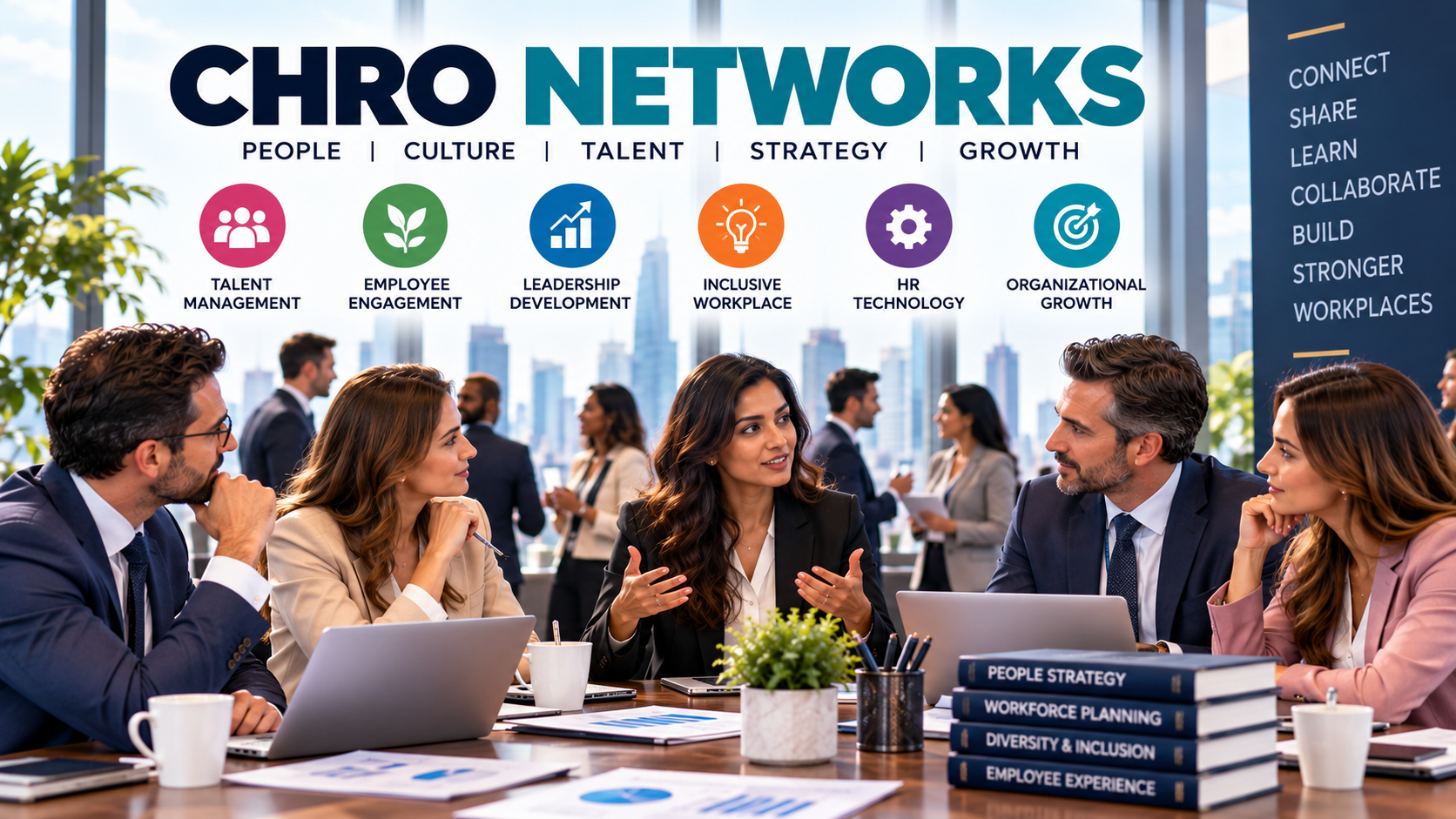
Human resources leadership has become increasingly important as organizations navigate changing workplace expectations, talent shortages, digital transformation, and evolving business strategies. Chief Human Resources Officers (CHROs) are responsible for aligning workforce planning, employee development, organizational culture, and talent management with broader business objectives. As these responsibilities expand, CHRO networks provide valuable opportunities for HR leaders to connect with peers, exchange knowledge, and discover practical solutions to complex workplace challenges.
A CHRO network is a professional community that connects chief human resources officers, HR directors, people executives, and other senior workforce leaders. These networks may operate through professional associations, executive forums, private peer groups, online communities, and industry conferences.
HR leaders regularly face challenges involving recruitment, employee retention, leadership development, workplace culture, compensation, performance management, and organizational change. Connecting with other experienced professionals can help CHROs evaluate different approaches and learn from real-world experiences.
CHRO networks can also support professional development by creating opportunities to discuss workforce analytics, artificial intelligence, employee engagement, succession planning, and changing employment practices. For businesses, these relationships may contribute to stronger HR strategies and more effective workforce management.
However, the value of a CHRO network depends on the quality of its members, the relevance of its discussions, and the willingness of participants to contribute. Simply joining a professional community does not guarantee better results. Effective networking requires consistent engagement, mutual respect, and responsible information sharing.
This article explores what CHRO networks are, why they matter, the different types available, and how HR leaders can use professional connections to strengthen workplace practices and support organizational growth.
What Is a CHRO Network?
A CHRO network is a professional community designed to connect senior human resources leaders for knowledge sharing, peer support, professional development, and collaboration.
Members may include CHROs from multinational corporations, HR directors from medium-sized businesses, people leaders from startups, talent management executives, and senior professionals responsible for organizational development.
Some networks focus on executive leadership and strategic workforce planning, while others emphasize recruitment, employee experience, compensation, workplace technology, or organizational culture.
For example, a CHRO at a technology company may join a network to discuss competition for skilled employees, employee retention, hybrid work, and leadership development. Another HR executive from a manufacturing company may contribute insights about workforce planning, employee safety, skills development, and shift scheduling.
These conversations help members compare experiences and discover approaches that may be relevant to their own organizations.
CHRO networks can be formal or informal. Some require membership applications and scheduled meetings, while others operate through professional platforms, industry events, and online discussion groups.
The most effective networks encourage meaningful discussion, protect confidential information, and help members build professional relationships that extend beyond individual meetings.
Why CHRO Networks Matter in Modern HR Leadership
1. Improving Talent Acquisition Strategies
Recruiting suitable employees is a major priority for many organizations. Businesses must compete for skilled professionals while balancing hiring costs, recruitment timelines, and changing candidate expectations.
CHRO networks provide opportunities to discuss recruitment strategies, candidate assessment, employer branding, workforce planning, and the use of recruitment technology.
For example, an HR leader struggling to fill specialized technical positions may learn how other organizations develop talent pipelines, improve job descriptions, or collaborate with educational institutions.
These insights can help HR teams evaluate their recruitment processes and identify areas for improvement.
However, recruitment strategies should be adapted to the company's industry, location, budget, and workforce requirements.
2. Strengthening Employee Retention
Employee turnover can create significant costs through recruitment, training, lost productivity, and reduced institutional knowledge.
CHRO networks allow HR leaders to discuss employee engagement, career development, management practices, compensation, and workplace flexibility.
Members may exchange ideas about conducting employee surveys, identifying turnover patterns, improving manager training, and creating clearer career pathways.
For instance, an organization experiencing high turnover among early-career employees might review onboarding, mentoring, professional development, and opportunities for advancement.
A network can help generate potential solutions, but organizations should use their own employee feedback and workforce data to determine which changes are appropriate.
3. Developing Stronger Workplace Cultures
Workplace culture influences how employees communicate, collaborate, solve problems, and respond to organizational expectations.
CHROs play an important role in helping businesses establish clear values and create environments where employees can contribute effectively.
Through networking, HR leaders can learn about approaches to recognition, inclusion, leadership accountability, conflict resolution, and employee communication.
These discussions can help organizations identify practical ways to strengthen trust and cooperation.
A healthy workplace culture does not require eliminating disagreements. Instead, it encourages respectful discussion, fair treatment, and constructive ways to resolve problems.
4. Supporting Leadership Development
Organizations need capable leaders at different levels, from frontline supervisors to senior executives.
CHRO networks provide opportunities to exchange ideas about leadership training, mentoring, executive coaching, succession planning, and management development.
For example, an HR executive may learn how another company identifies employees with leadership potential and prepares them for greater responsibility.
Such insights can help organizations build stronger internal talent pipelines and reduce dependence on external recruitment for every senior position.
Leadership development should be connected to actual business requirements rather than relying exclusively on training attendance or generic assessments.
5. Navigating Organizational Change
Businesses frequently introduce new technology, restructure departments, expand into different markets, or change their operating models.
These changes can create uncertainty among employees and require careful communication and workforce planning.
CHRO networks allow HR leaders to exchange experiences about change management, employee consultation, training, and organizational communication.
For example, when a company introduces a new enterprise software system, the CHRO may need to coordinate employee training, assess changing skill requirements, and support managers during implementation.
Learning from other organizations can help HR leaders anticipate common challenges and prepare more effective transition plans.
Types of CHRO Networks
Different CHRO networks serve different professional goals. Understanding their focus can help HR leaders choose the most suitable community.
1. CHRO Peer Advisory Groups
Peer advisory groups bring together a small number of senior HR executives to discuss leadership challenges and exchange practical advice.
Meetings may cover employee retention, workforce strategy, executive relationships, organizational change, and HR leadership development.
Some groups use professional facilitators to ensure discussions remain focused and participants have opportunities to contribute.
These networks can be particularly valuable for CHROs who want deeper conversations with peers facing similar responsibilities.
Confidentiality is essential because discussions may involve sensitive workforce information.
2. Industry-Specific CHRO Networks
Industry-specific networks connect HR leaders working in the same sector.
Examples include technology, healthcare, manufacturing, financial services, retail, logistics, and hospitality.
Members often face similar workforce challenges, making these networks useful for exchanging industry-relevant insights.
For example, CHROs in healthcare may discuss staffing requirements, professional training, employee well-being, and retention. Technology companies may focus on technical recruitment, remote work, skills development, and competition for specialized talent.
3. Global CHRO Networks
Global networks connect senior HR leaders across countries and regions.
These communities can help organizations with international operations understand different workforce practices, management approaches, and employment environments.
Members may exchange general insights about global talent acquisition, leadership across cultures, international mobility, and organizational development.
However, employment laws and HR requirements differ between jurisdictions. Networking discussions should not replace advice from qualified local employment and legal professionals.
4. Online CHRO Communities
Online communities allow HR executives to connect regardless of geographic location.
These networks may offer virtual meetings, private discussion forums, professional resources, webinars, and digital learning opportunities.
Online participation can be particularly useful for leaders who travel frequently or manage distributed teams.
Before joining, HR professionals should review the community's credibility, privacy practices, moderation standards, and relevance to their responsibilities.
5. HR Professional Associations
Professional associations provide opportunities for HR education, networking, research, conferences, and professional development.
Some focus on general human resources management, while others specialize in organizational development, talent acquisition, compensation, or workplace learning.
These organizations can help CHROs remain informed about emerging practices and build relationships with other HR professionals.
Membership benefits and eligibility requirements vary, so executives should evaluate the available resources before joining.
How CHRO Networks Support Business Growth
Human resources decisions can influence productivity, customer service, innovation, operating costs, and the organization's ability to execute its strategy.
CHRO networks can help HR leaders understand how workforce practices contribute to business performance.
Aligning Workforce Strategy With Business Goals
A company cannot execute its business strategy effectively without the right skills, staffing levels, and leadership capabilities.
CHROs must understand organizational priorities and determine which workforce capabilities are needed to achieve them.
Networking can provide examples of how other businesses connect workforce planning with strategic objectives.
For instance, a company preparing to expand into international markets may need employees with language skills, regional knowledge, and cross-cultural management experience.
A CHRO can use these insights to develop recruitment, training, and succession plans that support expansion.
Improving Workforce Planning
Workforce planning involves assessing current staffing, anticipating future skill requirements, and identifying potential gaps.
CHRO networks provide opportunities to discuss workforce analytics, skills inventories, succession planning, and recruitment forecasting.
These discussions can help HR leaders develop more systematic approaches to staffing decisions.
Effective workforce planning considers both immediate operational requirements and longer-term organizational changes.
Supporting Productivity
Employee productivity depends on several factors, including clear responsibilities, appropriate training, effective management, suitable technology, and a supportive work environment.
CHRO networks can help HR leaders compare approaches to performance management, employee development, and organizational design.
Rather than focusing exclusively on working hours or activity levels, organizations should evaluate meaningful outcomes, work quality, and the conditions employees need to perform effectively.
Strengthening Employer Reputation
A company's reputation as an employer can influence its ability to attract and retain talent.
CHROs can exchange ideas about recruitment communication, employee experience, leadership behavior, and responsible employer branding.
Organizations should ensure that their public employment messages reflect actual workplace practices.
Authentic communication is more sustainable than making promises that employees' experiences do not support.
Essential Skills CHROs Can Develop Through Networking
Strategic Thinking
Strategic thinking helps HR leaders connect workforce decisions with broader organizational goals.
Through peer discussions, CHROs can explore how recruitment, training, compensation, and organizational design influence business performance.
This perspective helps HR move beyond administrative responsibilities and contribute more effectively to executive decision-making.
Communication and Influence
CHROs must communicate with employees, managers, CEOs, board members, and other stakeholders.
Networking offers opportunities to learn how experienced HR executives present recommendations, discuss sensitive matters, and gain support for organizational initiatives.
Clear communication is particularly important during restructuring, policy changes, and workforce transitions.
Data-Driven Decision-Making
HR departments increasingly use workforce data to evaluate recruitment, turnover, engagement, performance, and skills development.
CHRO networks can provide opportunities to discuss useful metrics, analytical methods, and reporting practices.
However, workforce analytics must be interpreted carefully. Data should be accurate, appropriately protected, and used in ways that respect employee privacy and applicable requirements.
Change Management
Successful change management requires clear communication, employee support, training, and coordination with business leaders.
Networking can help CHROs learn from previous transformation projects and understand common implementation challenges.
These lessons can inform more realistic plans for future changes.
Conflict Resolution
Workplace disagreements may involve employees, managers, teams, or organizational policies.
CHROs need to address these issues fairly and professionally.
Peer discussions can help HR leaders compare approaches to mediation, manager training, workplace communication, and policy implementation.
Sensitive employment matters still require appropriate confidentiality and case-specific professional judgment.
The Role of AI and Technology in CHRO Networks
Artificial intelligence and digital HR systems are changing how organizations recruit employees, manage information, deliver training, and analyze workforce trends.
CHRO networks can help HR leaders evaluate emerging technologies and learn from the experiences of other organizations.
AI-enabled tools may assist with administrative tasks, recruitment workflows, employee learning recommendations, and workforce planning. However, these tools can also introduce risks involving privacy, accuracy, fairness, and inappropriate automated decision-making.
HR leaders should carefully evaluate how technology is used in employment-related decisions.
For example, an organization considering AI-assisted recruitment should assess whether its system produces unfair outcomes, uses appropriate data, and allows meaningful human review.
CHROs should also consider employee communication, training, and the potential effects of automation on job responsibilities.
Technology should support fair and effective HR practices rather than replace necessary human judgment.
How to Choose the Right CHRO Network
Selecting a CHRO network requires a clear understanding of professional objectives and organizational needs.
Define Your Goals
Determine whether you want to improve leadership skills, discuss workforce challenges, learn about HR technology, develop international relationships, or explore new career opportunities.
Clear goals make it easier to identify relevant communities.
Evaluate Member Experience
Review the professional backgrounds of participants and determine whether their experience aligns with your responsibilities.
A CHRO at a multinational company may require different discussions from an HR leader at a startup.
The most useful network is the one that offers relevant expertise and meaningful opportunities for participation.
Consider Costs and Time Commitments
Some networks are free, while others require membership fees, conference expenses, or scheduled meetings.
Evaluate these costs alongside the expected professional benefits and the time required to participate.
Review Confidentiality Standards
HR leaders often handle sensitive employee records, compensation information, organizational plans, and workplace investigations.
Before sharing information, understand the network's confidentiality policies and follow your employer's rules.
Do not disclose personally identifiable employee information or confidential company details without proper authorization.
Assess the Quality of Discussions
Look for networks that encourage practical learning, respectful disagreement, and meaningful professional exchange.
Communities focused primarily on promotional messages may provide less value than groups that facilitate relevant discussions and knowledge sharing.
Practical Strategies for Building Strong CHRO Relationships
Share Relevant Knowledge
Contribute useful professional insights and discuss lessons from your experience when appropriate.
Sharing knowledge should never require disclosing confidential employee information or sensitive organizational details.
Ask Focused Questions
Specific questions can lead to more useful discussions than broad requests for advice.
For example, an HR leader might ask how other organizations evaluate onboarding effectiveness or identify skills gaps in rapidly growing teams.
Follow Up Professionally
After a valuable conversation, send a brief message highlighting a useful point or sharing an appropriate resource.
Follow-up helps maintain professional relationships without requiring constant communication.
Build Long-Term Relationships
Participate consistently, respect other members' time, and look for opportunities to contribute.
Meaningful professional relationships often develop gradually through repeated interactions and mutual support.
Maintain Professional Integrity
CHROs should communicate accurately, protect confidential information, and respect professional boundaries.
Trust is especially important in HR networking because many workforce discussions involve sensitive matters.
Measuring the Value of a CHRO Network
HR leaders can evaluate networking activities using indicators that align with their goals.
Useful measures may include:
Relevant professional relationships developed.
HR knowledge and leadership skills gained.
Workforce practices improved after peer discussions.
Professional development opportunities identified.
Relevant collaborations or introductions explored.
Time and money invested in participation.
Improvements in workforce planning or HR processes.
Not every network produces immediate measurable financial results. A peer group may provide value through better decision-making, while a professional association may offer access to education and industry knowledge.
The objective is to determine whether participation contributes to meaningful professional development and better organizational practices.
Common CHRO Networking Mistakes to Avoid
Joining Too Many Networks
Participating in too many communities can reduce the time available for meaningful engagement.
Focus on a manageable number of networks that match your professional goals.
Expecting Immediate Results
Professional relationships require time and consistent effort.
CHROs should not expect every discussion to produce a job opportunity, business partnership, or immediate solution.
Ignoring Follow-Up
Failing to maintain contact can weaken promising professional relationships.
A thoughtful follow-up can help continue useful discussions and support future collaboration.
Sharing Confidential Employee Information
Protecting employee privacy is essential. Avoid discussing identifiable employee cases, private records, or sensitive organizational information unless disclosure is properly authorized and appropriate.
Treating Networking as a Substitute for Professional Advice
Peer experiences can provide useful perspectives, but specific employment, legal, and compliance matters may require qualified professional guidance.
CHROs should evaluate advice according to the circumstances and requirements of their organizations.
The Future of CHRO Networks
CHRO networks are likely to continue evolving as workplace practices, technology, and employee expectations change.
Virtual meetings and online communities make it easier for HR leaders to exchange ideas across locations and time zones. Digital platforms can also help professionals discover specialized expertise and participate in relevant discussions.
Artificial intelligence may support learning, research, and the organization of professional resources. Nevertheless, leaders must consider privacy, accuracy, and the responsible use of information.
At the same time, in-person events remain valuable for developing trusted relationships and discussing complex leadership challenges.
Future CHRO networks may combine virtual communities, private peer groups, leadership education, and industry-specific forums.
The most effective communities will be those that prioritize relevant expertise, practical learning, responsible information sharing, and meaningful professional relationships.
Conclusion
CHRO networks provide valuable opportunities for human resources leaders to exchange knowledge, strengthen professional relationships, develop leadership capabilities, and improve workforce management practices.
By connecting with relevant peers, CHROs can learn about talent acquisition, employee retention, leadership development, workforce planning, organizational culture, and HR technology.
However, the value of networking depends on the quality of the community and the effort members invest in their relationships.
HR leaders should choose networks that match their objectives, contribute useful insights, maintain professional integrity, and protect confidential information.
As workforce strategy becomes increasingly connected to business performance, professional networks can help CHROs remain informed and develop more effective approaches to organizational challenges.
When used strategically, CHRO networking can support professional growth, stronger HR practices, and sustainable business success.
Frequently Asked Questions About CHRO Networks
What is a CHRO network?
A CHRO network is a professional community connecting chief human resources officers and other senior HR leaders for knowledge sharing, peer support, professional development, and collaboration.
What are the benefits of joining a CHRO network?
Benefits may include access to HR expertise, leadership development, recruitment insights, workforce planning strategies, professional relationships, and opportunities to discuss organizational challenges.
Who can join a CHRO network?
Membership requirements vary. Some networks are exclusive to CHROs, while others welcome HR directors, people executives, talent management leaders, and other senior professionals.
How do CHRO networks help businesses?
They can help HR leaders improve talent management, strengthen workplace culture, develop leadership capabilities, and align workforce strategies with organizational objectives.
Are CHRO networks available online?
Yes. Many communities offer virtual meetings, online forums, webinars, digital resources, and remote professional networking opportunities.
How can I choose the right CHRO network?
Evaluate its members, professional focus, confidentiality practices, costs, time commitments, and relevance to your career and organizational goals.
Do CHRO networks guarantee better employee retention?
No. They can provide useful ideas and professional insights, but employee retention depends on many factors, including management quality, compensation, career development, workplace conditions, and organizational culture.