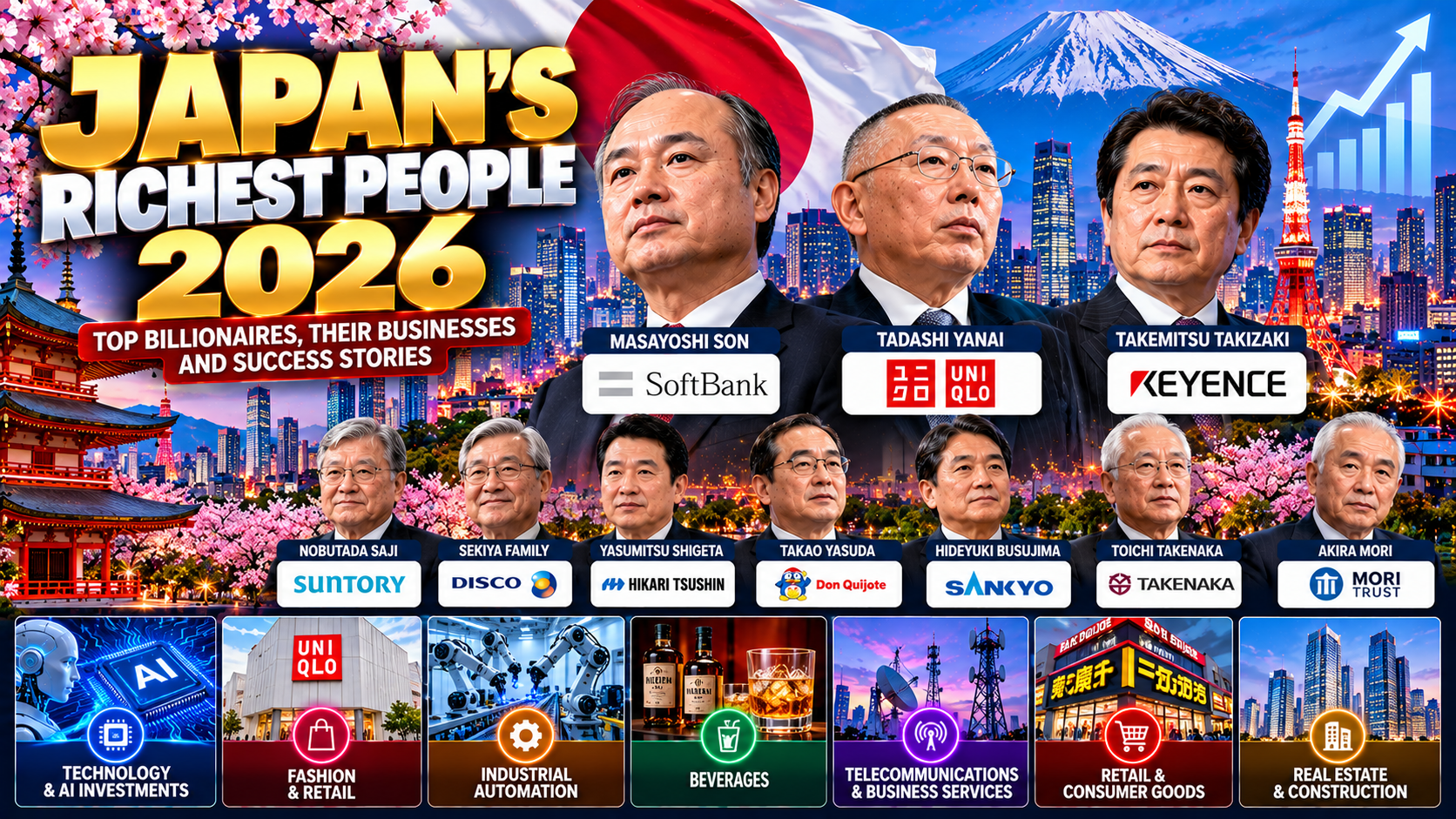
Japan is home to some of the world's most successful entrepreneurs, technology investors, retail pioneers, and industrial business leaders. From global fashion brands and artificial intelligence investments to precision manufacturing and consumer products, Japan’s wealthiest individuals have built fortunes across a wide range of industries.
According to Forbes’ 2026 ranking of Japan’s richest, Masayoshi Son reclaimed first place with an estimated net worth of $80 billion. Tadashi Yanai, the billionaire behind Uniqlo, ranked second with $65 billion, while Takemitsu Takizaki, founder of Keyence, secured third place with $23.6 billion.
The combined wealth of Japan’s 50 richest reached approximately $294 billion in 2026, a 29% increase from the previous year. A strong Japanese stock market and growing enthusiasm for artificial intelligence investments helped drive the rise.
This article explores Japan’s top 10 richest people and families in 2026, their estimated fortunes, business backgrounds, and the industries that contributed to their success.
Note: Net worth figures are estimates reported by Forbes for its 2026 ranking. They reflect stock prices and exchange rates as of May 22, 2026, and may change with market conditions.
Top 10 Richest People in Japan in 2026
Rank | Person or family | Estimated net worth | Main business |
|---|---|---|---|
1 | Masayoshi Son | $80 billion | SoftBank and technology investments |
2 | Tadashi Yanai | $65 billion | Uniqlo and Fast Retailing |
3 | Takemitsu Takizaki | $23.6 billion | Keyence and industrial automation |
4 | Nobutada Saji | $9.3 billion | Suntory beverages |
5 | Sekiya family | $9.1 billion | Disco semiconductor equipment |
6 | Yasumitsu Shigeta | $6 billion | Hikari Tsushin |
7 | Takao Yasuda | $4.7 billion | Don Quijote retail |
8 | Hideyuki Busujima | $4.6 billion | SANKYO gaming machines |
9 | Toichi Takenaka | $4 billion | Takenaka Corporation |
10 | Akira Mori | $3.95 billion | Mori Trust real estate |
Source: Forbes’ Japan’s 50 Richest 2026 ranking. Figures are in US dollars.
1. Masayoshi Son — $80 Billion
Masayoshi Son ranked first among Japan’s richest people in 2026, with an estimated fortune of $80 billion. He is the founder of SoftBank Group, a major technology investment company with interests in telecommunications, artificial intelligence, semiconductors, and other technology businesses.
Son established SoftBank in 1981 and gradually expanded it from a software distribution business into a global investment group. Over the years, SoftBank has invested in companies across technology, e-commerce, telecommunications, and digital services.
One of the major factors behind Son’s wealth increase in 2026 was SoftBank’s multibillion-dollar investment in OpenAI, the company behind ChatGPT. Growing investor interest in artificial intelligence helped increase the market value associated with SoftBank’s investment portfolio.
Forbes reported that Son’s net worth increased by approximately $51.8 billion during the measured period, making him one of the biggest wealth gainers on the list.
His business strategy reflects a long-term belief that artificial intelligence and advanced technology will reshape the global economy.
Main industry: Technology and investments
Estimated net worth: $80 billion
2. Tadashi Yanai — $65 Billion
Tadashi Yanai ranked second, with an estimated net worth of $65 billion. He is the founder and leading figure behind Fast Retailing, the parent company of Uniqlo, one of the world's most recognisable clothing retailers.
Yanai helped transform a Japanese clothing business into a global fashion brand by focusing on practical, everyday clothing, consistent quality, and accessible pricing.
Uniqlo's business model differs from many traditional fashion companies. Instead of relying primarily on rapidly changing trends, the brand emphasises functional basics, fabric innovation, and products designed for everyday use.
Fast Retailing's international expansion has helped Uniqlo establish a strong presence in Asia, Europe, North America, and other markets. Revenue growth and improved profitability contributed to Yanai's rising fortune in 2026.
His success demonstrates how a clear retail strategy, efficient supply chains, and global brand development can create extraordinary wealth.
Main industry: Fashion and retail
Estimated net worth: $65 billion
3. Takemitsu Takizaki — $23.6 Billion
Takemitsu Takizaki ranked third among Japan’s wealthiest people in 2026, with an estimated fortune of $23.6 billion. He founded Keyence, a Japanese company known for industrial automation equipment, sensors, measurement systems, and machine vision technologies.
Keyence provides products that help factories monitor production, inspect components, improve precision, and automate industrial processes.
As manufacturers invest in robotics, automation, and quality control, demand for sophisticated industrial equipment can increase. These technologies are important in industries such as automotive production, electronics, pharmaceuticals, and semiconductor manufacturing.
Keyence has developed a reputation for high-value products, technical sales, and a business model focused on research and customer support.
Takizaki's fortune reflects the importance of industrial innovation, even when a company does not sell directly to ordinary consumers.
Main industry: Industrial automation and technology
Estimated net worth: $23.6 billion
4. Nobutada Saji — $9.3 Billion
Nobutada Saji ranked fourth, with an estimated net worth of $9.3 billion. His wealth is associated with Suntory Holdings, one of Japan's major beverage companies.
Suntory operates across several beverage categories, including whisky, beer, soft drinks, and other consumer products. The company has also developed an international presence through acquisitions, brand development, and overseas distribution.
The beverage industry can generate substantial long-term value through established brands, repeat purchases, and international market expansion. Premium spirits, in particular, can benefit from brand reputation and demand among consumers in different markets.
Suntory's business illustrates how a company rooted in Japanese consumer culture can develop into an internationally recognised group.
Main industry: Beverages and consumer products
Estimated net worth: $9.3 billion
5. Sekiya Family — $9.1 Billion
The Sekiya family ranked fifth, with an estimated fortune of $9.1 billion. Their wealth is associated with Disco Corporation, a Japanese manufacturer of precision equipment used in semiconductor production.
Semiconductors are essential components in smartphones, computers, data centres, automobiles, and artificial intelligence systems. Producing advanced chips requires highly specialised manufacturing processes and equipment.
Disco supplies precision tools used to cut, grind, and polish semiconductor materials. Its technology plays an important role in preparing silicon wafers and other materials used in electronics manufacturing.
In 2026, growing demand for AI-related products helped boost interest in semiconductor equipment companies. Forbes reported that Disco's shares more than doubled over the measured period, contributing to the family's increase in wealth.
The family's ranking highlights how specialised industrial suppliers can benefit from technological changes taking place around the world.
Main industry: Semiconductor manufacturing equipment
Estimated net worth: $9.1 billion
6. Yasumitsu Shigeta — $6 Billion
Yasumitsu Shigeta ranked sixth, with an estimated fortune of $6 billion. He is associated with Hikari Tsushin, a Japanese company involved in telecommunications-related services and business solutions.
Hikari Tsushin has developed its business through sales, service contracts, and recurring revenue opportunities. Its operations have included telecommunications services, office equipment, and other business products.
Companies that provide essential services to businesses can benefit from repeat customers and long-term commercial relationships. However, their performance depends on customer demand, competition, operating costs, and the ability to maintain profitable contracts.
Shigeta's position in the 2026 ranking demonstrates that substantial wealth can also emerge from service businesses rather than only consumer brands or technology manufacturers.
Main industry: Telecommunications and business services
Estimated net worth: $6 billion
7. Takao Yasuda — $4.7 Billion
Takao Yasuda ranked seventh, with an estimated net worth of $4.7 billion. He is associated with Pan Pacific International Holdings, the company behind the Don Quijote discount retail chain.
Don Quijote is known for its broad selection of consumer goods, competitive pricing, and distinctive shopping experience. Its stores sell products ranging from groceries and cosmetics to electronics, household goods, and clothing.
The company has also expanded beyond Japan, including through its presence in other Asian markets and the United States.
Discount retail can attract customers who want variety and value, particularly when household budgets are under pressure. Effective purchasing, inventory management, store operations, and product selection are important to maintaining profitability.
Yasuda's success illustrates how a distinctive retail format can build a large customer base and support international expansion.
Main industry: Retail and consumer goods
Estimated net worth: $4.7 billion
8. Hideyuki Busujima — $4.6 Billion
Hideyuki Busujima ranked eighth, with an estimated fortune of $4.6 billion. His wealth is associated with SANKYO, a Japanese manufacturer known for pachinko machines and related entertainment equipment.
Pachinko is a popular form of mechanical gaming entertainment in Japan. Manufacturers compete through machine design, technology, content, and partnerships with operators.
SANKYO has established itself as a significant company in this specialised market. Its business illustrates how a domestic entertainment category can support a large industrial and technology operation.
However, companies in specialised entertainment markets can be affected by regulatory changes, consumer preferences, and the performance of the venues that use their products.
Busujima's place among Japan's richest people reflects the value that can accumulate through ownership in an established industry leader.
Main industry: Gaming machines and entertainment equipment
Estimated net worth: $4.6 billion
9. Toichi Takenaka — $4 Billion
Toichi Takenaka ranked ninth, with an estimated net worth of $4 billion. His fortune is associated with Takenaka Corporation, a major Japanese construction and engineering company.
Construction companies contribute to the development of offices, commercial buildings, industrial facilities, and other infrastructure. Japan's construction sector is known for its advanced engineering, earthquake-resistant design, and sophisticated building technologies.
Takenaka Corporation has a long history in architecture and construction, serving commercial and institutional clients.
Large construction projects require technical expertise, careful project management, and coordination across contractors and suppliers. Companies that deliver complex projects can build strong reputations and long-term client relationships.
The Takenaka fortune illustrates how construction and engineering can remain important sources of business wealth in an advanced economy.
Main industry: Construction and engineering
Estimated net worth: $4 billion
10. Akira Mori — $3.95 Billion
Akira Mori rounded out the top 10, with an estimated net worth of $3.95 billion. He is associated with Mori Trust, a Japanese real estate development and investment company.
Mori Trust owns and develops properties that include hotels, office buildings, and other commercial real estate assets. Its business is connected to Japan's urban property market and the demand for accommodation, workplaces, and business facilities.
Real estate wealth can come from rental income, property development, asset appreciation, and strategic investments. The value of these assets depends on location, occupancy, financing costs, market conditions, and future demand.
Japan's major cities, particularly Tokyo, remain important centres for finance, business, tourism, and international investment.
Mori's position demonstrates the continuing role of property ownership in Japan's wealth landscape.
Main industry: Real estate and property investment
Estimated net worth: $3.95 billion
Which Industries Create the Most Wealth in Japan?
Japan's richest people have built fortunes across technology, retail, manufacturing, consumer products, and real estate. Several industries stand out in the 2026 ranking.
1. Artificial intelligence and technology investments
Masayoshi Son's rise to the top highlights investor interest in artificial intelligence. AI companies, semiconductor businesses, cloud infrastructure providers, and related technology firms have attracted significant capital as businesses explore new applications.
Technology investments can create substantial wealth, but valuations may also fluctuate sharply when expectations change.
2. Fashion and retail
Tadashi Yanai's fortune demonstrates the global potential of retail brands. Successful retailers combine product development, pricing, distribution, brand recognition, and international expansion.
3. Semiconductor equipment and industrial automation
Companies such as Keyence and Disco benefit from the need for precision manufacturing, electronics production, and automated industrial processes. These businesses often supply essential tools to manufacturers across multiple industries.
4. Consumer beverages
Suntory and other consumer product companies benefit from established brands and international distribution. Their performance depends on customer demand, product innovation, pricing, and competition.
5. Telecommunications and business services
Japan's telecommunications and business-service companies provide infrastructure and services that support companies and consumers. Recurring contracts and long-term customer relationships can be important sources of revenue.
6. Real estate and construction
Property development, commercial buildings, and construction projects remain important sources of wealth. The value of real estate businesses is influenced by interest rates, rental demand, urban development, and economic conditions.
Why Did Japan’s Richest People Become Wealthier in 2026?
Forbes reported that the combined fortune of Japan's 50 richest increased from approximately $228 billion in 2025 to $294 billion in 2026.
Several factors contributed to this change.
Stock-market growth: A strong rally in Japanese equities increased the value of some major shareholdings.
Artificial intelligence demand: Investor enthusiasm for AI benefited technology-related investments and semiconductor equipment manufacturers.
Retail business performance: Growth at Fast Retailing helped support Tadashi Yanai's wealth.
International investment opportunities: Japanese companies with global operations benefited from overseas markets and strategic investments.
Currency movements: Changes in the yen's value affected the US-dollar valuation of Japanese fortunes.
The gains were not shared equally. Forbes reported that only 14 fortunes on the list increased, while 27 declined. This demonstrates that a rising stock market does not automatically increase the wealth of every billionaire.
How Do Japan’s Richest People Build Their Fortunes?
Although their industries differ, several business principles appear across Japan's wealthiest entrepreneurs.
Long-term business ownership: Holding substantial stakes in successful companies allows owners to benefit when those businesses grow.
Innovation and specialised expertise: Companies that develop valuable products or technologies can establish competitive advantages.
Global expansion: International markets can provide additional customers and opportunities for growth.
Strong operating models: Efficient production, distribution, pricing, and customer service can support profitability.
Strategic investment: Investing in promising businesses can increase wealth, although investment outcomes are never guaranteed.
Adaptation to changing markets: Companies that respond to shifts in technology and consumer behaviour may be better positioned for long-term success.
These principles help explain why Japan's billionaire list includes technology investors, fashion entrepreneurs, industrial founders, and property developers.
Frequently Asked Questions
Who is the richest person in Japan in 2026?
Masayoshi Son is Japan's richest person in Forbes' 2026 ranking, with an estimated net worth of $80 billion. His wealth is primarily associated with SoftBank Group and its technology investments.
Is the founder of Uniqlo one of Japan's richest people?
Yes. Tadashi Yanai, the billionaire behind Uniqlo's parent company Fast Retailing, ranked second in 2026 with an estimated fortune of $65 billion.
How much are Japan's 50 richest people worth?
Their combined estimated wealth reached approximately $294 billion in 2026, according to Forbes.
Why did Masayoshi Son's net worth increase so much?
His fortune benefited from the increase in value associated with SoftBank's investments, including its multibillion-dollar investment in OpenAI, as well as broader investor enthusiasm for artificial intelligence.
Who is the richest person in Japan's technology sector?
Masayoshi Son is the leading technology investor on the 2026 list. Takemitsu Takizaki is another major technology entrepreneur, known for founding Keyence, a manufacturer of industrial automation and sensor equipment.
Are Japan's richest people self-made?
Several people on the list built or expanded businesses through entrepreneurship, including Masayoshi Son, Tadashi Yanai, and Takemitsu Takizaki. The ranking also includes family fortunes and wealth associated with inherited business ownership.
Do billionaire net worth figures change every year?
Yes. Net worth estimates can change with share prices, exchange rates, company valuations, business performance, and changes in ownership. Forbes rankings represent estimates based on a particular valuation date rather than guaranteed cash holdings.
Conclusion
Japan's richest people in 2026 represent the country's strength in technology, global retail, industrial manufacturing, consumer products, and real estate. Masayoshi Son leads the ranking with an estimated $80 billion, followed by Tadashi Yanai at $65 billion and Takemitsu Takizaki at $23.6 billion.
The increase in Japan's combined billionaire wealth highlights the influence of financial markets and the growing importance of artificial intelligence and semiconductor technology. At the same time, established businesses in fashion, beverages, retail, construction, and property continue to create substantial value.
For entrepreneurs and business readers, Japan's richest list provides insight into how innovation, international expansion, specialised expertise, and long-term ownership can shape business success. While billionaire rankings will continue to change with market conditions, these leading figures remain influential examples of wealth creation in the Japanese economy.
Editorial source: Forbes, Japan’s 50 Richest 2026, published June 2026. Net worth figures reflect estimates based on stock prices and exchange rates as of May 22, 2026.