SEO Title:
Meta Description: Discover Taiwan’s richest people in 2026, their estimated net worth, businesses, and the success stories behind the semiconductor and technology billionaires.
URL Slug: taiwan-richest-people-2026
Focus Keyword: Taiwan’s richest people in 2026
Secondary Keywords: richest person in Taiwan, Taiwan billionaires 2026, Taiwan richest billionaires, Terry Gou net worth, Pierre Chen net worth, semiconductor billionaires, Taiwanese business tycoons
Category: Business & Finance
Tags: Taiwan Billionaires, Richest People, Net Worth, Semiconductors, Artificial Intelligence, Electronics Manufacturing, Forbes Rich List, Asian Billionaires
Introduction
Taiwan has become one of the world's most important technology and electronics manufacturing hubs. Its companies produce semiconductor components, electronic devices, power systems, and advanced equipment that support industries ranging from smartphones to artificial intelligence data centres.
These industries have helped create substantial fortunes for business founders, investors, and families with significant ownership stakes in major companies.
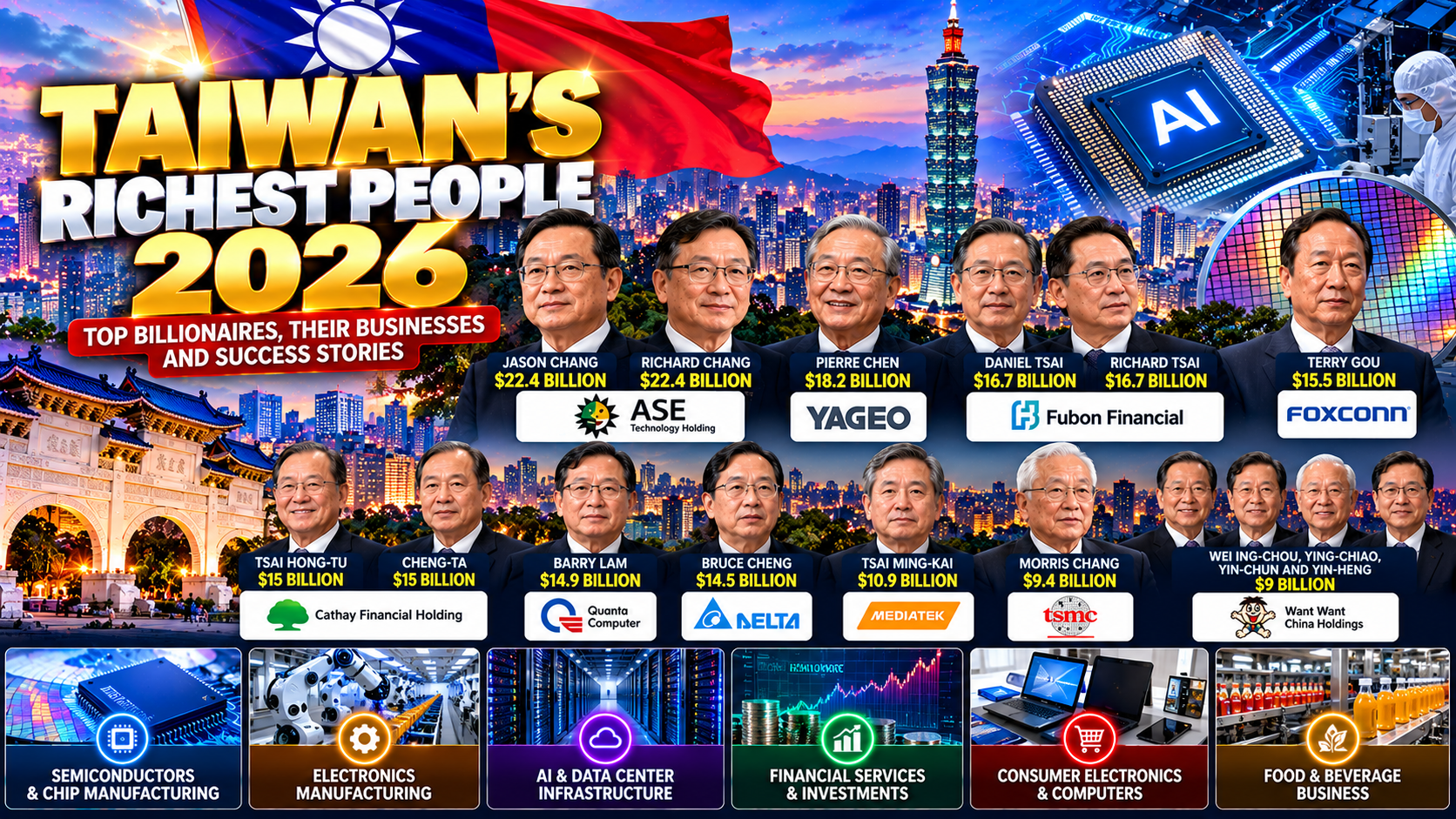
According to Forbes’ Taiwan’s 50 Richest 2026, Jason and Richard Chang, the brothers behind ASE Technology Holding, claimed first place with a combined estimated fortune of $22.4 billion. Electronics components entrepreneur Pierre Chen ranked second with $18.2 billion, followed by Daniel and Richard Tsai, whose combined wealth was estimated at $16.7 billion.
The combined wealth of Taiwan’s 50 richest reached a record $308 billion in 2026. Demand for AI infrastructure, strong semiconductor exports, and rising stock prices contributed to the increase.
This article examines the top 10 entries in the 2026 ranking, their estimated net worth, major businesses, and the industries behind their financial success.
Note: The figures below are Forbes estimates based on stock prices and exchange rates as of May 22, 2026. The ranking includes both individual and family fortunes, so some amounts represent combined wealth.
Top 10 Richest People in Taiwan in 2026
Rank | Billionaire or family | Estimated net worth | Main industry |
|---|---|---|---|
1 | Jason and Richard Chang | $22.4 billion | Semiconductor services |
2 | Pierre Chen | $18.2 billion | Electronics components |
3 | Daniel and Richard Tsai | $16.7 billion | Finance and investments |
4 | Terry Gou | $15.5 billion | Electronics manufacturing |
5 | Tsai Hong-tu and Cheng-ta | $15 billion | Financial services |
6 | Barry Lam | $14.9 billion | Computers and electronics |
7 | Bruce Cheng | $14.5 billion | Power electronics |
8 | Tsai Ming-kai | $10.9 billion | Semiconductors |
9 | Morris Chang | $9.4 billion | Semiconductor technology |
10 | Wei Ing-Chou, Ying-Chiao, Yin-Chun and Yin-Heng | $9 billion | Food and beverages |
Source: Forbes, Taiwan’s 50 Richest 2026. Figures are in US dollars.
1. Jason and Richard Chang — $22.4 Billion
Jason and Richard Chang ranked first in 2026, with a combined estimated fortune of $22.4 billion. They are the chairman and vice chairman, respectively, of ASE Technology Holding, one of the world's leading semiconductor packaging, assembly, and testing companies.
Semiconductor manufacturing involves more than designing and fabricating chips. After fabrication, chips must be packaged, connected, and tested to ensure that they perform reliably. ASE provides services that help semiconductor manufacturers prepare their products for commercial use.
The expansion of artificial intelligence has increased demand for advanced computing hardware. This has created opportunities for businesses involved in semiconductor packaging and testing, particularly as chips become more sophisticated.
Forbes reported that the Chang brothers added approximately $14.5 billion to their combined fortune during the measured period, helping them rise six places to the top of the ranking.
Their success highlights the importance of specialist suppliers in the global semiconductor industry.
Main industry: Semiconductor packaging and testing
Combined estimated net worth: $22.4 billion
2. Pierre Chen — $18.2 Billion
Pierre Chen ranked second, with an estimated net worth of $18.2 billion. He is the founder and chairman of Yageo, a major manufacturer of electronic components.
Yageo produces components such as resistors, capacitors, and other electronic parts used in computers, vehicles, telecommunications equipment, and industrial systems.
Although these components are often small, they are essential to the operation of modern electronic products. Demand can increase as manufacturers produce more advanced computing systems, connected devices, and automotive electronics.
Chen's fortune rose significantly in 2026 as Yageo's shares gained value. Forbes reported an increase of approximately $12.1 billion in his estimated wealth during the measured period.
His business demonstrates how companies supplying essential components can benefit from technological expansion across multiple industries.
Main industry: Electronics components
Estimated net worth: $18.2 billion
3. Daniel and Richard Tsai — $16.7 Billion
Brothers Daniel and Richard Tsai ranked third, with a combined estimated fortune of $16.7 billion. Their wealth is associated with Fubon Financial Holding, a major financial services group.
Fubon operates across several areas of finance, including banking, insurance, securities, and asset management. These services support individuals, businesses, and investors through financial products and investment opportunities.
Financial conglomerates can build value through customer deposits, insurance premiums, investment portfolios, lending, and wealth management. Their performance is influenced by interest rates, financial market conditions, investment returns, and economic activity.
Forbes reported that the Tsai brothers' combined fortune increased by approximately $2.8 billion, although they moved down from the previous year's top position as other fortunes grew more quickly.
Their ranking demonstrates the continuing importance of finance and investment in Taiwan's wealth landscape.
Main industry: Financial services
Combined estimated net worth: $16.7 billion
4. Terry Gou — $15.5 Billion
Terry Gou ranked fourth, with an estimated fortune of $15.5 billion. He founded Hon Hai Precision Industry, widely known internationally as Foxconn, a major electronics contract manufacturer.
Foxconn manufactures and assembles electronic products for global technology brands. Its operations span consumer electronics, computing equipment, communications hardware, and server systems used in data centres.
The company has also become increasingly relevant to the artificial intelligence industry through its production of AI server systems and related hardware.
Gou's business grew by connecting manufacturing expertise with the needs of international technology companies. Large-scale production, supply-chain coordination, and relationships with global brands helped establish Foxconn as a major industry participant.
Forbes reported that rising shares in Hon Hai contributed to Gou's wealth in 2026.
His career illustrates how manufacturing scale and international business relationships can create substantial wealth.
Main industry: Electronics manufacturing
Estimated net worth: $15.5 billion
5. Tsai Hong-tu and Cheng-ta — $15 Billion
Tsai Hong-tu and Cheng-ta ranked fifth, with a combined estimated fortune of $15 billion. Their wealth is associated with Cathay Financial Holding and the broader Cathay business group.
Financial services play an important role in Taiwan's economy, providing insurance, banking, investment, and asset-management products to households and businesses.
Financial groups can generate earnings from premiums, lending, investment returns, and fees. Their performance often depends on market conditions, regulatory requirements, and customer demand.
The Tsai family's financial interests illustrate how long-term ownership of major financial institutions can generate considerable wealth.
Their position among Taiwan's richest people also reflects the strength of the island's financial services industry alongside its better-known electronics and semiconductor businesses.
Main industry: Finance and investments
Combined estimated net worth: $15 billion
6. Barry Lam — $14.9 Billion
Barry Lam ranked sixth, with an estimated net worth of $14.9 billion. He is the founder of Quanta Computer, a major manufacturer of notebook computers, servers, and other electronic equipment.
Quanta supplies products to international technology companies and plays a significant role in the global electronics supply chain. Its manufacturing capabilities help customers bring complex computing products to market at scale.
Demand for cloud computing and artificial intelligence has created additional opportunities for companies producing servers and other data-centre hardware.
Lam's fortune reflects the value of a business that combines engineering, large-scale production, and relationships with global technology customers.
The company must also navigate challenges such as changing product demand, manufacturing costs, and competition from other electronics manufacturers.
Main industry: Computers and electronics manufacturing
Estimated net worth: $14.9 billion
7. Bruce Cheng — $14.5 Billion
Bruce Cheng ranked seventh, with an estimated fortune of $14.5 billion. He founded Delta Electronics, a company known for power-management systems, electronic components, thermal management, and industrial automation solutions.
Modern computing systems require efficient power delivery and cooling. These requirements become particularly important in AI data centres, where advanced processors can consume substantial amounts of electricity and generate significant heat.
Delta provides power and thermal-management technologies that support data centres, telecommunications infrastructure, industrial equipment, and other electronic systems.
Forbes reported that Cheng's wealth rose sharply in 2026 as Delta's shares increased. Growing demand for AI infrastructure was an important factor in investor interest in the company's products.
His business illustrates how companies providing essential supporting technology can benefit from the expansion of artificial intelligence.
Main industry: Power electronics and energy-management systems
Estimated net worth: $14.5 billion
8. Tsai Ming-kai — $10.9 Billion
Tsai Ming-kai ranked eighth, with an estimated fortune of $10.9 billion. He is associated with MediaTek, one of Taiwan's major semiconductor design companies.
MediaTek develops chips and system-on-chip platforms used in smartphones, connected devices, home electronics, and other computing products.
Semiconductor design is a highly specialised business. Companies must invest in engineering, research, intellectual property, and product development while responding to rapid changes in computing requirements.
MediaTek competes in an international market where performance, energy efficiency, cost, and reliability are critical to success.
Tsai's wealth reflects the commercial value of semiconductor design and Taiwan's broader role in the global electronics ecosystem.
Main industry: Semiconductor design
Estimated net worth: $10.9 billion
9. Morris Chang — $9.4 Billion
Morris Chang ranked ninth, with an estimated fortune of $9.4 billion. He founded Taiwan Semiconductor Manufacturing Company, better known as TSMC, which became one of the world's most important semiconductor foundries.
TSMC pioneered a business model focused on manufacturing chips designed by other companies. This allowed semiconductor designers to concentrate on developing processors and other integrated circuits without having to operate their own fabrication plants.
Advanced chip production requires enormous investment in facilities, equipment, engineering, and research. TSMC's manufacturing capabilities have made it a key supplier for major technology companies.
Although Chang retired from his executive leadership roles, his legacy remains central to Taiwan's semiconductor industry.
His story demonstrates how a business model based on technical expertise and specialised infrastructure can transform an entire industry.
Main industry: Semiconductor manufacturing
Estimated net worth: $9.4 billion
10. Wei Ing-Chou, Ying-Chiao, Yin-Chun and Yin-Heng — $9 Billion
The Wei brothers ranked tenth, with a combined estimated fortune of $9 billion. Their wealth is associated with Want Want China Holdings, a major food and beverage business known for snacks and consumer products.
Food and beverage companies can build substantial businesses by developing recognisable brands, establishing distribution networks, and maintaining consistent product quality.
Want Want has developed a presence across several Asian markets, offering packaged snacks, beverages, and other consumer products.
The group's business illustrates that technology is not the only source of substantial wealth in Taiwan. Consumer brands with strong distribution and established customer demand can also create major fortunes.
Main industry: Food and beverages
Combined estimated net worth: $9 billion
Which Industries Create the Most Wealth in Taiwan?
Taiwan's richest people are concentrated in several important sectors, with electronics and semiconductor-related businesses particularly prominent in the 2026 ranking.
1. Semiconductors and chip manufacturing
Semiconductors are among Taiwan's most important industries. Companies involved in chip manufacturing, packaging, testing, and design support the production of computers, smartphones, AI processors, and other electronic devices.
The rise of artificial intelligence has increased demand for specialised chips and the equipment required to manufacture them.
2. Electronics manufacturing
Companies such as Foxconn and Quanta manufacture electronic products and computing equipment for international customers. Their success depends on production capacity, engineering, cost management, and supply-chain expertise.
3. Electronic components and power systems
Component manufacturers supply essential parts used in consumer electronics, vehicles, servers, and industrial equipment. Power-management companies also benefit from demand for efficient computing infrastructure.
4. Finance and investments
Financial groups create wealth through banking, insurance, securities, and investment management. Their performance depends on economic activity, market conditions, and investment returns.
5. Food and consumer products
Established food and beverage businesses demonstrate the value of branding, distribution, and customer loyalty. These companies can serve large markets and expand into neighbouring regions.
How Artificial Intelligence Is Changing Taiwan's Billionaire Rankings
Artificial intelligence became one of the major forces behind the increase in Taiwanese billionaire wealth in 2026.
AI applications require substantial computing power. That demand supports businesses producing advanced chips, servers, power systems, cooling equipment, and semiconductor packaging services.
Companies that supply these essential technologies have attracted investor interest because their products are used throughout the AI hardware supply chain.
Forbes reported that Taiwan's 50 richest people held a combined $308 billion in 2026, up from $197 billion in 2025. The island's economy grew 8.7% in 2025, supported in part by semiconductor exports and strong technology demand.
However, rising stock prices do not guarantee continued gains. Semiconductor businesses are exposed to competition, changing demand, manufacturing costs, geopolitical uncertainty, and potential industry downturns.
How Taiwan's Wealthiest Entrepreneurs Built Their Fortunes
Several business principles appear across the experiences of Taiwan's richest people.
Specialised expertise: Companies that develop advanced technology or manufacturing capabilities can establish valuable positions in global supply chains.
International customers: Selling products and services to global businesses expands potential markets.
Long-term investment: Semiconductor facilities, engineering teams, and manufacturing systems require substantial investment over many years.
Innovation: New chip designs, more efficient power systems, and advanced production methods can help companies remain competitive.
Strong operations: Reliable manufacturing, quality control, and customer relationships are important to large industrial businesses.
Diversification: Financial investments and exposure to multiple markets can help reduce dependence on a single business line, although they do not eliminate risk.
These factors help explain why many of Taiwan's richest entrepreneurs have built their fortunes through companies that serve other businesses rather than directly selling products to consumers.
Frequently Asked Questions
Who is the richest person in Taiwan in 2026?
Jason and Richard Chang ranked first in Forbes' 2026 Taiwan rich list, with a combined estimated fortune of $22.4 billion.
Who is the second-richest person in Taiwan?
Pierre Chen ranked second, with an estimated net worth of $18.2 billion, largely associated with electronics components maker Yageo.
How much are Taiwan's 50 richest people worth?
Their combined estimated wealth reached approximately $308 billion in 2026, according to Forbes.
Why are so many Taiwanese billionaires connected to technology?
Taiwan has a major role in semiconductor manufacturing, electronics production, chip packaging, and related industrial technologies. Global demand for computing and AI hardware has supported the value of many companies in these sectors.
Is Terry Gou one of Taiwan's richest people?
Yes. Terry Gou ranked fourth in Forbes' 2026 Taiwan rich list, with an estimated fortune of $15.5 billion, associated with Foxconn.
Who founded TSMC?
Morris Chang founded Taiwan Semiconductor Manufacturing Company in 1987. TSMC became a leading semiconductor foundry serving customers around the world.
Are these net worth figures updated in real time?
No. The figures in this article refer to Forbes' annual 2026 ranking and its stated valuation date. Real-time wealth estimates may differ as stock prices, exchange rates, and private-company valuations change.
Conclusion
Taiwan's richest people in 2026 reflect the importance of semiconductors, electronics manufacturing, financial services, and consumer businesses. Jason and Richard Chang lead the ranking with a combined estimated fortune of $22.4 billion, followed by Pierre Chen and the Tsai brothers.
The growing demand for artificial intelligence has strengthened the position of companies that manufacture, package, test, and support advanced computing hardware. At the same time, established businesses in finance, electronics components, and food products continue to contribute to Taiwan's billionaire landscape.
With the combined wealth of its 50 richest reaching a record $308 billion, Taiwan's 2026 rich list offers insight into how technical expertise, international trade, and long-term business investment can create substantial wealth.
Editorial source: Forbes, Taiwan’s 50 Richest 2026, published June 10, 2026. Net worth figures are estimates based on market prices and exchange rates as of May 22, 2026.