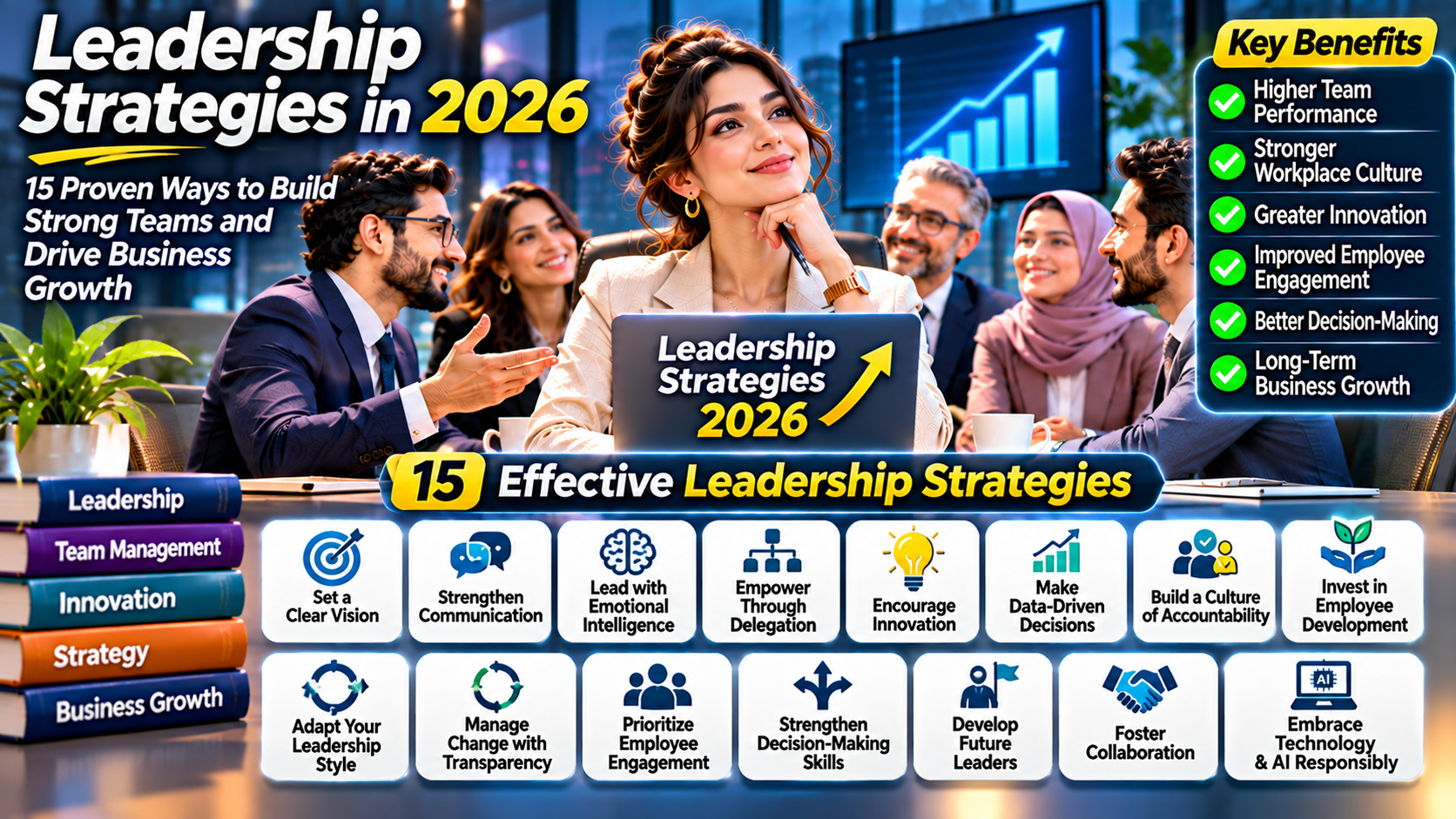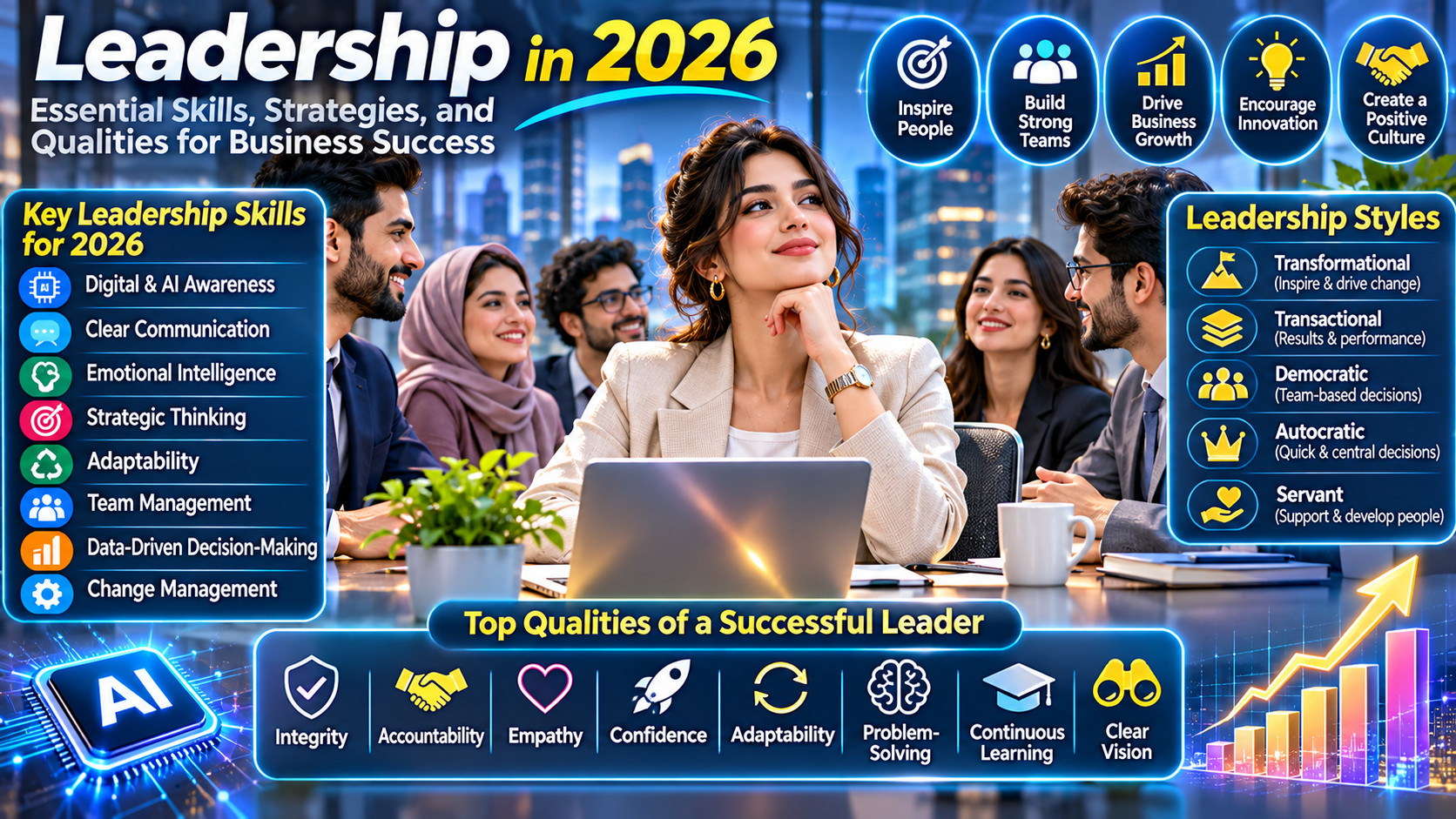
Leadership is one of the most important factors behind successful organizations. Whether managing a small business, leading a multinational company, or building a startup, effective leadership influences how people work, make decisions, solve problems, and achieve shared goals.
However, leadership is changing. Modern organizations face new challenges involving artificial intelligence, digital transformation, remote work, global competition, employee expectations, and rapidly changing markets.
Today's successful leaders need more than authority or management experience. They must communicate clearly, make informed decisions, encourage innovation, adapt to change, and build trust within their teams.
In 2026, leadership is increasingly about creating an environment where people can perform at their best while helping organizations remain competitive.
This guide explores the meaning of leadership, its major styles, essential qualities, important skills, practical strategies, common challenges, and the future of leadership in modern businesses.
What Is Leadership?
Leadership is the ability to guide, influence, motivate, and support individuals or groups toward achieving a common objective.
A leader provides direction, establishes priorities, makes decisions, and helps people understand how their contributions support organizational goals.
Leadership is not limited to executives or business owners. It can be demonstrated by managers, team supervisors, project coordinators, entrepreneurs, and employees who take responsibility and encourage others.
Effective leadership involves several important responsibilities:
Establishing a clear vision and direction.
Communicating goals and expectations.
Supporting employee development.
Making informed decisions.
Resolving conflicts.
Encouraging teamwork and innovation.
Managing organizational change.
Building trust and accountability.
Strong leadership helps organizations turn plans into meaningful results.
Why Is Leadership Important in Business?
Leadership directly influences organizational culture, employee performance, customer satisfaction, and long-term business development.
1. Provides Clear Direction
Employees perform more effectively when they understand the organization's goals and priorities.
Leaders communicate expectations and help teams focus on activities that contribute to business success.
2. Improves Employee Motivation
A supportive leader recognizes employee contributions, encourages professional growth, and creates a positive working environment.
Motivated employees are more likely to remain engaged and committed to their responsibilities.
3. Supports Better Decision-Making
Business leaders regularly make decisions involving budgets, employees, customers, operations, and future investments.
Effective leaders evaluate available information, consider potential risks, and select appropriate actions.
4. Encourages Innovation
Organizations need new ideas to remain competitive.
Leaders who encourage creativity and constructive experimentation help employees identify better ways to solve problems and improve products or services.
5. Strengthens Team Collaboration
Successful businesses depend on employees working together.
Leadership helps establish shared objectives, improve communication, and resolve disagreements before they affect productivity.
6. Supports Business Growth
Strong leadership helps organizations manage resources, develop talent, respond to market changes, and pursue sustainable growth opportunities.
Major Types of Leadership Styles
Different situations require different leadership approaches. Understanding leadership styles helps managers select methods that match their teams, organizational culture, and business objectives.
1. Transformational Leadership
Transformational leadership focuses on inspiring employees through a shared vision and encouraging them to achieve more than they initially expected.
Transformational leaders promote innovation, personal development, and organizational improvement.
Key characteristics:
Inspiring communication.
Clear long-term vision.
Encouragement of creativity.
Employee development.
Openness to change.
Example: A technology company leader encourages employees to develop innovative products and explore new markets while maintaining a shared business vision.
2. Transactional Leadership
Transactional leadership uses clearly defined responsibilities, performance expectations, rewards, and consequences.
It can be useful in environments where consistency, efficiency, and measurable outcomes are important.
Key characteristics:
Clearly defined targets.
Structured responsibilities.
Performance monitoring.
Rewards for achievement.
Established procedures.
Example: A sales manager establishes monthly sales targets and rewards team members who achieve their objectives.
3. Democratic Leadership
Democratic leadership encourages employees to participate in discussions and contribute ideas before decisions are made.
This approach can improve collaboration and help employees feel valued.
Key characteristics:
Open communication.
Employee participation.
Shared problem-solving.
Collaborative decision-making.
Respect for different perspectives.
Example: A project manager asks team members to evaluate several possible strategies before selecting the final approach.
4. Autocratic Leadership
Autocratic leadership involves centralized decision-making, with the leader maintaining significant control over decisions and instructions.
This style may be appropriate in emergencies or situations requiring immediate direction, although excessive use can reduce employee participation.
Key characteristics:
Centralized authority.
Direct instructions.
Limited consultation.
Fast decision-making.
Strong operational control.
Example: A production supervisor immediately instructs employees to follow emergency safety procedures during an equipment failure.
5. Servant Leadership
Servant leadership focuses on supporting employees, removing obstacles, and helping individuals develop professionally.
Rather than focusing only on authority, servant leaders prioritize the needs and development of their teams.
Key characteristics:
Empathy.
Active listening.
Employee empowerment.
Professional development.
Trust and support.
Example: A department manager helps employees access training, provides constructive feedback, and works to remove barriers affecting their performance.
6. Situational Leadership
Situational leadership involves adjusting leadership behavior according to employee experience, task complexity, and the requirements of a particular situation.
A new employee may need more guidance, while an experienced professional may perform better with greater independence.
Key characteristics:
Flexibility.
Awareness of employee capabilities.
Adaptive communication.
Appropriate delegation.
Continuous feedback.
Example: A manager provides detailed instructions to a new employee but allows experienced team members to manage their projects independently.
Essential Qualities of a Successful Leader
Effective leadership requires a combination of personal qualities, professional skills, and practical experience.
1. Clear Communication
Communication is one of the most important leadership qualities.
Leaders must explain expectations, share information, provide feedback, and listen carefully to employees.
Poor communication can create confusion, misunderstandings, and unnecessary workplace conflicts.
2. Emotional Intelligence
Emotional intelligence is the ability to recognize, understand, and manage emotions while responding appropriately to the emotions of others.
Emotionally intelligent leaders are better equipped to handle disagreements, support employees, and maintain professional relationships.
3. Integrity and Honesty
Trust is essential for effective leadership.
Leaders should communicate honestly, keep their commitments, accept responsibility, and apply workplace standards fairly.
4. Accountability
Successful leaders take responsibility for decisions and organizational outcomes.
They do not automatically blame employees when something goes wrong. Instead, they investigate problems, identify improvements, and establish corrective actions.
5. Adaptability
Markets, technologies, and customer expectations continue to change.
Adaptable leaders remain open to new ideas, learn from experience, and adjust their strategies when circumstances change.
6. Strategic Thinking
Strategic thinking allows leaders to understand the bigger picture and evaluate how present decisions affect future business objectives.
It involves identifying opportunities, evaluating risks, allocating resources, and setting priorities.
7. Confidence
Leaders need confidence to communicate direction, make difficult decisions, and manage uncertainty.
However, confidence should be balanced with humility and a willingness to consider alternative perspectives.
8. Empathy
Empathetic leaders consider employee experiences, challenges, and professional needs.
They understand that workplace performance is influenced by communication, support, workload, and organizational culture.
9. Problem-Solving Ability
Every organization encounters operational challenges.
Effective leaders identify the causes of problems, evaluate possible solutions, and coordinate appropriate actions.
10. Continuous Learning
Successful leaders recognize that leadership development is an ongoing process.
They seek feedback, learn from mistakes, study industry developments, and improve their professional capabilities.
Essential Leadership Skills in 2026
Modern business environments require leaders to combine traditional management capabilities with digital awareness and adaptability.
1. Digital Leadership
Digital leadership involves guiding organizations through technology adoption and digital transformation.
Leaders should understand how technology affects operations, customers, employees, and business models.
Important areas include:
Cloud computing.
Artificial intelligence.
Data analytics.
Cybersecurity.
Digital collaboration.
Business automation.
2. AI Awareness and Decision-Making
Artificial intelligence is changing how organizations analyze information, automate workflows, and deliver services.
Business leaders do not necessarily need to become AI engineers, but they should understand AI capabilities, limitations, risks, and appropriate business applications.
They should also establish responsible policies for data privacy, human oversight, and AI-generated decisions.
3. Remote Team Management
Remote and hybrid work arrangements require leaders to manage teams across different locations.
Effective remote leadership includes clear communication, measurable expectations, appropriate collaboration tools, and regular employee feedback.
4. Change Management
Organizational change can create uncertainty and resistance.
Leaders must explain why change is necessary, communicate implementation plans, support employees, and measure progress.
5. Data-Driven Decision-Making
Modern organizations generate large amounts of information.
Leaders should use relevant data, performance indicators, customer feedback, and financial reports to support business decisions.
6. Conflict Resolution
Workplace disagreements are unavoidable.
Strong leaders address conflicts professionally by listening to different perspectives, identifying the underlying issue, and finding practical solutions.
7. Delegation
Effective delegation allows leaders to distribute responsibilities according to employee capabilities.
It also helps employees develop new skills while allowing managers to focus on strategic priorities.
Leadership vs. Management: What Is the Difference?
Leadership and management are closely related, but they are not identical.
Leadership focuses on direction, influence, motivation, and long-term development. Management focuses more on planning, organizing, coordinating, and controlling operational activities.
Feature | Leadership | Management |
|---|---|---|
Main focus | Vision and direction | Planning and execution |
Primary role | Inspire and influence | Organize and coordinate |
Time horizon | Often long-term | Often short- and medium-term |
Main priority | People and change | Processes and performance |
Decision-making | Direction and strategy | Operational decisions |
Success measure | Shared progress and impact | Efficiency and target achievement |
Successful organizations need both leadership and effective management.
A business may have an inspiring vision, but without good management, its plans may not be implemented effectively. Similarly, efficient processes may not create long-term progress without leadership and direction.
How to Develop Strong Leadership Skills
Leadership skills can be developed through experience, learning, feedback, and consistent practice.
Here are practical steps for becoming a more effective leader.
Step 1: Understand Your Leadership Style
Evaluate how you currently communicate, make decisions, delegate responsibilities, and respond to challenges.
Identify your strengths and areas that require improvement.
Step 2: Improve Communication
Practice explaining ideas clearly and listening without interrupting.
Ask employees questions, encourage feedback, and make sure expectations are understood.
Step 3: Build Emotional Intelligence
Learn to recognize emotional responses and understand how your behavior affects others.
Remain professional during disagreements and avoid making decisions based entirely on frustration or pressure.
Step 4: Develop Decision-Making Skills
Collect relevant information, compare possible solutions, consider risks, and evaluate expected outcomes.
Learn from both successful and unsuccessful decisions.
Step 5: Learn to Delegate
Assign responsibilities based on individual strengths and experience.
Provide the necessary resources and allow employees appropriate independence.
Step 6: Encourage Employee Development
Support training, mentorship, knowledge sharing, and career development.
Employees who improve their capabilities can contribute more effectively to organizational goals.
Step 7: Request Feedback
Ask employees and colleagues how your leadership affects communication, teamwork, and productivity.
Use constructive feedback to identify opportunities for improvement.
Step 8: Keep Learning
Read business publications, attend professional development programs, study leadership approaches, and learn from experienced professionals.
Common Leadership Challenges in Modern Businesses
Even experienced leaders face challenges that can affect organizational performance.
1. Managing Workplace Conflict
Different personalities, expectations, and communication styles can create disagreements.
Leaders should address problems early and encourage respectful discussions.
2. Employee Disengagement
Employees may become less motivated when they lack recognition, development opportunities, or clear expectations.
Regular communication and meaningful professional support can improve engagement.
3. Resistance to Change
Employees may hesitate when organizations introduce new systems, technologies, or processes.
Leaders should explain the purpose of changes and involve employees where appropriate.
4. Decision-Making Under Pressure
Business leaders often make decisions with limited time or incomplete information.
They must balance speed with careful evaluation and responsible risk management.
5. Managing Remote and Hybrid Teams
Distance can make communication, collaboration, and team relationships more challenging.
Clear workflows, regular meetings, and appropriate digital tools can help address these issues.
6. Maintaining Work-Life Balance
Leadership responsibilities can create significant pressure.
Leaders should establish realistic priorities, delegate effectively, and encourage healthy workplace expectations.
How Leadership Influences Organizational Culture
Organizational culture refers to the shared values, behaviors, expectations, and practices that influence how people work together.
Leadership plays an important role in shaping this culture.
For example, leaders who encourage transparency and accountability can help establish an environment where employees communicate openly and take responsibility for their work.
A positive organizational culture may include:
Respectful communication.
Fair treatment.
Professional development.
Collaboration.
Innovation.
Accountability.
Recognition.
Ethical decision-making.
Leaders influence culture not only through their statements but also through their daily actions.
Employees often observe how managers respond to mistakes, treat colleagues, handle disagreements, and recognize achievements.
Consistency between leadership values and actual behavior is essential for building trust.
Measuring Leadership Effectiveness
Leadership effectiveness should be evaluated through meaningful organizational and employee outcomes.
Businesses can use several indicators to understand whether leadership practices are working.
Performance Indicator | What It Measures |
|---|---|
Employee engagement | Employee involvement and motivation |
Employee retention | Ability to retain talent |
Team productivity | Efficiency and completed work |
Goal achievement | Progress toward organizational objectives |
Customer satisfaction | Quality of customer experiences |
Internal collaboration | Cooperation between teams |
Employee development | Growth in employee capabilities |
Innovation outcomes | New ideas and improvements implemented |
No single measurement can fully describe leadership effectiveness.
Organizations should combine quantitative performance indicators with employee feedback, management assessments, and long-term business results.
The Future of Leadership: Trends to Watch
Leadership will continue evolving as technology, business models, and employee expectations change.
1. AI-Supported Leadership
AI tools can help leaders summarize reports, analyze business information, automate administrative work, and identify patterns in organizational data.
However, important decisions involving employees, ethics, and business strategy still require human judgment and accountability.
2. Human-Centered Leadership
As automation becomes more common, leaders will need to maintain strong relationships with employees.
Empathy, communication, trust, and professional development will remain important.
3. Flexible Leadership Models
Organizations increasingly need leaders who can adapt their approach to different employees, projects, and working environments.
Flexible leadership can support collaboration across departments and locations.
4. Greater Focus on Employee Well-Being
Employee expectations are changing.
Leaders will need to consider workload, professional development, workplace support, and sustainable performance.
5. Ethical and Responsible Leadership
Businesses face growing expectations around transparency, data protection, environmental responsibility, and fair treatment.
Leaders must consider the broader impact of organizational decisions.
6. Continuous Learning and Reskilling
Technology and market changes create new skill requirements.
Leaders will increasingly need to support employee training, professional development, and organizational learning.
Frequently Asked Questions (FAQs)
1. What is leadership in simple words?
Leadership is the ability to guide, motivate, and influence people toward achieving shared goals.
2. What are the most important qualities of a good leader?
Important leadership qualities include honesty, communication, empathy, accountability, confidence, adaptability, strategic thinking, and problem-solving.
3. What are the five main leadership styles?
Five widely discussed styles are transformational, transactional, democratic, autocratic, and servant leadership. Situational leadership is another important approach.
4. Why is leadership important in business?
Leadership provides direction, improves teamwork, supports employee motivation, encourages innovation, and helps organizations achieve their goals.
5. What is the difference between leadership and management?
Leadership focuses on vision, influence, and motivation, while management focuses on planning, organizing, and coordinating work.
6. Can leadership skills be learned?
Yes. Leadership skills can be developed through training, practical experience, feedback, mentorship, and continuous learning.
7. What is digital leadership?
Digital leadership is the ability to guide organizations through technology adoption, digital transformation, and technology-related business changes.
8. How does leadership affect employee performance?
Effective leadership can improve clarity, motivation, collaboration, and professional development, all of which can support better employee performance.
9. What are common leadership challenges?
Common challenges include managing conflict, motivating employees, making difficult decisions, handling organizational change, and managing remote teams.
10. What will leadership look like in the future?
Future leadership will increasingly combine human-centered management, digital awareness, AI-supported decision-making, adaptability, ethical responsibility, and continuous learning.
Conclusion
Leadership is more than holding a position of authority. It is the ability to guide people, create direction, build trust, and help organizations achieve meaningful objectives.
In 2026, successful business leaders must combine communication, emotional intelligence, strategic thinking, adaptability, and digital awareness.
They must also understand how technology is changing the workplace while maintaining a strong focus on people and organizational values.
Whether leading a startup, managing a growing company, or supervising a professional team, developing effective leadership skills can create long-term value.
The strongest leaders are not simply those who give instructions. They are the people who inspire others, take responsibility, encourage improvement, and create an environment where individuals and organizations can grow.