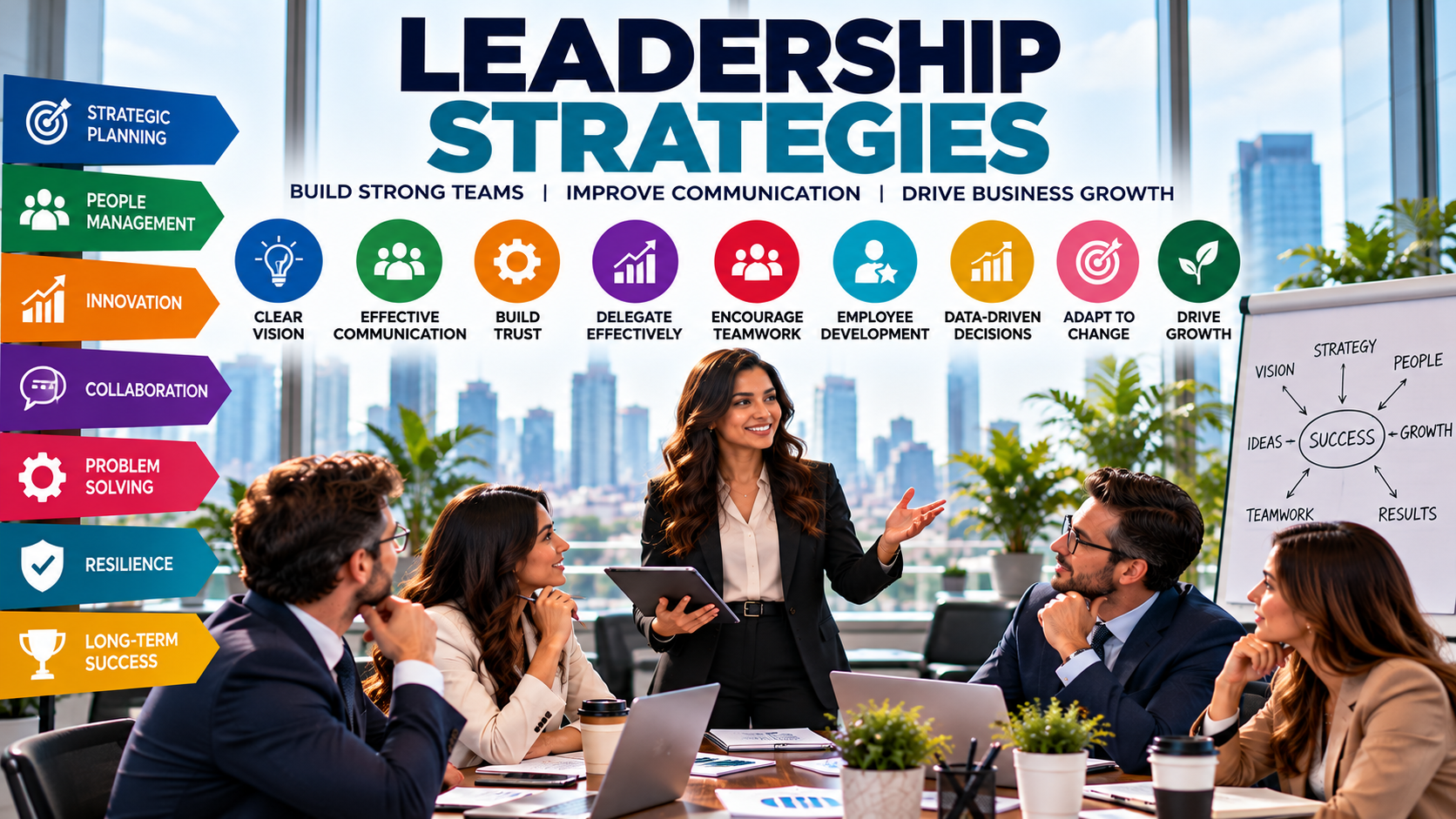
Leadership is one of the most important factors behind the success of any organization. Whether a business is a small startup, a growing e-commerce company, or a large international corporation, effective leadership helps teams work toward common goals, overcome challenges, and achieve sustainable growth. In today's competitive business environment, leadership is no longer limited to giving instructions or managing employees. It involves inspiring people, making informed decisions, encouraging innovation, and creating a workplace where individuals can perform at their best.
Modern businesses face constant changes in technology, customer expectations, market conditions, and employee needs. As a result, organizations require leaders who can adapt to new circumstances while maintaining a clear vision for the future. A successful leader understands that business growth depends not only on products and services but also on people, communication, trust, and strategic planning.
Leadership also plays an important role in employee satisfaction and organizational culture. Employees who feel supported, respected, and valued are often more motivated to contribute their ideas and improve their performance. By developing strong leadership practices, businesses can build more productive teams, improve collaboration, and establish a foundation for long-term success.
This article explores the meaning of leadership, the essential qualities of effective leaders, different leadership styles, practical strategies for developing leadership skills, and the role leadership plays in modern business growth.
What Is Leadership?
Leadership is the ability to guide, influence, and motivate individuals or groups toward achieving shared objectives. It involves establishing direction, communicating expectations, solving problems, and helping people understand how their contributions support the larger mission of an organization.
Although leadership and management are closely related, they are not exactly the same. Management generally focuses on organizing resources, coordinating tasks, monitoring performance, and maintaining operational efficiency. Leadership focuses more broadly on creating a vision, influencing people, encouraging progress, and guiding teams through change.
An effective business leader combines both abilities. They understand the importance of planning and accountability while recognizing that employees need encouragement, guidance, and opportunities to grow.
For example, a manager may assign responsibilities to a marketing team and establish deadlines for a new campaign. A leader goes further by explaining the campaign's purpose, encouraging creative ideas, helping team members solve problems, and connecting individual efforts to the company's overall objectives.
Leadership is not necessarily associated with a particular job title. Employees can demonstrate leadership by taking responsibility for a project, helping colleagues, suggesting improvements, and making thoughtful decisions. In successful organizations, leadership can exist at every level.
Why Leadership Matters in Business
Strong leadership contributes to business performance in several important ways. It helps organizations establish priorities, respond to challenges, and create a shared understanding of success.
1. Establishing a Clear Business Vision
A business needs a clear direction to make meaningful progress. Without a defined vision, employees may focus on separate priorities, departments may work toward conflicting objectives, and resources may be wasted on activities that do not support the company's long-term plans.
Effective leaders communicate where the organization wants to go and explain why that destination matters. They break broad ambitions into achievable goals and help employees understand their responsibilities.
For instance, an e-commerce business may want to expand into international markets. Its leadership team must identify target customers, evaluate competition, improve logistics, develop marketing strategies, and establish realistic growth targets.
A clear vision helps coordinate these activities and gives employees a common purpose.
2. Improving Employee Motivation
Employees are more likely to contribute positively when they understand their work, receive constructive feedback, and believe their efforts are recognized.
Leaders influence motivation through their behavior. They can encourage employees by acknowledging achievements, offering professional development opportunities, listening to concerns, and providing support when challenges arise.
Motivation does not always require financial rewards. Recognition, meaningful responsibilities, flexibility, and opportunities to learn can also help employees feel valued.
When leaders create an environment where employees can see the impact of their work, they strengthen engagement and encourage people to take greater responsibility for their performance.
3. Supporting Better Decision-Making
Businesses regularly make decisions involving budgets, hiring, customer service, marketing, technology, and expansion. Poor decisions can create financial losses, operational problems, or damage to customer relationships.
Effective leaders evaluate available information, consider different perspectives, identify potential risks, and choose actions that align with business objectives.
They also understand that decisions sometimes need to be made before every detail is known. In these situations, successful leaders distinguish between manageable uncertainty and unacceptable risk.
They monitor results, learn from mistakes, and adjust their approach when new information becomes available.
4. Building Trust and Accountability
Trust is an essential part of effective leadership. Employees need to believe that leaders will communicate honestly, treat people fairly, and take responsibility for their decisions.
Leaders build trust by keeping commitments, explaining important changes, acknowledging mistakes, and applying workplace standards consistently.
Accountability is equally important. A supportive leader does not ignore missed deadlines or poor performance. Instead, they identify the underlying problem, clarify expectations, and work with employees to develop solutions.
Combining trust with accountability creates an environment where people can discuss problems openly while remaining responsible for their work.
5. Encouraging Innovation and Adaptability
Markets change, customer expectations evolve, and new technologies introduce different ways of working. Businesses that rely entirely on established methods may struggle to remain competitive.
Leaders encourage innovation by inviting suggestions, testing new ideas, and allowing teams to learn from reasonable mistakes.
This does not mean accepting every proposal without evaluation. Instead, leaders create a structured process for considering ideas, testing their potential value, measuring results, and deciding whether to expand successful initiatives.
Organizations that balance creativity with disciplined decision-making are better positioned to adapt to changing business conditions.
Essential Qualities of an Effective Leader
Leadership requires a combination of personal qualities, professional skills, and practical experience. While different situations demand different approaches, several characteristics are consistently valuable.
Communication Skills
Communication is one of the foundations of leadership. Leaders must explain objectives, delegate responsibilities, provide feedback, resolve misunderstandings, and communicate changes clearly.
Good communication also involves listening. Leaders who listen carefully are more likely to understand employee concerns, identify operational problems, and discover ideas that might otherwise remain unspoken.
Clear communication reduces confusion and helps teams coordinate their efforts.
Emotional Intelligence
Emotional intelligence is the ability to recognize and manage emotions while understanding how feelings influence behavior and relationships.
Leaders with strong emotional intelligence can respond thoughtfully to difficult situations rather than reacting impulsively. They recognize when employees are frustrated, overwhelmed, or uncertain and adjust their communication accordingly.
Emotional intelligence also supports conflict resolution. Instead of immediately blaming one person, an effective leader examines the circumstances, listens to the individuals involved, and works toward a fair solution.
Integrity and Honesty
Integrity means acting according to ethical principles and maintaining consistency between words and actions.
Employees are more likely to respect leaders who communicate honestly, keep promises, and admit when they have made mistakes.
Integrity is especially important when a business faces financial pressure, customer complaints, or difficult organizational decisions. Leaders must consider not only immediate results but also the long-term consequences of their choices.
Ethical leadership protects relationships and supports a positive organizational reputation.
Confidence and Humility
Confidence helps leaders make decisions, communicate direction, and remain composed during challenging situations. However, confidence becomes less effective when it prevents leaders from considering alternative viewpoints.
Humility allows leaders to recognize that they do not have all the answers. They can seek advice, acknowledge the expertise of others, and change their opinions when evidence supports a different approach.
The combination of confidence and humility enables leaders to act decisively without becoming resistant to feedback.
Strategic Thinking
Strategic thinking involves understanding the broader business environment and considering how present decisions affect future outcomes.
A strategic leader evaluates market trends, customer needs, competitive pressures, available resources, and potential risks before establishing priorities.
For example, a company may experience a temporary increase in sales after spending heavily on advertising. A strategic leader will examine whether the additional revenue is profitable, whether customers return for repeat purchases, and whether the marketing investment supports sustainable growth.
This broader perspective helps organizations avoid decisions based only on short-term results.
Adaptability
Adaptable leaders respond constructively when circumstances change. They understand that a strategy that worked previously may not remain effective under different conditions.
Adaptability requires curiosity, continuous learning, and a willingness to revise plans.
In a modern workplace, leaders may need to introduce new software, respond to remote-work challenges, adjust to changing customer behavior, or reorganize responsibilities.
Rather than resisting every change, adaptable leaders evaluate its purpose, communicate its implications, and help employees transition successfully.
Empathy
Empathy allows leaders to consider situations from other people's perspectives. It helps them understand employee challenges, customer frustrations, and differences in working styles.
An empathetic leader does not automatically agree with every concern. Instead, they listen respectfully and seek to understand the circumstances before making a decision.
Empathy can improve workplace relationships and help leaders identify problems that may otherwise remain hidden.
Accountability
Effective leaders accept responsibility for their decisions and the outcomes of their actions. They do not automatically blame employees when a project fails or a target is missed.
Instead, they examine the situation, identify contributing factors, and determine what should change.
Accountability also includes recognizing successful performance and giving employees appropriate credit for their contributions.
When leaders demonstrate accountability themselves, they set an example for the rest of the organization.
Different Leadership Styles in the Workplace
There is no single leadership style that works equally well in every situation. The most appropriate approach depends on the organization's goals, the team's experience, the urgency of the situation, and the complexity of the work.
1. Transformational Leadership
Transformational leadership focuses on inspiring people to pursue meaningful goals and improve beyond their existing performance.
These leaders communicate an ambitious vision, encourage creative thinking, and support employees as they develop new skills.
This approach can be useful for startups, growing businesses, and organizations undergoing significant change. Employees may feel more engaged when they understand how their work contributes to a larger purpose.
However, a compelling vision must be supported by realistic plans, adequate resources, and measurable objectives.
2. Democratic Leadership
Democratic leadership involves employees in discussions and decision-making. Leaders encourage team members to share ideas, raise concerns, and contribute their expertise.
This approach can improve collaboration and generate useful perspectives, particularly when decisions affect multiple departments.
For example, a company planning a new product launch may gather feedback from marketing, sales, customer service, and product development teams before finalizing its strategy.
Democratic leadership can take longer than making decisions independently, so leaders must recognize when consultation is valuable and when immediate action is necessary.
3. Autocratic Leadership
Autocratic leadership involves centralized decision-making, with the leader establishing instructions and expectations.
Although this approach is sometimes criticized for limiting participation, it can be useful in emergencies or situations where clear direction is essential.
For example, during a serious operational disruption, employees may need immediate instructions rather than an extended discussion.
The important consideration is whether centralized control is appropriate for the circumstances. Excessive reliance on this style can reduce employee initiative and discourage open communication.
4. Servant Leadership
Servant leadership emphasizes supporting employees, removing obstacles, and helping individuals develop their capabilities.
Leaders who follow this approach focus on understanding what their teams need to perform effectively. They may provide coaching, improve access to resources, or advocate for employees during organizational discussions.
Servant leadership does not mean avoiding difficult decisions. It means making decisions with appropriate consideration for the people affected.
This style can be particularly valuable in organizations that prioritize collaboration, professional development, and employee well-being.
5. Situational Leadership
Situational leadership involves adapting the leadership approach to the needs of the team and the task.
A new employee may require detailed instructions and frequent guidance, while an experienced professional may perform better with greater independence.
Similarly, an urgent crisis may require direct leadership, whereas a long-term innovation project may benefit from collaboration and experimentation.
Situational leadership recognizes that effective leadership depends on understanding the circumstances rather than applying one rigid method to every problem.
How Leadership Influences Workplace Culture
Workplace culture refers to the shared values, behaviors, expectations, and practices that shape how people work together.
Leadership has a significant influence on culture because employees observe how leaders behave, communicate, resolve disagreements, and make decisions.
If leaders encourage respectful discussion, employees may become more comfortable sharing ideas. If leaders respond to mistakes with humiliation or unfair punishment, employees may become reluctant to report problems.
A healthy workplace culture does not eliminate disagreement. Instead, it provides constructive ways to address differences and make decisions.
Leaders can strengthen workplace culture by establishing clear standards, encouraging cooperation, recognizing contributions, and treating employees consistently.
They should also ensure that stated values are reflected in everyday decisions. A company that promotes innovation, for example, should provide reasonable opportunities for experimentation rather than expecting employees to follow established procedures without question.
When leadership behavior matches organizational values, employees have a stronger basis for trusting the company's commitments.
The Role of Leadership in Remote and Hybrid Teams
Remote and hybrid work arrangements have changed how many organizations communicate and coordinate activities.
When employees work from different locations, leaders cannot depend entirely on physical supervision or informal office conversations. They must establish clear communication practices and create reliable ways to measure progress.
Successful remote leadership begins with clear expectations. Employees should understand their responsibilities, deadlines, communication channels, and performance standards.
Leaders should also avoid excessive monitoring that distracts employees from meaningful work. Instead, they can focus on outcomes, deliverables, collaboration, and agreed performance indicators.
Regular meetings can help teams remain connected, but meetings should have clear purposes and should not unnecessarily interrupt focused work.
Remote leaders must also recognize the importance of inclusion. Employees who work remotely should have reasonable access to information, professional development, and opportunities to contribute to decisions.
Building trust is particularly important in distributed teams. Leaders who communicate consistently, provide timely feedback, and respect employees' time can help create a more effective remote-working environment.
Leadership in Small Businesses and Startups
Leadership is particularly important for small businesses and startups because these organizations often operate with limited resources and must respond quickly to changing conditions.
Business owners frequently manage several responsibilities at once, including marketing, finance, customer service, hiring, and strategic planning.
In this environment, leaders must prioritize activities that contribute most directly to business objectives.
For example, an online business may have limited funds for advertising. Rather than investing the entire budget in one campaign without testing its effectiveness, the owner can begin with a smaller experiment, measure customer acquisition costs, evaluate conversions, and expand the approach if the results justify the investment.
Small-business leaders should also avoid becoming the only person capable of making important decisions. As a company grows, delegating responsibilities becomes essential.
Creating clear processes, documenting procedures, and training employees allows the business to operate more efficiently without requiring the owner to supervise every task.
Strong leadership helps startups move from informal operations toward sustainable business systems.
How to Develop Leadership Skills
Leadership is not exclusively an inborn talent. Many leadership abilities can be developed through deliberate practice, feedback, and experience.
Step 1: Improve Self-Awareness
Begin by identifying your strengths, weaknesses, communication habits, and typical responses to pressure.
Consider questions such as:
Do I listen carefully before responding?
Can I explain expectations clearly?
How do I react when someone disagrees with me?
Do I accept responsibility when something goes wrong?
Which skills would help me become more effective?
Honest reflection helps identify areas for improvement.
Step 2: Practice Active Listening
During conversations, focus on understanding the other person's message rather than preparing your response immediately.
Ask relevant questions, clarify important details, and summarize what you have understood.
Active listening can reveal misunderstandings, uncover useful information, and improve professional relationships.
Step 3: Learn to Delegate
Delegation involves assigning responsibilities to appropriate people while providing the necessary resources, authority, and support.
Effective delegation does not mean transferring a task and abandoning the employee. Leaders should explain the desired outcome, agree on deadlines, establish checkpoints, and remain available when assistance is needed.
Delegation also creates opportunities for employees to develop confidence and practical skills.
Step 4: Become Comfortable With Feedback
Constructive feedback helps leaders understand how their behavior affects others.
Ask colleagues or team members for specific suggestions rather than simply asking whether your leadership is good.
For example, you might ask whether project expectations are clear, whether meetings are productive, or whether employees receive enough support.
Use the responses to identify realistic improvements and review your progress over time.
Step 5: Strengthen Decision-Making
Practice evaluating problems systematically. Define the issue, gather relevant information, consider alternatives, identify risks, and determine how success will be measured.
For important decisions, establish a review point so you can assess whether the chosen approach is producing the expected results.
This process encourages thoughtful decisions without requiring endless analysis.
Step 6: Continue Learning
Leadership knowledge develops through reading, training, mentoring, observation, and practical experience.
Leaders can learn from business case studies, professional courses, experienced colleagues, and their own successes and failures.
Continuous learning is particularly important as technology, customer expectations, and workplace practices evolve.
Step 7: Lead Through Your Actions
Employees pay attention to what leaders do, not only what they say.
If leaders expect punctuality, they should respect agreed schedules. If they encourage honesty, they should communicate transparently. If they value collaboration, they should demonstrate respect for different viewpoints.
Consistent behavior makes leadership principles more credible.
Common Leadership Mistakes to Avoid
Even experienced leaders can develop habits that reduce team effectiveness. Recognizing these mistakes is an important step toward improvement.
Micromanagement
Micromanagement occurs when leaders control too many details and provide insufficient independence.
Although close supervision may be necessary for certain tasks, excessive control can slow progress, reduce confidence, and prevent employees from developing problem-solving skills.
Leaders should establish clear expectations and appropriate checkpoints while allowing employees to determine how to complete their work when circumstances permit.
Poor Communication
Unclear instructions, inconsistent updates, and unexplained decisions create confusion.
Employees may waste time correcting mistakes or completing work that does not match expectations.
Leaders can reduce these problems by communicating priorities clearly, documenting important decisions, and encouraging questions when instructions are uncertain.
Avoiding Difficult Conversations
Ignoring poor performance, unresolved disagreements, or inappropriate behavior can allow small problems to become larger ones.
Effective leaders address concerns promptly and respectfully. They focus on specific behavior, explain its impact, listen to the employee's perspective, and agree on appropriate next steps.
Difficult conversations are more productive when they focus on improvement rather than personal criticism.
Failing to Recognize Contributions
When employees receive little acknowledgment for their efforts, they may feel that their contributions are overlooked.
Recognition should be genuine, specific, and fair. Leaders can highlight successful teamwork, thoughtful problem-solving, customer service, or improvements in performance.
They should also avoid giving recognition only to highly visible employees while overlooking valuable contributions made behind the scenes.
Resisting Change
Leaders who insist that existing methods must always remain unchanged may miss opportunities to improve efficiency or respond to new market conditions.
A better approach is to evaluate new ideas objectively, consider their risks, and test promising changes where appropriate.
At the same time, leaders should preserve practices that remain effective and avoid adopting new technologies simply because they are popular.
Ignoring Employee Development
Employees often need opportunities to learn new skills and prepare for greater responsibility.
Leaders who focus exclusively on immediate tasks may overlook long-term capability development.
Regular development discussions, mentoring, training, and carefully chosen assignments can help employees grow while strengthening the organization's future talent pool.
Measuring Leadership Effectiveness
Leadership should be evaluated through observable behaviors and meaningful outcomes rather than job titles alone.
Organizations can assess leadership effectiveness using a combination of qualitative feedback and quantitative indicators.
Useful measures may include:
Employee engagement and satisfaction.
Staff retention and turnover patterns.
Project completion rates.
Quality of work and error rates.
Customer satisfaction and complaint resolution.
Progress toward strategic business goals.
Employee development and internal promotions.
Team collaboration and communication quality.
No single metric provides a complete picture. For example, a team that completes projects quickly may still experience high employee turnover or poor-quality results.
Leaders should examine several indicators together and consider the circumstances behind the numbers.
Employee feedback can provide additional insight into whether leadership practices are helping people perform effectively.
Regular evaluation allows organizations to identify strengths, address weaknesses, and make informed improvements.
The Future of Leadership in the Age of Artificial Intelligence
Artificial intelligence and automation are changing how businesses analyze information, manage operations, communicate with customers, and complete routine tasks.
These developments create new opportunities for leaders, but they also introduce questions involving privacy, accuracy, employee training, accountability, and responsible technology use.
Modern leaders need to understand how emerging tools can support business objectives without assuming that every new technology will automatically improve performance.
For example, an e-commerce company may use AI tools to analyze customer questions, identify purchasing patterns, or assist with routine support requests. Leadership must determine whether these tools improve customer experiences, protect sensitive information, and allow employees to handle complex issues appropriately.
Leaders should also help employees develop the skills needed to work effectively alongside new technologies.
Human judgment remains important when decisions involve ethical concerns, conflicting priorities, sensitive relationships, or uncertain consequences.
The future of leadership will therefore require a balance of technological awareness, critical thinking, adaptability, and human understanding.
Leaders who combine these capabilities can make better use of innovation while maintaining appropriate standards of responsibility.
Leadership and Ethical Business Practices
Ethical leadership means considering fairness, honesty, responsibility, and the broader consequences of business decisions.
Organizations face pressure to achieve financial targets, compete for customers, and maintain market share. However, pursuing immediate gains through misleading advertising, unfair employment practices, or dishonest communication can damage long-term relationships.
Ethical leaders establish standards for acceptable behavior and make sure employees understand those expectations.
They encourage transparent communication, protect confidential information, and address misconduct appropriately.
For example, a business discovering an error in a product description should correct the information rather than knowingly allowing customers to make purchasing decisions based on inaccurate claims.
Ethical leadership also involves considering the effects of business activities on employees, customers, suppliers, and other stakeholders.
Responsible decisions can help protect reputation, strengthen trust, and support the long-term stability of an organization.
Building a Strong Leadership Strategy for Long-Term Growth
Organizations seeking sustainable growth should treat leadership development as an ongoing business priority.
A practical leadership strategy begins with defining the company's goals and identifying the capabilities required to achieve them.
Business leaders can then evaluate current skills, establish development priorities, and provide opportunities for employees to take on greater responsibility.
Mentoring programs, leadership workshops, project ownership, and regular feedback can support this process.
Organizations should also establish clear expectations for leadership behavior. These may include ethical decision-making, effective communication, accountability, collaboration, and employee development.
Leadership development should not be limited to senior executives. Employees at different levels can benefit from learning how to solve problems, manage projects, communicate effectively, and support colleagues.
Finally, organizations should evaluate whether leadership initiatives produce meaningful improvements. This may involve examining employee feedback, project outcomes, internal promotions, customer experiences, and progress toward business goals.
By connecting leadership development with measurable objectives, companies can create a stronger foundation for future growth.
Conclusion
Leadership is a fundamental element of organizational success. It influences how employees work together, how businesses respond to challenges, and how effectively organizations pursue their long-term goals.
Successful leaders combine communication, integrity, strategic thinking, adaptability, empathy, and accountability. They understand that leadership is not simply about exercising authority but about creating the conditions in which people can contribute, learn, and achieve meaningful results.
Different situations require different leadership styles. A growing startup may benefit from transformational leadership, an experienced team may respond well to greater autonomy, and an urgent operational problem may require direct decision-making. Effective leaders recognize these differences and adapt their approach to the circumstances.
Leadership development also requires continuous effort. Through self-awareness, active listening, constructive feedback, delegation, and practical experience, individuals can improve their ability to guide teams and make informed decisions.
As businesses adopt new technologies and navigate changing markets, leadership will continue to play an important role in building resilient organizations. Companies that invest in ethical leadership, employee development, innovation, and clear strategic direction are better equipped to pursue sustainable growth.
Ultimately, effective leadership is demonstrated through consistent actions, responsible decisions, and the ability to help people work toward a shared purpose. By developing these qualities, business leaders can strengthen their organizations and create lasting value for employees, customers, and stakeholders.
Frequently Asked Questions About Leadership
What is the most important quality of a good leader?
There is no single quality that guarantees success, but integrity, effective communication, and accountability are particularly important. They help leaders establish trust, clarify expectations, and guide teams responsibly.
Can leadership skills be learned?
Yes. Many leadership skills can be developed through experience, training, mentoring, self-reflection, and feedback. Individuals can improve their communication, decision-making, delegation, and conflict-resolution abilities over time.
What are the main types of leadership styles?
Common leadership styles include transformational, democratic, autocratic, servant, and situational leadership. Each approach has potential advantages, and the most suitable style depends on the task, team, and business environment.
Why is leadership important for small businesses?
Leadership helps small businesses establish priorities, manage limited resources, motivate employees, respond to customer needs, and build systems that support growth. Strong leadership also helps business owners delegate responsibilities as their companies expand.
How can leaders improve employee performance?
Leaders can improve employee performance by setting clear expectations, providing constructive feedback, recognizing achievements, offering development opportunities, and ensuring employees have the resources required to complete their work.
What is the difference between leadership and management?
Management focuses on organizing resources, coordinating tasks, and maintaining operations. Leadership focuses on establishing direction, influencing people, and guiding progress. Effective organizations generally need both.
How does leadership affect workplace culture?
Leadership influences workplace culture through everyday decisions, communication, recognition, accountability, and the treatment of employees. Consistent and ethical leadership can help create a culture of trust, cooperation, and continuous improvement.