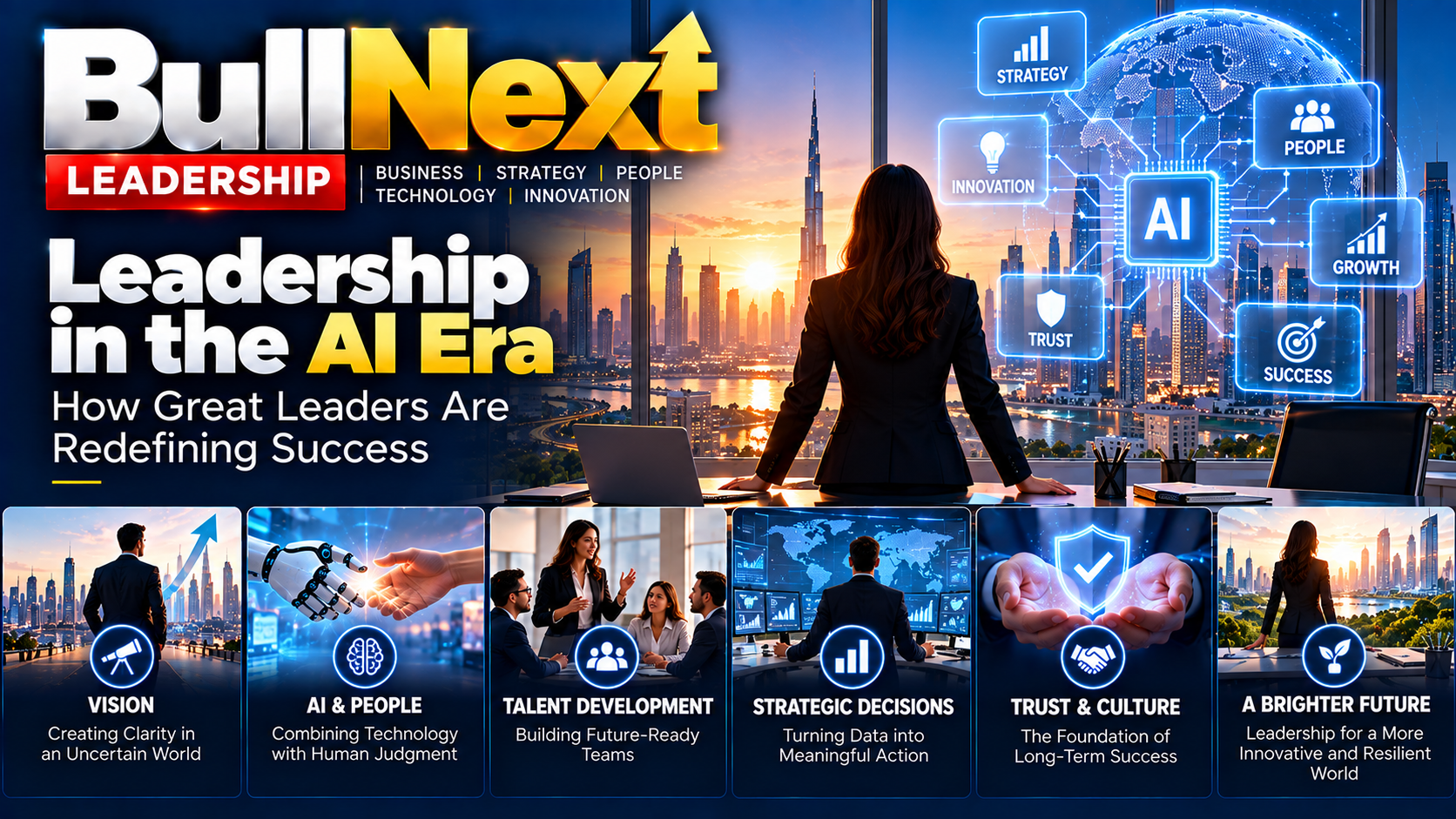
Leadership is changing.
For decades, effective leadership was often associated with experience, authority, expertise and the ability to make decisions faster than competitors.
Those qualities still matter.
But the modern business environment requires something more.
Artificial intelligence is changing how work gets done. Markets are becoming more unpredictable. Employees are developing new expectations. Technology cycles are becoming shorter, while businesses are being forced to adapt faster.
In this environment, leadership is no longer simply about telling people what to do.
It is about creating clarity when the future is uncertain, building trust during periods of change, developing people, making difficult decisions and helping organizations adapt without losing their identity.
The World Economic Forum has highlighted the growing importance of human-centered leadership skills as AI takes over more routine tasks. McKinsey similarly argues that AI cannot replace the human responsibilities of leadership, including setting aspirations, making difficult choices, building trust and holding people accountable.
The next generation of leaders will therefore need to combine human judgment with technological fluency.
Leadership Is Moving Beyond Authority
Traditional organizations often relied on hierarchy.
A senior executive made decisions.
Managers communicated those decisions.
Employees executed them.
That model can work in stable environments.
But today's businesses operate in conditions where information changes quickly.
A leader may need to make decisions while:
Customer expectations are changing
New technologies are emerging
Competitors are moving quickly
Employees are learning new skills
Supply chains are evolving
Economic conditions remain uncertain
This makes leadership less about having every answer and more about knowing how to find the right answer.
The strongest leaders are increasingly becoming orchestrators rather than controllers.
The New Leadership Advantage
Modern leaders need several capabilities that go beyond traditional management.
Vision
Leaders must explain where the organization is going and why.
Adaptability
They must be willing to change direction when circumstances change.
Judgment
Data can inform decisions, but leaders still need to determine what matters.
Communication
Employees need clarity, especially during uncertainty.
Empathy
Understanding people is essential when organizations are undergoing transformation.
Technology Fluency
Leaders do not need to become engineers, but they need to understand how technology affects their business.
Accountability
Someone must ultimately own important decisions and their consequences.
Together, these capabilities form a new leadership model.
AI Is Changing What Leaders Do
AI is increasingly capable of performing tasks that once required significant human effort.
It can summarize documents, analyze information, generate content, support coding, automate workflows and assist with decision-making.
This creates a major opportunity for leaders.
Instead of spending large amounts of time on repetitive tasks, executives and managers can potentially focus more on strategy, relationships and organizational development.
But this transition also creates a challenge.
If AI handles more execution, leaders need to become better at the work that machines cannot easily replace.
That includes:
Defining purpose
Making difficult trade-offs
Understanding people
Building trust
Resolving conflict
Creating culture
Taking responsibility
AI can provide information.
Leadership provides direction.
The Leader as an AI Orchestrator
The next generation of leaders may not be the people who know the most about every technology.
They may be the people who know how to combine technology with human capability.
An effective AI-oriented leader should be able to ask:
What problem are we trying to solve?
Where can AI create genuine value?
What should remain human?
What risks could the technology create?
Do employees understand how to use it?
How will success be measured?
This approach prevents AI from becoming a collection of disconnected experiments.
Recent World Economic Forum analysis argues that organizations increasingly need to treat AI as a business initiative rather than simply a technology upgrade and invest in workforce skills alongside AI infrastructure.
Great Leaders Create Clarity
Uncertainty is one of the biggest tests of leadership.
When employees do not understand what is happening, uncertainty can quickly become anxiety.
Leaders cannot always remove uncertainty.
But they can explain it.
A strong leader can say:
This is what we know.
This is what we do not know.
This is what we are going to do next.
This is how the change affects you.
That level of communication can create stability even when circumstances remain unstable.
The World Economic Forum has emphasized clarity and confidence as important leadership responsibilities during technological and organizational disruption.
Trust Is a Leadership Asset
Technology can improve productivity.
Strategy can improve competitiveness.
But trust determines whether people are willing to follow.
Employees need to trust that leaders are communicating honestly.
Customers need to trust the organization.
Partners need confidence in the company's decisions.
Investors need confidence in management.
Trust takes time to build.
It can also disappear quickly.
Leaders therefore need to demonstrate consistency between what they say and what they do.
Communication Is More Important Than Ever
Leadership communication is no longer limited to annual meetings or company emails.
Modern leaders communicate through:
Town halls
Video messages
Internal platforms
Team meetings
Social media
Interviews
Company updates
This creates more opportunities for connection.
It also creates more opportunities for mistakes.
A poorly communicated decision can spread rapidly through an organization.
Leaders need to communicate with clarity and purpose.
The goal is not to talk more.
It is to make important information easier to understand.
Employees Want to Know Where They Fit
Technology changes can create uncertainty for employees.
When AI and automation change workflows, people may wonder:
Will my role change?
Will my skills remain valuable?
What should I learn next?
Will there be opportunities for me in the future?
Leaders should not ignore these questions.
They should address them directly.
The World Economic Forum reports that many organizations are redesigning roles and that reskilling and workforce development are becoming increasingly important as AI changes work.
Good leadership therefore includes creating pathways for people to adapt.
The Future Leader Is a Teacher
One of the most important leadership responsibilities may become developing people.
When technology changes quickly, employees cannot depend only on skills learned several years ago.
Organizations need continuous learning.
Leaders can support this by encouraging:
Training
Mentoring
Internal mobility
Experimentation
Knowledge sharing
Cross-functional projects
A leader who develops capable people creates organizational resilience.
A leader who keeps all knowledge at the top creates dependency.
Middle Managers Matter
Senior executives often receive attention when discussing leadership.
But middle managers can determine whether strategy actually reaches employees.
They translate company objectives into daily work.
They answer employee questions.
They identify problems.
They manage performance.
They support change.
They often know what is happening inside the organization before senior leadership does.
The World Economic Forum reports that HR leaders increasingly view middle managers as critical to helping employees use AI effectively and adapting roles as work changes.
This makes middle-management development an important leadership priority.
Leaders Need to Make Better Questions
In a world where AI can provide answers quickly, asking the right question becomes more valuable.
Instead of asking:
“How can we automate this?”
A leader might ask:
“Should we automate this?”
Instead of:
“What does the data say?”
Ask:
“What does the data fail to tell us?”
Instead of:
“How can we reduce costs?”
Ask:
“Which costs reduce value, and which investments create future growth?”
Better questions can lead to better decisions.
Decision-Making in an Uncertain World
Leaders rarely have perfect information.
Waiting for complete certainty can mean missing an opportunity.
But acting too quickly can create unnecessary risk.
The answer is disciplined decision-making.
Leaders can:
Define the objective.
Identify the most important facts.
Understand the risks.
Consider multiple scenarios.
Make a decision.
Measure the outcome.
Adjust when necessary.
This creates an organization capable of moving quickly without becoming reckless.
Leadership Requires Curiosity
Technology changes too quickly for leaders to assume that yesterday's knowledge is enough.
Curiosity therefore becomes a strategic capability.
Curious leaders ask:
What are customers doing differently?
What are competitors changing?
Which technologies are becoming important?
What skills will our employees need?
What assumptions might be wrong?
The World Economic Forum has identified curiosity and broader performance understanding as important capabilities for modern C-suite leadership.
Curiosity prevents organizations from becoming comfortable with outdated assumptions.
Strong Leaders Build Resilient Cultures
A resilient organization does not assume that disruption can be avoided.
It prepares people to respond.
That requires a culture where employees can:
Raise concerns
Share ideas
Learn from mistakes
Experiment responsibly
Ask questions
Collaborate across teams
A culture of fear can hide problems.
A culture of trust can reveal them earlier.
Leaders therefore influence resilience not only through strategy but through everyday behavior.
Innovation Needs Leadership
Innovation is often associated with technology.
But technology alone does not create innovation.
People need permission to experiment.
Teams need resources.
Leaders need to tolerate reasonable failure.
Organizations need mechanisms for turning ideas into practical results.
A leader who says they want innovation but punishes every failed experiment will eventually create a cautious organization.
Innovation requires a balance between creativity and accountability.
Leadership and Business Performance
Leadership ultimately needs to produce results.
Vision without execution is not enough.
A strong leader connects:
Purpose → Strategy → People → Technology → Execution → Results
Each part supports the others.
If the strategy is unclear, employees struggle.
If people are not prepared, technology adoption fails.
If technology is poorly implemented, productivity suffers.
If execution is weak, strategy remains theoretical.
Leadership connects the entire system.
The Human Advantage
As AI becomes more capable, uniquely human capabilities can become more important.
These include:
Empathy
Judgment
Creativity
Ethical reasoning
Negotiation
Relationship building
Contextual understanding
Courage
AI can generate possibilities.
Humans decide which possibilities are worth pursuing.
AI can analyze information.
Humans determine what matters.
AI can automate processes.
Humans remain responsible for outcomes.
This distinction will be central to leadership in the years ahead.
Building the Next Generation of Leaders
Organizations should not wait until someone becomes a senior executive before teaching leadership.
Leadership development can begin early.
Employees can develop leadership through:
Project ownership
Mentoring
Cross-functional assignments
Customer-facing work
Decision-making responsibility
Problem-solving
Team management
This creates a stronger leadership pipeline.
It also helps organizations avoid relying on a small number of executives.
The Importance of Internal Talent
Hiring external executives can sometimes be necessary.
But organizations should not overlook the talent already inside the company.
Employees who understand the company's customers, culture and operations can become powerful future leaders.
Developing internal talent can also strengthen employee loyalty.
The World Economic Forum has highlighted internal mobility and skills investment as important responses to workforce changes driven by AI.
The next great leader may already be working inside the organization.
Leadership During Crisis
Crisis reveals leadership quality.
During difficult periods, employees often look to leaders for three things:
Direction.
Honesty.
Confidence.
Confidence does not mean pretending everything is fine.
A credible leader can acknowledge problems while explaining the path forward.
The best crisis leaders remain calm without becoming passive.
They make decisions.
They communicate.
They listen.
They adjust.
Leadership and Ethics
Technology gives organizations more power.
That makes ethical leadership increasingly important.
AI can influence hiring, customer experiences, pricing, financial decisions and many other activities.
Leaders need to consider not only:
Can we do this?
but also:
Should we do this?
Responsible leadership means considering the consequences of decisions for employees, customers, partners and society.
Long-term trust is often more valuable than short-term gains.
What Great Leaders Should Focus on Now
Leaders preparing for the next stage of business can focus on several priorities.
Build AI Fluency
Understand what AI can and cannot do.
Invest in People
Develop skills alongside technology.
Communicate Clearly
Give employees context and direction.
Encourage Learning
Make continuous development part of the culture.
Strengthen Trust
Be transparent about important decisions.
Think Long Term
Balance immediate performance with future capability.
Stay Adaptable
Treat strategy as something that can evolve.
Empower Teams
Give employees responsibility instead of centralizing every decision.
Measure Outcomes
Focus on business impact rather than technology adoption alone.
The Leadership Model of Tomorrow
The leader of the future may look different from the traditional executive.
They may spend less time giving instructions and more time creating conditions for good decisions.
They may rely on AI for analysis while focusing personally on judgment.
They may manage both humans and intelligent digital systems.
They may measure success not only through financial results but through organizational capability.
And they may see continuous learning as part of the job rather than something separate from it.
This is not the end of leadership.
It is a transformation of leadership.
Conclusion
The world does not need leaders who simply know how to operate yesterday's organizations.
It needs leaders who can build organizations capable of adapting to tomorrow.
AI will continue to change work.
Markets will continue to evolve.
Employees will continue to develop new expectations.
Technology will continue to accelerate.
In this environment, leadership becomes less about having all the answers and more about creating the conditions in which people can find better answers together.
The strongest leaders will combine technology awareness with human judgment, strategic thinking with empathy, and ambition with responsibility.
They will know when to move quickly.
They will know when to listen.
They will know when to experiment.
And they will know when to change direction.
The future of leadership is not human versus technology.
It is human leadership amplified by technology.
And organizations that learn how to combine the two may be best positioned to lead the next era of business.
Disclaimer: This article is for informational and educational purposes only and does not constitute business, financial, investment, employment or management advice.