The creator economy is transforming how people produce content, build audiences, and earn money online. From YouTubers and TikTok influencers to podcasters, bloggers, educators, streamers, and independent digital entrepreneurs, creators are building businesses around their knowledge, creativity, and personal brands.
In 2026, the creator economy is about much more than social media followers. It includes digital products, online communities, subscriptions, brand partnerships, affiliate marketing, livestreaming, and AI-powered content production. It is creating new opportunities for individuals and businesses while changing how brands connect with consumers.
This guide explains what the creator economy is, how it works, its main business models, benefits, challenges, leading platforms, and the trends shaping its future.
1. What Is the Creator Economy?
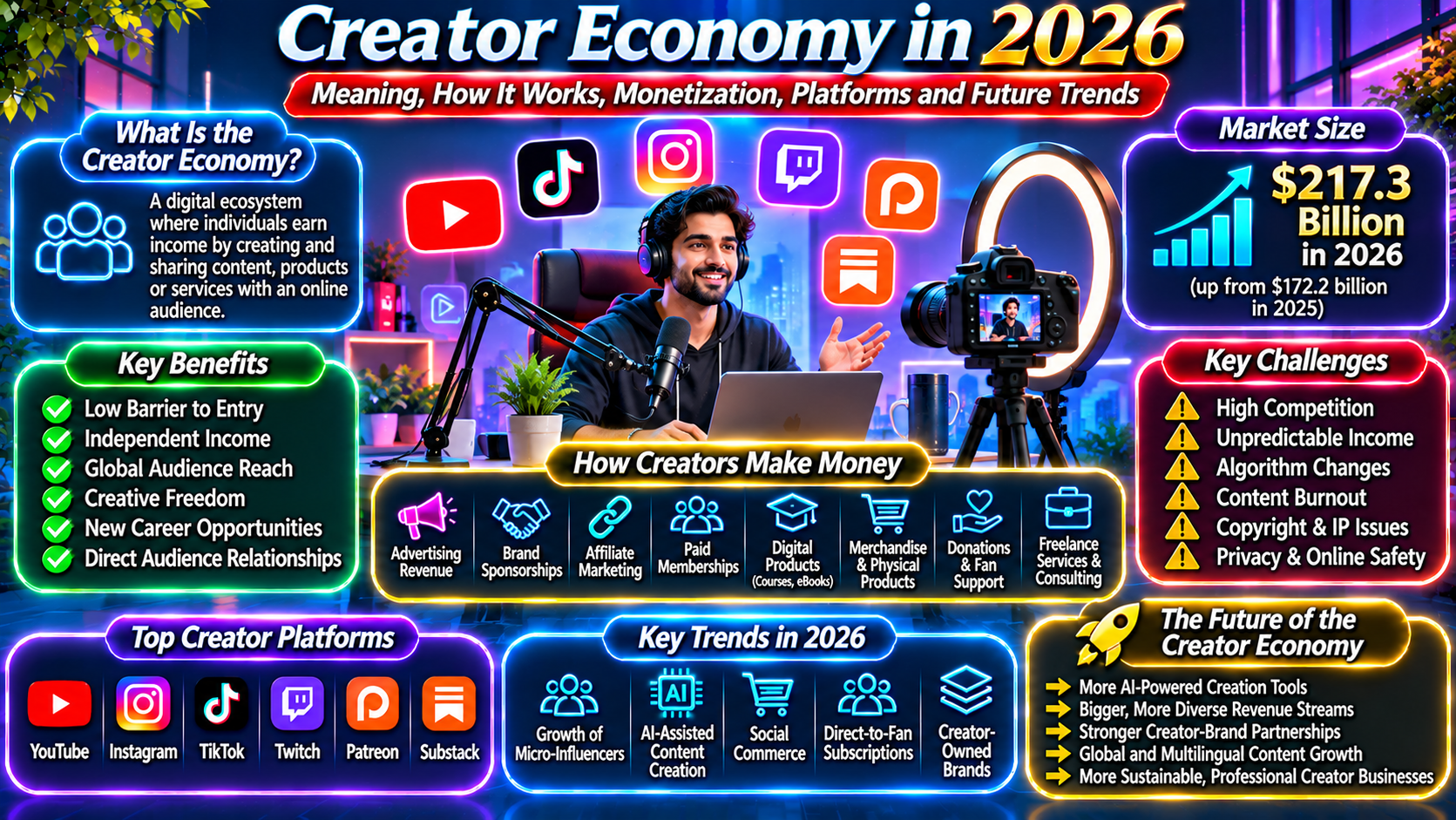
The creator economy is an online ecosystem in which independent creators earn income by producing and sharing content, products, services, or experiences with an audience.
Creators use digital platforms to publish material, develop communities, promote products, and generate revenue. Their content can include videos, photographs, articles, podcasts, livestreams, tutorials, newsletters, digital artwork, and educational resources.
Unlike traditional media, where large companies often control production and distribution, the creator economy gives individuals more direct opportunities to reach audiences and build their own businesses.
For example:
A YouTuber can earn money through advertising and sponsorships.
A TikTok creator can collaborate with brands and promote products.
A blogger can generate income through affiliate links and advertising.
An online educator can sell courses and learning materials.
A podcaster can earn through sponsorships and paid subscriptions.
A digital artist can sell illustrations, templates, and creative assets.
The central idea is simple: creators turn their skills, ideas, expertise, or entertainment into valuable content and business opportunities.
2. How Does the Creator Economy Work?
The creator economy connects four main groups: creators, audiences, digital platforms, and businesses.
Creators produce content: They create videos, posts, podcasts, articles, tutorials, entertainment, or other digital products.
Platforms distribute content: Services such as YouTube, Instagram, TikTok, and podcast platforms help creators reach audiences.
Audiences engage: Viewers watch, comment, share, subscribe, follow, and sometimes purchase products or services.
Businesses invest: Brands pay creators to promote products, produce sponsored content, or reach specific customer groups.
Creators earn revenue: Income comes from advertising, sponsorships, subscriptions, affiliate commissions, merchandise, and direct sales.
The ecosystem also includes video editors, designers, talent managers, marketing agencies, analytics providers, payment services, and software companies that support creators.
3. Creator Economy Market Size in 2026
The creator economy has developed into a significant global business sector. Its growth is driven by increasing digital content consumption, influencer marketing, online communities, social commerce, and the expansion of independent digital businesses.
A 2026 report by Paris Creator Week, sponsored by BNP Paribas and Influential, estimates the broader global creator economy at $217.3 billion in 2026, compared with a restated $172.2 billion in 2025. This estimate includes advertiser-funded activity, subscriptions and direct payments, and merchandise. It is a modeled market estimate, not a measurement of money earned by creators alone.
BNP Paribas+1
Another important development is the growing role of smaller creators. EMARKETER forecasts that micro- and nano-influencers will account for 45.5% of influencer marketing spending in 2026, showing that brands are increasingly interested in niche audiences and focused communities.
EMARKETER
These figures suggest that the creator economy is expanding beyond celebrity influencers. Educators, niche experts, independent publishers, entertainers, and small digital businesses are all part of this changing market.
4. Main Types of Content Creators
The creator economy includes many different types of creators. Each category serves a different audience and can use different ways to earn income.
4.1 Video Creators
Video creators publish long-form and short-form videos on platforms such as YouTube, TikTok, and Instagram. Their content may include entertainment, tutorials, product reviews, educational lessons, travel videos, and lifestyle content.
4.2 Social Media Influencers
Influencers build communities on social networks and influence audience interests, product discovery, and purchasing decisions. They often collaborate with companies through sponsored posts, product reviews, and brand campaigns.
4.3 Bloggers and Digital Publishers
Bloggers publish articles, guides, reviews, tutorials, and industry updates. They can monetize their websites through display advertising, sponsored articles, affiliate marketing, subscriptions, and digital products.
4.4 Podcasters
Podcasters create audio or video discussions, interviews, educational programs, and entertainment shows. Their revenue can come from sponsorships, advertising, memberships, and premium episodes.
4.5 Educators and Course Creators
Online educators share professional knowledge and practical skills through courses, workshops, tutorials, and learning communities. Popular subjects include technology, business, design, marketing, languages, and personal development.
4.6 Gamers and Live Streamers
Gaming creators broadcast gameplay, host live discussions, review games, and build communities around gaming interests. They may earn through subscriptions, donations, sponsorships, advertising, and merchandise.
4.7 Digital Artists and Designers
Digital artists create illustrations, animations, graphics, templates, fonts, photographs, and other creative assets. They can sell their work through marketplaces, personal websites, licensing agreements, and direct commissions.
5. How Do Content Creators Make Money?
One of the most important parts of the creator economy is monetization. Creators can earn through several business models rather than depending on one source of income.
5.1 Advertising Revenue
Advertising is a common monetization method. Platforms display advertisements around eligible creator content and may share part of the advertising revenue with creators who meet their requirements.
For example, YouTube creators can potentially earn through advertisements on eligible videos. Actual earnings depend on factors such as audience location, content category, watch time, advertiser demand, and platform rules.
5.2 Brand Sponsorships
Companies pay creators to feature products or services in videos, social media posts, podcasts, newsletters, or other content.
A technology creator might review a smartphone, while a beauty influencer could demonstrate skincare products. Sponsored content works best when the product is relevant to the creator's audience and the commercial relationship is clearly disclosed.
5.3 Affiliate Marketing
Affiliate marketing allows creators to earn commissions by recommending products or services through special tracking links.
When someone purchases through an eligible link, the creator may receive a commission. This approach is popular among bloggers, product reviewers, technology channels, and educational publishers.
5.4 Paid Memberships and Subscriptions
Creators can offer exclusive content, private communities, bonus videos, newsletters, or other benefits to paying members.
Memberships can provide recurring income and help creators build stronger relationships with their most engaged followers.
5.5 Selling Digital Products
Digital products allow creators to earn directly from their expertise and creative work. Examples include:
E-books and downloadable guides
Online courses and workshops
Graphic design templates
Photography presets
Website themes and digital resources
Business documents and planners
Educational worksheets
Digital products can be sold repeatedly without manufacturing or shipping physical inventory.
5.6 Merchandise and Physical Products
Some creators build product brands around their online communities. They may sell clothing, accessories, stationery, beauty products, artwork, or other merchandise.
A loyal audience can help creators introduce products, but successful merchandise businesses still require quality control, pricing, customer service, and fulfilment.
5.7 Donations and Fan Support
Some platforms allow audiences to support creators through tips, donations, gifts, and paid messages. This model is especially relevant to livestreamers, independent educators, musicians, and community-focused creators.
5.8 Freelance Services and Consulting
Creators can turn their skills into professional services. A marketing creator may offer social media consulting, while a designer may provide branding services or a technology educator may offer paid training.
6. Major Platforms Driving the Creator Economy
Different platforms offer different ways to publish content, reach audiences, and earn money.
YouTube
YouTube App Adds HDR Support for iPhone 12 - MacRumors
YouTube supports long-form videos, Shorts, livestreaming, memberships, and eligible advertising revenue. It is widely used for education, entertainment, reviews, and storytelling.
Duran — governed AI knowledge across channels
Instagram supports Reels, Stories, photographs, creator partnerships, and community engagement. It is especially relevant to lifestyle, fashion, beauty, travel, and visual storytelling.
TikTok
Relocate.to — Перше медіа для українців за кордоном
TikTok is known for short-form video discovery, trends, livestreaming, and creator-brand collaborations. Monetization features and eligibility vary by country.
Twitch
Free Icons to Download or Edit Online - PNG & SVG | Magnific (formerly Freepik)
Twitch focuses on livestreaming, gaming, interactive communities, subscriptions, and viewer support.
Patreon
File:Patreon logo.svg - Wikimedia Commons
Patreon helps creators offer paid memberships, exclusive material, and community benefits.
Substack
Substack enables writers, journalists, and independent publishers to distribute newsletters and offer paid subscriptions.
Creators should choose platforms according to their content format, audience, location, monetization eligibility, and business goals. A creator does not need to use every platform to build a successful business.
7. The Role of Artificial Intelligence in the Creator Economy
Artificial intelligence is changing how creators plan, produce, edit, and distribute content. AI tools can reduce repetitive work and help independent creators manage tasks that previously required larger teams.
Common applications include:
Content ideas: AI can help brainstorm topics, headlines, and video concepts.
Writing assistance: Tools can help create outlines, captions, scripts, and article drafts.
Video editing: AI-powered tools can assist with subtitles, background removal, scene selection, and editing.
Image generation: Creators can produce original visual concepts, illustrations, and design assets.
Voice and audio tools: AI can support transcription, audio cleanup, and voice production.
Audience analysis: Analytics tools can help identify content performance patterns and audience interests.
Translation: AI can help adapt content for different languages and regions.
AI can make content production faster, but it does not automatically create audience trust or originality. A creator's perspective, expertise, storytelling, and connection with viewers remain important.
A 2026 Epidemic Sound survey of 3,000 creators in the UK and US reported that 94% already used AI, while 75% said human-made content had become a premium. These findings come from that survey sample and should not be treated as universal statistics for every creator worldwide.
Epidemic Sound
8. Benefits of the Creator Economy
The creator economy offers opportunities to individuals, businesses, and audiences.
8.1 Low Barrier to Entry
People can begin creating content with a smartphone, an internet connection, and basic editing tools. Large studios and expensive equipment are not always necessary.
8.2 Independent Income Opportunities
Creators can develop different revenue streams instead of relying entirely on traditional employment.
8.3 Global Audience Reach
Digital platforms allow creators to reach viewers and customers across different countries and languages.
8.4 Creative Freedom
Creators can choose their subjects, formats, styles, and communities. They can develop content around personal interests and professional expertise.
8.5 Opportunities for Small Businesses
Small companies can collaborate with niche creators to reach relevant audiences without depending entirely on large advertising campaigns.
8.6 Growth of New Careers
The creator economy has increased demand for video editors, social media managers, content strategists, designers, virtual assistants, talent managers, and digital marketing specialists.
8.7 Direct Audience Relationships
Subscriptions, newsletters, websites, and private communities can help creators build relationships beyond public social media feeds.
9. Challenges Facing the Creator Economy
Although the creator economy offers significant opportunities, it also comes with financial, technical, and professional challenges.
9.1 High Competition
Millions of people publish online content. New creators must develop distinctive ideas and provide consistent value to attract attention.
9.2 Unpredictable Income
Advertising rates, sponsorship opportunities, audience spending, and platform policies can change. Many creators experience irregular monthly earnings.
9.3 Algorithm Changes
A platform can change its recommendation system, affecting the number of people who see a creator's content. Depending entirely on one platform can therefore be risky.
9.4 Content Burnout
The pressure to publish regularly, respond to audiences, follow trends, and maintain multiple accounts can lead to exhaustion.
9.5 Copyright and Intellectual Property
Creators must understand the rights associated with music, photographs, video clips, artwork, and other materials. Unauthorized use can lead to copyright claims or legal disputes.
9.6 Privacy and Online Safety
Public creators may face harassment, impersonation, scams, account theft, and unwanted exposure of personal information.
9.7 Unequal Revenue Distribution
A large audience does not guarantee a stable income. Revenue opportunities can be concentrated among a smaller number of highly visible creators, while many smaller creators struggle to earn consistently.
9.8 AI-Generated Content and Trust
AI makes it easier to produce large amounts of content, but inaccurate information, imitation, undisclosed synthetic media, and unclear ownership can damage audience trust.
10. Creator Economy Trends in 2026
Several developments are influencing the direction of the creator economy in 2026.
10.1 AI-Assisted Content Production
Creators are increasingly using AI for research, editing, ideation, translation, and production support. The strongest approach is to use AI to improve efficiency while retaining human judgment and creative direction.
10.2 Growth of Micro-Influencers
Micro-influencers often serve focused communities. Their smaller audiences can be valuable to brands looking for relevant engagement rather than simply the largest possible follower count.
10.3 Direct-to-Fan Business Models
Creators are developing paid communities, memberships, newsletters, and exclusive content. These models can create a closer relationship between creators and their most engaged supporters.
10.4 Short-Form Video
Short-form video remains an important discovery format. Creators use short clips to introduce ideas, share entertainment, promote products, and direct viewers toward longer content or other offerings.
10.5 Social Commerce
Social commerce connects content discovery with shopping. Product demonstrations, livestream shopping, affiliate links, and creator-led recommendations can help audiences discover products within digital platforms.
10.6 Creator-Owned Brands
Some creators are moving beyond sponsorships by launching their own products, services, and digital businesses. This can give them more control over branding, customer relationships, and revenue.
10.7 Multilingual and Local Content
Creators are reaching new audiences by publishing in regional languages and adapting content to local cultures. This creates opportunities for creators who understand specific communities and markets.
10.8 Intellectual Property Protection
As AI-generated content becomes more common, ownership, licensing, attribution, and permission are becoming increasingly important. Creators need to protect original work and understand how their content may be used.
11. How to Start a Creator Business in 2026
Starting a creator business does not require millions of followers or a large investment. A clear niche, consistent content, and a practical monetization strategy are more important.
Here is a step-by-step approach.
Step 1: Choose a Profitable Niche
Select a topic that combines your interests, skills, and audience demand.
Popular niches include:
Technology and artificial intelligence
Business and entrepreneurship
Beauty and skincare
Fashion and lifestyle
Education and tutorials
Gaming and entertainment
Food and cooking
Travel and tourism
Personal finance
Digital marketing
A focused niche makes it easier to attract an audience interested in your content.
Step 2: Select Your Main Platform
Choose a platform that matches your content format.
Content type | Suitable platform |
|---|---|
Long-form videos | YouTube |
Short-form videos | TikTok, Instagram Reels, YouTube Shorts |
Articles and blogs | WordPress, Medium |
Newsletters | Substack |
Livestreaming | Twitch, YouTube |
Paid communities | Patreon and membership platforms |
Start with one primary platform and expand when you can manage the additional workload.
Step 3: Develop Your Brand Identity
A professional creator brand should have a recognizable name, profile image, visual style, and content theme.
Consider creating:
A memorable creator name
A professional profile picture or logo
A consistent color palette
A short biography explaining your content
A recognizable editing and storytelling style
Your identity should help people understand what your content offers.
Step 4: Create a Content Strategy
Plan content around your audience's interests rather than publishing randomly.
For example, a technology creator might publish:
AI tool tutorials
Technology news and updates
Software comparisons
Smartphone reviews
Digital productivity tips
Business technology explainers
Use a content calendar to organize topics, publishing dates, and formats.
Step 5: Publish Consistently
Consistency helps audiences understand what to expect. However, publishing quality content is more valuable than uploading large amounts of repetitive material.
Monitor views, watch time, engagement, audience retention, website visits, and conversions to understand what works.
Step 6: Build Multiple Revenue Streams
Do not depend entirely on platform advertising. As your audience grows, consider adding sponsorships, affiliate marketing, memberships, digital products, and professional services.
Step 7: Build an Audience You Can Reach Directly
Social media followers are valuable, but creators should also consider building an email newsletter, website, or community.
These channels provide additional ways to communicate with audiences if a social platform changes its algorithm or policies.
12. Opportunities in the Creator Economy in Pakistan
Pakistan has opportunities for creators across entertainment, education, technology, fashion, food, and digital entrepreneurship.
With access to smartphones and online platforms, individuals can create content for both local and international audiences.
Some promising opportunities include:
Urdu and Punjabi entertainment: Comedy, storytelling, cultural content, and short-form videos can appeal to regional audiences.
Educational content: Teachers and professionals can publish tutorials about technology, languages, business, and academic subjects.
Technology and AI: Creators can explain AI tools, software, digital marketing, cybersecurity, and online business opportunities.
Beauty and fashion: Makeup tutorials, clothing ideas, skincare education, and product reviews can attract niche audiences.
Food content: Recipes, restaurant reviews, traditional cuisine, and cooking videos provide opportunities for video creators.
Freelancing and digital services: Skilled creators can earn through video editing, graphic design, content writing, social media management, and consulting.
However, creators should check platform-specific monetization eligibility, supported countries, payment methods, and local tax requirements before building a business around a particular revenue stream.
13. How Brands Benefit from the Creator Economy
The creator economy is not only valuable to individuals. Businesses also use creator partnerships to promote products, increase brand awareness, and develop stronger customer relationships.
Some major benefits for businesses include:
Targeted marketing: Brands can work with creators who already reach their ideal customers.
Authentic storytelling: Creators can demonstrate products in a relatable way.
Product discovery: Reviews and tutorials introduce products to new audiences.
Community engagement: Creators can communicate with audiences that brands may find difficult to reach directly.
Content production: Companies can use creator-produced material in eligible marketing campaigns.
Performance measurement: Brands can monitor engagement, clicks, conversions, and sales.
Companies should select creators based on audience relevance, content quality, credibility, and campaign objectives—not follower count alone.
14. The Future of the Creator Economy
The creator economy is likely to become more business-oriented as creators develop independent brands, products, communities, and professional services.
Artificial intelligence will continue to influence production, editing, and distribution. At the same time, audiences may place greater value on original ideas, genuine expertise, personal experiences, and trustworthy recommendations.
Creators who combine creativity with business skills may have an advantage. Understanding analytics, financial planning, intellectual property, marketing, and audience development will become increasingly important.
The future may also bring more creator-led media companies, specialized digital marketplaces, paid communities, and partnerships between independent creators and established businesses.
Ultimately, the creator economy is moving from a model focused mainly on gaining followers toward one focused on building sustainable creative businesses.
15. Frequently Asked Questions (FAQs)
What is the creator economy in simple words?
The creator economy is a system in which individuals earn money by creating digital content, building audiences, promoting products, selling services, or offering exclusive experiences online.
How do creators make money?
Creators earn through advertising, brand sponsorships, affiliate marketing, subscriptions, memberships, donations, merchandise, digital products, and professional services.
Is the creator economy growing in 2026?
Yes. A Paris Creator Week report estimates that the broader global creator economy will reach $217.3 billion in 2026. This is a modeled estimate that includes several creator-related revenue categories.
BNP Paribas+1
Which platforms are best for content creators?
YouTube, TikTok, Instagram, Twitch, Patreon, and Substack are among the platforms used by creators. The best option depends on content format, audience, location, and monetization goals.
Can beginners earn money from the creator economy?
Yes. Beginners can start with a focused niche and gradually build an audience. However, earning income takes time and is not guaranteed. Consistency, content quality, and a suitable monetization strategy are important.
Can AI help content creators?
Yes. AI can assist with writing, research, editing, subtitles, translation, image generation, and content planning. Creators should review AI-generated material for accuracy, originality, and rights compliance.
What is the difference between the creator economy and influencer marketing?
The creator economy is the broader industry involving creators, platforms, audiences, brands, tools, and services. Influencer marketing is one part of this industry in which businesses collaborate with creators to promote products or services.
Is the creator economy a good career option?
It can become a career for people who develop valuable skills, build an audience, and establish reliable revenue streams. However, income can be unpredictable, so financial planning and diversification are important.
What is a micro-influencer?
A micro-influencer is a creator with a relatively small, focused audience. Brands may work with micro-influencers because their content can reach specific communities and interest groups.
What is the future of the creator economy?
Its future will likely involve AI-assisted production, direct-to-fan subscriptions, creator-owned businesses, social commerce, multilingual content, and stronger intellectual property protection.
Conclusion
The creator economy is changing how people work, communicate, and earn money in the digital world. It has opened opportunities for individuals to transform their creativity, knowledge, and expertise into independent businesses.
In 2026, successful creators are increasingly thinking beyond followers and viral content. They are building recognizable brands, developing loyal communities, diversifying revenue, and creating products and services that provide lasting value.
Although competition, changing algorithms, inconsistent income, and copyright concerns remain important challenges, the creator economy continues to offer opportunities for individuals and businesses willing to adapt.
The most sustainable approach is to combine original content, audience trust, smart technology, and a clear business strategy.