Japan is one of the world's largest and most technologically advanced economies. Known for its automobile manufacturers, electronics companies, luxury retail brands, advanced machinery, and financial institutions, the country has produced some of the most successful entrepreneurs and business leaders in the world.
From technology investor Masayoshi Son to fashion entrepreneur Tadashi Yanai, Japan's wealthiest individuals have built international business empires that influence global markets. Their companies operate across industries such as artificial intelligence, telecommunications, retail, manufacturing, electronics, gaming, construction, and real estate.
In 2026, Japan's billionaire community experienced remarkable wealth growth, supported by a strong stock market and increasing international demand for artificial intelligence-related technologies.
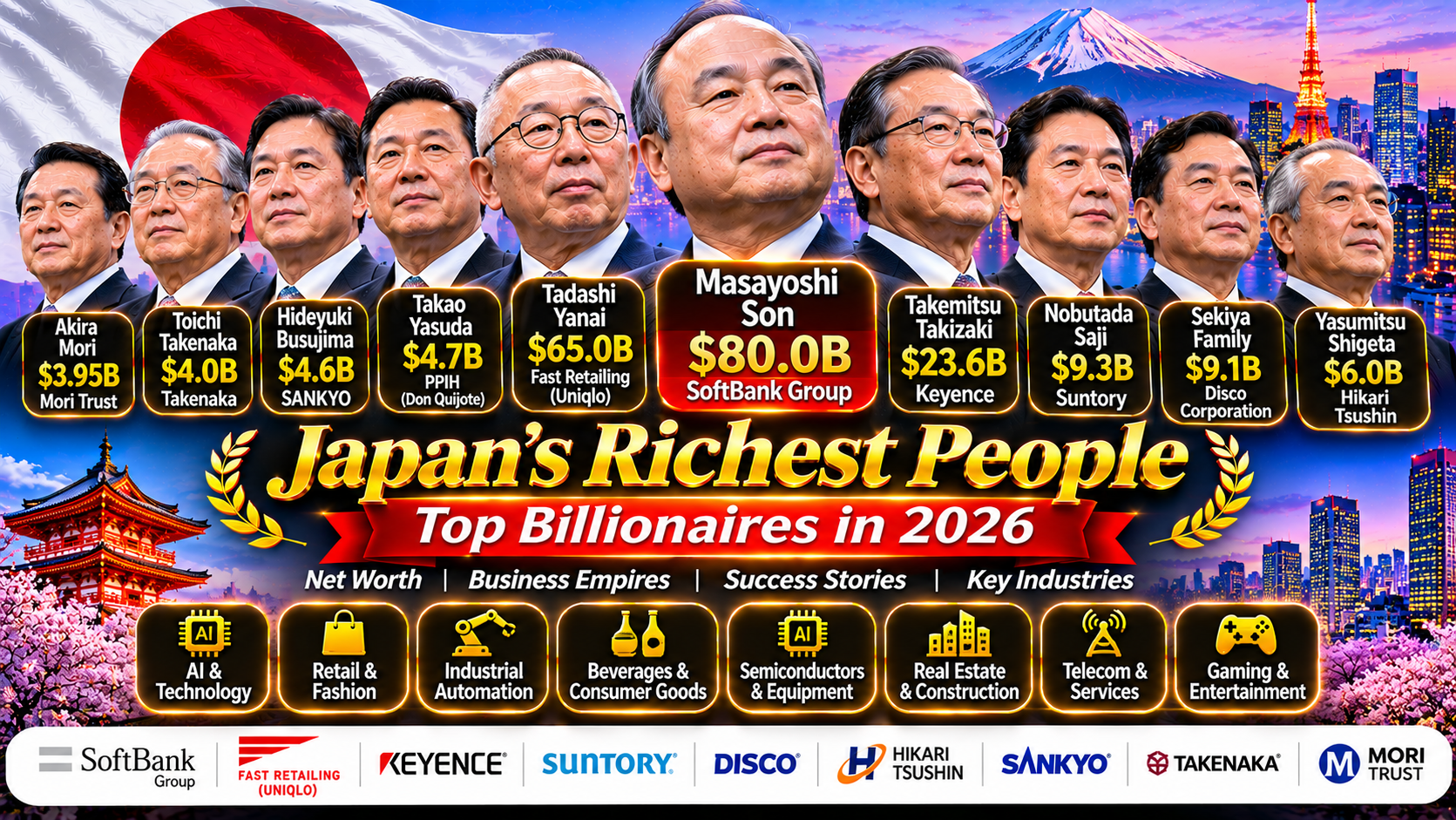
According to Forbes' June 2026 ranking of Japan's 50 Richest, Masayoshi Son reclaimed the position of Japan's richest person with an estimated net worth of $80 billion. His fortune increased substantially following SoftBank Group's investments in artificial intelligence and its multibillion-dollar investment in OpenAI.
Tadashi Yanai, the founder of Uniqlo's parent company Fast Retailing, secured second place with an estimated fortune of $65 billion. Takemitsu Takizaki, the founder of Keyence, ranked third with $23.6 billion.
The combined wealth of Japan's 50 richest people increased by approximately 29%, reaching $294 billion in 2026 compared with $228 billion in 2025.
The global AI investment boom, rising technology valuations, and strong stock-market performance contributed to this increase. However, the weaker Japanese yen affected the dollar value of several fortunes.
This article explores Japan's richest people in 2026, their estimated net worth, major companies, entrepreneurial journeys, and the industries behind their success.
Top 10 Richest People in Japan in 2026
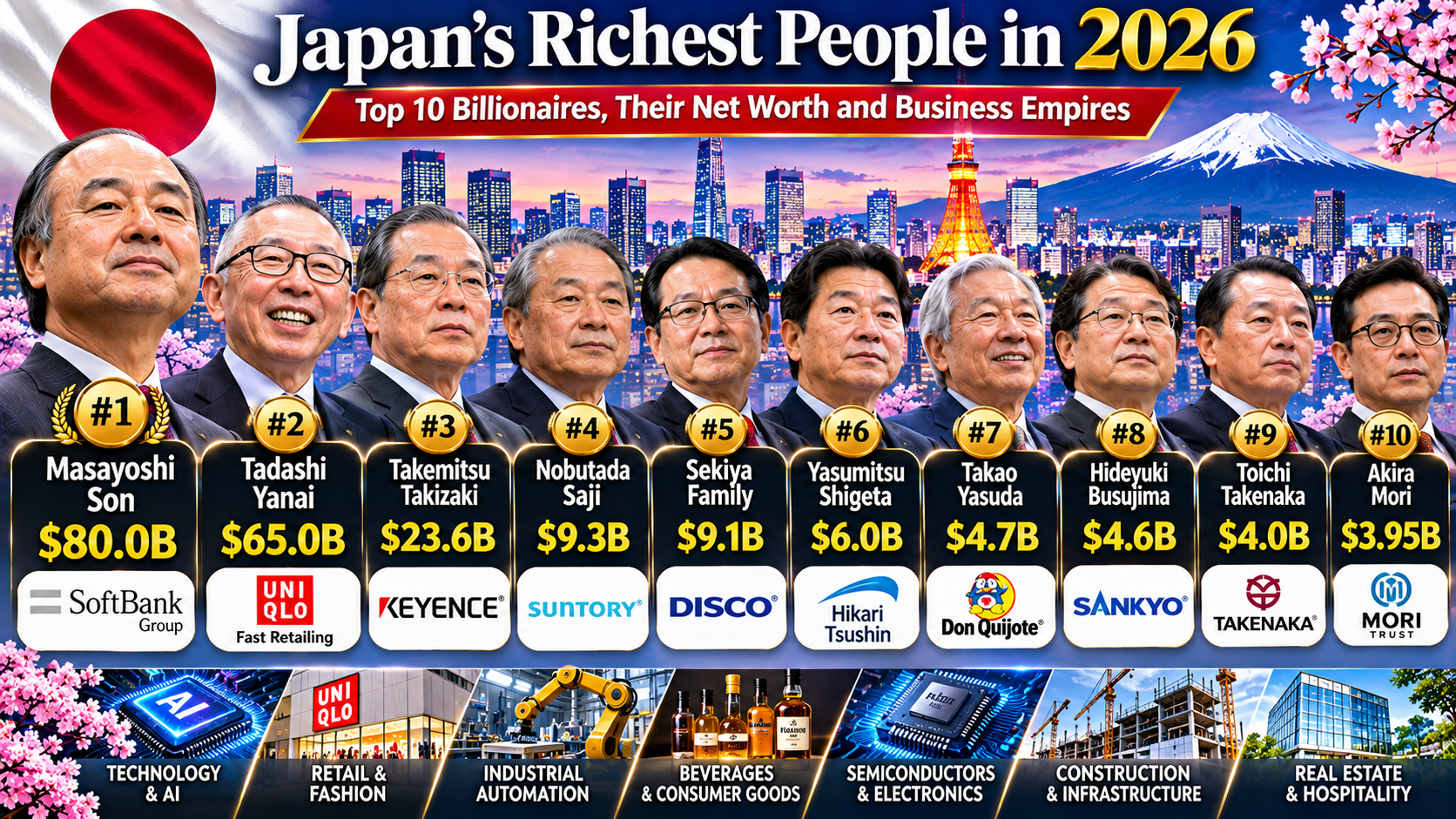
According to Forbes' June 2026 annual ranking, the top 10 wealthiest individuals and families are:
Rank | Name | Estimated Net Worth |
|---|---|---|
1 | Masayoshi Son | $80 billion |
2 | Tadashi Yanai | $65 billion |
3 | Takemitsu Takizaki | $23.6 billion |
4 | Nobutada Saji | $9.3 billion |
5 | Sekiya Family | $9.1 billion |
6 | Yasumitsu Shigeta | $6 billion |
7 | Takao Yasuda | $4.7 billion |
8 | Hideyuki Busujima | $4.6 billion |
9 | Toichi Takenaka | $4 billion |
10 | Akira Mori | $3.95 billion |
Net worth figures are estimates in US dollars. Family fortunes are combined where applicable.
1. Masayoshi Son – Japan's Richest Person
Estimated Net Worth: $80 Billion
Main Sources of Wealth: Technology, Artificial Intelligence, Telecommunications, and Investments
Masayoshi Son is Japan's richest person in 2026 and one of the most influential technology investors in the world.
He is the founder and chairman of SoftBank Group, an international investment and technology company with business interests across telecommunications, artificial intelligence, digital infrastructure, and emerging technologies.
Born in Japan in 1957, Son developed an interest in entrepreneurship and technology at an early age. He studied in the United States before returning to Japan and establishing SoftBank in 1981.
The company initially focused on software distribution and technology-related businesses. Over time, it expanded into telecommunications, internet services, and international investments.
One of the most important developments in Son's career was SoftBank's expansion into global technology investment.
The company became internationally recognized for its investments in technology startups and high-growth businesses through its Vision Fund.
SoftBank has invested in businesses operating across artificial intelligence, robotics, e-commerce, transportation, cloud computing, and digital services.
Masayoshi Son has also become one of the most prominent supporters of artificial intelligence development.
In 2026, his wealth increased dramatically following SoftBank's multibillion-dollar investment in OpenAI, the company behind ChatGPT.
SoftBank reported a record net profit of approximately ¥5 trillion for the financial year ended March 31, 2026.
According to Forbes, Son's estimated net worth increased by $51.8 billion, or 184%, reaching $80 billion.
This increase helped him reclaim the top position on Japan's rich list for the first time since 2021.
His business strategy demonstrates the importance of identifying emerging technologies and investing in companies with long-term growth potential.
As artificial intelligence continues transforming global industries, Son remains closely connected to one of the most significant investment trends of the decade.
2. Tadashi Yanai – Founder of Uniqlo and Fast Retailing
Estimated Net Worth: $65 Billion
Main Source of Wealth: Fashion, Retail, and Clothing Manufacturing
Tadashi Yanai is one of Japan's most successful entrepreneurs and the founder of Fast Retailing, the parent company of the internationally recognized Uniqlo clothing brand.
He built his fortune by transforming a Japanese clothing business into a global retail company.
Yanai was born in Yamaguchi Prefecture, Japan, in 1949. He became involved in his family's clothing business before expanding its operations and developing a larger retail strategy.
Uniqlo became known for affordable, functional, and comfortable clothing designed for everyday use.
Unlike luxury fashion brands that focus on exclusive designs and premium pricing, Uniqlo developed a business model centered on practical clothing, consistent quality, and accessible prices.
The company introduced innovative fabric technologies and developed products designed for different weather conditions and lifestyles.
Its popular clothing collections include HEATTECH, AIRism, and other functional apparel lines.
Fast Retailing expanded beyond Japan and established stores across major international markets, including the United States, China, South Korea, Europe, and Southeast Asia.
The company has become one of the world's largest fashion retailers.
In 2026, Yanai ranked second on Japan's richest list with an estimated net worth of $65 billion.
His wealth increased by more than one-third compared with the previous year's ranking, supported by growth in Fast Retailing's revenue and net profit.
Although he lost the number-one position to Masayoshi Son, he remains one of the most successful retail entrepreneurs in the world.
His business career demonstrates how a company focused on quality, innovation, affordability, and international expansion can develop into a global brand.
3. Takemitsu Takizaki – Founder of Keyence
Estimated Net Worth: $23.6 Billion
Main Source of Wealth: Industrial Automation and Technology
Takemitsu Takizaki is the founder of Keyence Corporation, a Japanese technology company specializing in industrial automation, sensors, measurement equipment, and machine vision systems.
His business success is closely connected to the development of advanced manufacturing technologies.
Modern factories depend on automated equipment to improve production efficiency, reduce errors, and maintain product quality.
Keyence supplies technologies that help manufacturers monitor production processes, measure components, identify defects, and automate industrial operations.
Its products are used in industries such as automotive manufacturing, electronics, pharmaceuticals, food processing, and semiconductor production.
The company's product portfolio includes sensors, microscopes, barcode readers, laser measurement systems, and machine vision equipment.
Keyence has established an international presence by supplying advanced industrial technologies to manufacturers worldwide.
The increasing use of robotics and automation has created opportunities for companies providing precision measurement and inspection systems.
Takemitsu Takizaki's fortune is closely connected to his ownership interest in Keyence.
According to Forbes' 2026 ranking, he held third place with an estimated net worth of $23.6 billion.
His wealth increased by approximately $2.9 billion compared with the previous year.
His career demonstrates how specialized industrial technology can create significant international business value.
4. Nobutada Saji – The Suntory Business Leader
Estimated Net Worth: $9.3 Billion
Main Source of Wealth: Beverages, Food, and Consumer Products
Nobutada Saji is associated with Suntory Holdings, one of Japan's most recognized beverage and consumer products companies.
Suntory has a long history in the Japanese beverage industry and is internationally recognized for its whisky, alcoholic beverages, soft drinks, and other consumer products.
The company was founded in 1899 by Shinjiro Torii as a wine business before expanding into other beverage categories.
Over the decades, Suntory developed a strong presence in both domestic and international markets.
Its portfolio includes Japanese whisky brands, bottled water, soft drinks, and other beverage products.
Suntory expanded internationally through acquisitions and investments, including the acquisition of Beam Inc. in 2014.
This acquisition strengthened its position in the global spirits market and expanded its international brand portfolio.
Nobutada Saji previously served as the company's chairman and has been an important figure in its business development.
Forbes estimated his net worth at approximately $9.3 billion in 2026, placing him fourth among Japan's wealthiest people.
His fortune declined compared with the previous year's estimate, reflecting changes in business valuations and financial market conditions.
The Suntory business story demonstrates how a traditional Japanese consumer brand can develop into a major international company.
5. The Sekiya Family – The Semiconductor Equipment Business
Combined Estimated Net Worth: $9.1 Billion
Main Source of Wealth: Semiconductor Manufacturing Equipment
The Sekiya family is associated with Disco Corporation, a Japanese company specializing in precision equipment used in semiconductor manufacturing.
The semiconductor industry has become one of the most important sectors in the global economy.
Modern electronics, artificial intelligence processors, smartphones, computers, electric vehicles, and data centers all depend on advanced semiconductor components.
Disco produces specialized equipment used in cutting, grinding, and polishing semiconductor wafers.
These processes are essential for preparing semiconductor materials and manufacturing high-precision electronic components.
As chip designs become increasingly advanced, semiconductor manufacturers require sophisticated equipment capable of delivering precision and efficiency.
Disco has developed a strong international customer base and plays an important role in the semiconductor supply chain.
The global AI boom has increased demand for advanced chips and semiconductor production technologies.
This trend has contributed to the company's strong stock-market performance.
According to Forbes, the Sekiya family's combined fortune reached approximately $9.1 billion in 2026.
Their wealth increased by around $4.1 billion compared with the previous year, allowing them to rise three positions in the ranking.
Their business success illustrates how companies producing specialized manufacturing equipment can benefit from technological developments taking place across the world.
6. Yasumitsu Shigeta – Founder of Hikari Tsushin
Estimated Net Worth: $6 Billion
Main Source of Wealth: Telecommunications and Investments
Yasumitsu Shigeta is a Japanese entrepreneur and the founder of Hikari Tsushin, a company with interests in telecommunications, business services, and investment activities.
Hikari Tsushin initially became known for its telecommunications distribution operations.
Over time, it expanded into a broader business group offering communication services, office equipment, insurance products, and other business-related solutions.
The company also developed an investment portfolio involving publicly traded businesses and other financial assets.
Its business model combines operating companies with long-term investment activities.
Telecommunications has played an important role in Japan's economic development because businesses and consumers depend on reliable communication services.
Although the industry has changed significantly with the expansion of smartphones, broadband networks, and digital platforms, telecommunications-related services remain important.
Shigeta's estimated fortune reached $6 billion in Forbes' 2026 ranking.
He secured sixth place among Japan's wealthiest individuals.
His career demonstrates how entrepreneurship, financial investments, and business diversification can create substantial wealth.
7. Takao Yasuda – Founder of Don Quijote
Estimated Net Worth: $4.7 Billion
Main Source of Wealth: Retail and Consumer Goods
Takao Yasuda is the founder of Don Quijote, a popular Japanese discount retail chain.
The business is operated by Pan Pacific International Holdings, which has developed a large retail presence in Japan and other international markets.
Don Quijote is known for its wide selection of consumer products, competitive pricing, and distinctive shopping experience.
Its stores sell groceries, electronics, cosmetics, clothing, household goods, toys, and many other products.
The company's retail strategy focuses on providing customers with a large variety of products in convenient locations.
Over time, Don Quijote expanded beyond Japan into international markets, including the United States and Southeast Asia.
The company has also developed other retail formats and strengthened its online presence.
The retail industry remains an important part of Japan's economy because it connects manufacturers and distributors with millions of consumers.
Takao Yasuda's estimated net worth reached $4.7 billion in Forbes' 2026 ranking.
His entrepreneurial journey demonstrates how a distinctive retail concept can develop into a successful international business.
8. Hideyuki Busujima – The SANKYO Gaming Equipment Fortune
Estimated Net Worth: $4.6 Billion
Main Source of Wealth: Gaming and Entertainment Equipment
Hideyuki Busujima is associated with SANKYO, a Japanese manufacturer specializing in pachinko machines and related entertainment equipment.
Pachinko is a popular form of mechanical gaming entertainment in Japan.
The industry has developed into a major part of the country's entertainment market, with specialized machines and venues serving millions of customers.
SANKYO produces pachinko machines and other gaming equipment used by entertainment operators.
The company invests in product design, technology, graphics, and entertainment features to maintain customer interest.
Its products combine mechanical systems with digital technology, creating interactive gaming experiences.
Hideyuki Busujima's wealth is connected to his ownership interests in the company and its business performance.
Forbes estimated his net worth at approximately $4.6 billion in 2026, placing him eighth among Japan's richest people.
His position demonstrates the financial value of specialized entertainment manufacturing businesses.
9. Toichi Takenaka – The Takenaka Corporation Family Fortune
Estimated Net Worth: $4 Billion
Main Source of Wealth: Construction and Infrastructure
Toichi Takenaka is associated with Takenaka Corporation, one of Japan's major construction and engineering companies.
The company has a long history dating back to 1610, when it began as a carpentry business.
Over several centuries, it developed into a major construction organization involved in commercial buildings, infrastructure, industrial facilities, and architectural projects.
Japan is internationally recognized for its engineering capabilities, advanced construction methods, and earthquake-resistant building technologies.
Construction companies play an essential role in developing transportation systems, office buildings, factories, hospitals, and public infrastructure.
Takenaka Corporation has contributed to numerous major construction projects in Japan and international markets.
Its work includes commercial properties, cultural facilities, industrial buildings, and large architectural developments.
Toichi Takenaka's estimated fortune reached approximately $4 billion in Forbes' 2026 ranking.
He secured ninth place, representing a significant rise from his previous position.
His business legacy demonstrates the importance of engineering expertise, craftsmanship, and long-term investment in construction and infrastructure.
10. Akira Mori – The Real Estate Billionaire Behind Mori Trust
Estimated Net Worth: $3.95 Billion
Main Source of Wealth: Real Estate and Property Investment
Akira Mori is one of Japan's prominent real estate entrepreneurs and a leading figure associated with Mori Trust.
The company has developed a substantial portfolio of commercial buildings, hotels, offices, and investment properties.
Real estate has historically been an important source of wealth in Japan, particularly in major cities such as Tokyo and Osaka.
Large commercial developments provide office spaces, hotels, shopping facilities, and other services required by businesses and international visitors.
Mori Trust has developed major properties and hospitality projects in Japan.
Its strategy focuses on property development, asset management, and long-term real estate investment.
The company has also participated in hospitality developments aimed at attracting international visitors.
Japan's tourism industry has created opportunities for hotel owners and property developers as international travel demand has increased.
Akira Mori's estimated fortune reached $3.95 billion in Forbes' 2026 ranking.
His business success demonstrates how real estate investment and commercial property development can create substantial long-term wealth.
Other Notable Japanese Billionaires
Beyond the top 10, Japan has many other successful entrepreneurs and wealthy business families.
Takahisa Takahara
Takahisa Takahara is associated with Unicharm, a major Japanese manufacturer of personal care and hygiene products.
The company produces diapers, feminine care products, healthcare items, and other consumer goods.
Its international operations have helped establish it as an important participant in the global personal care industry.
Hiroshi Mikitani
Hiroshi Mikitani is the founder of Rakuten Group, one of Japan's major technology and e-commerce companies.
Rakuten operates across online shopping, financial technology, digital services, telecommunications, and international investments.
His business career demonstrates the growth potential of digital commerce and financial technology.
Akio Nitori
Akio Nitori is the founder of Nitori Holdings, a major Japanese furniture and home furnishings retailer.
The company sells furniture, household accessories, bedding, and interior products.
Its affordable pricing and extensive retail network have helped establish a strong position in Japan's home furnishings market.
Masakazu Idemitsu
Masakazu Idemitsu is associated with Idemitsu Kosan, a major Japanese petroleum and energy company.
The company's operations include oil refining, fuel distribution, petrochemicals, and energy-related businesses.
He entered Forbes' 2026 list with a combined family fortune of approximately $1.15 billion.
Fumio Sakiya
Fumio Sakiya is the founder of Rorze, a company specializing in equipment used in semiconductor and flat-panel display manufacturing.
His business benefited from growing interest in semiconductor production technologies and increased demand for advanced manufacturing equipment.
He entered the 2026 ranking with an estimated fortune of $1.55 billion.
How Japan's Richest People Built Their Fortunes
Japan's wealthiest entrepreneurs have built their businesses across several important industries.
1. Technology and Artificial Intelligence
Technology has become one of the most important sources of wealth in Japan.
Companies involved in software, artificial intelligence, telecommunications, robotics, and digital infrastructure have attracted significant investment.
Masayoshi Son's SoftBank Group demonstrates how international technology investments can generate enormous financial returns.
The growing demand for AI infrastructure has also increased the importance of semiconductor equipment manufacturers and technology suppliers.
2. Fashion and Retail
Japan has developed internationally recognized consumer brands.
Tadashi Yanai's Uniqlo demonstrates how a domestic retail business can expand into a global clothing company.
Retail entrepreneurs have also benefited from changing consumer preferences, international expansion, and efficient distribution networks.
3. Industrial Automation
Japanese manufacturers are internationally recognized for precision engineering and industrial automation.
Companies such as Keyence provide specialized products that help factories improve productivity and manufacturing quality.
The expansion of robotics and smart manufacturing creates opportunities for industrial technology businesses.
4. Food and Beverage
Japan's beverage industry has produced internationally recognized companies.
Suntory has developed a strong international presence through its beverage products, acquisitions, and consumer brands.
Food and beverage businesses can build substantial wealth through brand recognition, distribution networks, and international market expansion.
5. Semiconductor Manufacturing
Semiconductors are essential components of modern electronic devices.
Japanese companies supply advanced materials, manufacturing equipment, and precision technologies used throughout the semiconductor supply chain.
The growth of AI has created additional demand for semiconductor production equipment.
6. Real Estate and Construction
Real estate and construction remain important sources of wealth in Japan.
Entrepreneurs have developed commercial properties, hotels, residential buildings, and infrastructure projects.
Japan's engineering expertise and international construction capabilities also create opportunities for major industrial groups.
Japan's Economy and the Billionaire Wealth Boom in 2026
Japan experienced a remarkable increase in billionaire wealth in 2026.
According to Forbes' June 2026 ranking, the combined fortune of Japan's 50 richest people reached $294 billion, compared with $228 billion in 2025.
This represented an increase of approximately 29%.
The country's benchmark Nikkei 225 stock index increased by nearly 70% between the previous wealth measurement periods.
The global artificial intelligence boom was an important factor behind this performance.
Investors showed increasing interest in businesses involved in AI infrastructure, semiconductors, robotics, and advanced technology.
Masayoshi Son was the largest wealth gainer, adding approximately $51.8 billion to his fortune.
Tadashi Yanai also experienced substantial growth, supported by Fast Retailing's financial performance.
However, not every billionaire benefited from the market rally. Forbes reported that 27 fortunes declined during the ranking period.
The Japanese yen's weakness also reduced the US-dollar value of some Japanese fortunes.
Forbes calculated its 2026 wealth estimates using stock prices and exchange rates as of May 22, 2026.
These figures demonstrate how stock-market performance, business results, currency movements, and international economic trends influence billionaire wealth.
Challenges Facing Japan's Wealthiest Business Leaders
Despite Japan's strong technology and industrial sectors, its wealthiest entrepreneurs face several challenges.
Global Economic Uncertainty
Changes in international trade, inflation, interest rates, and consumer demand can affect company revenues and investments.
Businesses with international operations must manage economic risks across multiple markets.
Currency Fluctuations
The Japanese yen's exchange rate influences the international value of business assets and personal fortunes.
A weaker yen can reduce the US-dollar value of wealth even when domestic assets remain unchanged in yen terms.
Technology Competition
Japanese companies face competition from businesses in the United States, China, South Korea, Taiwan, and other international markets.
Maintaining technological leadership requires continuous research and development.
Aging Population
Japan has an aging population and a declining birth rate.
These demographic changes can influence consumer spending, employment, healthcare demand, and long-term economic growth.
Energy and Manufacturing Costs
Manufacturing businesses depend on reliable energy supplies, raw materials, and international supply chains.
Changes in production costs can affect profitability and investment decisions.
What Is the Future of Japan's Billionaire Economy?
Japan has opportunities to create additional wealth through emerging technologies and industrial innovation.
Artificial intelligence, robotics, semiconductor manufacturing, renewable energy, healthcare technology, advanced materials, and digital services may contribute to future economic growth.
Technology investors are likely to remain interested in companies developing AI systems and the infrastructure required to operate them.
Manufacturing businesses may benefit from increasing demand for automation, precision equipment, and advanced electronic components.
Retail companies may continue expanding internationally as Japanese consumer brands attract customers in new markets.
The healthcare and medical technology industries could also create opportunities as Japan responds to its aging population.
Entrepreneurs who combine technological innovation, international investment, and efficient business operations may become part of Japan's next generation of billionaires.
Conclusion
Japan's richest people in 2026 represent a diverse group of technology investors, retail entrepreneurs, industrial leaders, and business families.
Masayoshi Son leads the Forbes ranking with an estimated net worth of $80 billion, followed by Tadashi Yanai with $65 billion and Takemitsu Takizaki with $23.6 billion.
Their businesses operate across artificial intelligence, fashion, telecommunications, industrial automation, food and beverages, semiconductor manufacturing, construction, and real estate.
The combined wealth of Japan's 50 richest people reached approximately $294 billion in 2026, supported by strong stock-market performance and growing demand for artificial intelligence-related technologies.
Although billionaire fortunes can fluctuate with market conditions, Japan continues to maintain an important position in the global business and technology landscape.
The success of its wealthiest entrepreneurs demonstrates the value of innovation, strategic investment, international expansion, and long-term business development.
Japan's billionaire economy is not simply a story about personal fortunes. It reflects the country's industrial achievements, international business relationships, and continuing role in shaping the global economy.