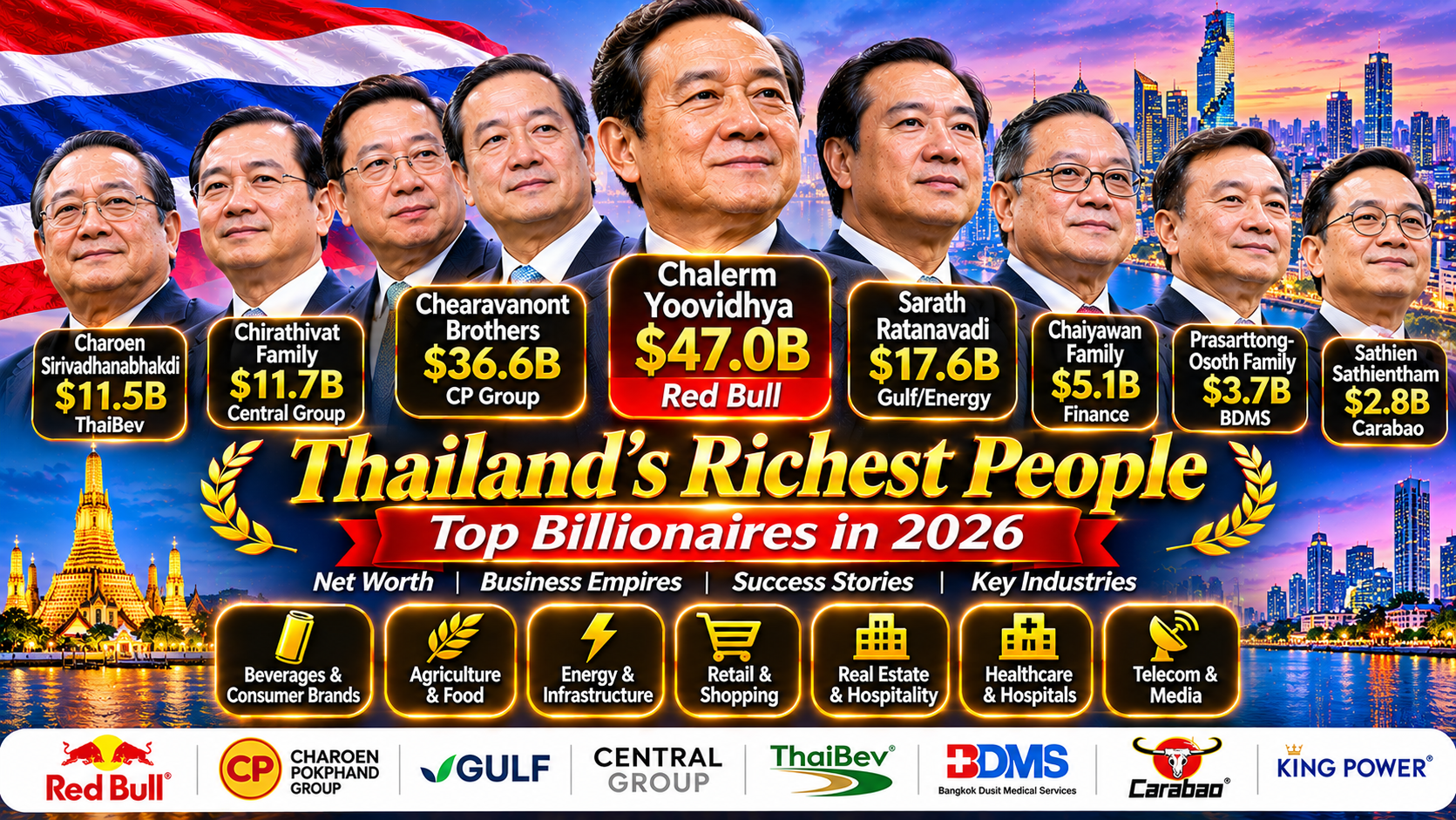
Thailand is home to some of Asia's most influential business families and entrepreneurs. From the global success of Red Bull to powerful conglomerates operating in telecommunications, energy, banking, retail, real estate, and food production, the country's wealthiest individuals have built business empires that extend far beyond its borders.
In 2026, Thailand's richest people represent a diverse range of industries. Some control internationally recognized consumer brands, while others have built fortunes through infrastructure, property development, financial investments, and telecommunications.
According to Forbes' Thailand's 50 Richest 2026 ranking, the combined wealth of the country's 50 richest individuals and families reached approximately $187 billion, representing a 10% increase from the previous year's $170.5 billion. Chalerm Yoovidhya and family retained the top position, followed by the Chearavanont brothers and energy and telecommunications entrepreneur Sarath Ratanavadi.
This article explores Thailand's richest people in 2026, their estimated fortunes, the companies behind their success, and the industries influencing Thailand's economic future.
Top 10 Richest People in Thailand in 2026
The following ranking is based on Forbes' annual Thailand's 50 Richest list, published in July 2026. It includes individual and family fortunes, so some positions represent extended business families rather than a single person.
Rank | Person or family | Estimated net worth | Main business |
|---|---|---|---|
1 | Chalerm Yoovidhya and family | $47 billion | Red Bull |
2 | Chearavanont brothers | $36.6 billion | Charoen Pokphand Group |
3 | Sarath Ratanavadi | $17.6 billion | Energy and telecommunications |
4 | Chirathivat family | $11.7 billion | Central Group and retail |
5 | Charoen Sirivadhanabhakdi | $11.5 billion | Beverages and real estate |
6 | Chaiyawan family | $5.1 billion | Finance and insurance |
7 | Prasarttong-Osoth family | $3.7 billion | Healthcare and hospitals |
8 | Sathien Sathientham | $2.8 billion | Energy drinks |
9 | Aiyawatt Srivaddhanaprabha and family | $2.4 billion | Retail and aviation-related business |
10 | Chachchon Ratanarak | $2.3 billion | Media and investments |
All figures are estimated US-dollar fortunes reported in the 2026 Forbes annual ranking. They are not guaranteed current market values.
1. Chalerm Yoovidhya and Family – $47 Billion
Industry: Beverages and consumer products
Chalerm Yoovidhya and his family occupy the number one position among Thailand's richest people in 2026. Their wealth is closely associated with Red Bull, one of the world's most recognizable energy drink brands.
Red Bull became an international success by building a powerful identity around sports, entertainment, adventure, and youth culture. Its marketing strategy helped transform an energy drink into a globally recognized lifestyle product.
The company has established a presence in markets across Europe, Asia, North America, and other regions. Its involvement in motorsports, football, extreme sports, and international events has strengthened its brand recognition.
According to Forbes, the family's estimated fortune reached $47 billion in 2026, maintaining its position at the top of Thailand's wealth ranking for the third consecutive year.
How did the family build its fortune?
The family's business success is connected to several important factors:
International expansion of Red Bull.
Strong brand positioning and marketing.
Global distribution partnerships.
Long-term investment in sports and entertainment.
Continued demand for energy drinks.
The Red Bull business demonstrates how a consumer product can become a global commercial empire through branding and international distribution.
2. Chearavanont Brothers – $36.6 Billion
Industry: Agribusiness, food production, retail, and telecommunications
The Chearavanont brothers are associated with Charoen Pokphand Group, commonly known as CP Group. It is one of Thailand's largest and most influential business conglomerates.
CP Group has operations across multiple industries, including agriculture, animal feed, food production, retail, and telecommunications.
The group's business model covers several stages of the food supply chain. Its operations include agricultural production, livestock, food processing, distribution, and retail activities.
This diversified structure has helped the family establish a strong presence in domestic and international markets.
CP Group's business influence
Some of the group's major areas include:
Agricultural products and animal feed.
Livestock and food processing.
Supermarkets and retail.
Telecommunications through True Corporation.
International investments and partnerships.
The group's telecommunications interests have also attracted attention. In January 2026, Arise Digital Technology, an investment company owned by Suphachai Chearavanont, agreed to acquire nearly 25% of True Corporation from Telenor Group for more than 100 billion baht.
The Chearavanont family's estimated fortune reached $36.6 billion in the 2026 Forbes ranking.
3. Sarath Ratanavadi – $17.6 Billion
Industry: Energy, infrastructure, and telecommunications
Sarath Ratanavadi is one of Thailand's most influential entrepreneurs in the energy and infrastructure sectors.
He is closely associated with Gulf Development, a major company involved in energy generation, infrastructure, and telecommunications-related investments.
Thailand's growing electricity requirements and expanding digital economy have created opportunities for companies operating in these sectors.
Energy infrastructure is especially important because modern economies require reliable electricity for industrial operations, transportation, commercial buildings, and data centers.
Sarath's business interests have expanded beyond traditional electricity generation. His investment activities have also included telecommunications and financial-sector exposure.
Why is Sarath Ratanavadi important?
His business strategy reflects the increasing relationship between energy and technology.
Artificial intelligence, cloud computing, and digital services require large amounts of electricity. As demand for data centers increases, reliable energy infrastructure becomes an increasingly important economic asset.
Forbes estimated his fortune at $17.6 billion in July 2026, an increase of $5.6 billion compared with the previous year.
4. Chirathivat Family – $11.7 Billion
Industry: Retail, shopping centers, and hospitality
The Chirathivat family is behind Central Group, one of Thailand's most recognizable retail and commercial business groups.
The family has developed a substantial presence in department stores, shopping centers, supermarkets, hotels, and international retail operations.
Central Group's business model combines traditional shopping experiences with modern commercial developments. Its properties attract local consumers, international tourists, and major global brands.
Central Group's business empire
The family's commercial interests include:
Department stores.
Shopping malls.
Supermarkets.
Specialty retail businesses.
Hospitality and hotel operations.
International retail investments.
Central Retail, one of the group's major businesses, has continued investing in store upgrades and expansion.
According to Forbes, the Chirathivat family's wealth increased by more than one-third to approximately $11.7 billion in 2026.
Their success illustrates the financial opportunities created by consumer spending, tourism, and large-scale retail development.
5. Charoen Sirivadhanabhakdi – $11.5 Billion
Industry: Beverages, real estate, and hospitality
Charoen Sirivadhanabhakdi is a prominent Thai businessman whose fortune is connected to beverage production, property development, and investments.
He built a powerful business presence through the beverage industry and subsequently expanded into real estate and other commercial sectors.
His business interests are associated with companies such as Thai Beverage and Frasers Property.
Diversification beyond beverages
One of the most important elements of Charoen's business strategy has been diversification.
Instead of relying on a single industry, his investments extend into:
Beverage production and distribution.
Commercial property.
Residential real estate.
Hotels and hospitality.
Industrial and logistics properties.
Frasers Property has operations in multiple markets, giving the business exposure to different real estate sectors.
Forbes estimated Charoen's fortune at approximately $11.5 billion in its 2026 Thailand ranking.
His business journey demonstrates how a successful consumer-products company can become a foundation for a much broader investment portfolio.
6. Chaiyawan Family – $5.1 Billion
Industry: Finance and insurance
The Chaiyawan family holds the sixth position in Thailand's 2026 wealth ranking, with an estimated fortune of $5.1 billion.
The family's wealth is associated with the financial-services industry, particularly insurance and investment activities.
Financial businesses play an important role in modern economies. Insurance companies help individuals and businesses manage financial risks, while investment operations provide opportunities to allocate capital across different sectors.
Thailand's financial industry serves a broad customer base, including households, businesses, investors, and commercial institutions.
The family's position in the ranking demonstrates the importance of financial services in Thailand's wealth landscape.
7. Prasarttong-Osoth Family – $3.7 Billion
Industry: Healthcare and aviation
The Prasarttong-Osoth family's wealth is associated with healthcare and aviation-related businesses.
One of the most important companies connected with the family is Bangkok Dusit Medical Services, widely known as BDMS.
BDMS operates a major private healthcare network in Thailand, serving domestic patients and international visitors.
Thailand has developed a reputation as a destination for medical tourism. International patients visit the country for various healthcare services, supported by private hospitals, specialist facilities, and medical professionals.
Healthcare as a major business opportunity
The healthcare industry offers opportunities through:
Private hospitals.
Specialist medical services.
Diagnostic facilities.
Medical tourism.
Healthcare technology.
International patient services.
The family's estimated fortune was listed at $3.7 billion in 2026. Forbes reported the family's wealth under the family name following the death of healthcare entrepreneur Prasert Prasarttong-Osoth.
8. Sathien Sathientham – $2.8 Billion
Industry: Energy drinks and consumer products
Sathien Sathientham is the founder of Carabao Group, a major Thai beverage company known for its energy drink products.
Carabao has developed a strong presence in Thailand and has expanded its distribution into international markets.
The energy drink industry is competitive, with companies competing through pricing, branding, product development, and distribution networks.
Carabao's business model focuses on building consumer recognition and reaching customers through broad distribution channels.
Business growth strategy
Several factors have contributed to the company's development:
Brand recognition in Thailand.
Distribution partnerships.
International market expansion.
Product positioning.
Competition in the beverage market.
Sathien's estimated fortune reached $2.8 billion in the Forbes 2026 ranking.
His business illustrates that Thailand's beverage industry extends beyond the internationally famous Red Bull brand.
9. Aiyawatt Srivaddhanaprabha and Family – $2.4 Billion
Industry: Retail and aviation-related business
Aiyawatt Srivaddhanaprabha is associated with the King Power business group, a major name in Thailand's duty-free retail industry.
The company became well known through its presence in airport retail, travel shopping, and luxury consumer products.
Airport retail is closely connected to international tourism and passenger traffic. As travelers move through major airports, duty-free stores provide opportunities to purchase cosmetics, fragrances, electronics, fashion products, and other goods.
The importance of King Power
King Power's business activities reflect the relationship between tourism, aviation, and retail.
Thailand attracts international visitors through its beaches, cultural destinations, shopping districts, food, and hospitality industry.
This creates commercial opportunities for businesses that serve international travelers.
Aiyawatt and his family were estimated to have a fortune of $2.4 billion in the 2026 Forbes ranking.
10. Chachchon Ratanarak – $2.3 Billion
Industry: Media and investments
Chachchon Ratanarak appears in tenth position in the 2026 Thailand wealth ranking.
His fortune is connected to the Ratanarak family's business interests and media investments.
The family has longstanding associations with Bangkok Broadcasting & Television, the organization behind Thailand's Channel 7HD.
The media industry has undergone major changes as television businesses adapt to streaming services, digital advertising, online entertainment, and changing audience habits.
Traditional media companies are increasingly competing with digital platforms for viewers and advertising revenue.
Chachchon's position in the ranking reflects the continuing financial importance of established business holdings and family investments.
Industries Creating Thailand's Biggest Fortunes
Thailand's wealthiest people have built their fortunes across several major economic sectors. Their business activities demonstrate how different industries contribute to the country's economic development.
1. Food and agriculture
Agriculture and food production remain important parts of Thailand's economy.
Large conglomerates have developed integrated supply chains covering farming, livestock, animal feed, processing, logistics, and retail.
These businesses benefit from domestic food consumption and international demand for agricultural products.
2. Energy and infrastructure
Energy is one of the most important sectors behind Thailand's largest business fortunes.
Electricity generation, renewable energy, infrastructure, and telecommunications require substantial investment.
The growth of digital services and data centers may create additional demand for reliable electricity and modern infrastructure.
3. Beverages and consumer brands
Red Bull and Carabao demonstrate Thailand's ability to build internationally recognized consumer brands.
Strong marketing, product distribution, and brand positioning have helped beverage companies reach customers around the world.
4. Retail and shopping centers
Thailand's retail industry benefits from domestic consumer spending and international tourism.
Shopping centers, department stores, hotels, and commercial properties generate business opportunities for large retail groups.
5. Real estate
Property development has played a significant role in the wealth creation of Thailand's leading entrepreneurs.
Commercial offices, hotels, residential developments, logistics facilities, and industrial properties are important parts of the country's real estate market.
6. Healthcare and medical tourism
Thailand's private healthcare industry attracts patients from different countries.
Private hospital groups have invested in specialist services, medical facilities, and international patient care.
Healthcare demand, an aging population, and medical tourism may continue creating opportunities for the sector.
How Thailand's Richest People Built Their Wealth
Although the individuals and families on the list operate in different industries, their business journeys reveal several common strategies.
Building strong brands
Red Bull and Carabao demonstrate how powerful branding can help consumer products expand internationally.
A recognizable brand can create customer loyalty, strengthen distribution opportunities, and support long-term commercial growth.
Expanding into multiple industries
Many wealthy Thai business families do not depend on a single source of income.
They invest across different sectors, including property, finance, energy, retail, and consumer products.
Diversification can reduce reliance on one industry, although it also introduces new investment and management risks.
Investing for the long term
Large business empires are generally developed over many years.
Their growth often involves reinvesting profits, developing infrastructure, acquiring companies, and expanding into new markets.
Understanding international markets
International expansion has been particularly important for Thailand's beverage, food, retail, and hospitality businesses.
Companies that understand foreign consumer preferences and establish reliable distribution systems have opportunities to reach much larger markets.
Taking advantage of economic changes
The growth of tourism, digital services, renewable energy, artificial intelligence, and modern logistics is creating new investment opportunities.
Entrepreneurs who recognize these changes may be able to build businesses around emerging market demand.
What Could Shape Thailand's Billionaire Economy in the Future?
Thailand's business environment is changing as technology, international investment, consumer behavior, and regional trade evolve.
Several sectors could influence future wealth creation.
Artificial intelligence and data centers: The expansion of AI and cloud computing is increasing demand for data centers, electricity, cooling systems, and digital infrastructure.
Renewable energy: Businesses investing in solar power, clean electricity, and energy infrastructure may benefit from changing corporate and environmental requirements.
Tourism and hospitality: Thailand's international tourism sector creates opportunities for hotels, restaurants, travel services, entertainment, and luxury retail.
Healthcare technology: Digital health services, specialist hospitals, medical devices, and medical tourism could become increasingly important.
Logistics and industrial development: Manufacturing, warehousing, transportation, and industrial estates remain important for international trade and supply chains.
Digital commerce: Online shopping, financial technology, digital payments, and telecommunications may create new opportunities for Thai companies.
These sectors do not guarantee future billionaire wealth. Their development will depend on investment, competition, regulation, economic conditions, and the ability of businesses to innovate.
Challenges Facing Thailand's Wealthiest Business Families
Even the largest business groups face significant challenges.
Economic uncertainty
Changes in global demand, inflation, interest rates, and international trade can affect business performance.
International competition
Thai companies compete with international brands and multinational corporations across several industries.
Technological disruption
Traditional retailers, media companies, financial institutions, and manufacturers must adapt to new technologies and customer expectations.
Regulatory requirements
Businesses operating in energy, finance, telecommunications, healthcare, and consumer products must comply with industry-specific regulations.
Family business succession
Large family-controlled companies must plan leadership transitions, ownership structures, and long-term management responsibilities.
The ability to respond to these challenges will influence how Thailand's major business groups perform in the years ahead.
Conclusion: Who Is the Richest Person in Thailand in 2026?
According to Forbes' Thailand's 50 Richest 2026 ranking, Chalerm Yoovidhya and family are Thailand's wealthiest, with an estimated fortune of $47 billion.
The Chearavanont brothers rank second with $36.6 billion, while Sarath Ratanavadi holds third place with $17.6 billion.
Their business empires represent the strength and diversity of Thailand's private sector, from globally recognized beverage brands and food production to energy, telecommunications, retail, healthcare, and real estate.
Thailand's wealthiest entrepreneurs also demonstrate the importance of long-term investment, international expansion, diversification, and strong business management.
As artificial intelligence, renewable energy, tourism, and digital infrastructure continue to develop, Thailand may see new opportunities for entrepreneurs and established business families to expand their influence.
The country's richest people are not simply wealthy individuals. They are connected to major companies and industries that play an important role in Thailand's economic and commercial landscape.
Frequently Asked Questions (FAQs)
1. Who is the richest person in Thailand in 2026?
According to Forbes' Thailand's 50 Richest 2026 list, Chalerm Yoovidhya and family rank first with an estimated fortune of $47 billion.
2. Who are the top three richest people in Thailand?
The top three positions are held by Chalerm Yoovidhya and family, the Chearavanont brothers, and Sarath Ratanavadi.
3. How much is Chalerm Yoovidhya worth?
Forbes estimated the wealth of Chalerm Yoovidhya and family at approximately $47 billion in July 2026.
4. Is the owner of Red Bull from Thailand?
Red Bull has strong historical connections to Thailand. The brand was developed internationally from the Thai energy drink Krating Daeng, and the Yoovidhya family holds a major ownership interest.
5. Who owns Charoen Pokphand Group?
Charoen Pokphand Group is associated with the Chearavanont family, one of Thailand's wealthiest business families.
6. Who is Sarath Ratanavadi?
Sarath Ratanavadi is a Thai entrepreneur known for his business interests in energy, infrastructure, and telecommunications.
7. Who is the richest family in Thailand?
The Yoovidhya family ranks first in Forbes' 2026 Thailand wealth ranking, with an estimated fortune of $47 billion.
8. What is Thailand's biggest business industry?
Thailand has major industries in agriculture, food production, manufacturing, tourism, retail, energy, and financial services. No single industry accounts for all of the wealth of its richest business families.
9. Who is the richest woman in Thailand?
The Forbes 2026 top-ten ranking includes family fortunes and does not by itself establish a definitive individual ranking of Thailand's richest women. A separate gender-specific ranking would be needed for an accurate answer.
10. How many billionaires are there in Thailand?
The number depends on the ranking methodology. Forbes' Thailand's 50 Richest includes wealthy individuals and families, while its global billionaire rankings count qualifying individual billionaires separately.
11. What company made Chalerm Yoovidhya rich?
His family's fortune is primarily associated with Red Bull, the internationally recognized energy drink business.
12. What is the main source of wealth for Thailand's richest families?
Their wealth comes from a variety of industries, including beverages, food production, retail, real estate, telecommunications, energy, finance, and healthcare.
13. Is Thailand a wealthy country?
Thailand is an upper-middle-income economy with significant industrial, tourism, agricultural, and service sectors. However, the wealth of its richest families is not representative of the financial situation of the average household.
14. How are billionaire net worth estimates calculated?
Estimates generally consider company ownership, publicly traded shares, private business valuations, investments, and other assets. These estimates can change as market prices and exchange rates move.
15. Will Thailand produce more billionaires in the future?
It is possible. Growth in technology, renewable energy, tourism, healthcare, logistics, and digital commerce could create opportunities for new entrepreneurs, although future wealth rankings cannot be predicted with certainty.