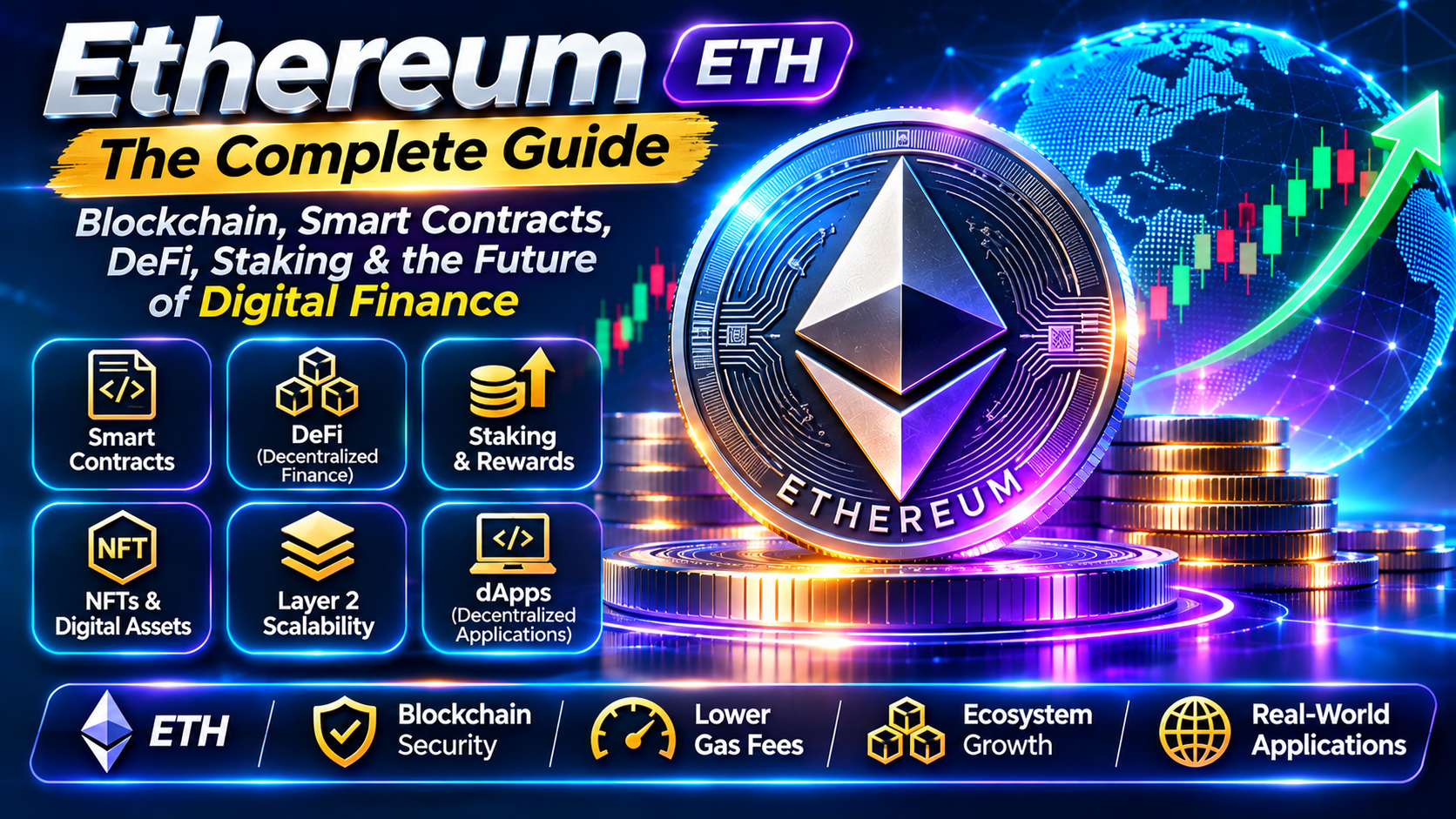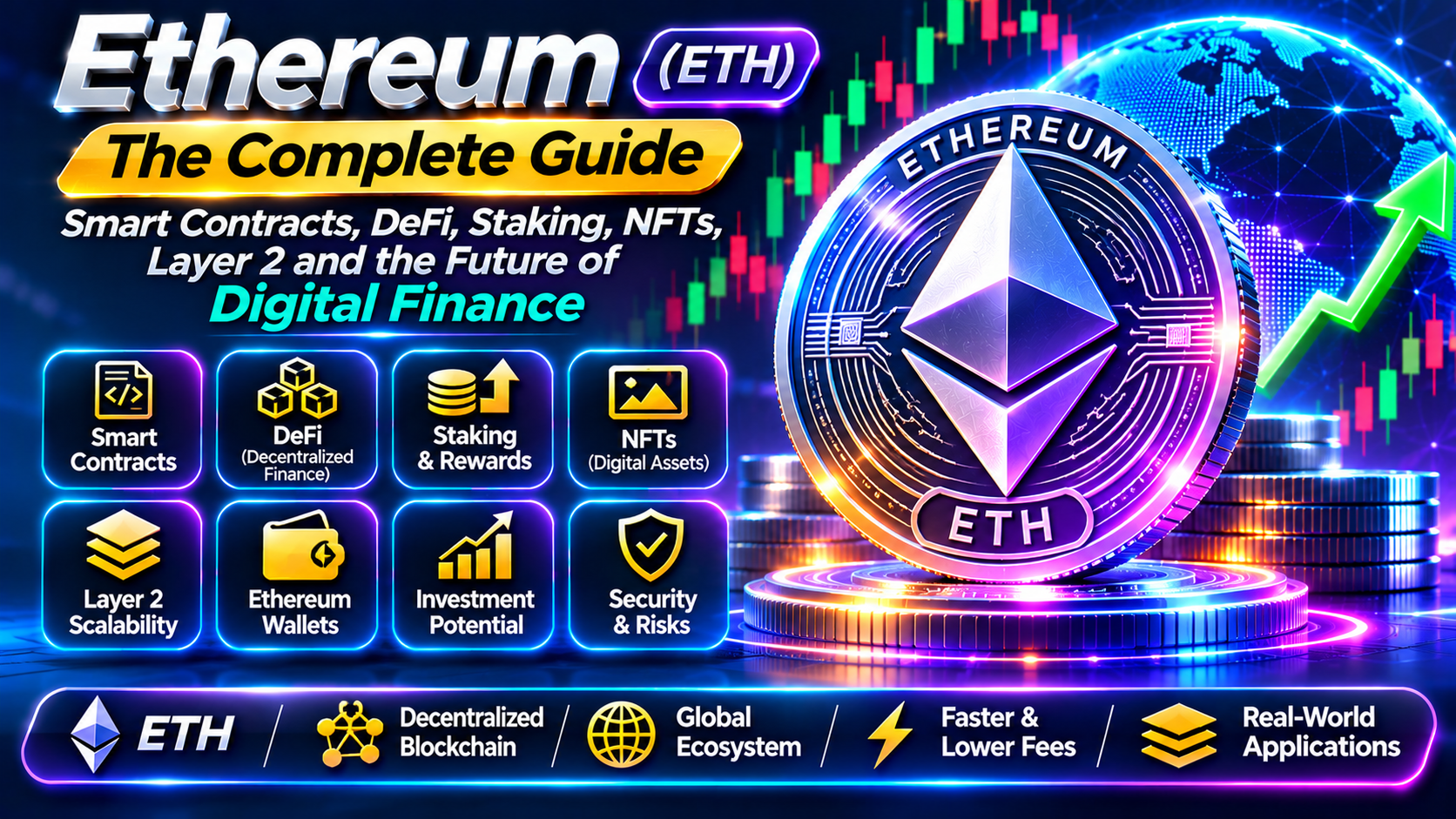
Ethereum (ETH) has become one of the most important technologies in the cryptocurrency industry. It has changed how people think about digital money, online applications, financial services, and ownership of digital assets. While Bitcoin introduced a decentralized payment system, Ethereum expanded the possibilities of blockchain technology by allowing developers to build programmable applications that operate without depending entirely on centralized companies.
Today, Ethereum supports a broad ecosystem of decentralized finance platforms, digital currencies, NFT marketplaces, blockchain games, payment applications, and tokenization projects.
Its native cryptocurrency, Ether (ETH), powers transactions and smart contract operations across the network. It is also used in staking, helping secure Ethereum through its Proof of Stake consensus mechanism.
As businesses, developers, investors, and financial institutions explore blockchain technology, Ethereum remains a major platform to understand.
This article explores Ethereum's technology, ecosystem, practical applications, investment considerations, security challenges, and potential future in the global digital economy.
1. What Is Ethereum?
Ethereum is an open-source, decentralized blockchain platform that enables developers to create applications using smart contracts.
A traditional online application usually depends on servers and databases controlled by a company. Ethereum offers another model: applications can use blockchain-based programs that execute according to predefined rules.
These applications are commonly known as decentralized applications, or dApps.
Ethereum's native cryptocurrency is Ether, commonly identified by the symbol ETH.
ETH performs several important functions within the ecosystem:
Paying transaction fees.
Executing smart contracts.
Transferring digital value.
Supporting staking and network security.
Interacting with decentralized applications.
Providing liquidity across supported financial protocols.
Ethereum was proposed by Vitalik Buterin in 2013 and launched in 2015. Its development helped establish the concept of a programmable blockchain.
2. How Ethereum Changed Blockchain Technology
The early development of blockchain technology focused heavily on decentralized digital payments. Ethereum expanded this concept by making blockchain infrastructure programmable.
Instead of recording only financial transfers, Ethereum allows developers to create applications that follow automated instructions.
For example, a developer can create a smart contract that distributes digital assets when certain conditions are met. Another developer might build a decentralized exchange where users trade tokens through blockchain-based protocols.
This flexibility has created opportunities in several industries:
Banking and financial services.
Digital entertainment.
Gaming and virtual economies.
Online marketplaces.
Digital identity.
Supply chain management.
Asset management.
Digital ownership and verification.
Ethereum helped transform blockchain from a technology primarily associated with cryptocurrency payments into infrastructure for a much wider range of applications.
3. Understanding the Ethereum Network
Ethereum operates through a distributed network of computers called nodes.
These nodes maintain and verify information about the blockchain. They follow Ethereum's protocol rules to ensure that transactions and smart contract operations are processed correctly.
The network includes several important components.
Nodes
Nodes communicate with one another, share blockchain information, and help verify network activity.
Validators
Validators participate in Ethereum's Proof of Stake consensus process. They help propose and confirm blocks.
Smart Contracts
Smart contracts are programs deployed on the blockchain. They perform predefined operations when transactions interact with them.
Ethereum Virtual Machine
The Ethereum Virtual Machine (EVM) is the execution environment used to process smart contract code.
It allows compatible applications to operate according to common execution rules across the network.
Ether
ETH is the native asset used to pay transaction fees and support other network activities.
Together, these components form the foundation of Ethereum's programmable blockchain ecosystem.
4. What Makes ETH Valuable?
ETH has several important uses that distinguish it from digital assets created only for trading or speculation.
Network Utility
Users need ETH to pay transaction fees when interacting directly with Ethereum.
Smart Contract Execution
ETH is used to pay for the computational resources required to execute smart contracts.
Staking
ETH can be staked to participate in the network's Proof of Stake security system.
Digital Asset Transfers
Users can transfer ETH between compatible wallets around the world.
DeFi Applications
ETH is widely used throughout decentralized financial applications, including lending, borrowing, trading, and liquidity protocols.
Ecosystem Demand
Ethereum supports a large ecosystem of developers, applications, and digital assets. Activity across this ecosystem contributes to ETH's role within the network.
However, the usefulness of Ethereum does not guarantee that ETH's market price will increase. Market value is also influenced by supply, demand, competition, regulation, and investor sentiment.
5. Ethereum Smart Contracts Explained
Smart contracts are one of Ethereum's most important innovations.
A smart contract is a computer program deployed on a blockchain. It contains instructions that determine how specific operations should be performed.
For example, consider a digital marketplace. A smart contract could manage the transfer of a digital item once the required payment conditions have been satisfied.
Other examples include:
Automatically distributing digital tokens.
Managing lending agreements.
Executing decentralized trades.
Recording NFT ownership transfers.
Supporting membership systems.
Managing digital voting mechanisms.
Smart contracts can reduce the need for certain intermediaries and make some processes more transparent.
However, they are not automatically secure or legally enforceable in every situation. Poorly written code, vulnerabilities, and incorrect assumptions can create serious problems.
6. Ethereum and Decentralized Finance
Decentralized finance, also known as DeFi, is one of Ethereum's largest application categories.
DeFi uses blockchain technology and smart contracts to provide financial services without relying exclusively on traditional financial intermediaries.
Decentralized Exchanges
Decentralized exchanges allow users to trade supported digital assets through smart-contract-based systems.
Lending Platforms
Some DeFi applications allow users to deposit digital assets and borrow other assets against collateral.
Stablecoins
Stablecoins are digital tokens designed to maintain a relatively stable value against another asset, commonly a fiat currency.
Liquidity Pools
Liquidity pools contain digital assets supplied by users to support decentralized trading and other financial operations.
Yield Opportunities
Some platforms offer rewards to users who provide liquidity, stake assets, or participate in supported activities.
These services can create new opportunities, but DeFi users face risks involving smart contract vulnerabilities, liquidation, price volatility, malicious applications, and changing protocol conditions.
7. What Is Ethereum Proof of Stake?
Ethereum uses Proof of Stake to secure its blockchain.
The network transitioned from Proof of Work to Proof of Stake in September 2022 through an upgrade known as The Merge.
Under Proof of Stake, validators deposit ETH into the staking system and participate in block proposal and confirmation processes.
This system differs from Bitcoin's Proof of Work model, which uses specialized mining hardware and computational competition.
Important features of Ethereum staking include:
Validators participate in network consensus.
Staked ETH supports blockchain security.
Validators may earn rewards for correct participation.
Certain forms of misconduct can result in penalties.
Users can participate directly or through supported staking services.
Running a validator requires technical knowledge and meeting protocol requirements. Staking through third-party services introduces additional provider and custody risks.
8. Ethereum Gas Fees and Transaction Costs
Every operation on Ethereum requires computational resources. Gas measures the amount of work required to process a transaction or execute a smart contract.
Users pay gas fees to compensate for these resources.
Gas fees are influenced by:
Network demand.
Transaction complexity.
Available block capacity.
The gas price at the time of execution.
The type of smart contract interaction.
During busy periods, transaction costs may become expensive.
This can make smaller transfers or frequent interactions less practical for some users.
Before confirming a transaction, users should review the estimated fee displayed in their wallet.
9. Ethereum Layer 2: Improving Blockchain Scalability
Scalability is one of the major challenges facing blockchain networks.
Ethereum's main network has limited transaction capacity, so Layer 2 solutions have developed to process transactions more efficiently while using Ethereum for important security or settlement functions, depending on their design.
Examples include:
Arbitrum.
Optimism.
Base.
Layer 2 networks use different technologies and security models. Many use rollup designs to process transactions outside the main Ethereum execution environment before publishing relevant data or proofs to Ethereum.
Potential advantages include:
Lower Transaction Costs: Many Layer 2 networks aim to make blockchain transactions more affordable.
Higher Capacity: They can support more transactions than relying exclusively on the Ethereum main network.
Improved User Experience: Lower costs and faster interactions can make applications more practical.
Ecosystem Expansion: Developers can build services for users who may find mainnet transactions too expensive.
However, users should understand bridge security, withdrawal procedures, network compatibility, and the specific trust assumptions of each Layer 2 system.
10. Ethereum Token Standards and Digital Assets
Ethereum allows developers to create digital tokens through smart contracts.
Token standards provide common rules that help wallets, exchanges, marketplaces, and applications interact with these assets.
ERC-20
ERC-20 is a widely used standard for fungible tokens.
It supports digital assets such as utility tokens, governance tokens, and certain stablecoins.
ERC-721
ERC-721 is a standard for non-fungible tokens. Each token can represent a distinct digital item or record.
ERC-1155
ERC-1155 supports multiple types of tokens within a single contract, including fungible and non-fungible assets.
These standards have helped Ethereum become a major platform for digital asset creation and management.
11. Ethereum and Non-Fungible Tokens
Non-fungible tokens, commonly known as NFTs, represent unique blockchain-based digital assets.
Ethereum helped popularize NFTs by providing infrastructure for creating, transferring, and verifying token ownership.
NFT applications include:
Digital artwork.
Collectible items.
Gaming assets.
Membership passes.
Digital tickets.
Virtual items.
Certain forms of digital certificates.
NFT technology introduced new opportunities for creators, artists, developers, and online communities.
However, owning an NFT does not automatically mean owning the copyright to the underlying artwork or content. Its value can also change significantly depending on demand and market conditions.
12. Ethereum's Role in Real-World Asset Tokenization
Real-world asset tokenization is an emerging application of blockchain technology.
It involves creating digital tokens that represent ownership, financial interests, or rights associated with assets outside the blockchain.
Potential examples include:
Real estate interests.
Certain financial instruments.
Investment fund units.
Commodities.
Collectibles.
Business-related assets.
Ethereum's smart contract infrastructure can help manage token issuance, transfers, and certain ownership records.
Financial institutions and technology companies have shown interest in tokenization because it may support more programmable and efficient financial infrastructure.
However, real-world tokenization requires more than a blockchain transaction. Legal ownership, custody, regulation, identity verification, and investor protection must also be addressed.
13. Ethereum vs. Bitcoin: Which One Is Different?
Bitcoin and Ethereum are both major blockchain networks, but they have different primary objectives.
Feature | Ethereum (ETH) | Bitcoin (BTC) |
|---|---|---|
Main purpose | Programmable blockchain platform | Decentralized digital money |
Launch year | 2015 | 2009 |
Consensus | Proof of Stake | Proof of Work |
Native asset | ETH | BTC |
Supply design | No fixed maximum supply | Maximum 21 million BTC |
Smart contracts | Extensive programmable functionality | More limited scripting functionality |
Major applications | DeFi, NFTs, dApps and tokens | Payments and digital store of value |
Ethereum focuses on supporting a broad ecosystem of programmable applications. Bitcoin focuses primarily on decentralized digital money.
Both have different technological strengths, risks, and investment characteristics.
14. What Influences the Price of Ethereum?
ETH is traded on cryptocurrency markets, where its price changes according to supply, demand, liquidity, and investor expectations.
Several factors can influence its market performance.
Network Adoption
Increased use of Ethereum applications may create additional demand for network resources.
DeFi Activity
Decentralized financial applications contribute to Ethereum ecosystem activity and may influence demand for ETH.
Institutional Participation
Institutional investment products, financial services, and corporate involvement can influence investor sentiment.
Regulation
Government policies concerning digital assets, staking, exchanges, and decentralized finance can affect the market.
Competition
Other blockchain networks compete for developers, users, and applications.
Macroeconomic Conditions
Interest rates, inflation, global liquidity, and investor risk appetite can influence cryptocurrency prices.
Network Upgrades
Technical improvements may affect Ethereum's scalability, usability, security, and long-term development.
Investors should examine these factors together instead of relying on a single prediction or market headline.
15. How to Buy and Store Ethereum
People generally buy ETH through cryptocurrency exchanges or other supported digital asset services.
A typical purchasing process includes:
Choose a reputable exchange available in your jurisdiction.
Review its fees, security practices, and supported payment methods.
Create an account and complete any required verification.
Deposit funds using an available payment method.
Search for Ethereum or ETH.
Review the quoted price and transaction costs.
Place an order.
Consider transferring your ETH to a wallet if appropriate.
Users can store ETH in hot wallets or cold wallets.
Hot wallets are connected to the internet and provide convenient access to applications. Cold wallets keep private keys offline and are commonly considered for longer-term storage.
Whichever wallet you choose, keep your recovery phrase private and verify addresses before sending funds.
16. Major Risks of Investing in Ethereum
Ethereum has a significant role in the blockchain industry, but ETH is not a risk-free investment.
Market Volatility
ETH can experience sharp price increases and declines. Investors may lose substantial amounts of money.
Smart Contract Vulnerabilities
Bugs in decentralized applications can lead to financial losses.
Network Competition
Other blockchain platforms compete with Ethereum by offering different performance, costs, and developer environments.
Regulatory Changes
Changes in laws and financial regulations may affect exchanges, staking services, and decentralized applications.
Wallet Security
Phishing attacks, malicious software, and compromised private keys can result in stolen assets.
Staking Risks
Staking may involve lock-up conditions, validator penalties, provider risks, and changes in reward levels.
Technical Complexity
Bridges, Layer 2 networks, smart contract approvals, and decentralized applications can be difficult for new users to understand.
Investors should research each opportunity carefully and avoid committing money they cannot afford to lose.
17. Ethereum Security: Best Practices for Users
Protecting digital assets requires careful wallet management and awareness of online threats.
Recommended practices include:
Use reputable wallet providers.
Keep recovery phrases offline and private.
Never share private keys.
Verify transaction details before approving them.
Avoid suspicious links and unofficial applications.
Review smart contract permissions.
Use hardware wallets when appropriate.
Keep devices and software updated.
Research staking and DeFi providers before depositing assets.
Be cautious of guaranteed-return investment claims.
Ethereum's decentralized nature gives users greater control over their assets, but that control also creates personal security responsibilities.
18. The Future of Ethereum
Ethereum's future will depend on its ability to remain useful, secure, scalable, and attractive to developers and users.
Several areas may influence its long-term development.
More Efficient Blockchain Infrastructure
Continued improvements to Ethereum's underlying infrastructure may increase capacity and improve network performance.
Layer 2 Expansion
Layer 2 networks may make blockchain services more accessible by reducing transaction costs and supporting higher transaction volumes.
Institutional Applications
Financial institutions may continue exploring blockchain-based settlement, tokenized assets, and digital financial products.
Growth of Decentralized Finance
DeFi developers may introduce new financial services and improve existing applications.
Real-World Asset Tokenization
Tokenized assets may become an important application of blockchain technology if legal and technical challenges are addressed.
Digital Identity and Ownership
Blockchain applications may support new approaches to digital credentials, ownership records, memberships, and verification.
Developer Innovation
New programming tools, applications, and infrastructure improvements could strengthen Ethereum's ecosystem.
These developments offer opportunities, but Ethereum's future is not guaranteed. Competition, regulation, security, and adoption will remain important factors.
19. Why Businesses Are Exploring Ethereum
Businesses are increasingly interested in blockchain technology because it can provide programmable records, transparent transactions, and automated processes.
Ethereum offers a platform where businesses can experiment with applications such as:
Digital asset management.
Automated settlement.
Tokenized memberships.
Supply chain verification.
Digital certificates.
Programmable payment systems.
Blockchain-based marketplaces.
For example, a company could use smart contracts to automate certain payment conditions or manage digital ownership records.
However, companies must evaluate privacy, scalability, integration costs, regulatory compliance, and cybersecurity before adopting blockchain solutions.
Ethereum is not the right solution for every business problem, but it offers infrastructure for exploring new digital business models.
20. Final Things to Understand Before Using ETH
Before buying ETH or using Ethereum applications, users should understand the following:
Ethereum is a blockchain platform, while ETH is its native cryptocurrency.
Transaction fees are generally paid in ETH.
Network fees change with demand and transaction complexity.
Smart contracts can contain vulnerabilities.
Staking rewards are not guaranteed profits.
Layer 2 networks have different technical and security assumptions.
Cryptocurrency transactions are generally irreversible.
Private keys and recovery phrases must remain confidential.
ETH's market price can be highly volatile.
Future adoption does not guarantee investment returns.
Understanding these points can help users make better decisions when interacting with the Ethereum ecosystem.
Frequently Asked Questions (FAQs)
1. What is Ethereum (ETH)?
Ethereum is a decentralized blockchain platform that supports smart contracts and decentralized applications. ETH is its native cryptocurrency.
2. Who founded Ethereum?
Ethereum was proposed by Vitalik Buterin in 2013 and launched in 2015 with contributions from a broader group of developers and co-founders.
3. What is ETH used for?
ETH is used for transaction fees, smart contract execution, digital transfers, staking, and interacting with decentralized applications.
4. Is Ethereum decentralized?
Ethereum operates through a distributed network of nodes and validators rather than being controlled by one central organization.
5. Does Ethereum use mining?
No. Ethereum transitioned from Proof of Work to Proof of Stake in September 2022.
6. What is Ethereum staking?
Staking involves depositing ETH into Ethereum's Proof of Stake system to participate in network validation and security.
7. What are Ethereum gas fees?
Gas fees are payments for the computational resources needed to process transactions and execute smart contracts.
8. What are Ethereum smart contracts?
Smart contracts are blockchain-based programs that execute predefined operations when the required conditions are met.
9. What is Ethereum Layer 2?
Layer 2 networks are systems designed to improve transaction efficiency while using Ethereum for important security or settlement functions, depending on their design.
10. Is ETH the same as an ERC-20 token?
No. ETH is Ethereum's native cryptocurrency, while ERC-20 tokens are separate assets created using Ethereum smart contracts.
11. Can Ethereum be used for international transfers?
ETH can be transferred between compatible wallets globally, although fees, regulations, and service availability vary.
12. Is Ethereum a good long-term investment?
Ethereum has an established technology ecosystem, but ETH remains volatile and carries significant risks. Investment decisions should be based on independent research and personal financial circumstances.
13. Does Ethereum have a maximum supply?
Ethereum does not have a fixed maximum supply like Bitcoin. Its circulating supply changes through ETH issuance and the burning of certain transaction fees.
14. What is the Ethereum Virtual Machine?
The Ethereum Virtual Machine is the execution environment responsible for running smart contract operations across Ethereum.
15. What is the future of Ethereum?
Potential areas of development include Layer 2 scaling, decentralized finance, tokenization, institutional applications, digital identity, and blockchain-based business infrastructure.
Conclusion
Ethereum has become a central part of the modern blockchain ecosystem by making programmable applications possible on a decentralized network.
Its technology supports smart contracts, DeFi platforms, NFTs, token standards, Layer 2 networks, and emerging real-world asset applications. ETH powers these activities through transaction fees, staking, and digital value transfers.
However, Ethereum also faces challenges involving scalability, competition, security, regulatory uncertainty, and user experience.
Its long-term success will depend on continued technological development, practical adoption, network security, and the ability to support useful applications.
For investors, developers, businesses, and cryptocurrency enthusiasts, understanding Ethereum provides valuable insight into the changing world of digital finance and decentralized technology.