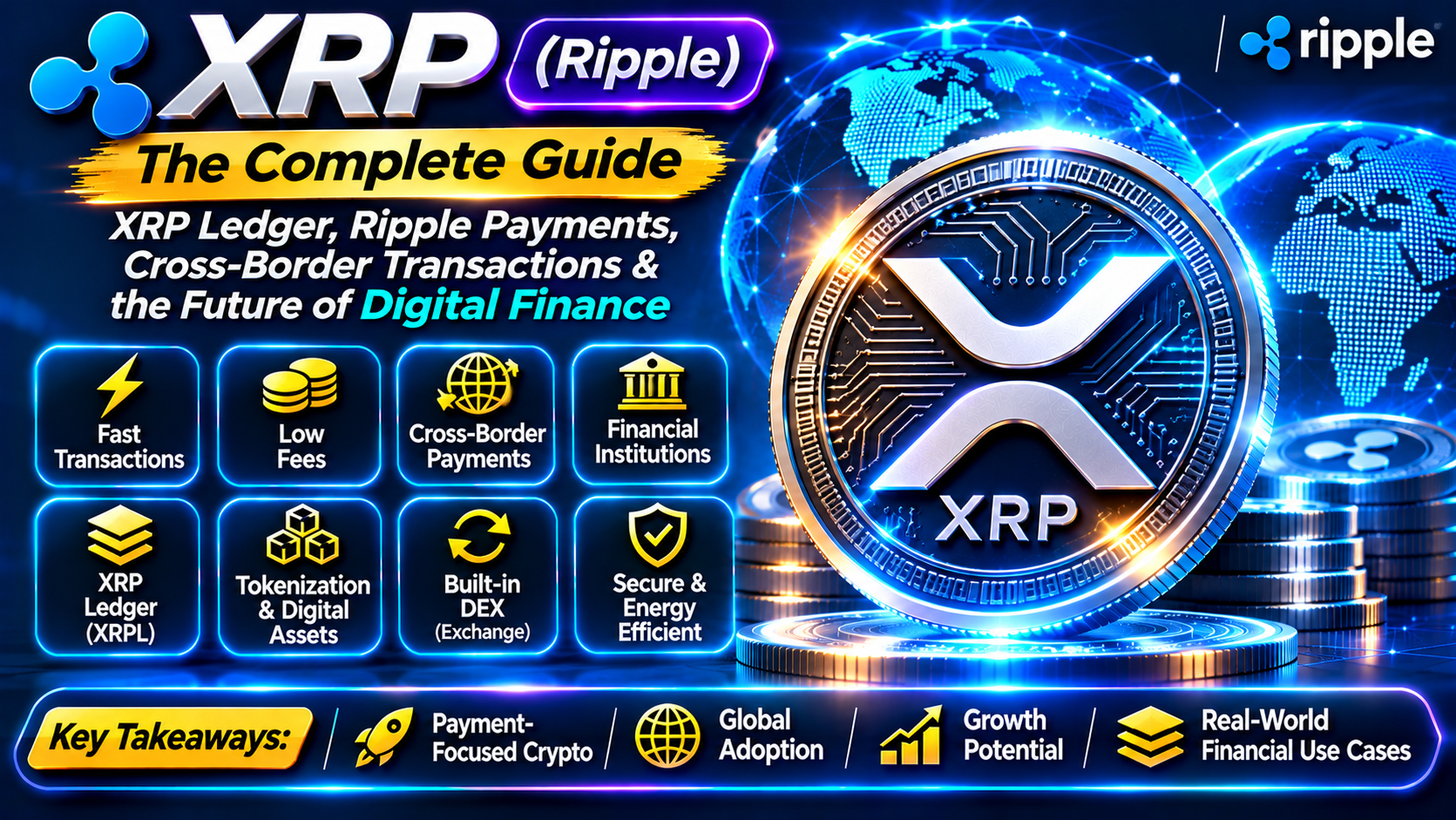
XRP is one of the most recognized cryptocurrencies in the global digital asset market. Designed to support fast and efficient value transfers, XRP is closely associated with the development of blockchain-based payment infrastructure and cross-border financial transactions.
Unlike cryptocurrencies that primarily focus on decentralized applications or digital stores of value, XRP is particularly known for its potential role in improving international payments. Its underlying technology is designed to help move value between different currencies and financial systems with speed and relatively low transaction costs.
XRP is the native digital asset of the XRP Ledger (XRPL), an open-source blockchain designed for payments, tokenization, and other financial applications. Ripple, a financial technology company, has developed payment-related products that use blockchain infrastructure and, in certain services, XRP.
As cryptocurrency adoption expands, XRP continues to attract attention from investors, developers, financial institutions, and blockchain enthusiasts.
This comprehensive guide explores what XRP is, how it works, its relationship with Ripple, its payment technology, investment potential, risks, and its possible role in the future of global finance.
1. What Is XRP?
XRP is a digital cryptocurrency that operates on the XRP Ledger, a decentralized, open-source blockchain.
It was designed to enable efficient transfers of value between individuals, businesses, and financial services.
XRP can be used for:
Sending and receiving digital payments.
Transferring value across borders.
Providing liquidity for certain payment transactions.
Paying transaction fees on the XRP Ledger.
Interacting with supported blockchain applications.
Participating in the XRPL digital asset ecosystem.
One of XRP's key characteristics is its transaction efficiency. The XRP Ledger uses a consensus mechanism that differs from Bitcoin's Proof of Work mining system.
XRP is also known for its relatively low transaction costs and fast settlement times under normal network conditions.
2. What Is the Difference Between XRP and Ripple?
XRP and Ripple are related, but they are not the same thing.
XRP is a digital cryptocurrency that operates on the XRP Ledger.
Ripple is a financial technology company that develops blockchain-based payment and financial infrastructure products.
The distinction is important because the XRP Ledger is an open-source network that can operate independently of Ripple as a company.
Ripple has developed products and services intended to improve international payments and financial transactions. Some of its services may use XRP, while others can operate without requiring XRP.
Understanding this difference helps investors and readers avoid confusing a cryptocurrency with the company associated with some of its use cases.
3. What Is the XRP Ledger?
The XRP Ledger, commonly known as XRPL, is an open-source decentralized blockchain designed to support digital payments and financial applications.
It was launched in 2012 and has developed into an ecosystem supporting several types of digital asset activity.
The ledger records transactions and maintains information about accounts, balances, and supported assets.
Important features include:
Fast Transactions
The XRP Ledger is designed to process transactions quickly, making it suitable for certain payment applications.
Low Transaction Costs
The network generally has low transaction fees, although actual costs can depend on network conditions.
Built-In Decentralized Exchange
XRPL includes decentralized trading functionality that supports exchanges between eligible assets.
Tokenization
Developers can issue supported digital assets on the ledger.
Open-Source Infrastructure
Developers can examine the technology and build applications using the network.
These capabilities make the XRP Ledger an important project in the development of blockchain-based financial infrastructure.
4. How Does XRP Work?
XRP transactions take place through the XRP Ledger.
When a user sends XRP, the transaction is submitted to the network. Participating validators communicate and use the ledger's consensus process to agree on which transactions should be included in the next ledger version.
Once the network reaches consensus, the ledger is updated.
The general process involves:
A user creates an XRP transaction through a compatible wallet.
The transaction is digitally signed.
The transaction is submitted to the XRP Ledger.
Network validators participate in the consensus process.
Valid transactions are included in the next ledger version.
The updated ledger records the transaction.
Unlike Bitcoin, XRP does not rely on traditional mining to create and confirm blocks.
The XRP Ledger uses a consensus protocol designed to achieve agreement among participating validators.
5. What Makes XRP Different From Other Cryptocurrencies?
XRP has several characteristics that distinguish it from other major digital assets.
Payment-Focused Design
XRP is closely associated with digital payments and cross-border value transfers.
No Traditional Mining
The XRP Ledger does not use Bitcoin-style Proof of Work mining.
Fast Settlement
The network is designed to confirm transactions within a short period under normal operating conditions.
Low Transaction Fees
XRP Ledger transactions generally require relatively small fees.
Fixed Initial Supply
XRP was created with a total supply of 100 billion tokens. Its supply structure differs from Bitcoin's mining-based issuance model.
Financial Infrastructure
The XRP ecosystem focuses significantly on payment technology, asset transfers, and financial applications.
These features have helped XRP establish a distinct position in the cryptocurrency industry.
6. XRP and Cross-Border Payments
International payments can involve several financial institutions, currencies, and payment networks.
Traditional cross-border transfers may experience delays, intermediary charges, and complicated settlement processes.
Blockchain technology offers alternative ways to transfer value between participants.
XRP is designed to support efficient digital value transfers and can potentially serve as a bridge asset between different currencies.
For example, a payment service may use a digital asset to facilitate the movement of value between two different currency systems.
A simplified example:
A sender initiates a payment in one currency.
A payment provider converts the value into a supported digital asset where applicable.
The asset is transferred through compatible blockchain infrastructure.
The receiving side converts the value into the destination currency if required.
The recipient receives the payment through the supported service.
Actual payment processes depend on the provider, jurisdiction, liquidity, and available infrastructure.
XRP's payment-focused design is one of the main reasons it attracts attention from the financial technology industry.
7. What Is Ripple Payments?
Ripple develops payment-related technology designed to help financial institutions and businesses move money internationally.
Its products and services have evolved over time and are intended to improve aspects of cross-border payment infrastructure.
Potential benefits of blockchain-based payment systems include:
Faster settlement processes.
Improved transaction visibility.
More efficient liquidity management.
Reduced reliance on certain intermediaries.
Support for international value transfers.
It is important to understand that Ripple's products do not all require XRP. The use of XRP depends on the specific service, payment route, and business arrangement.
The wider Ripple ecosystem and the XRP Ledger should therefore be evaluated separately when researching the cryptocurrency.
8. Does XRP Use Mining?
No. XRP does not use traditional cryptocurrency mining.
Bitcoin miners compete to solve computational challenges using specialized hardware. The XRP Ledger uses a different consensus mechanism.
Validators participate in the process of agreeing on transaction validity and the next ledger state.
This approach does not require the energy-intensive mining competition used by Proof of Work networks.
The XRP Ledger's consensus system is designed to support efficient transaction processing.
However, network validators and the decentralized nature of the ledger remain important considerations when evaluating the system's security and governance.
9. Understanding XRP Supply and Tokenomics
XRP has a different supply structure from Bitcoin and several other cryptocurrencies.
A total of 100 billion XRP tokens were created at the beginning of the project.
Unlike Bitcoin, XRP does not have a mining process that continuously introduces new coins through block rewards.
Some XRP has historically been held in escrow arrangements, with scheduled releases governed by specific conditions.
Not all released XRP necessarily enters the open market. The amount available for trading depends on how tokens are distributed, held, used, or returned to escrow.
A small amount of XRP is also destroyed as transaction fees when transactions are processed.
Important supply concepts include:
Total supply.
Circulating supply.
Escrow arrangements.
Token distribution.
Transaction fee destruction.
Market demand and liquidity.
Investors should distinguish between total supply and circulating supply when analyzing XRP's market value.
10. What Is the XRP Ledger Consensus Mechanism?
The XRP Ledger uses a consensus protocol rather than Proof of Work mining or Ethereum-style Proof of Stake.
Participating validators communicate and evaluate proposed transactions. They work toward agreement on the next version of the ledger.
The process is designed to allow the network to confirm transactions without requiring miners to compete through intensive computational calculations.
Important characteristics include:
Validator participation.
Agreement on transaction ordering.
Digital signatures.
Network-based transaction verification.
Regular ledger updates.
The system is designed to provide efficient transaction confirmation while maintaining a shared and verifiable record.
The security of the network depends on the implementation of its consensus protocol, validator participation, software quality, and broader network conditions.
11. XRP and Decentralized Finance
The XRP Ledger has expanded beyond basic payment transfers.
Its ecosystem supports additional financial and digital asset features, including decentralized exchange functionality and tokenization.
Potential applications include:
Digital Asset Trading
The ledger supports trading between eligible digital assets through its built-in exchange functionality.
Token Issuance
Developers can issue digital tokens using XRPL features.
Payment Applications
Businesses can explore payment services built on the ledger.
Liquidity Management
Digital assets can support different types of value transfer and liquidity applications.
Decentralized Finance
Developers continue exploring ways to build financial applications around the XRP Ledger.
The ecosystem is different from Ethereum's DeFi environment, and users should evaluate the available applications, security, liquidity, and functionality before participating.
12. XRP and Stablecoins
Stablecoins are digital assets designed to maintain a relatively stable value against another asset, commonly the US dollar.
They have become an important part of the cryptocurrency industry because they can support trading, payments, and blockchain-based financial services.
The XRP Ledger supports the issuance and transfer of digital assets, including stablecoin-related applications.
Ripple has also introduced RLUSD, a dollar-denominated stablecoin, as part of its broader digital asset ecosystem.
Stablecoins and XRP serve different purposes.
XRP is a cryptocurrency with a market-driven price.
Stablecoins are designed to maintain a relatively stable reference value.
Both can be used in blockchain-based financial applications, depending on network and service support.
Stablecoins also carry risks, including issuer, reserve, regulatory, and redemption risks.
13. XRP vs. Bitcoin vs. Ethereum
XRP, Bitcoin, and Ethereum are three major cryptocurrency projects, but they have different designs and objectives.
Feature | XRP | Bitcoin | Ethereum |
|---|---|---|---|
Main focus | Payments and value transfers | Decentralized digital money | Smart contracts and applications |
Launch | 2012 | 2009 | 2015 |
Native asset | XRP | BTC | ETH |
Consensus | XRPL consensus protocol | Proof of Work | Proof of Stake |
Traditional mining | No | Yes | No longer |
Supply design | 100 billion created initially | Maximum 21 million | No fixed maximum |
Major use cases | Payments, liquidity and tokenization | Digital money and store of value | DeFi, NFTs and dApps |
Each project has different strengths and limitations.
XRP focuses on efficient value transfers, Bitcoin emphasizes decentralized monetary infrastructure, and Ethereum supports a broad programmable application ecosystem.
14. What Factors Influence the Price of XRP?
XRP's market price changes according to supply, demand, liquidity, and investor expectations.
Several factors can influence its performance.
Cryptocurrency Market Trends
Broader movements in Bitcoin and other digital assets can influence XRP's price.
Institutional Interest
Interest from financial institutions and investment products may affect market sentiment and demand.
Payment Adoption
The use of XRP in payment-related services may influence perceptions of its utility.
Regulatory Developments
Government decisions concerning cryptocurrency classification, trading, and financial services can affect the market.
Token Supply
Circulating supply, escrow releases, token distribution, and market liquidity can influence price dynamics.
XRP Ledger Development
New network features, applications, and ecosystem improvements may affect investor interest.
Investor Sentiment
News, market speculation, social media discussions, and trading activity can create short-term volatility.
No single factor can reliably predict XRP's future price.
15. Is XRP a Good Investment?
XRP attracts investors because of its payment-focused technology, established market presence, and connection to the broader blockchain financial infrastructure industry.
However, XRP is a volatile cryptocurrency and should not be treated as a guaranteed investment.
Before considering XRP, investors should examine:
Technology: Understand how the XRP Ledger works and what distinguishes it from other blockchains.
Real-World Utility: Research actual payment applications and distinguish confirmed usage from speculative announcements.
Regulation: Monitor relevant legal and regulatory developments in the countries where XRP is traded or used.
Market Conditions: Evaluate liquidity, trading activity, supply, and broader cryptocurrency trends.
Risk Tolerance: Consider whether you can withstand substantial price fluctuations.
Investment Strategy: Avoid making decisions based entirely on social media predictions or promises of rapid profits.
The long-term value of XRP will depend on adoption, utility, competition, market demand, and regulatory conditions.
16. How to Buy XRP
XRP can be purchased through cryptocurrency exchanges and other services that support the asset.
A typical process includes:
Research a reputable cryptocurrency exchange available in your country.
Review its regulatory status, fees, and security practices.
Create an account and complete required identity verification.
Deposit funds using an available payment method.
Search for XRP.
Review the quoted price and trading fees.
Place your order.
Consider transferring XRP to a compatible personal wallet.
Exchange availability and payment methods vary by jurisdiction.
Always check the official website of the exchange and avoid suspicious links or unofficial sellers.
17. XRP Wallets and Security
An XRP wallet allows users to manage their XRP and interact with the XRP Ledger.
Wallets generally fall into two categories.
Hot Wallets
Hot wallets are connected to the internet and are often convenient for frequent transactions.
Cold Wallets
Cold wallets store private keys offline and can provide additional protection against online attacks.
Security practices include:
Use trusted wallet software or hardware.
Keep your recovery phrase private.
Never share private keys.
Verify wallet addresses before sending funds.
Avoid suspicious websites and applications.
Be careful when connecting wallets to unfamiliar services.
Maintain secure backups of recovery information.
Some XRP Ledger accounts may have account reserve requirements. Users should check current network rules and wallet guidance before opening or funding an account.
18. XRP Risks and Challenges
Despite its potential, XRP faces several challenges.
Market Volatility
XRP can experience significant price fluctuations, resulting in financial losses.
Regulatory Uncertainty
Cryptocurrency regulations vary across countries and can change over time.
Competition
Other blockchain networks and payment technologies compete to provide efficient international transfers.
Adoption Challenges
The success of payment-focused digital assets depends on real-world usage, liquidity, partnerships, and integration.
Security Risks
Phishing attacks, compromised wallets, malicious applications, and exchange failures can lead to lost funds.
Market Dependence
Investor sentiment and broader cryptocurrency market conditions can influence XRP's price independently of its technology.
Centralization Concerns
Questions about validator distribution, governance, and the influence of major ecosystem participants are relevant when evaluating decentralization.
Understanding these challenges is essential before buying or using XRP.
19. The Future of XRP and the XRP Ledger
The future of XRP will depend on how successfully its technology supports useful financial applications and attracts users, businesses, and developers.
Several areas may influence its development.
Cross-Border Payments
XRP may continue to be explored for international value transfers and liquidity-related services.
Financial Institution Integration
Businesses and financial institutions may continue experimenting with blockchain-based settlement and payment infrastructure.
Tokenization
The XRP Ledger's asset issuance features may support additional tokenized financial products and digital assets.
Stablecoin Ecosystem
Stablecoin development may create additional payment and financial applications on the ledger.
Decentralized Exchange Development
Improvements to trading and liquidity infrastructure could expand the XRPL ecosystem.
Regulatory Clarity
Clearer digital asset regulations could influence how businesses and investors participate in the market.
Developer Innovation
New applications, infrastructure improvements, and developer tools may expand the usefulness of the XRP Ledger.
These opportunities are not guarantees of future success. Competition, market conditions, technical development, and regulation will remain important.
20. Why XRP Matters in the Evolution of Digital Finance
Global financial systems depend on reliable ways to transfer money, manage liquidity, and settle transactions.
Blockchain technology offers alternative infrastructure that may help modernize parts of this process.
XRP is important to this discussion because it focuses on the movement of digital value and the potential improvement of international payment systems.
Its broader ecosystem demonstrates how blockchain networks can support more than cryptocurrency trading.
Potential areas of development include:
International payment infrastructure.
Digital asset transfers.
Tokenized financial products.
Stablecoin payments.
Decentralized trading.
Business-to-business financial services.
Blockchain-based settlement systems.
Whether XRP becomes a major component of future financial infrastructure will depend on practical adoption and its ability to compete with other payment technologies.
Frequently Asked Questions (FAQs)
1. What is XRP?
XRP is a digital cryptocurrency that operates on the XRP Ledger, an open-source blockchain designed to support payments, digital assets, and financial applications.
2. Is XRP the same as Ripple?
No. XRP is a cryptocurrency, while Ripple is a financial technology company that develops blockchain-based payment products.
3. Who created XRP?
XRP was developed by the founders of the XRP Ledger, including David Schwartz, Jed McCaleb, and Arthur Britto. The ledger launched in 2012.
4. What is the XRP Ledger?
The XRP Ledger is a decentralized, open-source blockchain that supports payments, digital asset transfers, tokenization, and decentralized exchange functionality.
5. Does XRP use mining?
No. The XRP Ledger uses a consensus protocol rather than traditional Proof of Work mining.
6. How fast are XRP transactions?
The XRP Ledger is designed to confirm transactions in a few seconds under normal operating conditions. Actual performance can depend on network conditions.
7. What is the maximum supply of XRP?
A total of 100 billion XRP tokens were created at the beginning of the project.
8. Can XRP be used for international payments?
XRP can be used for digital transfers and may support certain cross-border payment arrangements through compatible services.
9. Is XRP decentralized?
The XRP Ledger is an open-source network with independent validators. Its decentralization can be evaluated by examining validator participation, governance, and network influence.
10. What is the difference between XRP and Bitcoin?
XRP focuses on efficient digital value transfers and payment-related applications, while Bitcoin primarily serves as decentralized digital money.
11. Can XRP be stored in a wallet?
Yes. XRP can be stored in compatible hot or cold wallets that support the XRP Ledger.
12. Is XRP a good long-term investment?
XRP has an established market presence and payment-focused technology, but its price is volatile and future performance is uncertain. Investors should conduct independent research.
13. What is XRP escrow?
Escrow refers to arrangements in which XRP is held under predefined conditions for scheduled release or other purposes.
14. Does Ripple need XRP to operate?
Not all Ripple products require XRP. The use of XRP depends on the particular product, service, and payment arrangement.
15. What is the future of XRP?
Potential areas include cross-border payments, tokenization, stablecoins, digital asset trading, and blockchain-based financial infrastructure. Future adoption is not guaranteed.
Conclusion
XRP has established an important position in the cryptocurrency industry through its focus on efficient digital value transfers and payment-related blockchain infrastructure.
The XRP Ledger offers a different approach from Bitcoin's mining-based network and Ethereum's smart contract ecosystem. Its fast transaction design, low fees, decentralized exchange features, and tokenization capabilities provide opportunities for financial and digital asset applications.
Ripple's work on payment infrastructure has also helped bring attention to the XRP ecosystem, although XRP and Ripple remain separate entities.
Despite its potential, XRP faces important challenges involving regulation, competition, market volatility, security, and adoption.
For investors, businesses, and cryptocurrency enthusiasts, understanding XRP requires looking beyond price movements and examining its technology, real-world utility, and long-term development.
As global financial services continue exploring blockchain technology, XRP remains a cryptocurrency worth understanding and following.