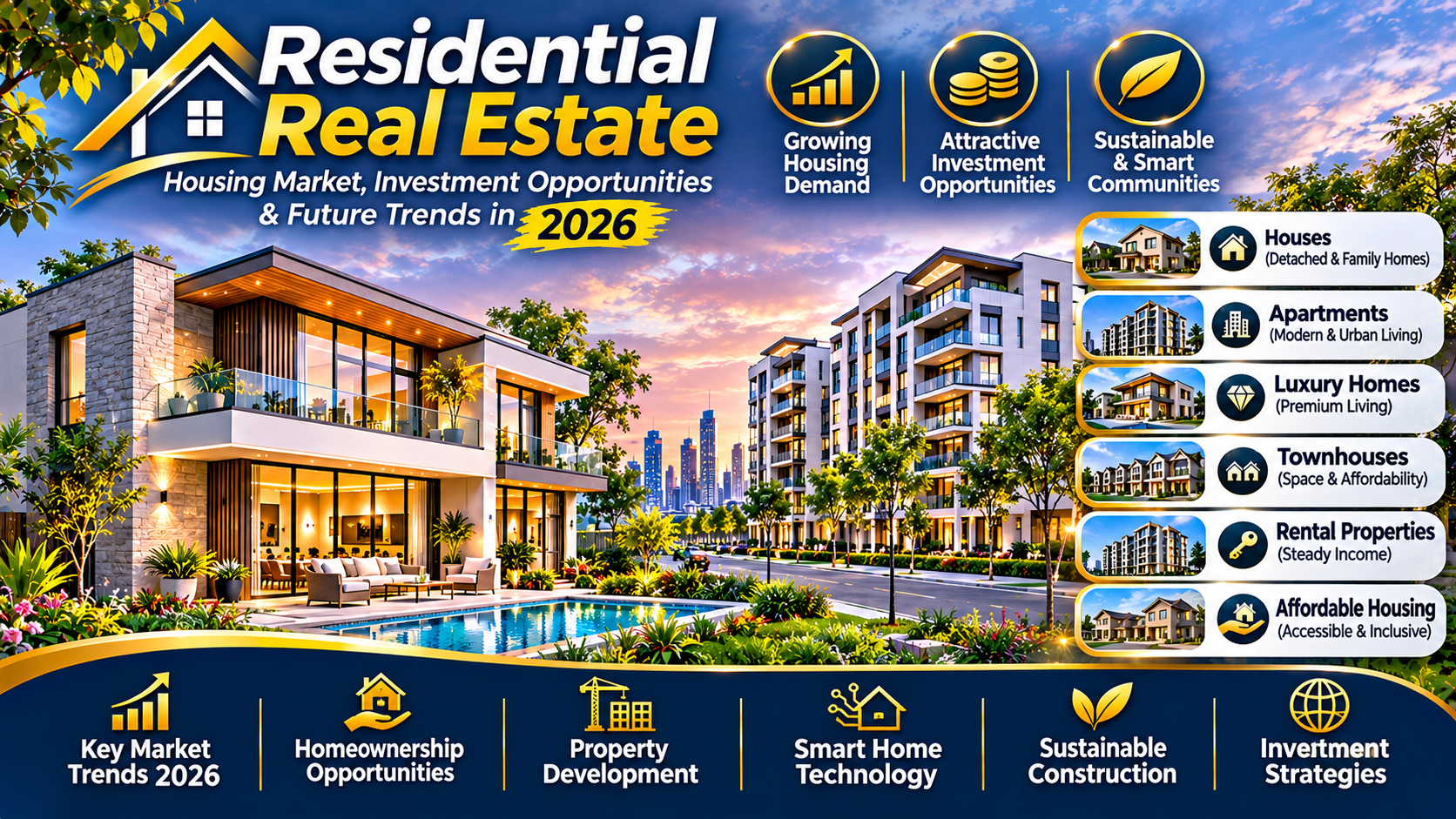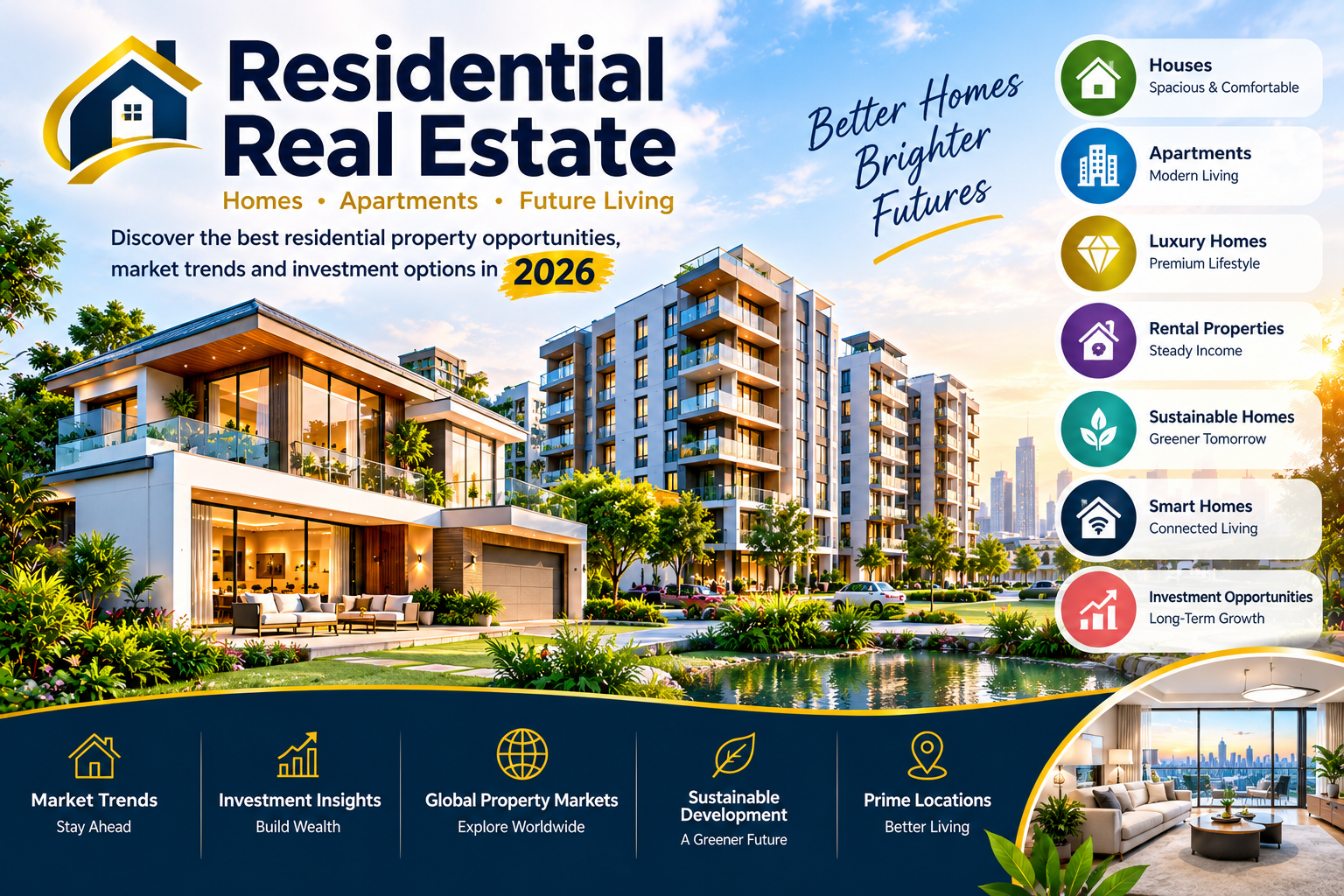
Residential real estate is one of the most important segments of the global property industry. It includes houses, apartments, condominiums, villas, townhouses, rental properties, and residential communities where people live and build their daily lives.
As populations grow, cities expand, and lifestyles change, demand for suitable housing continues to influence property markets around the world. Residential real estate also attracts investors seeking rental income, long-term asset ownership, and opportunities to participate in property development.
In 2026, the residential property sector is experiencing several important changes. Housing affordability, mortgage costs, rental demand, construction expenses, urban development, and technology are influencing how people buy, rent, sell, and manage homes.
For buyers, understanding these developments can help with making informed housing decisions. For investors, evaluating local demand, property values, rental potential, and financial risks is essential.
This guide explores the residential real estate industry, major property categories, international housing trends, investment strategies, technology, sustainability, and opportunities shaping the future of residential property.
What Is Residential Real Estate?
Residential real estate refers to land and buildings designed primarily for residential use. These properties provide accommodation for individuals, families, and households.
Unlike commercial real estate, which generally supports business activities, residential properties are primarily intended for living purposes.
The residential property market includes several participants:
Homebuyers and property owners
Tenants and landlords
Real estate agents and brokers
Property developers and builders
Mortgage lenders and financial institutions
Property management companies
Architects and construction professionals
Real estate investors
The market connects housing supply with the needs of people looking for affordable, convenient, safe, and comfortable places to live.
Major Types of Residential Properties
Residential real estate includes different property categories designed to accommodate various household sizes, lifestyles, and financial requirements.
1. Single-Family Homes
Single-family homes are independent residential buildings designed for one household.
They commonly include private entrances, kitchens, bedrooms, bathrooms, and outdoor spaces. Some properties also feature garages, gardens, driveways, and additional recreational areas.
Single-family homes are popular among families seeking privacy, space, and long-term ownership.
Important considerations include location, construction quality, maintenance expenses, neighborhood facilities, and resale demand.
2. Apartments
Apartments are individual residential units located within larger buildings or residential complexes.
They are common in urban areas where land availability and population density influence housing development.
Apartment buildings may offer shared facilities such as:
Parking areas
Elevators
Security systems
Fitness centers
Swimming pools
Community spaces
Maintenance services
Apartments can appeal to first-time buyers, professionals, small households, and investors interested in rental properties.
3. Condominiums
Condominiums, commonly known as condos, are individually owned residential units within a shared building or community.
Owners generally hold ownership of their individual units while sharing responsibility for common areas under applicable ownership and association arrangements.
Condominium developments may include shared facilities, maintenance services, security, and recreational amenities.
Before purchasing a condominium, buyers should examine association fees, maintenance obligations, building regulations, financial reserves, and ownership documents.
4. Townhouses
Townhouses are multi-level residential properties that often share one or more walls with neighboring homes.
They combine certain features of apartments and detached houses, sometimes offering private entrances, small outdoor areas, and multiple floors.
Townhouses are often developed in planned residential communities where efficient land use is important.
5. Luxury Residential Properties
Luxury residential real estate includes high-end houses, villas, penthouses, waterfront homes, and exclusive residential developments.
These properties may offer premium architecture, larger living spaces, advanced security, private outdoor areas, and specialized amenities.
Their value can depend on location, construction quality, design, privacy, scarcity, and demand from high-income buyers.
6. Rental Properties
Rental properties are residential units owned by landlords and occupied by tenants in exchange for periodic rent.
They include apartments, houses, condominiums, townhouses, and multi-unit residential buildings.
Rental property investment requires attention to tenant demand, vacancy periods, maintenance costs, legal responsibilities, insurance, and property management.
7. Affordable Housing
Affordable housing refers to homes designed or made available at costs that are more manageable for households with limited or moderate incomes.
This segment is important in rapidly growing cities where housing prices and rents can exceed the financial capacity of many residents.
Affordable housing projects may involve government initiatives, private developers, housing associations, and public-private partnerships.
Residential Real Estate Market Trends in 2026
The residential property market is not moving in the same direction everywhere. Conditions differ according to local economies, interest rates, housing supply, household income, and population changes.
Several major trends are shaping the industry in 2026.
Housing Affordability Remains a Major Challenge
Housing affordability continues to influence residential markets across many countries.
High property prices, mortgage expenses, construction costs, and household living expenses can make homeownership difficult for first-time buyers.
Affordability is not determined by property prices alone. Buyers also need to consider their income, down payment, interest rates, taxes, insurance, maintenance, and other ownership expenses.
This challenge is increasing interest in smaller homes, affordable housing developments, rental accommodation, and alternative ownership arrangements.
Rental Demand and Flexible Housing
Renting remains an important part of the residential property market.
Some households prefer renting because it offers flexibility, reduces the need for a large initial purchase payment, and may make it easier to relocate for employment or education.
In its September 2026 research, Savills reported that average prime rents across 30 tracked global cities increased by 1.1% in the first half of 2026, while prime capital values increased by 0.6%. This illustrates the strength of rental demand in those particular prime markets, rather than representing every residential market worldwide.
Urbanization and Population Growth
Urbanization continues to influence residential development.
People move toward cities for employment, education, healthcare, transportation, and business opportunities. This can increase demand for apartments, houses, and planned residential communities.
Developers increasingly evaluate transportation access, schools, hospitals, retail facilities, public services, and employment centers when planning new residential projects.
Smaller and More Flexible Living Spaces
Changing household structures and affordability pressures are encouraging interest in smaller, efficient residential properties.
Studio apartments, compact homes, co-living spaces, and flexible residential layouts can appeal to students, young professionals, and smaller households.
Developers are also exploring multifunctional rooms, built-in storage, and space-efficient designs.
Growing Interest in Prime Residential Markets
Luxury and prime residential markets continue to attract international attention.
However, performance varies by city. Supply constraints, international demand, household wealth, taxation, and economic conditions can influence local results.
Buyers and investors should compare individual cities rather than assuming that all luxury property markets perform similarly.
Residential Real Estate Investment Opportunities
Residential real estate offers different investment strategies depending on financial objectives, available capital, market conditions, and risk tolerance.
Buying Property for Long-Term Appreciation
Some investors purchase residential property with the expectation that its value may increase over time.
Potential appreciation can be influenced by:
Location and neighborhood development
Employment growth
Population changes
Infrastructure improvements
Housing supply
Local economic activity
Property condition and quality
Property appreciation is not guaranteed. Values can also decline due to economic conditions, oversupply, changing demand, or financing pressures.
Rental Property Investment
Rental property investment involves purchasing a residential property and generating income through tenant payments.
Investors commonly evaluate:
Monthly rental income
Annual operating expenses
Vacancy rates
Property management fees
Insurance
Maintenance and repairs
Taxes and financing costs
A property with attractive rental income may still produce weak returns if expenses are high or vacancies are frequent.
Multi-Family Residential Investment
Multi-family properties contain several independent residential units within one building or development.
Examples include apartment buildings and residential complexes.
These properties can provide multiple rental income streams, but they also require effective tenant management, maintenance planning, financial management, and compliance with local housing regulations.
Student Housing
Student housing provides accommodation for university and college students.
Demand may be influenced by university enrollment, international education, campus locations, affordability, and the availability of suitable accommodation.
Investors should evaluate academic calendars, seasonal vacancy, management requirements, and local regulations.
Senior Living and Retirement Housing
Population aging is increasing attention on residential environments designed for older adults.
These developments may include independent living communities, assisted living facilities, and age-friendly residential projects.
The requirements of this sector can be more specialized, involving accessibility, healthcare support, safety, staffing, and operational management.
Affordable Residential Developments
Affordable housing development focuses on providing homes at prices or rents accessible to a wider range of households.
Opportunities may exist where housing demand is strong but suitable supply remains limited.
Successful projects require careful land selection, construction cost management, appropriate financing, and a clear understanding of local housing needs.
How to Evaluate a Residential Property Investment
Before purchasing a residential property, investors should examine its financial potential and practical suitability.
Rental Yield
Rental yield measures the relationship between annual rental income and the property's purchase price.
The basic gross rental yield formula is:
Gross Rental Yield = (Annual Rental Income ÷ Property Purchase Price) × 100
For example:
Item | Illustrative Amount |
|---|---|
Property purchase price | $150,000 |
Monthly rental income | $1,000 |
Annual rental income | $12,000 |
Gross rental yield | 8% |
This is an illustrative calculation, not a guaranteed return or a market benchmark.
Net Rental Income
Gross rental yield does not account for expenses.
Investors should calculate the income remaining after operating costs such as maintenance, insurance, management fees, taxes, and vacancy losses.
Net Operating Income (NOI) = Rental Income − Operating Expenses
Financing expenses and income taxes may also need to be considered separately when calculating the investor's overall return.
Property Appreciation
Property appreciation refers to an increase in a property's market value over time.
Investors should examine comparable property transactions, neighborhood development, employment opportunities, infrastructure, and local demand.
Total Cost of Ownership
The purchase price is only one part of the financial commitment.
Additional costs may include:
Legal and registration fees
Property taxes
Insurance
Repairs and maintenance
Renovation expenses
Mortgage interest
Property management fees
Utility and service charges
A complete financial assessment provides a more realistic picture of affordability and investment performance.
The Role of Location in Residential Real Estate
Location is one of the most important factors influencing residential property demand.
Two properties with similar designs and sizes can have very different values because of their surrounding environments.
Important location factors include:
Transportation: Access to roads, public transportation, airports, and major employment areas can influence convenience.
Education: Nearby schools, colleges, and universities may attract families and students.
Healthcare: Access to hospitals, clinics, and pharmacies can improve residential convenience.
Employment: Locations near business districts and employment centers may attract working professionals.
Safety: Neighborhood security and local conditions can influence buyer and tenant preferences.
Infrastructure: Reliable electricity, water, drainage, internet, and other essential services are important for residential quality.
Future development: Planned infrastructure and community improvements may influence future demand, although proposed projects should be independently verified.
How Technology Is Transforming Residential Real Estate
Technology is changing how buyers discover homes, how agents communicate with clients, and how property owners manage residential buildings.
Artificial Intelligence in Property Search
AI-powered platforms can help users filter properties, compare features, organize listings, and identify potentially relevant options.
Property professionals may also use AI tools to support customer communication, marketing, and data analysis.
AI-generated estimates should not replace professional property valuations or independent market research.
Virtual Property Tours
Virtual tours allow buyers and tenants to explore properties online before arranging physical visits.
They can be especially useful for international buyers, overseas investors, and people relocating to another city.
However, buyers should still inspect properties and verify documents before completing transactions.
Smart Homes
Smart home technology connects household devices and systems through digital networks.
Common features include:
Smart lighting
Connected security cameras
Digital door locks
Smart thermostats
Automated curtains
Energy monitoring
Connected appliances
These features can improve convenience and help monitor household energy use.
Digital Property Management
Property management software can support rent collection, tenant communication, maintenance requests, document management, and financial reporting.
For landlords managing several properties, digital systems can help organize daily operations and maintain better records.
Sustainable Residential Real Estate
Sustainability is becoming an important consideration in residential construction and property management.
Homeowners and developers are increasingly interested in energy-efficient designs, water conservation, better insulation, and environmentally responsible materials.
Important sustainable housing features include:
Solar energy systems
Energy-efficient lighting
Improved insulation
Efficient heating and cooling
Water-saving fixtures
Rainwater harvesting where suitable
Sustainable construction materials
Natural lighting and ventilation
Green spaces and landscaping
Sustainable features may reduce resource consumption and improve living conditions, although their financial benefits depend on installation costs, climate, energy prices, and maintenance requirements.
Residential Real Estate Opportunities in Pakistan
Pakistan's residential property sector includes houses, apartments, residential plots, gated communities, and large-scale housing developments.
Major cities such as Lahore, Karachi, Islamabad, Faisalabad, and Rawalpindi have different housing requirements and development patterns.
Several areas are relevant to residential property research.
Urban Housing
Growing urban populations create demand for apartments, houses, and residential communities.
Developers must consider affordability, infrastructure, construction quality, and access to employment centers.
Apartment Developments
Apartment buildings can provide housing in locations where land is expensive or limited.
Buyers should evaluate building approvals, ownership documents, maintenance arrangements, parking, utilities, and construction standards.
Gated Residential Communities
Planned communities may provide residential plots, houses, roads, security arrangements, and shared facilities.
Before purchasing, buyers should verify the relevant development approvals, land ownership, project status, possession arrangements, and utility availability.
Affordable Housing
Affordable housing remains an important area for Pakistan's residential sector.
Developers and policymakers face the challenge of delivering suitable homes while managing land costs, construction expenses, financing, and household purchasing power.
Overseas Pakistani Property Buyers
Overseas Pakistanis may consider residential property for family accommodation, future relocation, or investment.
However, remote purchases require additional care.
Buyers should independently verify ownership documents, authorized representatives, development approvals, payment arrangements, and applicable legal requirements before transferring money.
Common Risks in Residential Real Estate
Residential property can be a long-term asset, but it is not free from financial or legal risks.
Market Risk
Property values can decline due to economic downturns, reduced demand, oversupply, or changes in local conditions.
Vacancy Risk
Rental properties may remain unoccupied between tenants, reducing expected income.
Maintenance Costs
Unexpected repairs involving plumbing, electrical systems, roofing, elevators, or structural components can increase ownership expenses.
Financing Risk
Higher interest rates, changing lending conditions, or reduced household income can affect mortgage affordability.
Legal and Documentation Risk
Incomplete ownership records, disputed land, unauthorized construction, and missing approvals can create serious complications.
Liquidity Risk
Residential properties can take time to sell. Owners may not be able to access their invested capital immediately when needed.
Natural Disaster and Climate Risk
Flooding, extreme heat, storms, earthquakes, and other environmental hazards can affect residential property safety, insurance costs, and long-term maintenance.
How to Buy Residential Real Estate Safely
Purchasing a home is a significant financial decision. A structured buying process can reduce avoidable risks.
Set a realistic budget: Consider the purchase price, down payment, financing, taxes, and future maintenance.
Choose the right location: Compare neighborhood facilities, accessibility, employment, infrastructure, and local demand.
Research market prices: Examine comparable properties and recent transactions.
Inspect the property: Check structural condition, utilities, plumbing, electrical systems, and general construction quality.
Verify ownership: Confirm the seller's legal authority and review property documents.
Check approvals: Verify relevant building permits, planning approvals, and development permissions.
Review the agreement: Understand payment schedules, transfer conditions, responsibilities, and legal obligations.
Use qualified professionals: Consult an independent lawyer, property inspector, and financial adviser when appropriate.
Complete registration and transfer: Follow the legal procedures applicable to the property and jurisdiction.
Maintain proper records: Keep copies of agreements, receipts, registration documents, and related correspondence.
The Future of Residential Real Estate Beyond 2026
Residential real estate will continue evolving as demographic patterns, technology, construction methods, and household preferences change.
Several developments may influence the next stage of the industry.
More Demand for Affordable Housing
Housing affordability is likely to remain a central issue for buyers, tenants, governments, and developers.
Innovative construction methods, better land planning, and efficient housing designs may help address supply challenges.
Growth of Smart Residential Communities
Connected security, energy management, digital services, and integrated infrastructure may become more common in new residential developments.
Flexible Housing Models
Co-living, rental communities, smaller apartments, and flexible residential arrangements may attract households seeking affordability and convenience.
Energy-Efficient Homes
More developers may incorporate insulation, efficient appliances, renewable energy, and water-saving technologies into residential projects.
Technology-Enabled Property Transactions
Digital identity verification, online property documentation, virtual tours, and improved property data platforms may make transactions more accessible and organized.
Specialized Residential Segments
Student accommodation, senior living, and professionally managed rental communities may attract more attention as household needs and demographics change.
Frequently Asked Questions
What is residential real estate?
Residential real estate includes houses, apartments, condominiums, villas, townhouses, and other properties primarily designed for people to live in.
What are the main types of residential properties?
The main types include single-family homes, apartments, condominiums, townhouses, luxury homes, rental properties, and affordable housing developments.
Is residential real estate a good investment?
Residential property may provide rental income and potential long-term appreciation. However, performance depends on location, purchase price, demand, expenses, financing, and market conditions.
What is rental yield in residential real estate?
Rental yield measures annual rental income relative to the property's purchase price. Gross rental yield does not include operating expenses.
What factors influence residential property prices?
Location, demand, supply, infrastructure, employment, interest rates, property condition, neighborhood facilities, and economic conditions can influence property prices.
How can buyers avoid residential property scams?
Buyers should verify ownership documents, check development approvals, inspect the property, confirm the seller's authority, and use qualified legal professionals before making payments.
How is technology changing residential real estate?
AI-assisted property searches, virtual tours, smart home systems, and digital property management tools are changing how residential properties are marketed and managed.
What is the future of residential real estate?
Important trends include affordable housing, smart homes, sustainable construction, flexible rental models, urban development, and technology-enabled property services.
Conclusion
Residential real estate remains a fundamental part of the global property industry, connecting housing demand with construction, investment, urban development, and economic growth.
From single-family homes and apartments to luxury residences, rental communities, and affordable housing projects, the sector serves a wide range of household needs and financial objectives.
In 2026, affordability, rental demand, infrastructure, technology, sustainability, and changing lifestyles are influencing residential property decisions around the world.
For buyers, careful research and legal verification are essential before purchasing a home. For investors, understanding local market conditions, rental potential, operating expenses, and long-term risks can support more informed decisions.
As residential markets continue to evolve, the strongest property decisions will depend on a combination of location, quality, affordability, reliable information, and long-term planning.