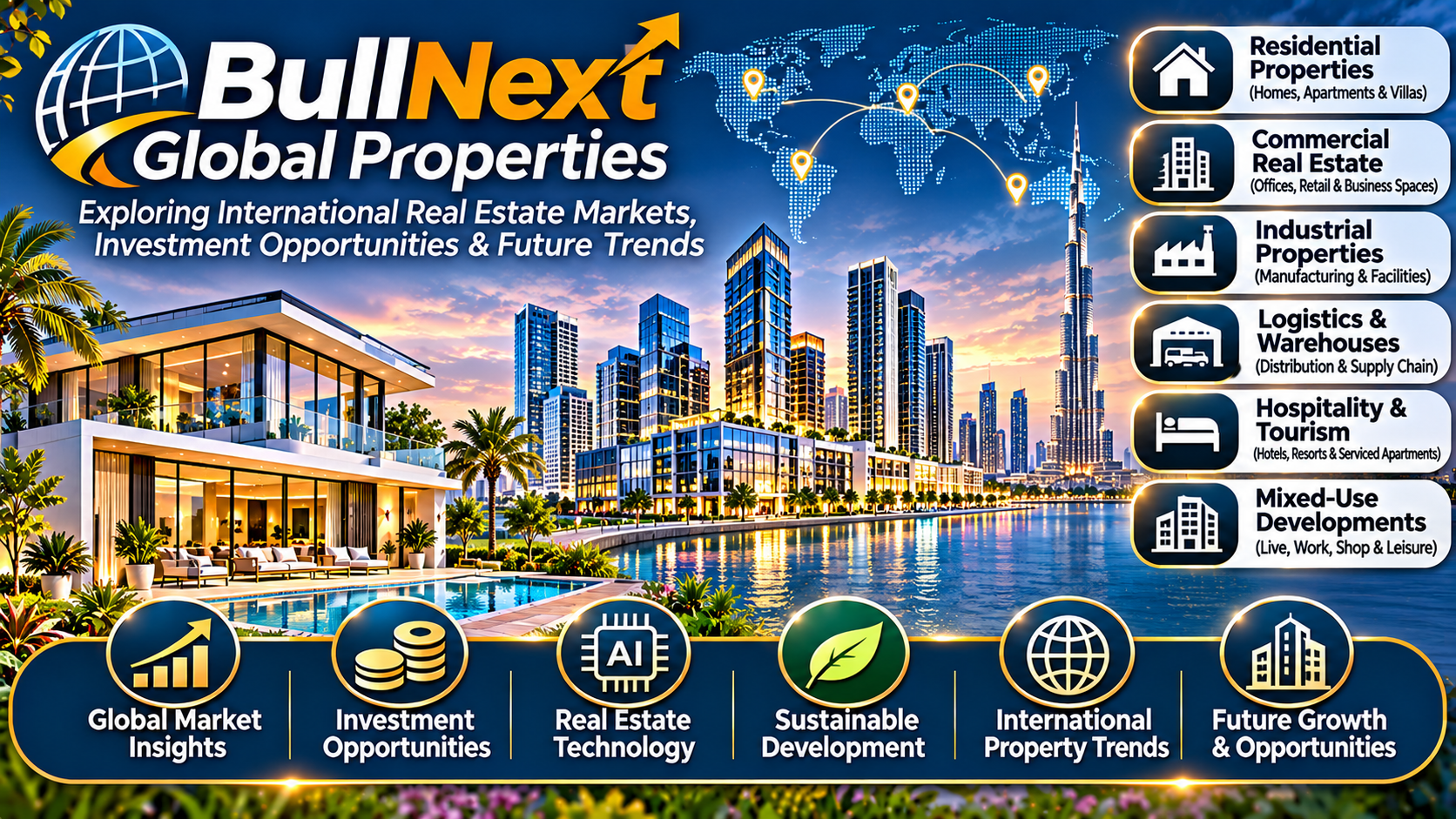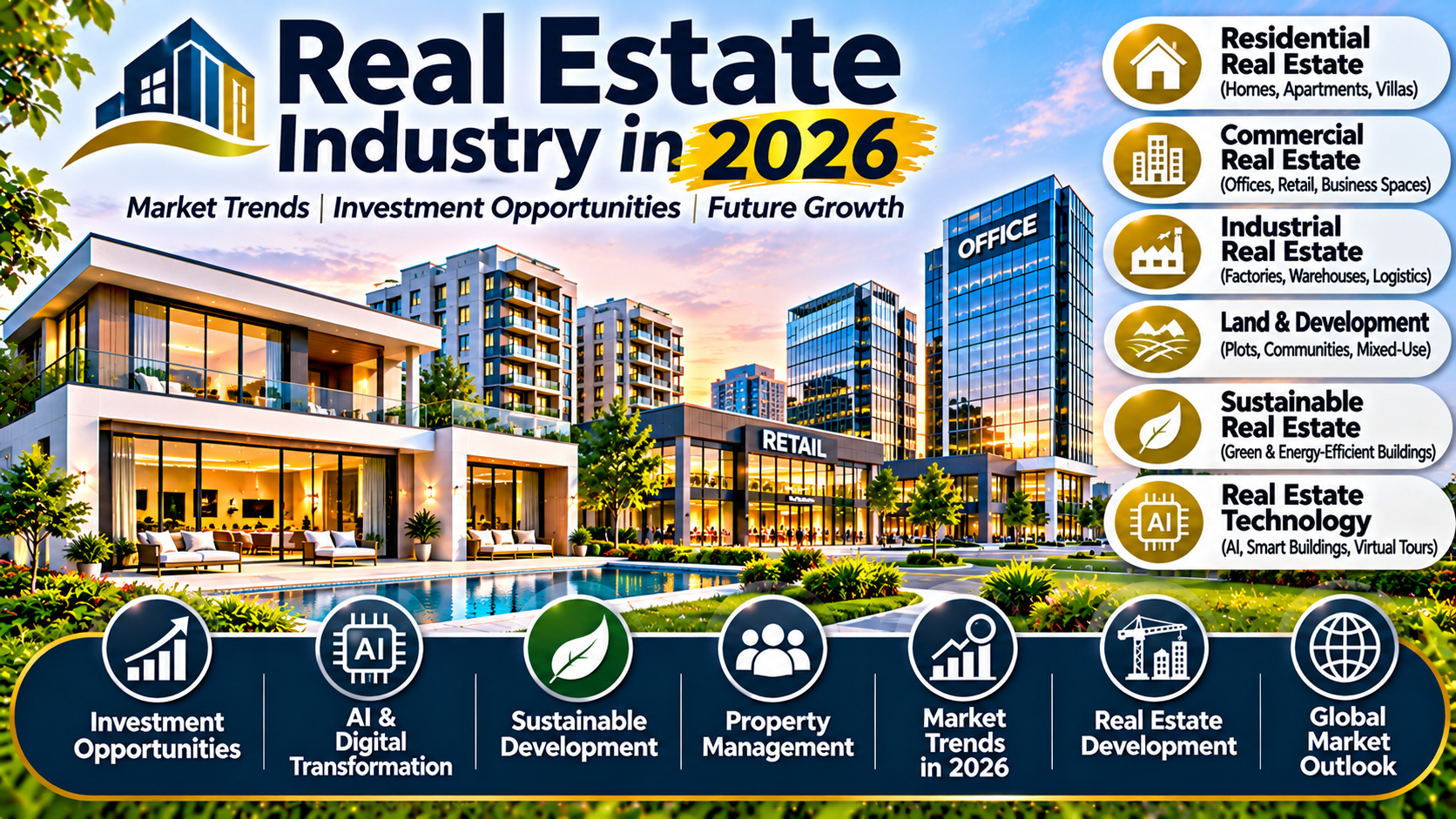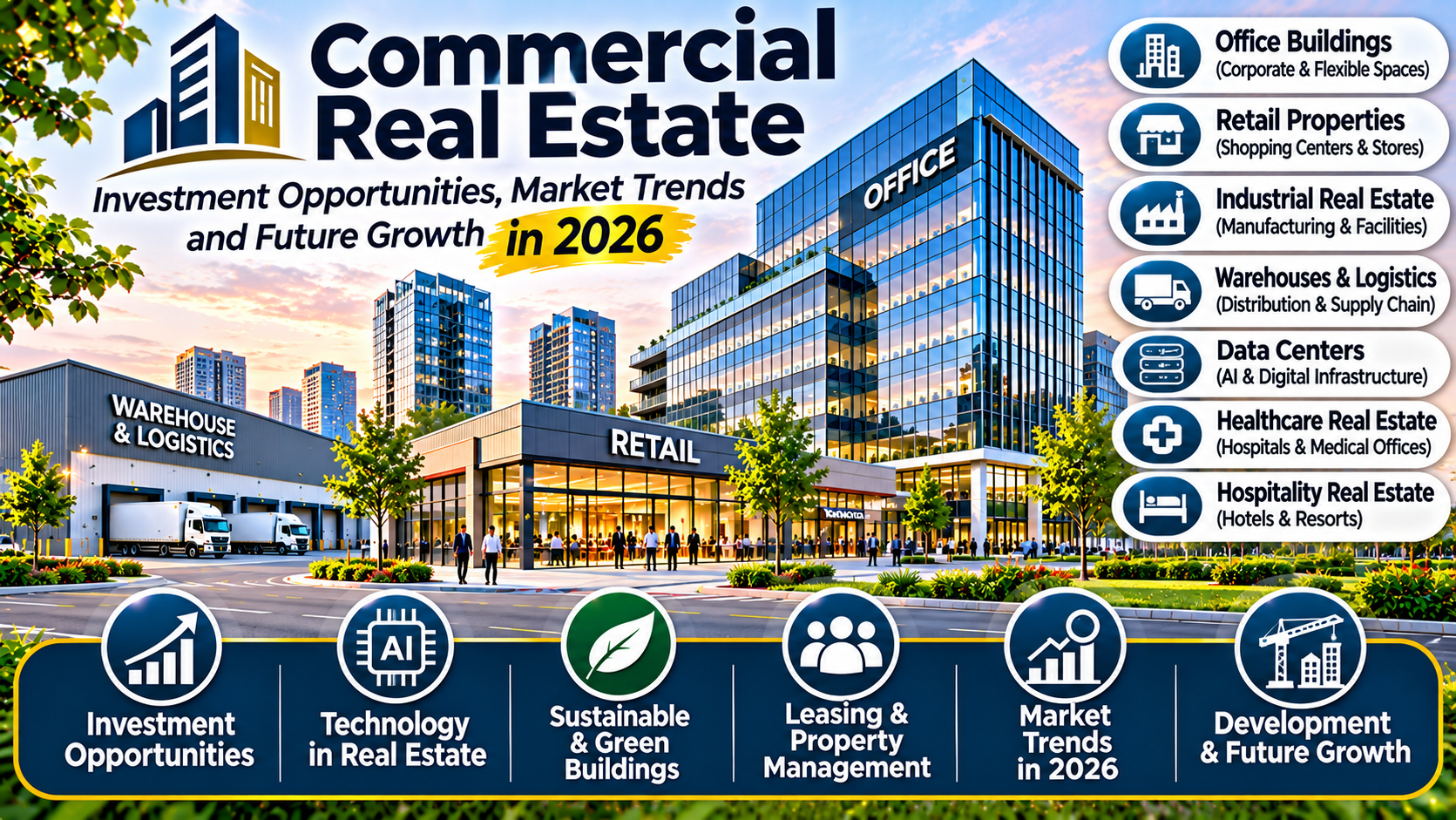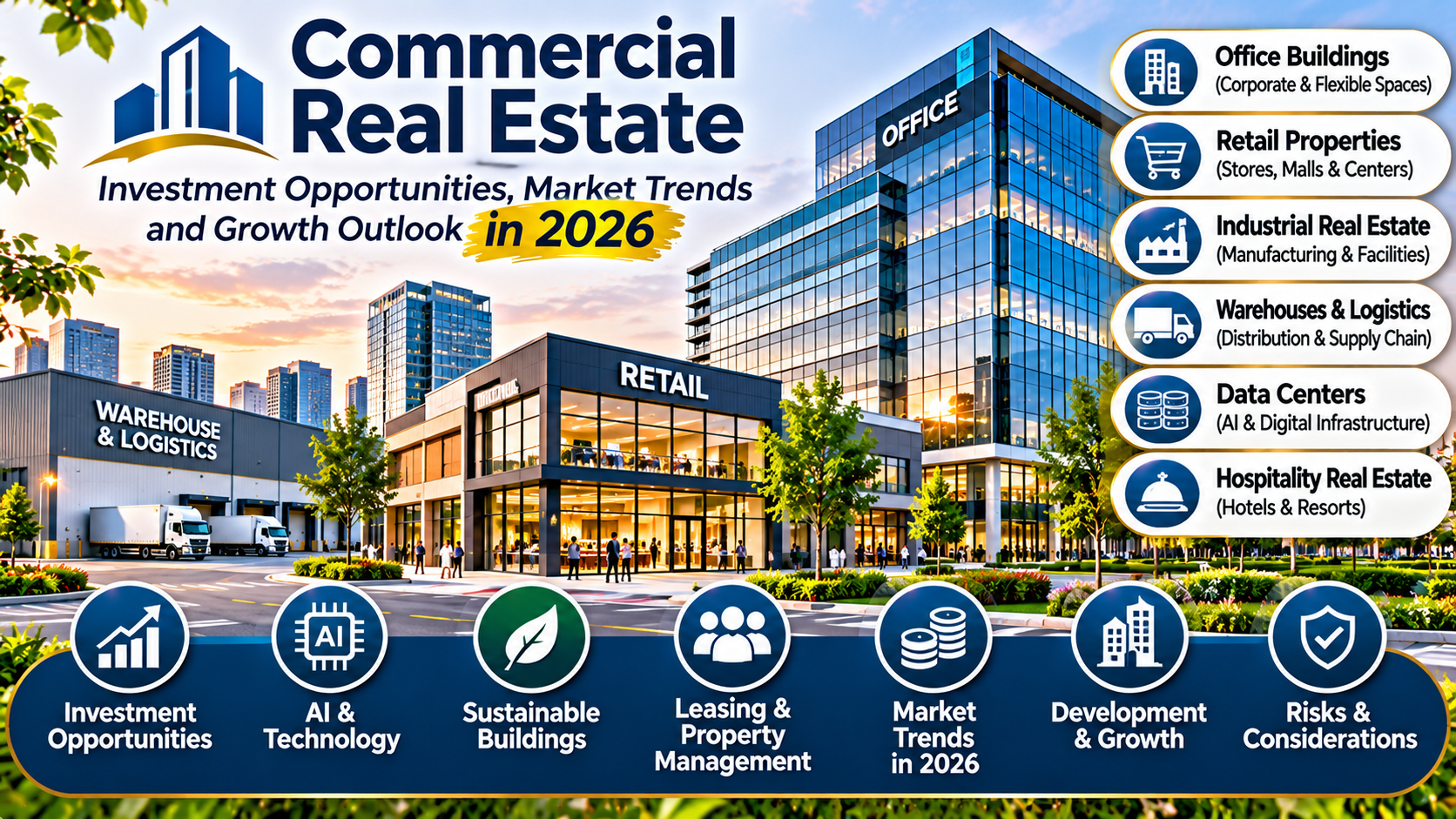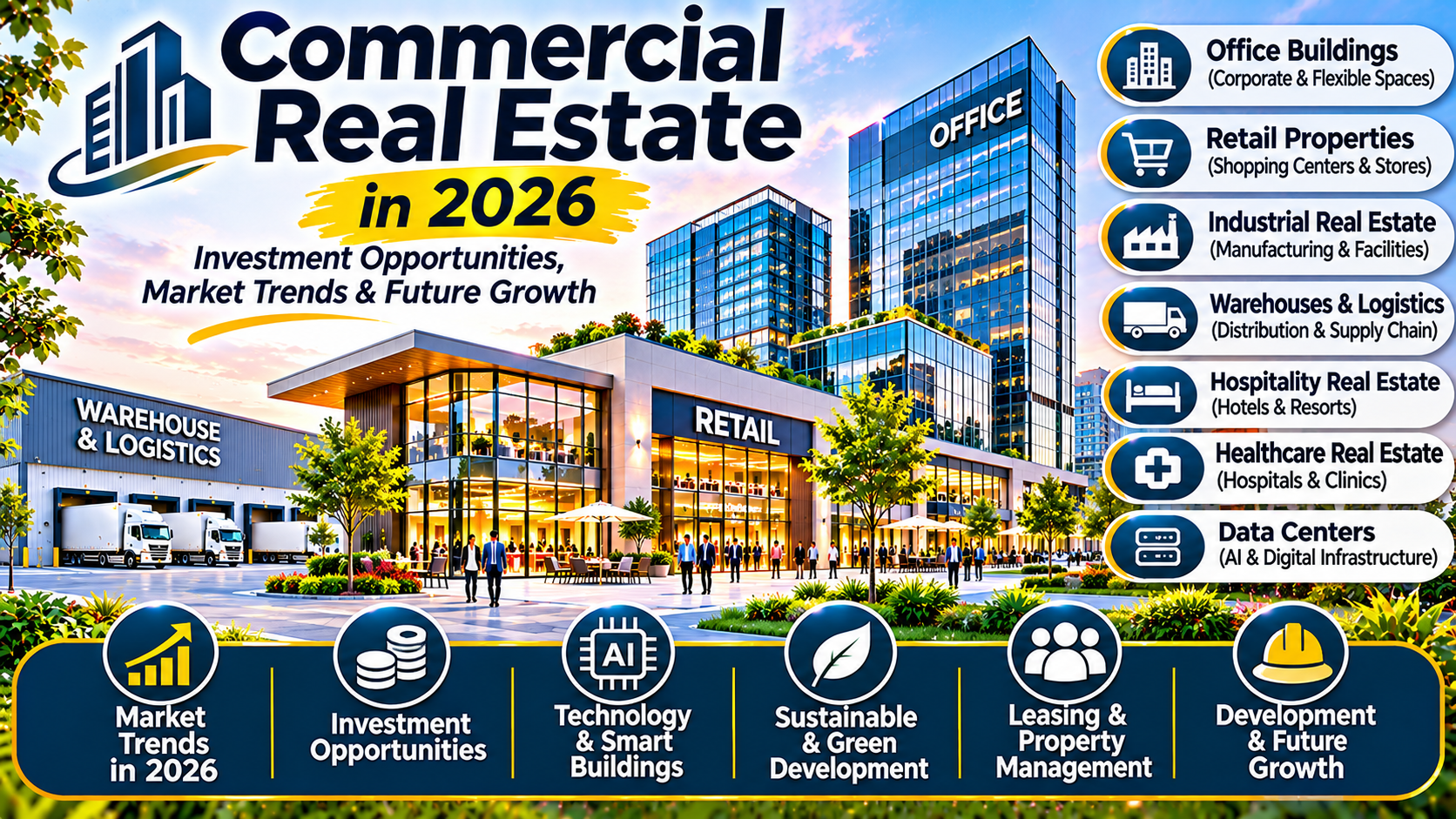
Commercial real estate is a major part of the global property industry, providing the buildings and infrastructure businesses need to operate, grow, and serve customers. From modern office towers and shopping centers to industrial warehouses, hotels, healthcare facilities, and data centers, commercial properties support economic activity across numerous industries.
In 2026, commercial real estate is experiencing significant changes driven by technology, business expansion, evolving workplace requirements, e-commerce, and sustainability. Investors are paying greater attention to property quality, rental income, tenant stability, financing costs, and long-term market demand.
The industry also offers opportunities for developers, property owners, real estate agencies, and institutional investors. However, successful investment requires careful research, financial planning, and an understanding of local market conditions.
This guide explores the commercial real estate market, its major property categories, investment strategies, financial fundamentals, technology, challenges, and future opportunities.
1. What Is Commercial Real Estate?
Commercial real estate (CRE) refers to land and buildings primarily used for business operations, commercial activities, or income generation.
Unlike residential properties, which are mainly designed for individuals and families, commercial properties support companies, retailers, manufacturers, service providers, and institutions.
The commercial real estate industry includes:
Commercial property buying and selling
Office and retail leasing
Industrial property development
Warehouse and logistics management
Commercial property investment
Building maintenance and management
Real estate financing
Property valuation and consulting
Commercial property owners may generate income through rental agreements, property appreciation, redevelopment, or the sale of completed projects.
2. Major Types of Commercial Real Estate
Commercial real estate includes several property categories. Each serves different business requirements and has its own investment characteristics.
Office Buildings
Office buildings provide professional workplaces for businesses, corporations, government organizations, and service providers.
Common types include:
Corporate office towers
Business parks
Class A office buildings
Class B office buildings
Class C office buildings
Coworking spaces
Flexible office facilities
Modern offices often include conference rooms, parking facilities, advanced security, high-speed internet, energy-efficient systems, and shared amenities.
In 2026, businesses are increasingly selective about office locations and building quality. Flexible layouts, employee facilities, accessibility, and technology infrastructure can influence tenant demand.
Retail Real Estate
Retail real estate includes properties used by businesses to sell products and services directly to consumers.
Examples include:
Shopping malls
Shopping centers
Retail plazas
Supermarkets
Restaurants
Standalone retail shops
Outlet centers
High-street commercial properties
Retail developments increasingly combine shopping with dining, entertainment, fitness, and other experiences.
Property owners must consider customer traffic, tenant quality, local purchasing power, parking, accessibility, and competition from online retailers.
Industrial Real Estate
Industrial real estate supports manufacturing, production, storage, and distribution activities.
Common property types include:
Manufacturing plants
Industrial parks
Production facilities
Distribution centers
Logistics buildings
Cold-storage facilities
Light industrial units
Industrial property demand is influenced by manufacturing activity, transportation infrastructure, supply-chain requirements, and business expansion.
Warehouse and Logistics Properties
Warehouses and logistics facilities play an important role in modern supply chains.
They provide space for storing, processing, sorting, and distributing products.
Important categories include:
E-commerce fulfillment centers
Regional distribution warehouses
Cold-storage buildings
Last-mile delivery facilities
Automated storage facilities
Transportation hubs
Location is particularly important because road access, delivery times, transportation expenses, and proximity to customers can affect operational efficiency.
Hospitality Real Estate
Hospitality real estate includes properties used for accommodation, tourism, and business travel.
Examples include:
Hotels
Resorts
Serviced apartments
Convention centers
Conference facilities
Extended-stay properties
Hospitality property performance depends on tourism, business travel, location, customer demand, operating expenses, and service quality.
Healthcare Real Estate
Healthcare real estate includes specialized properties used for medical and healthcare services.
Examples include:
Hospitals
Medical office buildings
Diagnostic centers
Specialist clinics
Rehabilitation facilities
Senior living communities
These properties require specialized infrastructure, safety standards, accessibility, and regulatory compliance.
Data Centers
Data centers are specialized commercial facilities that support digital infrastructure.
They contain servers, networking equipment, storage systems, and computing infrastructure used by technology companies and organizations.
Their important requirements include:
Reliable electricity
Backup power systems
Cooling infrastructure
High-speed connectivity
Physical security
Fire protection
Operational reliability
Growing demand for cloud computing, artificial intelligence, and digital services has increased attention on data center development.
3. Commercial Real Estate Market Trends in 2026
The commercial real estate market in 2026 is shaped by economic conditions, financing costs, business demand, and technological development.
Different property sectors may experience different market conditions. A modern warehouse in a strategic logistics location, for example, may have very different investment characteristics from an older office building in an oversupplied market.
Several factors are influencing commercial property decisions.
Changing Interest Rates
Interest rates affect commercial mortgages, construction financing, refinancing, and investment returns.
Higher financing costs can reduce purchasing power and make development projects more expensive.
Demand for Modern Office Spaces
Businesses are evaluating office buildings based on location, flexibility, employee experience, energy efficiency, and technology infrastructure.
Older properties may need renovations or repositioning to remain competitive.
Growth of E-Commerce
Online shopping continues to influence demand for distribution centers, fulfillment facilities, and last-mile logistics properties.
Expansion of Digital Infrastructure
Artificial intelligence and cloud computing are increasing interest in data centers and supporting infrastructure.
Sustainability Requirements
Property owners and developers are paying greater attention to energy consumption, environmental performance, and operating efficiency.
Selective Investment Decisions
Investors are increasingly examining property fundamentals, tenant financial strength, rental income, and financing risks rather than relying only on expected appreciation.
4. Why Invest in Commercial Real Estate?
Commercial real estate offers several potential investment opportunities.
Rental Income
Property owners can lease commercial buildings to businesses and receive recurring rental payments.
Lease structures may include fixed rent, scheduled increases, or additional expense-sharing arrangements.
Long-Term Ownership
Commercial properties may provide opportunities for long-term asset ownership and potential appreciation.
However, property values can decline, and future growth is not guaranteed.
Portfolio Diversification
Investors can diversify their portfolios through different commercial property categories, including offices, warehouses, retail centers, and healthcare buildings.
Property Development
Developers can acquire land, construct commercial buildings, renovate existing properties, or reposition underperforming assets.
Business Opportunities
Commercial property ownership can support additional services, including property management, leasing consultancy, maintenance, and commercial real estate marketing.
5. Commercial Real Estate Investment Strategies
Investors use different strategies depending on their capital, financial objectives, experience, and risk tolerance.
Core Investment
Core investment focuses on established properties in desirable locations with relatively stable occupancy and reliable tenants.
Examples include modern office buildings and well-positioned commercial properties with established rental income.
Value-Add Investment
Value-add investment involves purchasing properties that require improvements to increase their income potential or market value.
Common improvements include:
Building renovations
Energy-efficient upgrades
Modern security systems
Improved tenant facilities
Better property management
Updated interiors and layouts
Opportunistic Investment
Opportunistic investment focuses on properties or projects with greater uncertainty and potentially higher returns.
Examples include vacant buildings, major redevelopment projects, and new commercial construction.
These investments require significant research, financing, and professional management.
Real Estate Investment Trusts
Real Estate Investment Trusts (REITs) provide investors with access to real estate portfolios without requiring direct ownership of entire buildings.
Depending on their structure, REITs may invest in office buildings, shopping centers, industrial properties, warehouses, and healthcare facilities.
Investors should review the portfolio, fees, leverage, management, and distribution policies before investing.
6. Understanding Commercial Property Financial Performance
Financial analysis is essential when purchasing or developing commercial property.
Net Operating Income
Net Operating Income (NOI) measures the income a property generates after operating expenses are deducted.
Formula:
NOI = Effective Gross Income − Operating Expenses
Example:
Financial item | Amount |
|---|---|
Annual rental income | $250,000 |
Vacancy and collection losses | $10,000 |
Operating expenses | $70,000 |
Net Operating Income | $170,000 |
The illustrative property generates an NOI of $170,000.
Capitalization Rate
The capitalization rate, or cap rate, measures the relationship between annual NOI and property value.
Formula:
Cap Rate = (Annual NOI ÷ Property Value) × 100
Example:
Annual NOI: $170,000
Property purchase price: $2,000,000
Cap Rate = ($170,000 ÷ $2,000,000) × 100
Cap Rate = 8.5%
This is an illustrative calculation, not a market benchmark or guaranteed return.
Cash Flow
Cash flow represents the money remaining after relevant operating and financing expenses.
A commercial property can generate positive NOI but still produce negative cash flow if debt repayments and other costs are high.
Return on Investment
Return on Investment (ROI) measures the financial gain relative to the capital invested.
Investors should consider acquisition expenses, renovation costs, financing, taxes, management expenses, and selling costs when calculating returns.
7. Commercial Property Leasing and Rental Agreements
Leasing is one of the primary methods through which commercial property owners generate income.
A commercial lease establishes the rights and responsibilities of the landlord and tenant.
Important lease conditions include:
Monthly or annual rent
Lease duration
Security deposit
Rent increases
Maintenance responsibilities
Utility payments
Insurance requirements
Renewal conditions
Early termination provisions
Common Commercial Lease Types
Gross Lease: The tenant pays an agreed rent, while the landlord generally covers specified property operating expenses.
Net Lease: The tenant pays rent and certain additional property expenses according to the agreement.
Triple Net Lease: The tenant typically pays base rent plus specified property taxes, insurance, and maintenance expenses.
Percentage Lease: The tenant pays base rent and an additional amount calculated using a percentage of sales.
Lease arrangements vary across countries and markets. Legal professionals should review commercial agreements before signing.
8. Technology Transforming Commercial Real Estate
Technology is changing the way commercial properties are marketed, leased, operated, and maintained.
Artificial Intelligence
AI tools can help commercial real estate businesses analyze data and improve operational efficiency.
Potential applications include:
Property valuation support
Market research
Tenant communication
Automated reporting
Lead generation
Lease document analysis
Predictive maintenance
Energy management
AI-generated information should be verified using reliable data and professional judgment.
Smart Building Technology
Smart buildings use connected systems to improve building performance.
Examples include automated lighting, access control, temperature management, security monitoring, and energy consumption tracking.
Virtual Property Tours
Virtual tours allow potential tenants and investors to examine commercial properties remotely.
They can make property marketing more accessible and reduce the need for initial physical visits.
Digital Property Management
Property management platforms can help owners manage leases, maintenance requests, tenant communication, rent collection, and operational records.
9. Sustainability in Commercial Property Development
Sustainability is becoming an important consideration in commercial real estate.
Businesses and investors are increasingly interested in energy-efficient buildings and responsible resource management.
Important sustainable development practices include:
Energy-efficient construction: Improved insulation, efficient lighting, and optimized heating and cooling systems.
Renewable energy: Solar panels and other renewable energy systems may reduce dependence on conventional electricity.
Water conservation: Efficient plumbing, rainwater harvesting, and water recycling can help reduce water consumption.
Sustainable materials: Recycled and responsibly sourced construction materials may reduce environmental impact.
Green building certification: Programs such as LEED provide frameworks for assessing building sustainability.
Sustainable property investments should be evaluated based on construction costs, operating savings, local regulations, and tenant demand.
10. Commercial Real Estate Marketing Strategies
Marketing is essential for property developers, commercial landlords, real estate agencies, and investment companies.
Search Engine Optimization
SEO helps commercial real estate websites attract customers searching for business properties and investment information.
Effective strategies include:
Commercial property landing pages
Location-specific keywords
Optimized property descriptions
Educational real estate articles
Internal linking
Technical SEO
Relevant industry backlinks
Image optimization
Examples of commercial real estate keywords include:
Commercial real estate investment
Office space for rent
Commercial property for sale
Industrial warehouse investment
Retail property development
Commercial real estate market trends
Social Media Marketing
LinkedIn, Facebook, Instagram, TikTok, and YouTube can help commercial property businesses reach potential customers.
Useful content includes property walkthroughs, project updates, business location guides, market analysis, and investment education.
Professional Photography and Video
High-quality photographs, drone footage, floor plans, and virtual tours help prospective tenants understand property features.
Content Marketing
Publishing informative articles about leasing, property investment, commercial development, and market trends can strengthen a company's digital presence.
11. Commercial Real Estate Opportunities in Pakistan
Pakistan's commercial property sector includes office buildings, retail plazas, shopping centers, industrial properties, warehouses, hotels, and mixed-use developments.
Important business markets include Lahore, Karachi, Islamabad, Faisalabad, and other growing commercial centers.
Potential areas of opportunity include:
Modern office spaces
Retail shops and commercial plazas
Industrial facilities
Warehouse and logistics properties
Healthcare buildings
Hospitality developments
Mixed-use commercial projects
Important Checks Before Buying Commercial Property in Pakistan
Buyers should conduct proper due diligence before making a commercial property investment.
Verify land ownership and title documents.
Confirm commercial land-use permissions.
Check relevant development authority approvals.
Review building plans and construction permissions.
Verify taxes, outstanding dues, and utility charges.
Inspect the building and its surrounding infrastructure.
Review existing tenant agreements.
Consult a qualified property lawyer.
Investors should independently verify claims about approvals, rental income, possession dates, and future development.
12. Major Risks in Commercial Real Estate
Commercial real estate can involve financial, legal, and operational risks.
Vacancy Risk
An empty property generates little or no rental income while the owner may still have to pay taxes, insurance, maintenance, and financing costs.
Financing Risk
Higher interest rates or refinancing difficulties can affect investment profitability.
Construction Cost Increases
Changes in material, labor, and equipment costs can make commercial development more expensive.
Tenant Risk
A tenant's financial difficulties or early departure can reduce expected rental income.
Market Oversupply
Too many similar properties in a particular location can create competition, lower rental prices, and increase vacancy.
Legal and Regulatory Risk
Ownership disputes, zoning restrictions, construction approvals, and regulatory changes can delay projects and create unexpected expenses.
13. Leading Commercial Real Estate Companies
The global commercial real estate industry includes property service providers, investment managers, developers, and specialized real estate companies.
Some recognized organizations include:
CBRE Group: Provides commercial real estate services, property management, leasing, valuation, and investment advisory.
JLL: Offers real estate services, workplace solutions, leasing, and property investment management.
Cushman & Wakefield: Provides commercial property advisory, leasing, valuation, and management services.
Colliers: Operates in commercial real estate services, investment management, and property advisory.
Savills: Provides international real estate consultancy and property services.
Prologis: Focuses on industrial and logistics real estate.
These companies operate across different markets and property segments. Their inclusion is for informational purposes and is not an investment recommendation.
14. How to Choose the Right Commercial Property
Selecting a commercial property requires detailed research and financial evaluation.
Before investing, consider the following:
Factor | Important questions |
|---|---|
Location | Is the property accessible and commercially attractive? |
Tenant demand | Are businesses looking for this type of space? |
Purchase price | Is the valuation supported by comparable properties? |
Building condition | Does the property require major repairs? |
Rental income | Is the expected income realistic? |
Operating costs | What are the taxes, insurance, and maintenance expenses? |
Legal status | Are ownership and approvals verified? |
Financing | Are repayment obligations manageable? |
Exit strategy | Can the property be sold or repositioned if necessary? |
A low purchase price does not automatically make a property a good investment. Investors must examine income potential, legal status, building condition, and future marketability.
15. Future of Commercial Real Estate Beyond 2026
The future of commercial real estate will be influenced by technology, business requirements, infrastructure, and changing customer expectations.
AI and Digital Infrastructure
Artificial intelligence and cloud computing may continue to increase demand for data centers and supporting infrastructure.
Modern Office Buildings
Businesses may increasingly prefer flexible, technology-enabled offices with convenient locations and improved employee facilities.
Logistics and Warehousing
E-commerce, distribution networks, and supply-chain modernization may support demand for strategically located logistics properties.
Sustainable Commercial Buildings
Energy-efficient systems and responsible resource management are likely to remain important development priorities.
Mixed-Use Developments
Developments combining offices, retail, hospitality, and residential spaces may attract interest in locations where integrated communities are in demand.
Smart Property Management
Automation and connected systems may help property owners improve maintenance, security, energy performance, and tenant services.
16. Frequently Asked Questions
What is commercial real estate?
Commercial real estate refers to properties used mainly for business operations or income generation, including offices, shopping centers, warehouses, hotels, and industrial buildings.
What are the main types of commercial real estate?
The major categories include office buildings, retail properties, industrial facilities, warehouses, logistics centers, hospitality properties, healthcare buildings, and data centers.
Is commercial real estate a good investment in 2026?
Commercial property may provide opportunities for rental income, development, and long-term ownership. However, returns depend on location, tenant demand, financing costs, property quality, and market conditions.
How do commercial property owners make money?
Owners may generate income through rental payments, property appreciation, redevelopment, and property sales.
What is NOI in commercial real estate?
Net Operating Income is the income remaining after property operating expenses are deducted from effective gross income.
What is a cap rate?
A capitalization rate measures a property's annual net operating income as a percentage of its market value or purchase price.
What is the difference between residential and commercial real estate?
Residential properties are primarily used for living, while commercial properties are generally used for business operations, services, and income generation.
What are the biggest commercial real estate risks?
Important risks include vacancies, financing costs, refinancing difficulties, tenant defaults, legal problems, construction delays, and changing market demand.
How can beginners enter commercial real estate?
Beginners should learn about property valuation, commercial leases, financing, legal requirements, and rental income analysis. They can also research REITs as an alternative to directly purchasing commercial buildings.
Conclusion
Commercial real estate in 2026 offers opportunities across office buildings, retail developments, industrial facilities, warehouses, healthcare properties, hospitality, and digital infrastructure.
Technology, changing workplace requirements, e-commerce, and sustainability are reshaping how commercial properties are developed, marketed, leased, and managed.
However, successful commercial property investment requires more than identifying an attractive location. Investors must understand tenant demand, property valuation, operating costs, legal documentation, financing arrangements, and long-term market conditions.
A strong commercial real estate strategy focuses on quality assets, realistic financial expectations, reliable tenants, and professional property management.