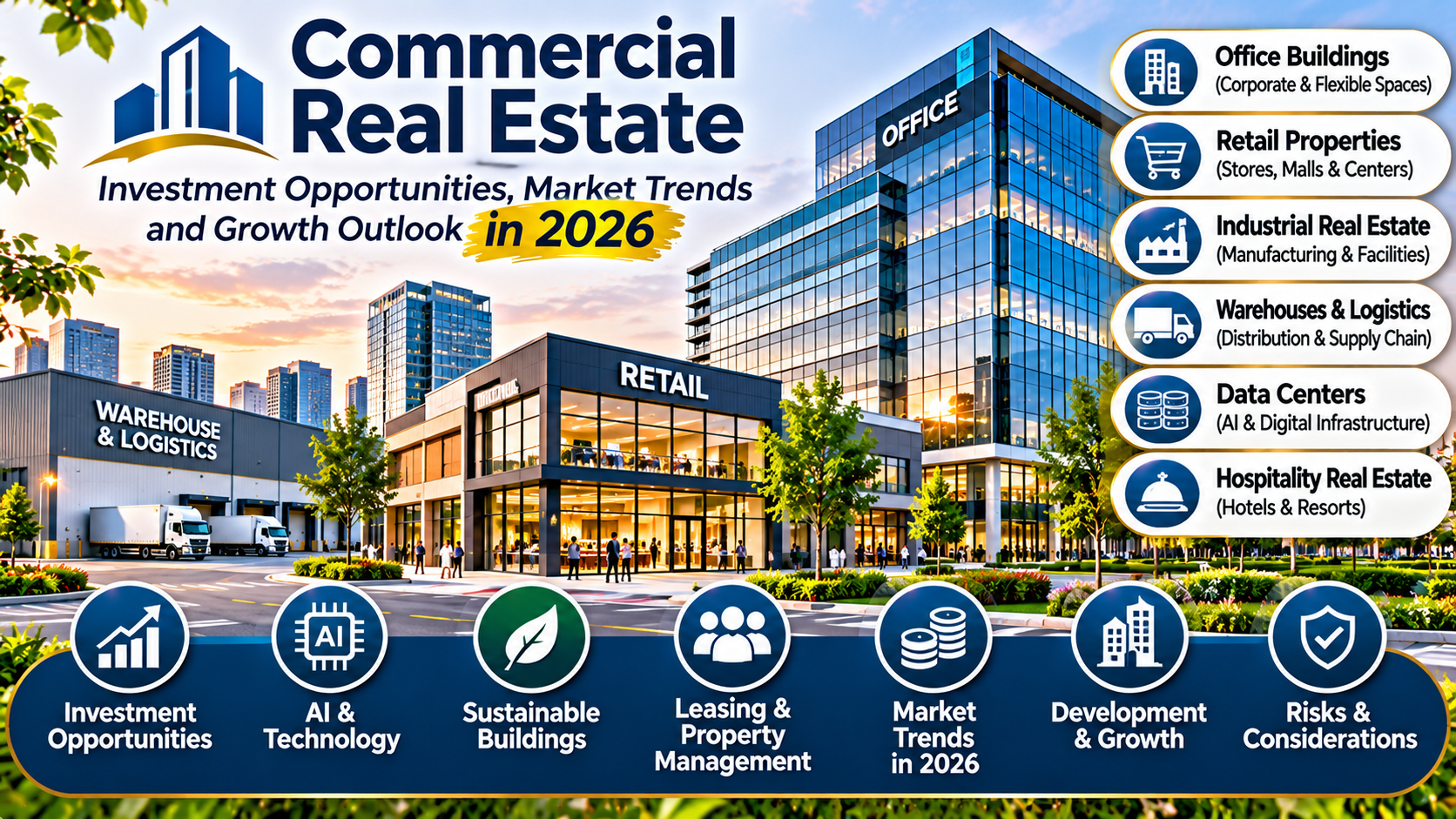
Commercial real estate is an essential part of the global economy, providing the physical spaces businesses need to operate, serve customers, manufacture products, and manage their operations. From modern office buildings and shopping centers to warehouses, hotels, and industrial facilities, commercial properties support employment, investment, trade, and economic development.
In 2026, the commercial real estate industry is experiencing significant changes. Businesses are reconsidering office requirements, retailers are adapting to changing shopping habits, and logistics companies are investing in modern distribution facilities. At the same time, artificial intelligence, data centers, smart buildings, and sustainable construction are creating new opportunities for property owners and investors.
The investment environment is also evolving. Investors are paying closer attention to property quality, rental income, financing costs, tenant demand, and long-term operating expenses. Instead of treating all commercial properties equally, many are focusing on specific locations and property types with stronger underlying demand.
This comprehensive guide explores commercial real estate in 2026, including its major property categories, investment opportunities, market trends, technology, sustainability, risks, and future outlook.
1. What Is Commercial Real Estate?
Commercial real estate, commonly known as CRE, refers to land and buildings used primarily for business, commercial, income-generating, or investment purposes.
Unlike residential property, which is mainly designed for people to live in, commercial property supports business operations and economic activity.
Commercial real estate includes several major categories:
Office buildings.
Retail stores and shopping centers.
Industrial properties.
Warehouses and distribution facilities.
Hotels and hospitality properties.
Medical and healthcare buildings.
Mixed-use developments.
Specialized facilities such as data centers.
Commercial properties may be owned by individuals, companies, institutional investors, real estate investment trusts, or property development organizations.
They can generate revenue through rent, leasing agreements, property operations, and other commercial arrangements.
2. Major Types of Commercial Real Estate
Understanding the different property categories is important for investors, business owners, developers, and tenants.
A. Office Buildings
Office buildings provide workplaces for companies, professional services, government organizations, and corporate teams.
They range from small professional offices to large corporate towers and business campuses.
Common office property types include:
Corporate headquarters.
Shared office spaces.
Co-working facilities.
Business centers.
Professional office suites.
Medical office buildings.
Technology campuses.
Modern office properties increasingly focus on flexible layouts, employee comfort, collaboration areas, energy efficiency, and reliable digital infrastructure.
In 2026, office demand is becoming increasingly selective. Well-located, modern buildings with attractive amenities may perform differently from older properties that require major renovations.
B. Retail Real Estate
Retail real estate includes buildings and spaces where businesses sell products and services directly to consumers.
Examples include:
Shopping malls.
Retail plazas.
Grocery-anchored shopping centers.
High-street retail stores.
Restaurants.
Convenience stores.
Outlet centers.
Neighborhood shopping complexes.
Physical retail continues to play an important role even as online shopping expands.
Many retailers use physical locations for product demonstrations, customer service, order collection, and convenient local access.
Retail properties with strong locations, suitable tenant combinations, and consistent customer traffic can offer attractive business opportunities.
C. Industrial Real Estate
Industrial real estate supports manufacturing, production, storage, transportation, and distribution activities.
Important property categories include:
Manufacturing facilities.
Industrial parks.
Warehouses.
Distribution centers.
Cold storage facilities.
Logistics hubs.
Assembly plants.
The expansion of e-commerce, international trade, and advanced manufacturing has increased the importance of modern industrial facilities.
Businesses increasingly require properties with efficient transportation access, suitable power infrastructure, loading facilities, and advanced building systems.
D. Warehouse and Logistics Properties
Warehouses and logistics facilities are specialized industrial properties that support inventory management and supply chain operations.
Their importance has increased as businesses seek faster delivery and more efficient distribution networks.
Important features include:
Large storage areas.
Loading docks.
High ceilings.
Truck access.
Inventory management systems.
Automated storage solutions.
Security infrastructure.
Temperature-controlled storage.
Modern distribution centers may also use robotics, artificial intelligence, and automated equipment to improve operational efficiency.
E. Hospitality Real Estate
Hospitality properties provide accommodation, dining, and recreational services.
Examples include:
Hotels.
Resorts.
Serviced apartments.
Conference centers.
Convention facilities.
Extended-stay accommodation.
Hospitality property performance is influenced by tourism, business travel, events, local economic conditions, and customer spending.
F. Healthcare Real Estate
Healthcare real estate includes buildings designed for medical and healthcare services.
Property types include:
Hospitals.
Medical office buildings.
Diagnostic centers.
Outpatient clinics.
Rehabilitation facilities.
Specialized healthcare centers.
Healthcare facilities often require specialized construction, technical equipment, safety systems, and regulatory approvals.
G. Data Centers
Data centers are specialized commercial facilities that house servers, networking equipment, and digital infrastructure.
They support cloud computing, artificial intelligence, online platforms, financial services, and enterprise technology.
Demand for data center facilities is increasing because digital businesses require greater computing capacity, reliable connectivity, electricity, cooling, and security.
Data centers are becoming an important area of commercial real estate investment, although their development requires substantial capital and specialized technical expertise.
3. Commercial Real Estate Market Outlook in 2026
The commercial real estate market in 2026 is showing selective recovery and changing investment preferences.
Performance differs by country, city, property type, and building quality. Investors are paying greater attention to reliable income, tenant demand, property operations, and financing conditions.
CBRE's January 2026 U.S. market outlook projected a 16% increase in commercial real estate investment activity for the year, with investment expected to reach approximately $562 billion. Its report also highlighted improving leasing activity and differences between prime and secondary properties.
These figures relate specifically to the United States and should not be interpreted as a global market forecast.
Several factors are influencing the market.
Interest Rates and Financing Costs
Interest rates affect the cost of borrowing for property acquisitions, construction, and refinancing.
Higher financing costs can reduce investment returns and make new developments more expensive.
Investors are therefore evaluating financing structures, loan maturity dates, interest rate exposure, and the ability of rental income to cover debt payments.
Business Expansion
When companies expand their operations, they may require additional office space, warehouses, retail locations, or manufacturing facilities.
Business confidence, employment growth, and economic activity influence commercial property demand.
Property Supply and Demand
New construction can increase the availability of commercial space, while business expansion can increase demand.
Markets with limited new supply and strong tenant demand may experience better rental conditions than markets with significant vacant inventory.
Quality of Buildings
Modern properties with efficient layouts, suitable locations, strong connectivity, and attractive amenities may have an advantage over older buildings.
In 2026, property quality is an important consideration for both investors and commercial tenants.
4. Commercial Real Estate Investment Opportunities
Commercial property can provide opportunities for rental income, portfolio diversification, and long-term asset ownership.
However, each property type has different operational requirements, financial risks, and tenant demand patterns.
Office Property Investment
Office buildings may generate rental income through long-term leases with businesses and professional organizations.
Potential investment advantages include:
Long-term leasing opportunities.
Corporate tenant demand.
Income from multiple office units.
Potential property value appreciation.
Opportunities to renovate and reposition older buildings.
Investors should evaluate vacancy rates, tenant financial strength, lease expiration dates, building maintenance, and local office demand.
Retail Property Investment
Retail properties can generate rental income from businesses operating in shopping centers and commercial locations.
Potential opportunities include grocery-anchored centers, neighborhood retail, convenience stores, and service-oriented commercial spaces.
Important considerations include customer traffic, tenant quality, accessibility, parking, and the surrounding population.
Industrial Property Investment
Industrial facilities can benefit from manufacturing, logistics, e-commerce, and distribution requirements.
Investors may examine:
Warehouse demand.
Industrial land availability.
Transportation infrastructure.
Tenant lease agreements.
Building specifications.
Power and utility capacity.
Modern industrial buildings may attract tenants seeking efficient operations and reliable infrastructure.
Data Center Investment
Data center real estate is attracting attention because of increasing digital infrastructure requirements.
However, this sector requires specialist knowledge.
Investors must assess electricity availability, cooling systems, network connectivity, water requirements, security, development costs, and regulatory approvals.
Healthcare Property Investment
Medical offices, outpatient centers, and healthcare facilities may benefit from demand for accessible healthcare services.
Investment analysis should consider healthcare regulations, operator experience, tenant stability, building specifications, and long-term service demand.
Hotel and Hospitality Investment
Hospitality properties can generate income through room bookings, food services, events, and other guest facilities.
Their performance is more closely connected to tourism, travel patterns, seasonal demand, and operating costs than many traditional leased commercial properties.
5. Understanding Commercial Property Income and Returns
Commercial real estate investors commonly evaluate properties based on rental income, operating expenses, financing costs, and property value.
One widely used measurement is the capitalization rate, commonly called the cap rate.
What Is a Cap Rate?
A capitalization rate estimates a property's annual net operating income relative to its market value or purchase price.
Formula:
Cap Rate = Net Operating Income ÷ Property Value × 100
For example, consider a commercial property with:
Financial Item | Amount |
|---|---|
Annual rental income | $150,000 |
Annual operating expenses | $50,000 |
Net operating income | $100,000 |
Property purchase price | $1,250,000 |
Cap rate | 8% |
The calculation is:
$100,000 ÷ $1,250,000 × 100 = 8%
This example is illustrative, not a market benchmark or guaranteed investment return.
Net Operating Income
Net operating income, or NOI, represents property income after operating expenses but before financing costs, income taxes, depreciation, and certain capital expenditures.
Common operating expenses may include:
Property management.
Maintenance.
Insurance.
Property taxes.
Utilities paid by the owner.
Common-area expenses.
Investors should examine how these costs may change over time.
Cash Flow
Cash flow represents the money remaining after income and relevant expenses, including debt payments where applicable.
A property can have a positive cap rate but still produce weak cash flow if financing costs or unexpected expenses are high.
Return on Investment
Return on investment helps investors evaluate the financial performance of a property relative to the capital invested.
A complete investment assessment should consider rental income, operating costs, financing, capital improvements, taxes, and potential changes in property value.
6. Technology Transforming Commercial Real Estate
Technology is changing the way commercial buildings are developed, marketed, leased, and managed.
Digital solutions can improve property operations, reduce manual work, and support better investment decisions.
Artificial Intelligence
Artificial intelligence is becoming increasingly useful in commercial real estate.
Potential applications include:
Rental price analysis.
Tenant demand forecasting.
Property valuation support.
Automated customer service.
Lease document analysis.
Predictive maintenance.
Investment research.
Building energy optimization.
AI can help property professionals analyze large datasets, although important financial and legal decisions still require appropriate human review.
Smart Building Technology
Smart buildings use connected systems to monitor and manage building operations.
Examples include:
Automated lighting.
Smart temperature controls.
Digital access systems.
Security monitoring.
Energy management.
Occupancy sensors.
Predictive maintenance systems.
These technologies can improve efficiency and create more convenient environments for tenants.
Virtual Property Tours
Virtual tours allow businesses to inspect commercial properties remotely.
Companies can explore office layouts, retail spaces, warehouses, and other facilities before arranging physical visits.
Property Management Software
Digital property management systems help owners and managers organize:
Tenant information.
Rental payments.
Maintenance requests.
Lease documentation.
Expense records.
Building inspections.
Financial reporting.
These tools can improve administrative efficiency and provide better visibility into property performance.
Digital Leasing and Transactions
Electronic signatures, digital document management, and online payment systems can simplify leasing and transaction processes.
However, digital transactions must comply with applicable legal requirements and security standards.
7. Sustainability and Green Commercial Buildings
Sustainability has become an important consideration in commercial property development and management.
Buildings consume energy and water, generate waste, and influence the environmental performance of cities.
Green building strategies aim to improve efficiency, reduce environmental impact, and support healthier indoor environments.
Energy-Efficient Lighting
LED lighting and automated controls can reduce electricity consumption.
Occupancy sensors and daylight controls can also help prevent unnecessary energy use.
Solar Energy Systems
Commercial buildings may install solar panels to generate electricity and reduce dependence on conventional energy sources.
The financial value of solar installations depends on installation costs, energy prices, sunlight, system performance, and local regulations.
Water Conservation
Water-saving fixtures, efficient cooling systems, rainwater collection, and monitoring technology can help reduce water consumption.
Sustainable Construction Materials
Developers may consider recycled materials, responsibly sourced timber, low-emission finishes, and durable construction products.
Green Building Certifications
Several certification systems assess environmental and building performance.
Examples include:
LEED.
BREEAM.
EDGE.
WELL Building Standard.
Certification requirements vary. Investors and tenants should verify the actual certification and rating achieved by an individual property.
8. Commercial Real Estate Leasing: What Businesses Should Know
Leasing is one of the most important activities in commercial real estate.
Businesses lease commercial properties to establish offices, operate retail stores, manage inventory, manufacture products, or provide services.
Before signing a lease, tenants should carefully evaluate the agreement and the property's suitability.
Lease Duration
Commercial leases may have different terms depending on the property type, tenant requirements, and local market conditions.
Businesses should consider how long they expect to use the space and whether expansion or relocation may become necessary.
Rent and Additional Costs
Commercial tenants should understand the complete financial obligations.
These may include:
Base rent.
Service charges.
Maintenance contributions.
Utility expenses.
Property taxes where contractually applicable.
Insurance obligations.
Parking charges.
Tenant Improvements
Some commercial spaces require modifications before business operations can begin.
These improvements may include partitions, lighting, flooring, electrical systems, and specialized equipment.
The lease should clearly explain who is responsible for these expenses.
Location and Accessibility
Location can influence business performance.
Tenants should examine customer access, transportation links, parking, nearby businesses, delivery access, and the surrounding population.
Legal Review
Commercial leases can contain complex terms concerning rent increases, repairs, renewal options, termination, insurance, and permitted activities.
Qualified legal review can help businesses understand their rights and responsibilities.
9. Commercial Real Estate Development Process
Commercial property development requires detailed planning, financial resources, technical expertise, and regulatory compliance.
The process usually involves several stages.
Step 1: Market Research
Developers analyze demand, competing properties, rental rates, local businesses, population trends, and economic conditions.
Step 2: Site Selection
The location must support the intended commercial use.
Developers evaluate road access, utilities, zoning, land characteristics, transportation, and surrounding infrastructure.
Step 3: Financial Feasibility
A project budget should include land acquisition, construction, professional fees, financing, taxes, marketing, and operating costs.
Developers also estimate rental income, occupancy, and potential sales revenue.
Step 4: Design and Approvals
Architects and engineers prepare building plans.
The project must obtain relevant permissions and comply with planning regulations, building codes, fire safety requirements, and environmental standards.
Step 5: Construction
Construction teams coordinate labor, contractors, materials, equipment, quality control, and project schedules.
Step 6: Leasing and Marketing
Developers promote the property to potential tenants and investors.
Marketing may include commercial property websites, brokerage networks, direct outreach, digital advertising, and property exhibitions.
Step 7: Property Management
After completion, the property requires ongoing maintenance, tenant communication, financial administration, inspections, and operational management.
10. Commercial Real Estate Marketing Strategies
Marketing is essential for attracting tenants, buyers, investors, and business customers.
A well-planned marketing strategy helps commercial property companies build visibility and generate qualified inquiries.
Search Engine Optimization
SEO helps commercial real estate websites appear in search engine results.
Important practices include:
Location-specific property landing pages.
Commercial property descriptions.
Relevant keyword research.
Optimized page titles and meta descriptions.
High-quality property images.
Mobile-friendly website design.
Fast loading speeds.
Internal linking.
Useful market research articles.
Social Media Marketing
Platforms such as LinkedIn, Facebook, Instagram, and YouTube can help property businesses reach potential customers.
Useful content includes:
Office building walkthroughs.
Retail property tours.
Warehouse presentations.
Commercial investment guides.
Market updates.
Development project announcements.
Content Marketing
Educational content can establish credibility and attract people researching commercial property.
Article ideas include commercial lease guides, warehouse investment opportunities, office design trends, property management, and commercial market analysis.
Email Marketing
Email campaigns can help businesses share available properties, investment opportunities, market updates, and company announcements with interested contacts.
Professional Property Photography
High-quality photographs and video presentations help potential tenants and investors understand a property's design, condition, and features.
11. Risks and Challenges in Commercial Real Estate
Commercial real estate can offer investment opportunities, but it also involves financial, operational, legal, and market-related risks.
Economic Uncertainty
Economic slowdowns can affect business expansion, tenant demand, consumer spending, and rental payments.
High Financing Costs
Higher borrowing costs can reduce investment returns and make refinancing more difficult.
Vacancy Risk
Commercial properties may experience extended vacancy periods if businesses close, relocate, or reduce their space requirements.
Vacant properties can continue generating maintenance, insurance, tax, and financing expenses.
Tenant Concentration
A property that depends heavily on one major tenant may face significant income disruption if that tenant leaves or experiences financial difficulties.
Property Maintenance
Commercial buildings require regular inspections, repairs, equipment servicing, and compliance checks.
Unexpected maintenance expenses can affect operating performance.
Changing Business Requirements
Remote work, digital commerce, automation, and changing customer preferences can influence demand for different types of commercial space.
Regulatory and Environmental Compliance
Property owners must comply with applicable zoning, building safety, environmental, accessibility, and business regulations.
Failure to meet these requirements can create financial and legal consequences.
12. Commercial Real Estate Trends to Watch in 2026
Several trends are shaping commercial property demand and investment strategies.
AI and Data Center Infrastructure
Artificial intelligence is increasing demand for digital infrastructure.
Data centers require reliable power, advanced cooling, strong connectivity, and specialized building systems.
Modern Office Buildings
Companies are increasingly selective about office locations and facilities.
High-quality buildings with convenient access, modern amenities, collaboration spaces, and efficient operations may attract stronger tenant interest.
Industrial and Logistics Demand
E-commerce, advanced manufacturing, and supply chain restructuring are supporting demand for modern warehouses and distribution facilities.
Grocery-Anchored Retail Centers
Retail properties anchored by grocery stores and essential services may benefit from recurring customer visits and neighborhood demand.
Flexible Workspaces
Co-working offices and flexible leasing arrangements provide businesses with alternatives to traditional long-term office commitments.
Energy-Efficient Buildings
Energy costs and sustainability expectations are encouraging owners to improve building efficiency.
Healthcare and Specialized Properties
Healthcare facilities and other specialized properties may attract interest because they serve specific business and community requirements.
Greater Investment Selectivity
Investors are increasingly focused on asset quality, location, tenant strength, operating performance, and realistic financing assumptions rather than relying only on expected property appreciation.
13. Commercial Real Estate Companies and Industry Leaders
The commercial real estate industry includes property brokerage firms, investment managers, advisory organizations, developers, and research companies.
Some major international organizations include:
Company | Main Business Focus |
|---|---|
CBRE | Commercial real estate services and investment |
JLL | Property services, advisory, and investment management |
Cushman & Wakefield | Commercial real estate services |
Colliers | Property advisory and investment services |
Savills | International real estate consulting |
Newmark | Commercial property services and capital markets |
Prologis | Industrial and logistics real estate |
Brookfield Properties | Global property ownership and development |
Hines | Real estate investment and development |
Related Companies | Large-scale property development |
These organizations operate across different markets and business segments, including property management, leasing, investment, development, and advisory services.
14. Commercial Real Estate in Emerging Markets
Emerging markets offer different commercial property opportunities depending on economic growth, infrastructure, business activity, and regulatory conditions.
Countries across Asia, the Middle East, and Africa are developing commercial centers, logistics facilities, industrial zones, and mixed-use projects.
Pakistan's Commercial Real Estate Market
Pakistan's commercial property sector includes office buildings, retail centers, shopping malls, warehouses, industrial facilities, business plazas, and mixed-use developments.
Major urban markets such as Karachi, Lahore, Islamabad, Faisalabad, and other growing cities support different types of commercial activity.
Potential areas of interest include:
Retail and shopping developments.
Industrial and logistics facilities.
Office and business centers.
Healthcare properties.
Mixed-use commercial projects.
Warehousing and distribution facilities.
However, local property investment requires careful examination of title documents, approved land use, development permissions, utility availability, taxes, market demand, and transaction procedures.
Investors should also consider financing costs, economic conditions, currency exposure where relevant, and the reliability of projected rental income.
15. How to Evaluate a Commercial Property Before Investing
Before purchasing a commercial property, investors should conduct detailed due diligence.
1. Examine the location: Evaluate transportation access, nearby businesses, population, infrastructure, and future development plans.
2. Review rental income: Check current rents, lease agreements, payment history, and potential rental growth.
3. Analyze occupancy: Examine vacancy levels, tenant retention, and the time required to find replacement tenants.
4. Inspect the building: Review structural conditions, electrical systems, plumbing, elevators, fire safety, and maintenance requirements.
5. Calculate operating expenses: Include property management, insurance, taxes, repairs, utilities, and service charges.
6. Evaluate financing: Examine loan terms, interest rates, repayment obligations, and refinancing risks.
7. Verify legal documents: Confirm ownership, permitted use, building approvals, lease rights, and outstanding liabilities.
8. Assess future demand: Research local business activity, competing developments, and changes in industry requirements.
9. Consult professionals: Obtain independent advice from property valuers, lawyers, accountants, engineers, and relevant market specialists.
A detailed assessment can help investors avoid unsuitable properties and make more informed financial decisions.
16. The Future of Commercial Real Estate Beyond 2026
Commercial real estate is likely to continue evolving as businesses adapt to new technology, consumer expectations, and economic conditions.
AI-Integrated Buildings
Artificial intelligence may support building operations, predictive maintenance, energy optimization, tenant services, and property investment analysis.
Growth of Digital Infrastructure
Data centers and related infrastructure may become increasingly important as cloud computing and AI workloads expand.
Flexible Commercial Spaces
Businesses may continue seeking adaptable office and retail spaces that can change with operational requirements.
Sustainable Property Development
Energy-efficient construction, renewable power, water conservation, and climate resilience may become more important in commercial development decisions.
Advanced Industrial Facilities
Manufacturing and logistics companies may require buildings designed for automation, robotics, higher power capacity, and more efficient distribution.
Experience-Driven Retail
Retail developments may focus more on dining, entertainment, services, and customer experiences alongside traditional shopping.
Data-Driven Property Management
Property owners may increasingly use digital platforms to monitor occupancy, rental performance, operating expenses, maintenance, and tenant satisfaction.
17. Frequently Asked Questions About Commercial Real Estate
What is commercial real estate?
Commercial real estate refers to properties primarily used for business activities, investment, and income generation. Examples include offices, shopping centers, warehouses, hotels, and industrial buildings.
What are the main types of commercial real estate?
The main categories include office, retail, industrial, logistics, hospitality, healthcare, and specialized properties such as data centers.
Is commercial real estate a good investment in 2026?
Commercial real estate may offer rental income and long-term investment opportunities, but results depend on location, property quality, financing, tenant demand, and operating costs. Returns are not guaranteed.
How does commercial real estate generate income?
Commercial property can generate income through rent, leasing agreements, business occupancy, property operations, and the eventual sale of assets.
What is a commercial property cap rate?
A capitalization rate measures annual net operating income as a percentage of a property's market value or purchase price.
What is the difference between commercial and residential real estate?
Commercial real estate is primarily used for business purposes, while residential real estate is mainly designed for people to live in.
Why are warehouses important in commercial real estate?
Warehouses support storage, inventory management, e-commerce, manufacturing, and distribution operations. Their importance is connected to supply chain and logistics requirements.
What is a commercial lease?
A commercial lease is a legal agreement that allows a business to occupy and use a property for a specified period under agreed financial and operational conditions.
How is AI changing commercial real estate?
AI can support property analysis, valuation, leasing, maintenance forecasting, customer service, energy management, and investment research.
What are the biggest commercial real estate trends in 2026?
Major trends include data center expansion, modern office demand, industrial logistics, grocery-anchored retail, flexible workspaces, sustainable buildings, and more selective investment strategies.
Conclusion
Commercial real estate remains an important part of the global economy, supporting businesses, employment, manufacturing, retail, logistics, healthcare, and digital infrastructure.
In 2026, the industry is undergoing significant changes as companies reconsider workplace requirements, retailers adapt to new shopping habits, and investors evaluate opportunities in industrial facilities, data centers, and other specialized property categories.
Technology, sustainability, building quality, and efficient property management are becoming increasingly important to commercial real estate performance.
For investors, developers, landlords, and business owners, success depends on understanding local market conditions, evaluating tenant demand, managing operating costs, and making informed financial decisions.
As the industry continues to evolve, commercial properties that combine strong locations, modern facilities, reliable infrastructure, and practical business value may be better positioned to meet future market requirements.