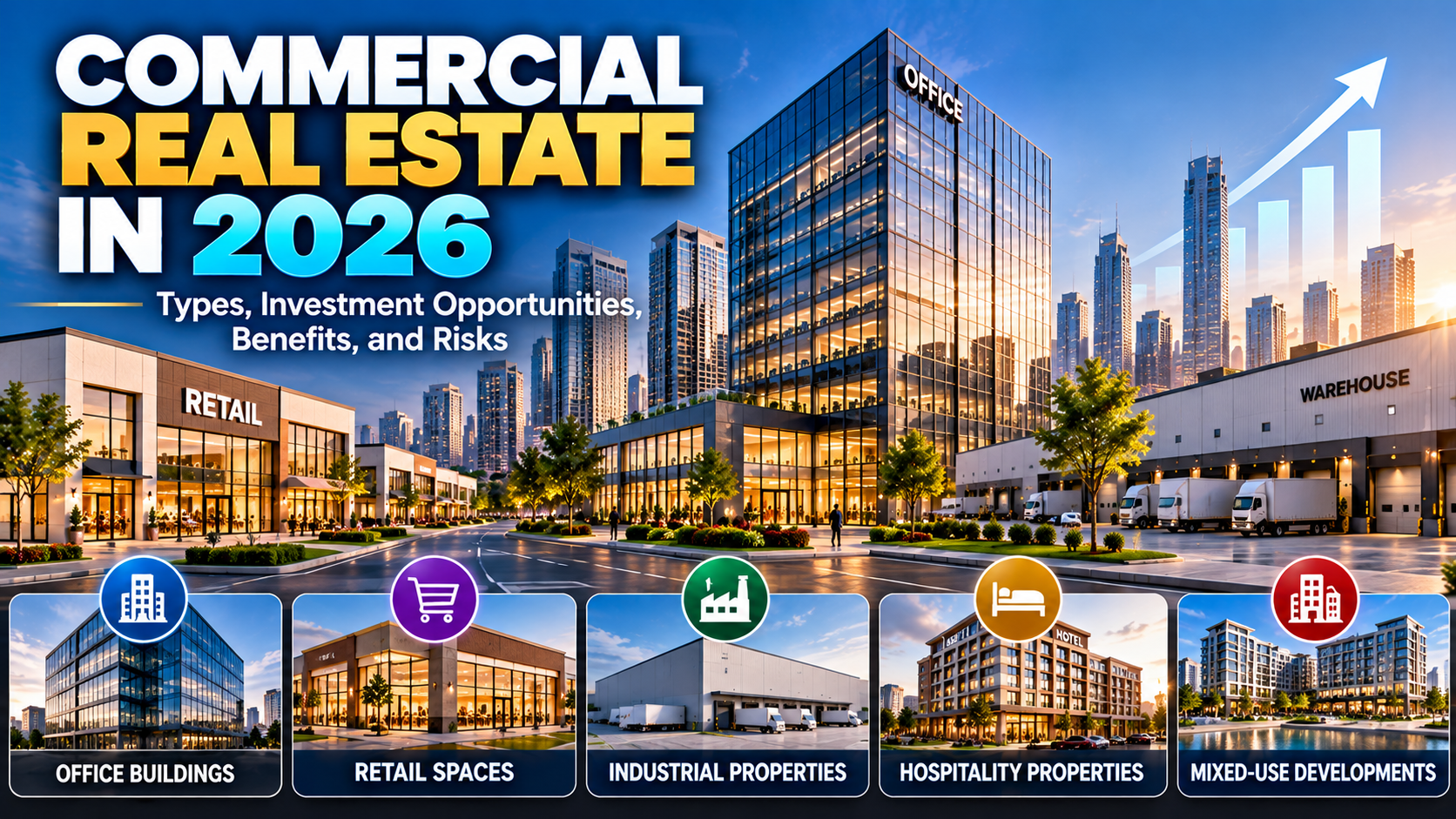
Commercial real estate is an important part of the global property market, providing spaces for businesses, retailers, manufacturers, and service providers. From office buildings and shopping centers to warehouses and industrial facilities, commercial properties support economic activity while offering investors opportunities to generate rental income and long-term returns.
In 2026, commercial real estate investors are evaluating changing business needs, borrowing costs, property prices, and demand for different types of commercial space. While some properties may benefit from growing business activity and logistics demand, others face challenges related to operating expenses, changing workplace habits, and competition from newer developments.
Understanding how commercial real estate works can help investors identify suitable opportunities, evaluate potential returns, and manage risks before committing capital.
What Is Commercial Real Estate?
Commercial real estate (CRE) refers to property primarily used for business, commercial, or income-generating purposes. Unlike residential real estate, which focuses on housing individuals and families, commercial property generally serves businesses, organizations, and commercial tenants.
Common examples include office buildings, retail stores, shopping malls, hotels, warehouses, factories, and mixed-use developments.
Investors can purchase commercial properties directly, lease space to tenants, develop new buildings, or gain exposure through real estate investment trusts (REITs) and real estate funds.
Commercial real estate investments often require detailed financial analysis because property values depend on rental income, occupancy levels, operating expenses, lease agreements, financing costs, and market demand.
Major Types of Commercial Real Estate
Commercial property covers several sectors, each with different income potential, operating requirements, and risks.
1. Office Buildings
Office properties provide workspaces for companies, professional firms, and other organizations. They range from small office suites to large buildings in central business districts.
Office demand can be influenced by employment growth, business expansion, commuting patterns, and remote or hybrid work arrangements.
Investors should evaluate tenant demand, building quality, location, accessibility, lease duration, and the cost of attracting new tenants. Modern facilities and flexible layouts may appeal to some businesses, but no building is guaranteed to maintain high occupancy.
2. Retail Properties
Retail commercial real estate includes shopping malls, supermarkets, neighborhood shopping centers, standalone stores, and restaurant premises.
Retail properties depend on consumer spending, local population, visibility, parking, accessibility, and the strength of nearby businesses.
Locations serving everyday needs may have different demand patterns from properties focused on luxury shopping or discretionary spending.
Before investing, buyers should examine tenant quality, rental agreements, vacancy rates, competition, and the financial health of the businesses occupying the property.
3. Industrial Real Estate
Industrial real estate includes manufacturing facilities, distribution centers, warehouses, and logistics buildings.
Demand for industrial space is influenced by manufacturing activity, transportation networks, inventory requirements, and the movement of goods.
Properties near major highways, ports, transport hubs, or large population centers may appeal to certain logistics operators. However, suitable zoning, building specifications, utilities, and access requirements must be verified.
Industrial properties may require specialized facilities, making it important to understand the needs of potential tenants before purchasing.
4. Multifamily Properties
Multifamily real estate consists of residential buildings containing multiple rental units. In many commercial property classifications, larger apartment complexes are treated as commercial investments.
These properties generate income from multiple tenants rather than relying on a single household. However, investors must account for maintenance, vacancies, insurance, taxes, property management, and local housing regulations.
Rental demand, affordability, population changes, and the supply of competing apartments can all influence performance.
5. Hospitality Properties
Hospitality real estate includes hotels, resorts, serviced apartments, and other accommodation facilities.
Revenue depends on visitor demand, occupancy, room rates, operating costs, and seasonal travel patterns. Unlike some properties with long-term leases, hotels may face significant changes in revenue as tourism and business travel fluctuate.
Hospitality investments often require specialist operational knowledge and careful analysis of local tourism trends.
6. Mixed-Use Developments
Mixed-use properties combine two or more uses, such as residential apartments, retail stores, offices, restaurants, or entertainment spaces.
These developments can attract different types of occupants and create convenient environments for residents and visitors.
However, mixed-use projects can involve complex planning, higher development costs, multiple tenant categories, and additional management requirements.
How Commercial Real Estate Investors Make Money
Investors generally pursue commercial real estate for rental income, capital appreciation, or a combination of both.
Rental Income
An investor purchases a property and leases it to a business or another tenant. Rental income can provide recurring revenue, depending on the lease terms and the tenant's ability to pay.
Some commercial leases require tenants to cover certain operating expenses, while other arrangements leave more costs with the property owner. Investors should carefully review the lease rather than assume that all expenses will be passed to tenants.
Capital Appreciation
Capital appreciation occurs when a property's market value increases. Improvements to the property, stronger rental income, better occupancy, or changes in market conditions may support higher valuations.
However, property values can decline if demand weakens, financing becomes more expensive, or operating income falls.
Property Development
Developers may purchase land, construct commercial buildings, renovate existing properties, or convert buildings for different uses.
Development can create value, but it involves construction expenses, permits, financing, contractor management, and potential delays. Investors must assess whether projected rents and sale prices justify the total cost.
Real Estate Investment Trusts
A real estate investment trust (REIT) allows investors to gain exposure to real estate assets without directly purchasing an entire commercial building.
Depending on its structure and portfolio, a REIT may hold offices, retail centers, warehouses, apartments, or other property assets.
Publicly traded REITs may be easier to buy and sell than direct property, although their share prices fluctuate and distributions are not guaranteed. Investors should research the REIT's holdings, fees, debt levels, and local regulations.
How to Evaluate a Commercial Real Estate Investment
Evaluating commercial property requires more than comparing purchase prices. Investors should analyze both the property's financial performance and its legal and physical condition.
1. Research the Location
Location affects tenant demand, rental rates, accessibility, and resale potential.
Evaluate nearby businesses, transport connections, population and employment trends, competing properties, and future development plans. Confirm that proposed infrastructure projects are officially approved rather than relying on rumors.
2. Examine Rental Income and Occupancy
Review existing leases, rental rates, tenant payment histories, vacancy levels, and lease expiration dates.
A property with high occupancy may still be financially weak if rents are below market levels or major leases are about to expire.
3. Calculate Net Operating Income
Net operating income (NOI) is the property's annual income after operating expenses but before mortgage payments, income taxes, depreciation, and capital expenditures.
A simplified formula is:
Net Operating Income = Effective Rental Income − Operating Expenses
For example, suppose a commercial property generates $240,000 in annual effective rental income and incurs $80,000 in operating expenses.
Its annual NOI would be $160,000.
This figure helps investors compare properties and evaluate the income available before financing costs and other excluded items.
4. Understand the Capitalization Rate
The capitalization rate, commonly called the cap rate, compares a property's net operating income with its purchase price.
Cap Rate = Annual NOI ÷ Property Purchase Price × 100
If a property has an annual NOI of $160,000 and costs $2 million, its cap rate is 8%.
A higher cap rate does not automatically mean a better investment. It may reflect greater risk, weaker tenant demand, a less desirable location, or expected capital expenses. Investors should compare similar properties and assess the reasons behind the difference.
5. Review Financing and Debt
Commercial property financing may involve different loan terms, interest rates, repayment schedules, and refinancing requirements from residential mortgages.
Investors should evaluate debt payments, interest-rate exposure, lender conditions, and whether rental income can comfortably support financing obligations.
A property that appears profitable before debt payments may generate little cash flow after financing costs.
6. Conduct Legal and Physical Due Diligence
Before purchasing, verify property ownership, zoning, building permits, environmental requirements, lease agreements, taxes, insurance, and outstanding liabilities.
A professional inspection can identify structural defects, outdated systems, safety concerns, or expensive repairs.
Independent legal, financial, and technical advice can help identify problems before the transaction is completed.
Benefits of Commercial Real Estate Investment
Commercial property can offer several potential advantages when purchased at a reasonable valuation and managed effectively.
Potential rental income: Leases may provide recurring revenue from business tenants.
Longer lease terms: Some commercial agreements extend over multiple years, although terms vary widely.
Income-based valuation: Investors can analyze rental income and operating expenses to estimate property performance.
Portfolio diversification: Commercial real estate may provide exposure to an asset class different from stocks and bonds.
Multiple investment options: Investors can choose among offices, retail, industrial facilities, multifamily buildings, and REITs.
Potential appreciation: Properties may gain value if income, demand, or market conditions improve.
These benefits depend on the specific property, lease structure, financing, and economic environment. None guarantees a positive return.
Risks of Commercial Real Estate
Commercial real estate can be rewarding, but investors must understand its financial and operational risks.
Vacancy Risk
When tenants leave, rental income may decline while property taxes, insurance, maintenance, and financing expenses continue.
Tenant Concentration
A building that depends on one major tenant may experience a substantial income loss if that tenant defaults or vacates the property.
Interest Rate and Refinancing Risk
Higher borrowing costs can reduce cash flow and property valuations. Investors may also face difficulty refinancing loans if lending conditions tighten.
Economic Downturns
Businesses may reduce space, close locations, or negotiate lower rents during periods of economic weakness.
Maintenance and Capital Expenditure
Commercial buildings can require costly repairs to roofs, elevators, heating and cooling systems, electrical infrastructure, and other facilities.
Limited Liquidity
Selling a commercial building can take time and involve substantial transaction costs. Investors may not be able to access their capital quickly.
Legal and Regulatory Risk
Changes in zoning, building standards, environmental rules, taxes, and lease regulations may affect a property's profitability or permitted use.
Diversifying tenants and property types, maintaining cash reserves, and conducting thorough due diligence can help manage some risks, but they cannot eliminate them.
Commercial Real Estate Trends to Watch in 2026
Commercial property performance varies by country, city, and property category. Rather than assuming that the entire market will rise or fall together, investors should monitor several important developments.
Demand for logistics facilities: Distribution networks and inventory management can influence demand for modern warehouses and logistics properties.
Changing office requirements: Businesses may prioritize flexible layouts, convenient locations, energy efficiency, and high-quality workplace facilities. Demand varies considerably across markets.
Retail adaptation: Retail properties increasingly compete through location, convenience, tenant selection, and customer experience. Local spending patterns remain important.
Operating cost management: Energy efficiency, building maintenance, insurance, and financing expenses can significantly affect net income.
Data-driven property analysis: Digital leasing systems, building-management technologies, and better market data can help owners evaluate occupancy and operating performance.
Selective investment decisions: Investors may focus on properties with sustainable income, reasonable valuations, and manageable debt rather than relying solely on expectations of rising prices.
These are factors to investigate, not predictions that every commercial property sector will perform well in 2026.
Commercial Real Estate Investment for Beginners
New investors should start by defining their budget, preferred investment period, and income goals.
Direct ownership of a commercial building may require substantial capital, specialist advice, and active management. Investors with smaller budgets may explore regulated investment funds or publicly traded REITs where available and appropriate.
Before investing, beginners should:
Research the local commercial property market.
Compare similar properties and realistic rental rates.
Calculate operating expenses and expected net income.
Review tenant quality and lease expiration dates.
Verify ownership, permits, and legal compliance.
Assess financing costs and emergency reserves.
Understand the property's resale market and exit options.
Avoid investments that depend on unrealistic rental growth or guaranteed-profit claims.
A careful investment process is more valuable than making a quick decision based on an attractive listing.
Frequently Asked Questions
What is commercial real estate?
Commercial real estate refers to properties used primarily for business, commercial, or income-generating purposes. Examples include offices, retail stores, warehouses, hotels, and certain multifamily buildings.
Is commercial real estate a good investment in 2026?
It may be suitable for investors who understand the property market, can evaluate rental income and expenses, and can manage the associated risks. Returns depend on location, purchase price, tenants, financing, and economic conditions.
How do commercial real estate investors earn money?
Investors may generate rental income, benefit from capital appreciation, develop properties, or invest through REITs and real estate funds.
What is a good cap rate for commercial property?
There is no single cap rate that is appropriate for every property. The rate depends on location, property type, tenant quality, lease terms, financing conditions, and investment risk. Comparing similar assets is more useful than relying on one universal benchmark.
Is commercial real estate riskier than residential real estate?
The risk depends on the investment. Commercial properties may face concentrated tenant risk, longer vacancies, and larger repair costs. Residential properties have their own risks, including tenant turnover, maintenance, and housing-market fluctuations.
Can beginners invest in commercial real estate with limited money?
Direct ownership can be expensive, but some investors may gain exposure through REITs or property funds. Availability, minimum investments, fees, and regulations vary by market and investment structure.
Conclusion
Commercial real estate provides opportunities to invest in office buildings, retail properties, warehouses, multifamily developments, hospitality assets, and mixed-use projects. Investors may benefit from rental income and property appreciation, but outcomes depend on tenant demand, operating expenses, financing, location, and purchase price.
In 2026, careful research and financial analysis remain essential. By evaluating net operating income, cap rates, lease agreements, legal documentation, and market conditions, investors can make more informed decisions and avoid relying on unrealistic return expectations.
Disclaimer: This article is for educational purposes only and does not constitute financial, legal, tax, or investment advice. Commercial real estate investments involve risks, and readers should conduct independent research and seek qualified professional advice before investing.