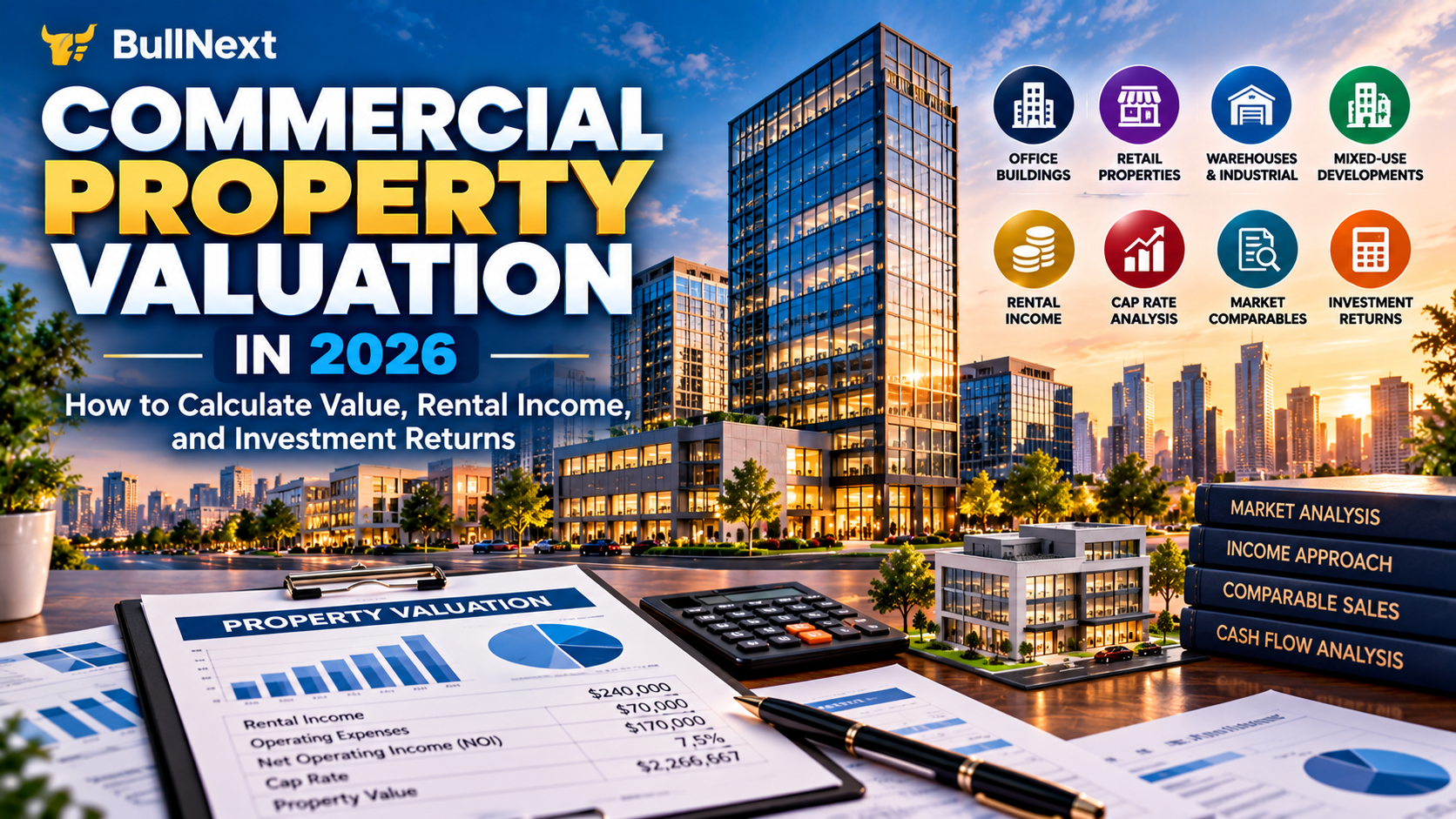
Commercial property valuation is one of the most important steps in real estate investing. Whether an investor is considering an office building, retail center, warehouse, or mixed-use development, understanding a property's value can help determine whether the asking price is reasonable and whether the investment may generate sufficient income.
In 2026, commercial real estate investors must consider more than a building's location and appearance. Rental income, operating expenses, vacancy rates, lease agreements, financing costs, and market conditions all influence property value. A property with strong rental income may still be overpriced, while a lower-priced building may carry hidden maintenance costs or significant vacancy risks.
This guide explains how commercial property valuation works, the main valuation methods, how to calculate rental returns, and what investors should examine before buying or selling a commercial property.
What Is Commercial Property Valuation?
Commercial property valuation is the process of estimating the market value of a property used for business or investment purposes.
The valuation may be required when purchasing a property, selling an asset, refinancing a loan, arranging insurance, settling a legal matter, or assessing an investment portfolio.
A commercial property's value depends on several factors, including:
Location and accessibility.
Current and potential rental income.
Occupancy rates and tenant quality.
Lease duration and renewal conditions.
Building condition and maintenance requirements.
Comparable property transactions.
Interest rates and financing conditions.
Local economic activity and future demand.
Valuation is not an exact prediction of the price a property will sell for. The final transaction price depends on market conditions, negotiations, financing availability, and the circumstances of the buyer and seller.
For significant transactions, investors may need an independent professional valuation that follows the relevant local standards and regulations.
Why Commercial Property Valuation Matters
Accurate valuation helps investors make better-informed decisions and avoid relying solely on asking prices or optimistic income projections.
Avoid Overpaying for Property
A seller may set a price based on expected future development, a desirable location, or an optimistic estimate of rental income.
Investors should independently examine the property's financial performance and compare it with similar assets before deciding whether the asking price is justified.
Estimate Potential Investment Returns
Valuation helps investors compare the property's cost with the income it generates.
A property that produces substantial rent may still offer a weak investment return if the purchase price is too high or operating expenses are excessive.
Support Financing Decisions
Lenders may use property valuations when assessing collateral for commercial real estate loans.
A lower-than-expected valuation may affect how much a lender is willing to finance. Buyers should not assume that a lender will accept the seller's asking price as the property's value.
Assess Buying and Selling Opportunities
Property valuation helps owners evaluate offers and helps buyers compare different investment opportunities.
However, investors should account for transaction costs, potential capital expenditure, and the time it may take to sell a property.
Main Methods of Commercial Property Valuation
Commercial property professionals commonly use several valuation methods. The appropriate approach depends on the property type, available data, and purpose of the valuation.
1. Income Capitalization Method
The income capitalization method estimates a property's value based on its net operating income and an appropriate capitalization rate.
It is particularly useful for income-producing properties with relatively predictable operating performance.
The basic formula is:
Property value = Net operating income ÷ Capitalization rate
For example, suppose a commercial building generates annual net operating income of $150,000 and an appropriate market capitalization rate is 7.5%.
The estimated value would be:
$150,000 ÷ 0.075 = $2,000,000
Under these assumptions, the property would have an estimated value of $2 million.
The result is only an illustration. The capitalization rate must be supported by relevant market evidence, and the income estimate should reflect realistic vacancies, operating costs, and property condition.
A small change in the capitalization rate can materially affect the estimated value.
2. Comparable Sales Method
The comparable sales method estimates a property's value by examining recent sales of similar properties.
For example, an investor evaluating a retail building might compare it with other retail properties in the same area.
Useful comparison factors include:
Location and visibility.
Building size and usable floor area.
Property condition and age.
Tenant occupancy.
Lease terms.
Parking and access.
Sale date and market conditions.
Comparable properties rarely match perfectly. Adjustments may be necessary for differences in condition, size, location, or income.
Recent completed transactions are generally more informative than asking prices alone, although the availability and quality of transaction data vary by market.
3. Cost Approach
The cost approach estimates the cost of replacing or reproducing a building, less depreciation and relevant deterioration, then adds the value of the land.
This approach may be useful for newer buildings, specialized properties, or assets with limited comparable sales.
The method can be less reliable for older properties or buildings whose value depends heavily on rental income and market demand.
Replacement cost should not be confused with market value. A building can be expensive to construct but still have limited commercial appeal.
4. Discounted Cash Flow Method
The discounted cash flow (DCF) method estimates the present value of projected future cash flows, including a potential sale at the end of the forecast period.
It can be useful for properties with changing rental income, planned renovations, lease expirations, or anticipated improvements in occupancy.
The method requires assumptions about future rent, expenses, vacancies, capital expenditures, discount rates, and the property's eventual sale value.
Because the results depend heavily on these assumptions, investors should test different scenarios rather than relying on a single forecast.
How to Calculate Net Operating Income
Net operating income, commonly known as NOI, is a key measure of the financial performance of an income-producing property.
It is generally calculated by subtracting operating expenses from effective property income.
Consider a hypothetical commercial property with the following annual figures:
Item | Annual amount |
|---|---|
Potential rental income | $240,000 |
Vacancy and credit losses | $20,000 |
Effective rental income | $220,000 |
Operating expenses | $70,000 |
Net operating income | $150,000 |
In this example, the property's annual NOI is $150,000.
Operating expenses may include property management, routine maintenance, insurance, property taxes, and owner-paid utilities, depending on the lease structure.
NOI is normally calculated before mortgage payments and income taxes. Major capital expenditures may require separate treatment in the valuation and investment analysis.
Investors should examine actual financial records where available instead of accepting projected income without verification.
Understanding the Capitalization Rate
The capitalization rate, or cap rate, measures the relationship between a property's annual net operating income and its market value or purchase price.
Cap rate = Net operating income ÷ Property value × 100
Suppose a commercial property generates annual NOI of $150,000 and is offered for $2 million.
Its cap rate would be:
$150,000 ÷ $2,000,000 × 100 = 7.5%
This calculation provides a simplified measure of the property's unleveraged operating yield.
It does not represent the investor's guaranteed annual return. Financing, taxes, capital expenditures, future income changes, and selling costs can affect actual results.
What Is a Good Cap Rate?
There is no universally ideal cap rate for every commercial property.
An appropriate rate depends on the location, property type, tenant quality, lease duration, income stability, financing environment, and perceived risk.
A property with a higher cap rate may offer more income relative to its price, but it may also have weaker tenants, greater vacancy risk, or more substantial maintenance needs.
Investors should compare similar properties in the same market and use consistent assumptions.
Factors That Influence Commercial Property Value in 2026
Commercial property values change as economic conditions, tenant requirements, and financing markets evolve.
Interest Rates and Financing Costs
Borrowing costs influence the affordability of commercial properties and the returns investors can achieve using debt.
When financing becomes more expensive, buyers may reduce the prices they are willing to pay. Higher interest rates can also increase refinancing risks for owners with loans approaching maturity.
Investors should evaluate how different financing scenarios affect cash flow and affordability.
Rental Demand and Occupancy
Strong demand from businesses can support occupancy and rental income. Weak demand may lead to vacancies, rent reductions, or longer periods required to find tenants.
Office, retail, industrial, and hospitality properties can experience very different market conditions.
Local vacancy data and actual leasing activity are more useful than assuming every commercial property category will perform similarly.
Lease Terms and Tenant Quality
A building with reliable tenants and sustainable long-term leases may offer greater income visibility than a property with frequent turnover.
However, long leases can also limit the owner's ability to increase rents immediately when market rents rise.
Investors should review rent escalations, renewal options, tenant financial strength, and the timing of lease expirations.
Property Condition and Capital Expenditure
A building may require upgrades to its roof, elevators, electrical systems, heating and cooling equipment, or other infrastructure.
These costs can reduce the amount an investor is willing to pay.
Professional inspections and realistic repair estimates help prevent investors from overlooking significant expenses.
Location and Future Development
Accessibility, transport links, business activity, and nearby services can affect tenant demand.
New infrastructure or commercial developments may influence property values, but proposed projects can be delayed or cancelled.
Investors should distinguish confirmed developments from speculative marketing claims.
How to Value a Commercial Property Before Buying
A systematic evaluation helps investors identify potential problems before committing capital.
Step 1: Verify the property's financial records. Review rent rolls, lease agreements, income statements, operating expenses, and vacancy history.
Step 2: Inspect the building. Examine structural condition, building systems, maintenance needs, and any required improvements.
Step 3: Research comparable properties. Compare recent transactions, market rents, occupancy, and relevant property characteristics.
Step 4: Calculate NOI and cap rate. Use realistic income and expense assumptions to assess the property's operating performance.
Step 5: Evaluate the financing. Estimate debt payments, loan terms, refinancing exposure, and the effect of changing interest rates.
Step 6: Review legal and regulatory requirements. Verify ownership, permitted use, approvals, leases, environmental considerations, and outstanding obligations.
Step 7: Test alternative scenarios. Examine what happens if rents fall, vacancies increase, repairs become more expensive, or the eventual sale price is lower than expected.
These steps do not eliminate risk, but they can help buyers understand the assumptions behind a proposed investment.
Common Mistakes in Commercial Property Valuation
Relying Only on Asking Prices
A seller's asking price reflects the seller's expectations, not necessarily the property's market value.
Investors should review completed transactions and relevant income data.
Overestimating Rental Income
Projected rents may be unrealistic if local demand is weak or competing properties offer better terms.
Use verifiable market evidence and allow for vacancies and unpaid rent.
Ignoring Maintenance Costs
An attractive building may still require major repairs. Underestimating these expenses can distort the estimated value and expected returns.
Using an Unsupported Cap Rate
A cap rate taken from a different location or property type may not be appropriate.
Investors should seek relevant market evidence and consider the property's specific risks.
Treating Forecasts as Guaranteed Outcomes
Valuation models rely on assumptions about future income, expenses, and market conditions.
Even a detailed calculation cannot guarantee that the property will achieve the projected value.
Frequently Asked Questions
What is commercial property valuation?
Commercial property valuation is the process of estimating the market value of a property used for business or investment purposes. It may consider income, comparable sales, replacement costs, and projected cash flows.
What is the most common commercial property valuation method?
The income capitalization method is widely used for income-producing properties. Comparable sales, cost-based analysis, and discounted cash flow methods may also be appropriate, depending on the asset and purpose of the valuation.
How do you calculate commercial property value using NOI?
Divide the property's net operating income by an appropriate capitalization rate expressed as a decimal. For example, $100,000 in NOI divided by a 5% cap rate gives an estimated value of $2 million.
Does a higher cap rate mean a better investment?
Not necessarily. A higher cap rate may indicate greater income relative to price, but it can also reflect higher risk, weaker demand, or a property requiring substantial repairs.
Can commercial property values fall in 2026?
Yes. Values may decline because of higher financing costs, reduced tenant demand, oversupply, lower rental income, or unfavorable economic conditions. Results vary by property type and location.
Should I hire a professional property valuer?
Professional valuation may be particularly useful for major purchases, sales, financing, disputes, or complex assets. A qualified professional can assess relevant market evidence and apply an appropriate valuation method.
Conclusion
Commercial property valuation helps investors estimate what a business property may be worth and whether its income potential justifies the purchase price. Income capitalization, comparable sales, cost-based analysis, and discounted cash flow methods each offer different perspectives on value.
In 2026, investors should pay close attention to rental demand, tenant quality, financing costs, building condition, and local market evidence. They should also recognize that valuation models depend on assumptions and cannot eliminate the possibility of financial loss.
A careful valuation combines financial calculations with legal checks, physical inspections, and market research. Before committing capital, investors should verify the underlying data and consider obtaining independent professional advice.
Disclaimer: This article is for educational and informational purposes only and does not constitute financial, legal, tax, or investment advice. Property valuations are estimates, not guarantees of sale prices or investment returns. Consult qualified professionals before making significant real estate decisions.