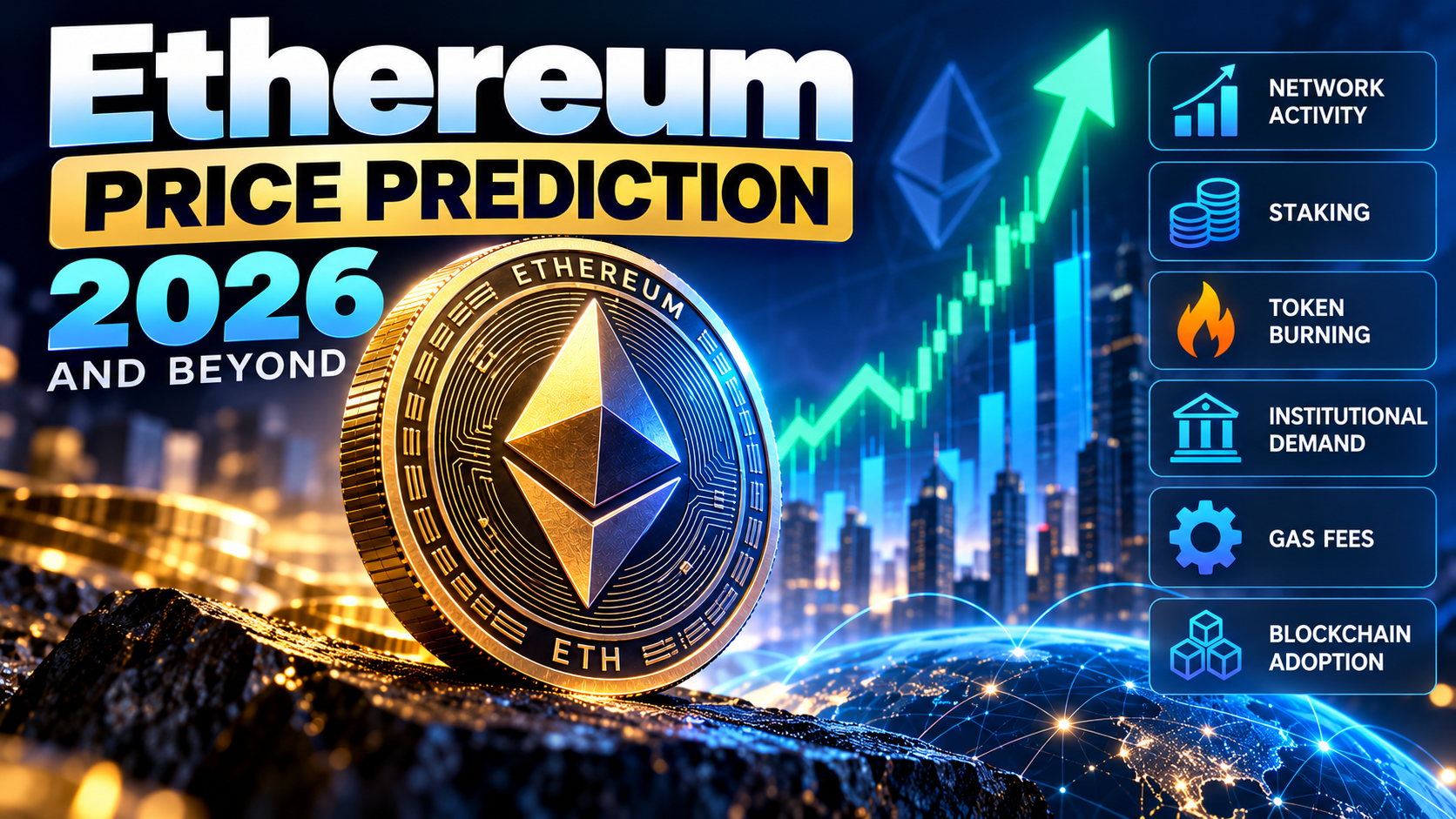
Ethereum remains one of the most closely watched cryptocurrency projects because of its smart-contract technology, decentralized applications, and extensive blockchain ecosystem. Its native cryptocurrency, Ether (ETH), is used to pay transaction fees, support network security through staking, and transfer value between users.
Investors researching Ethereum often ask whether ETH could rise in value, what might drive its next major price movement, and whether the network can maintain its position in an increasingly competitive blockchain industry.
The answers depend on several factors, including market demand, network activity, staking, transaction fees, institutional participation, regulation, and broader economic conditions. Although Ethereum has established itself as a major blockchain platform, its future market performance is uncertain.
This guide explores the factors that may influence Ethereum's price in 2026 and beyond, potential bullish and bearish scenarios, important market indicators, and the risks investors should consider before making decisions.
What Is Ethereum and Why Does ETH Matter?
Ethereum is a decentralized blockchain that allows developers to build and operate smart contracts and decentralized applications. These applications can support financial services, tokenized assets, digital collectibles, and other blockchain-based activities.
ETH is the network's native cryptocurrency. It is used to pay for computational resources, participate in proof-of-stake security, and transfer value. Ethereum's official documentation explains that the network uses validators who stake ETH to help propose and verify blocks. https://ethereum.org/developers/docs/intro-to-ethereum
ETH's market value is influenced by both cryptocurrency trading activity and expectations about the network's future use. However, increased use of Ethereum does not automatically mean that its token price must rise.
Investors need to evaluate network adoption and ETH's market economics separately.
Ethereum Price Prediction for 2026: Key Factors to Watch
Predicting an exact ETH price is difficult because cryptocurrency markets react to rapidly changing information. Rather than relying on a single target, investors can monitor several factors that may affect its direction.
1. Ethereum network activity
Ethereum supports decentralized finance applications, stablecoins, token issuance, and many other services. Increased demand for these applications can create more activity on the network.
Investors can examine transaction activity, decentralized application usage, and demand for block space to understand how the ecosystem is developing.
However, not every transaction creates the same economic effect, and some activity takes place on layer-2 networks. Network growth should therefore be considered alongside fees, token supply, and the wider market.
2. ETH supply and token burning
Ethereum does not have a fixed maximum supply of 21 million coins like Bitcoin. Its supply changes through issuance and the burning of transaction fees.
A portion of Ethereum's transaction fees is burned under its fee mechanism. Depending on network activity and issuance, ETH's total supply can increase or decrease over a given period.
Supply changes can influence market economics, but they do not independently determine price. Demand, liquidity, and investor expectations remain important.
3. Staking and validator participation
Ethereum uses proof of stake to secure the network. Participants can stake ETH directly as validators or use supported staking services.
Staking can affect how holders manage their ETH, but it introduces risks, including validator penalties, withdrawal restrictions, provider risk, and changing reward rates.
The amount of ETH staked is one useful metric to monitor, but it should not be interpreted as a guaranteed signal of future price increases.
4. Institutional demand
Institutional participation can affect cryptocurrency liquidity and investor sentiment. Changes in investment-product flows, custody arrangements, and access to regulated markets may influence demand for ETH.
Still, institutional involvement does not guarantee that prices will rise. Investors should distinguish between announcements, actual investment flows, and long-term adoption.
5. Competition from other blockchain networks
Ethereum faces competition from alternative smart-contract platforms and blockchain ecosystems. Users and developers compare networks based on fees, performance, security, decentralization, and application availability.
Ethereum's layer-2 ecosystem is also important because these networks aim to increase transaction capacity and lower costs. Their growth may expand Ethereum-related activity, but the effect on ETH's market value is not straightforward.
6. Interest rates and economic conditions
Cryptocurrencies are sensitive to changes in investor risk appetite. Interest rates, inflation, employment data, currency movements, and broader financial-market conditions can influence buying and selling decisions.
If investors become more cautious, demand for volatile assets may weaken. If financial conditions become more supportive of risk-taking, crypto markets may benefit. These relationships vary across market cycles and are not reliable standalone trading signals.
Bullish Scenario: What Could Support ETH?
A bullish Ethereum scenario would involve several favorable developments occurring together rather than a single announcement.
Potential supportive factors include:
Growing use of Ethereum-based applications.
Strong demand for ETH across exchanges and financial markets.
Improvements in network capacity and user experience.
Continued development of layer-2 networks and related applications.
Favorable regulatory developments in important markets.
Increased investor confidence and liquidity.
If demand grows faster than the available selling supply, ETH could benefit. However, these conditions are possibilities, not guarantees, and favorable developments may already be reflected in market prices.
Bearish Scenario: What Could Put Pressure on ETH?
Ethereum could also face challenges that weaken demand or investor confidence.
Potential negative factors include:
A broad decline across cryptocurrency markets.
Lower activity or demand within important Ethereum applications.
Competition from alternative blockchain platforms.
Security incidents involving major applications or infrastructure.
Restrictive regulatory changes.
Weak liquidity or large-scale selling.
Macroeconomic conditions that reduce demand for risky assets.
A bearish scenario does not require the Ethereum network to stop functioning. Market prices can decline because expectations change, investors reduce risk, or available selling pressure increases.
Why Ethereum Gas Fees Matter
Ethereum gas fees are payments made in ETH for the computational work required to process transactions and execute smart contracts.
Fees vary according to transaction complexity and demand for network resources. During busy periods, users may pay more to have transactions included promptly.
Gas fees matter because they affect the cost of using Ethereum applications. High fees can discourage smaller transactions or push users toward layer-2 networks. Lower fees may make some applications more accessible.
However, the relationship between fees and ETH price is complex. Higher fees can indicate strong demand for block space, but they can also make the network less convenient for some users. Fees alone should not be treated as a price-prediction tool.
Ethereum Layer-2 Growth and Its Impact
Layer-2 networks are designed to process transactions outside Ethereum mainnet while using Ethereum for some part of their security or settlement process.
These networks can reduce costs and improve transaction capacity for applications such as decentralized trading, payments, and blockchain gaming.
Layer-2 adoption may support a broader Ethereum ecosystem by making applications more affordable. However, the effect on ETH demand depends on how the networks operate, how they settle data, and how their economic models develop.
Users should also consider differences in security assumptions, withdrawal procedures, bridge risks, and operator arrangements when using layer-2 networks.
ETH vs. Bitcoin: Which Has More Potential?
Bitcoin and Ethereum have different designs and investment characteristics.
Bitcoin is widely viewed as a decentralized digital monetary asset with a maximum supply of 21 million BTC. Ethereum is a programmable blockchain that supports smart contracts, decentralized applications, and proof-of-stake security.
ETH's market performance may be influenced by activity within its application ecosystem, network fees, staking, and competition. Bitcoin's performance is influenced by its own supply model, investor demand, liquidity, and broader economic conditions.
Neither asset is guaranteed to outperform the other. Investors should compare their goals, risk tolerance, and investment time horizon rather than assuming that one cryptocurrency will always perform better.
How to Research Ethereum Before Investing
Investors can use a structured approach instead of relying entirely on price predictions.
Check live market data
Review ETH's current price, trading volume, market capitalization, and price changes over multiple timeframes. Market-data providers such as CoinGecko and CoinMarketCap can help with this process.
Examine network fundamentals
Look into Ethereum application usage, network fees, staking activity, and developments affecting its technology. Use reliable sources and check when the data was published.
Understand the risks
Consider market volatility, smart-contract vulnerabilities, exchange and custody risks, regulation, and competition. Even strong technology cannot eliminate investment losses.
Avoid decisions based on hype
Social media predictions and guaranteed-return claims should be treated cautiously. A price target is an opinion or model output, not a promise of future performance.
Set a risk limit
Only consider an amount that fits your financial circumstances. Avoid borrowing money to speculate on a volatile asset, and remember that diversification does not eliminate the possibility of losses.
Is Ethereum a Good Long-Term Investment?
Whether ETH is appropriate for a long-term portfolio depends on an individual's financial goals, risk tolerance, time horizon, and understanding of cryptocurrency markets.
Supporters point to Ethereum's developer ecosystem, smart-contract functionality, and broad range of applications. Critics may focus on competition, complexity, regulatory uncertainty, network costs, and the difficulty of determining the token's fair value.
Both perspectives are relevant. A balanced evaluation should consider the network's technological strengths alongside the uncertainty of its market economics.
Ethereum's continued development does not guarantee an increase in ETH's price. Investors should conduct independent research and avoid relying on a single prediction.
Frequently Asked Questions
What is the Ethereum price prediction for 2026?
There is no reliable way to know the exact future price of ETH. Its performance will depend on market demand, network activity, supply dynamics, regulation, competition, and wider economic conditions.
Can Ethereum reach a new all-time high?
It is possible, but not guaranteed. Whether ETH reaches a new high depends on future demand, liquidity, market conditions, and investor expectations. No price target should be treated as certain.
What could make Ethereum's price rise?
Potential supportive factors include growing application usage, stronger demand, favorable market conditions, and continued development of Ethereum's ecosystem. These factors do not guarantee higher prices.
What could cause Ethereum to fall?
ETH could decline because of broad crypto-market weakness, selling pressure, lower demand, regulatory uncertainty, security incidents, or competition from other networks.
Does staking make Ethereum's price increase?
No. Staking helps secure Ethereum and may provide rewards to participants, but it does not guarantee price appreciation. Staking also involves risks and changing reward rates.
Does Ethereum have a maximum supply?
Ethereum does not have a fixed maximum supply like Bitcoin. Its supply changes through issuance and transaction-fee burning under the network's rules.
Is ETH safer than other cryptocurrencies?
No cryptocurrency is risk-free. Ethereum has an established ecosystem, but ETH remains volatile and users can face technical, market, custody, and regulatory risks.
Where can I check the latest ETH price?
You can check current ETH market data through CoinGecko, CoinMarketCap, or a reputable cryptocurrency exchange. Prices vary across trading pairs and platforms.
Conclusion
Ethereum remains an important blockchain platform because of its smart-contract functionality, decentralized application ecosystem, and proof-of-stake design. These characteristics provide potential opportunities for continued adoption, but they do not guarantee that ETH will rise in value.
The outlook for Ethereum in 2026 and beyond will depend on network usage, supply dynamics, competition, institutional demand, regulatory developments, and broader financial conditions.
Instead of relying on a single price prediction, investors should monitor reliable market data, evaluate the technology, and consider both bullish and bearish scenarios. Cryptocurrency investing carries substantial risk, so careful research and disciplined risk management are essential.
Disclaimer: This article is for educational and informational purposes only and does not constitute financial or investment advice. Cryptocurrency prices are volatile, and you may lose some or all of your investment.