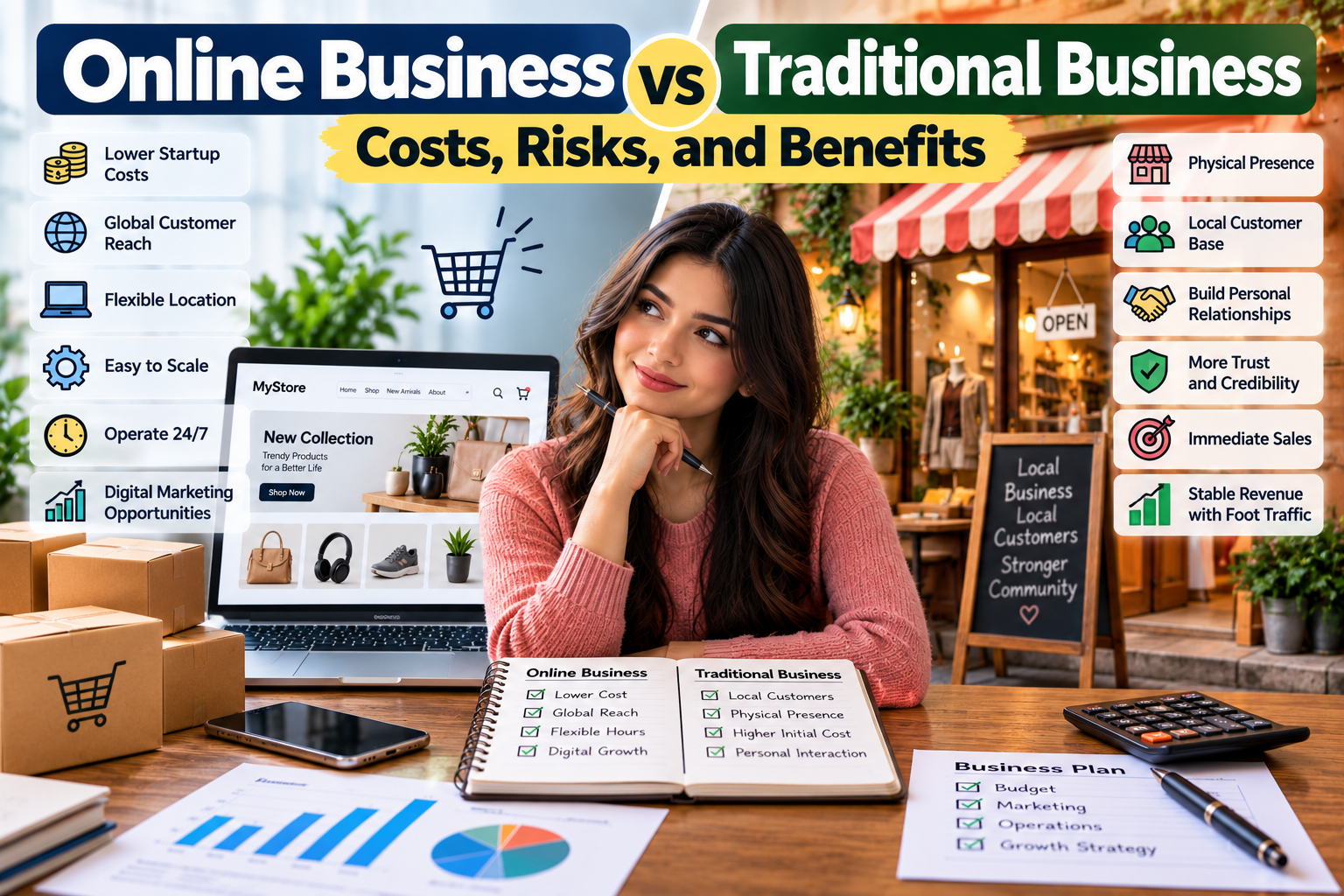
Starting a business requires more than choosing a product or service. Entrepreneurs must also decide how they will reach customers, deliver value, manage expenses, and generate revenue. One of the earliest decisions is whether to operate primarily online or through a traditional physical location.
An online business can sell products through an e-commerce website, provide digital services, offer online consulting, or operate through a marketplace. A traditional business may use a physical shop, office, restaurant, salon, or other location where customers visit in person.
Both models offer opportunities, but they also come with different costs, operational requirements, and risks. An online business may avoid the expense of a customer-facing storefront, yet still require spending on technology, shipping, advertising, and customer acquisition. A traditional business may benefit from face-to-face interactions, but it often needs to cover rent, utilities, maintenance, and location-related expenses.
The right choice depends on the business idea, target customers, available budget, competition, and the owner's capabilities.
In this guide, we compare online business vs. traditional business, explore their costs and benefits, examine their potential risks, and explain how entrepreneurs can choose a model that fits their goals.
What Is an Online Business?
An online business uses the internet as a primary channel for selling products, delivering services, communicating with customers, or generating revenue.
Unlike a business that depends on a physical storefront, an online business can often operate from a home office, shared workspace, or other suitable location.
Common examples include:
E-commerce stores selling physical products.
Freelance writing, graphic design, and consulting services.
Online tutoring and educational services.
Digital product businesses selling templates, courses, or software.
Subscription-based online services.
Affiliate marketing and content-based websites.
Businesses selling through online marketplaces.
Some online businesses serve customers in a local area, while others target national or international markets.
However, operating online does not automatically eliminate geographic restrictions. Payment processing, taxes, shipping, licensing, and consumer protection requirements may limit where a business can operate.
Key Characteristics of an Online Business
An online business typically uses digital tools to manage activities such as marketing, sales, customer communication, payments, and recordkeeping.
It may operate without a customer-facing storefront, although physical inventory, warehouses, offices, or production facilities may still be necessary.
Its success often depends on reaching the right audience, maintaining a reliable digital presence, and providing a good customer experience.
What Is a Traditional Business?
A traditional business typically operates through a physical location where customers visit, products are displayed, or services are delivered in person.
Examples include retail shops, restaurants, salons, repair services, clinics, and local professional offices.
Some traditional businesses also use websites, social media, and online payment systems. The defining feature is that their operations rely significantly on physical premises or in-person service delivery.
Key Characteristics of a Traditional Business
Traditional businesses may offer direct personal interaction, physical product inspection, immediate purchases, or services that require an in-person visit.
They often depend on location, local reputation, foot traffic, and relationships with customers in their surrounding community.
However, they may also face higher fixed costs because of rent, utilities, maintenance, staffing, and other location-related expenses.
The actual costs vary by industry. A home-based repair service, for example, may have much lower premises costs than a restaurant in a busy commercial district.
Online Business vs. Traditional Business: Key Differences
Although both models aim to generate revenue and serve customers, they differ in several important ways.
Factor | Online Business | Traditional Business |
|---|---|---|
Physical location | May operate without a customer-facing storefront | Often requires a physical premises |
Startup costs | Can be lower for certain business models | May include rent, deposits, equipment, and fit-out |
Customer reach | Can reach geographically dispersed customers | Often depends more on local customers |
Operating expenses | May include software, hosting, ads, and shipping | May include rent, utilities, staffing, and maintenance |
Customer interaction | Mainly digital or remote | Often face-to-face |
Business hours | Digital sales can occur at any time | Customer access may depend on opening hours |
Product experience | Customers often rely on photos and descriptions | Customers may inspect products in person |
Marketing | Often relies on digital channels | May rely on local marketing and referrals |
Logistics | Shipping, delivery, and returns may be important | Customers may collect purchases or receive local service |
Growth potential | Geographic expansion may be easier in some models | Expansion may require additional locations or staff |
These are general patterns, not universal rules. A large online retailer may have substantial infrastructure costs, while a small traditional service business may operate with relatively little overhead.
1. Startup Costs: Which Business Is More Affordable?
Startup costs are often one of the first considerations for new entrepreneurs.
Online businesses can be less expensive to launch when they do not require inventory, commercial premises, or specialized equipment. However, the cost depends on the business model.
Online Business Startup Costs
Potential expenses include:
Domain registration and website hosting.
E-commerce platform or software subscriptions.
Product samples and initial inventory.
Website design and branding.
Payment processing fees.
Marketing and advertising.
Shipping and fulfillment.
Business registration and compliance.
A freelance service provider who already owns a computer may need relatively little additional investment.
An online store that imports products, purchases inventory, and pays for advertising may require a much larger budget.
Traditional Business Startup Costs
Traditional businesses may need to cover:
Rent deposits and advance rent.
Renovation and interior fit-out.
Furniture and equipment.
Initial inventory.
Utilities and maintenance.
Employee recruitment and payroll.
Permits, licenses, and insurance.
Signage and local marketing.
A restaurant or retail store may require substantial upfront investment before it serves its first customer.
How to Compare Startup Costs Properly
Do not compare businesses solely by their registration or website costs.
Estimate the full cost of reaching the first paying customer, then calculate the ongoing expenses needed to continue operating.
Also consider how much working capital you need to cover bills before the business generates consistent revenue.
The cheapest business to launch is not necessarily the most profitable or suitable one.
2. Operating Costs and Monthly Expenses
Startup costs are only part of the financial picture. Businesses must also cover recurring expenses.
Online Business Operating Costs
Online businesses may pay for website hosting, software, cybersecurity, payment processing, advertising, customer service, inventory storage, shipping, and returns.
Some businesses also depend heavily on paid advertising or third-party marketplaces, which can increase costs as competition changes.
Digital tools may reduce certain administrative tasks, but subscriptions and integrations can add up over time.
Traditional Business Operating Costs
A physical business may face recurring expenses such as rent, electricity, water, maintenance, security, payroll, cleaning, inventory, and insurance.
These costs may continue even during slow periods when sales are below expectations.
For a business with a long-term lease, reducing premises expenses may be difficult in the short term.
Which Model Has Lower Monthly Costs?
An online service business may have lower fixed costs than a retail shop, especially if it operates from home.
However, an e-commerce company with substantial inventory and advertising spending may have higher overall costs than a small local service provider.
The most useful comparison is the total cost structure of the specific business models you are considering.
3. Customer Reach and Market Size
Customer reach is another major difference between online and traditional businesses.
Online Businesses Can Reach Wider Markets
A website or online marketplace can allow a business to reach customers beyond its immediate neighborhood.
For example, a designer can work with clients in different countries, while an online store may sell products to customers across an entire country.
However, reaching a wider audience requires suitable marketing, customer support, payment options, and delivery arrangements.
International expansion can also introduce customs, tax, currency, and regulatory complications.
Traditional Businesses Often Focus on Local Customers
A physical store may rely on nearby residents, commuters, tourists, or customers who travel specifically to use its services.
Its location can provide an advantage when customers value convenience or immediate access.
For example, a neighborhood grocery store, salon, or repair shop may serve a defined local market effectively.
A physical business can still expand its reach through online ordering, delivery, or additional locations, but doing so may require more resources.
4. Marketing: Online vs. Traditional Business
Both business models need a way to attract customers, but their marketing methods may differ.
Online Business Marketing
Online businesses commonly use:
Search engine optimization: Improving website content and structure to help relevant pages appear in search results.
Content marketing: Publishing useful articles, videos, guides, and other material that answers customer questions.
Social media marketing: Sharing content, demonstrating products, and interacting with potential customers.
Email marketing: Sending relevant updates and offers to people who have provided appropriate consent.
Paid advertising: Running campaigns on search engines, social platforms, or other advertising networks.
Digital marketing can provide measurable data about impressions, clicks, conversions, and acquisition costs. However, traffic and sales are not guaranteed, and competition can make customer acquisition expensive.
Traditional Business Marketing
Traditional businesses may use:
Local signage and storefront displays.
Community events.
Printed promotional materials.
Local partnerships and sponsorships.
Referrals and word-of-mouth recommendations.
Local directories and business listings.
Newspaper, radio, or other local advertising.
The most effective strategy depends on where customers look for products and services.
Many businesses benefit from combining online and offline marketing instead of choosing only one approach.
5. Customer Trust and Personal Interaction
Trust plays an important role in both business models, but customers may build trust in different ways.
Advantages of In-Person Interaction
A physical location allows customers to speak directly with staff, inspect products, ask questions, and receive immediate assistance.
For some services, such as personal care, repairs, hospitality, or specialized consultations, face-to-face interaction can be particularly valuable.
Customers may also feel more confident when they know where a business operates and can return to the location if a problem occurs.
However, physical presence alone does not guarantee good service or trustworthiness.
Building Trust Online
Online businesses must help customers feel confident when they cannot inspect products or meet the seller in person.
Useful practices include:
Accurate product descriptions and photographs.
Transparent prices and delivery information.
Clear refund and return policies.
Secure payment options.
Accessible contact information.
Genuine customer reviews.
Reliable customer support.
Trust also depends on delivering what was promised.
An online store with clear policies and reliable fulfillment can build strong customer relationships even without a physical storefront.
6. Flexibility and Work-Life Management
Online businesses may offer greater flexibility because certain tasks can be performed remotely.
An entrepreneur might manage a website, communicate with customers, or deliver digital services from different locations.
However, online businesses can also create pressure to remain available outside normal hours, especially when customers expect quick responses across time zones.
Traditional businesses may have more structured working hours, but owners often need to be physically present to supervise operations, serve customers, or manage staff.
Restaurants, shops, and service businesses may require early starts, evening shifts, or weekend work.
Neither model automatically produces a better work-life balance. The outcome depends on the operating model, customer expectations, staffing, and how responsibilities are organized.
7. Risks of Running an Online Business
Online businesses face several risks that should be considered before launch.
High Competition
Many online markets have numerous sellers offering similar products or services.
Businesses need a clear value proposition, reliable products, appropriate pricing, and effective marketing to stand out.
Dependence on Digital Platforms
A business may rely on search engines, social media, marketplaces, or advertising networks for customer acquisition.
Algorithm changes, policy updates, account restrictions, and rising advertising costs can affect performance.
Businesses should reduce unnecessary dependence on a single platform where practical.
Cybersecurity and Data Privacy
Online businesses may handle customer details, payment-related information, account credentials, and order records.
Weak security can expose the company and its customers to fraud or data breaches.
Use appropriate access controls, software updates, secure payment providers, and data protection practices.
Shipping and Fulfillment Problems
Businesses selling physical products must manage delivery delays, damaged goods, returns, and supplier reliability.
These problems can increase costs and damage customer relationships.
Unpredictable Customer Acquisition Costs
Paid advertising can become more expensive, while organic traffic may take time to develop.
A business should track how much it spends to acquire customers and whether those customers generate sufficient contribution to cover the cost.
8. Risks of Running a Traditional Business
Traditional businesses face a different set of operational risks.
High Fixed Expenses
Rent, utilities, insurance, and staffing may create substantial recurring obligations.
If customer demand declines, the business may still need to cover these costs.
Location Dependence
A poor location can limit foot traffic and reduce sales opportunities.
Changes in nearby development, customer habits, transportation, or competition may affect the performance of a physical business.
Limited Geographic Reach
A location-based business may have difficulty serving customers who live far away unless it adds delivery, online services, or additional premises.
Staffing and Operational Challenges
Traditional businesses may need employees to cover opening hours, serve customers, maintain equipment, and handle daily operations.
Recruitment, training, scheduling, and staff turnover can create additional costs.
Local Competition
A physical store may compete with nearby businesses offering similar products or services.
Its success may depend on location, service quality, pricing, reputation, and customer loyalty.
9. Which Business Model Is More Profitable?
There is no universal answer to whether an online business or a traditional business is more profitable.
Profitability depends on revenue, direct costs, operating expenses, pricing, customer demand, and how efficiently the business operates.
An online business may save on rent but spend heavily on advertising, shipping, returns, and technology.
A traditional business may have higher premises costs but benefit from repeat local customers, immediate purchases, or services that command strong prices.
Example: Comparing Two Hypothetical Businesses
Consider two businesses operating for one month.
Financial item | Online store | Physical store |
|---|---|---|
Revenue | $20,000 | $20,000 |
Product costs | $8,000 | $8,000 |
Marketing | $3,000 | $1,000 |
Rent and utilities | $500 | $3,000 |
Shipping and fulfillment | $2,000 | $500 |
Other operating expenses | $2,000 | $3,000 |
Illustrative operating profit | $4,500 | $4,500 |
In this simplified example, both businesses generate $4,500 in operating profit before any additional expenses not included in the table.
The online store spends more on marketing and fulfillment, while the physical store spends more on premises and other operating costs.
This demonstrates why it is misleading to assume that one model is always more profitable.
Actual results depend on the specific industry, business structure, customer acquisition strategy, and operating costs.
10. How to Choose the Right Business Model
Choosing between an online and traditional business starts with understanding what customers need and how you can serve them effectively.
Step 1: Identify Your Target Customers
Determine who will buy your product or service and what matters most to them.
If customers need immediate access to products, physical inspection, or face-to-face service, a traditional location may be valuable.
If customers are comfortable buying online and value convenience or broad product selection, an online model may be suitable.
Step 2: Evaluate Your Budget
Estimate the total startup and operating costs of each option.
Include equipment, premises, inventory, technology, marketing, staffing, insurance, and working capital.
Choose a model that you can realistically finance without relying on overly optimistic sales assumptions.
Step 3: Assess Your Skills
Online businesses often require skills related to digital marketing, website management, customer communication, logistics, or remote service delivery.
Traditional businesses may require location management, in-person sales, inventory handling, and staff supervision.
Some skills are useful in both models, but consider where your experience gives you an advantage.
Step 4: Research Competition
Study businesses serving the same target customers.
Compare prices, customer reviews, product quality, delivery options, service levels, and marketing strategies.
Identify how your business could offer a meaningful advantage rather than competing solely on price.
Step 5: Test Demand Before Investing Heavily
Where possible, validate the idea with a small test.
An online business might test a landing page or limited product range. A physical business might begin with a temporary stall, appointment-based service, or pop-up arrangement where legally permitted.
The objective is to learn whether customers will pay for the offer before committing to substantial long-term expenses.
11. Is a Hybrid Business Model a Better Option?
Some businesses combine online and traditional operations.
A retailer might operate a physical store while accepting online orders. A restaurant might serve walk-in customers and offer delivery. A consultant might meet clients in person while also providing remote services.
This approach can help businesses serve different customer preferences and create additional sales channels.
Benefits of a Hybrid Business
A hybrid model can combine the convenience of online shopping with the trust and personal interaction associated with physical operations.
It may also reduce dependence on a single customer acquisition channel.
For example, a local shop can use its website to display inventory, answer questions, and accept orders while continuing to serve customers in person.
Challenges of a Hybrid Business
Operating both channels can increase complexity.
The business may need to coordinate inventory, staffing, customer service, pricing, fulfillment, and financial reporting across online and offline sales.
A hybrid model is not automatically better. It should be adopted when the additional customer reach and revenue opportunities justify the added cost.
12. Practical Tips for Starting With Limited Money
Entrepreneurs with a limited budget should focus on validating demand and controlling risk.
Start with essential expenses. Avoid unnecessary equipment, premium software, or elaborate premises before confirming customer demand.
Choose a clear target market. A focused audience makes product development and marketing easier to plan.
Track every expense. Include small recurring costs, payment fees, delivery, advertising, and administration.
Build customer relationships. Good communication and reliable service can encourage repeat purchases and referrals.
Use technology where it helps. Digital tools can support scheduling, bookkeeping, customer communication, and marketing without requiring a large technology investment.
Review financial results regularly. Compare actual sales and expenses with your budget, and change your approach when the evidence suggests a problem.
Expand gradually. Add inventory, staff, marketing, or premises when demand and available resources support the investment.
The goal is to build a sustainable business model rather than simply launch as quickly as possible.
Conclusion
The choice between an online business and a traditional business depends on the product or service, target customers, available resources, and operational requirements.
Online businesses can offer geographic reach, flexible operations, and lower premises costs in some cases. Traditional businesses can provide personal interaction, physical product experiences, and strong local relationships.
Both models also carry risks. Online businesses may face digital competition, platform dependence, cybersecurity concerns, and fulfillment costs. Traditional businesses may face rent obligations, staffing challenges, location dependence, and higher fixed expenses.
There is no single model that guarantees greater profitability or success.
Before making a decision, research your market, estimate the full cost of each option, and test demand where possible. Choose the approach that fits your customers and financial capabilities, then improve it using real business results.
For some entrepreneurs, an online model will be the most practical starting point. For others, a physical location will provide the service experience their customers need. A carefully planned hybrid model may also make sense when the benefits justify the additional complexity.
The best business model is the one that can serve customers reliably while supporting sustainable finances and long-term goals.
Frequently Asked Questions (FAQs)
1. What is the difference between an online business and a traditional business?
An online business primarily uses digital channels to sell products or deliver services, while a traditional business typically relies more on a physical location and in-person operations. Both models may use online and offline channels.
2. Is an online business cheaper to start?
Some online businesses have lower startup costs because they do not require a customer-facing storefront. However, inventory, technology, shipping, advertising, and payment fees can still make an online business expensive to launch.
3. Which business model is more profitable?
Neither model is universally more profitable. Profitability depends on revenue, pricing, customer demand, direct costs, operating expenses, and how effectively the business is managed.
4. Can I start an online business from home?
Yes. Many service-based businesses, digital product businesses, and online stores can be managed from home. Physical inventory, local regulations, licensing, and other operational requirements may affect the setup.
5. What are the advantages of a traditional business?
A traditional business may offer direct customer interaction, physical product inspection, local visibility, immediate service, and stronger face-to-face relationships.
6. What are the disadvantages of an online business?
Online businesses may face intense competition, digital platform dependence, cybersecurity risks, shipping problems, advertising costs, and challenges in building customer trust.
7. What are the disadvantages of a traditional business?
Traditional businesses may face rent, utilities, maintenance, staffing expenses, location dependence, and limited reach beyond their local customer base.
8. Can a traditional business sell products online?
Yes. A traditional business can create an online store, accept digital orders, use social media, or offer delivery. A combined approach may help serve customers who prefer different purchasing methods.
9. Is a hybrid business model worth considering?
A hybrid model may be useful when customers value both online convenience and in-person service. However, additional sales channels can increase costs and operational complexity, so the business should evaluate the benefits before expanding.
10. How do I choose between an online and traditional business?
Research your target customers, estimate startup and operating costs, assess your skills, study competitors, and test demand. Choose the model that fits your customers' needs and your available resources.
11. Do online businesses need registration and licenses?
Requirements depend on the business location, legal structure, industry, and target markets. Online operations may still require registration, tax compliance, permits, and consumer protection measures.
12. How can I reduce business startup costs?
Start with essential expenses, test demand before investing heavily, use existing resources where appropriate, compare suppliers, and avoid long-term commitments until the business model has been validated.
13. Do online businesses need marketing?
Yes. Online stores and service providers generally need a way to reach customers. Search engine optimization, useful content, social media, referrals, email marketing with appropriate consent, and paid advertising are potential channels.
14. Can a small traditional business compete with large online retailers?
A small traditional business may compete through specialized products, local knowledge, personal service, convenience, community relationships, or a carefully selected niche. Its strategy should focus on customer needs rather than trying to match every advantage of a large retailer.
15. What should I consider before opening a physical store?
Evaluate customer demand, location, rent, deposits, utilities, staffing, inventory, licenses, competition, and working capital. Prepare a financial forecast to understand how much revenue the store needs to cover its costs.