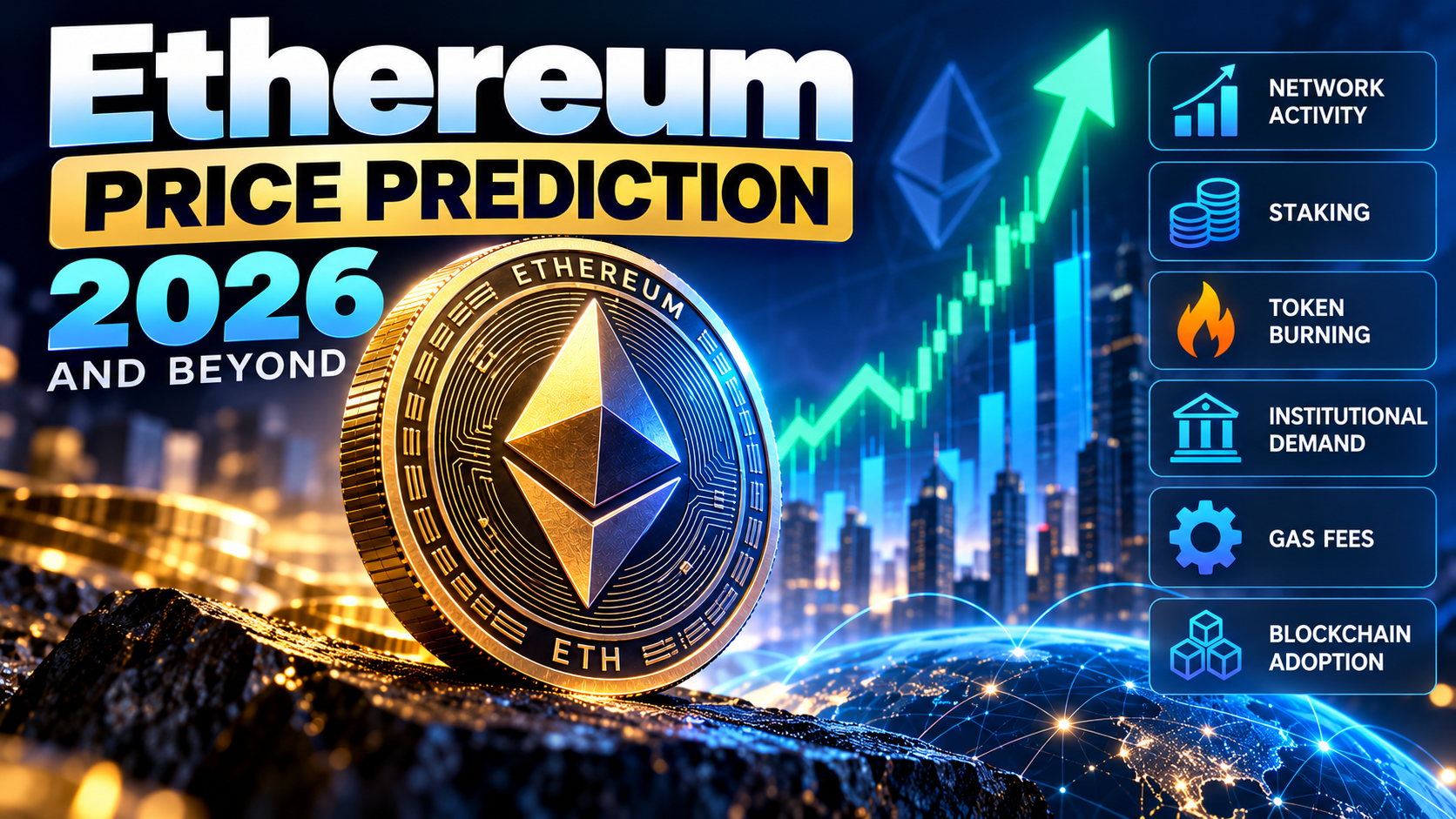
Ethereum is one of the most important blockchain networks in the cryptocurrency industry. While Bitcoin is primarily known as a decentralized digital currency, Ethereum offers a platform where developers can build applications, create digital assets, and run smart contracts without relying on a single central authority.
Its native cryptocurrency, Ether (ETH), is used to pay transaction fees, support network security, and participate in Ethereum's proof-of-stake system. ETH is also widely traded on cryptocurrency exchanges, making it an important asset for investors who follow the digital currency market.
Ethereum has developed an extensive ecosystem covering decentralized finance (DeFi), stablecoins, non-fungible tokens (NFTs), blockchain gaming, and tokenized assets. However, ETH also carries risks, including market volatility, changing network fees, competition, security threats, and regulatory uncertainty.
This guide explains what Ethereum is, how ETH works, what influences its price, its potential benefits and risks, and what investors should understand before buying it.
What Is Ethereum?
Ethereum is a decentralized, open-source blockchain platform that enables developers to create applications and programs known as smart contracts. Instead of depending entirely on a central company or server, these applications can operate using rules recorded on a shared blockchain.
Ethereum was proposed by Vitalik Buterin in 2013 and launched in 2015. It expanded the concept of blockchain beyond digital payments by providing a programmable environment for applications and financial services.
The network uses a system of computers called nodes to maintain and verify its shared data. Transactions are grouped into blocks, and the network's consensus mechanism helps participants agree on the valid state of the blockchain.
Ethereum is not a company, and ETH is not a share in a corporation. Owning ETH does not automatically provide company ownership, dividends, or guaranteed income.
What Is Ether (ETH)?
Ether, commonly identified by the ticker symbol ETH, is Ethereum's native cryptocurrency. Although people often use the terms Ethereum and Ether interchangeably, they refer to different things.
Ethereum: The blockchain network and its application platform.
Ether (ETH): The cryptocurrency used within that network.
ETH has several important functions. Users pay transaction fees in ETH, validators stake ETH to help secure the network, and developers and applications use it as part of Ethereum's economic system.
ETH can also be transferred between wallets, held as a digital asset, or traded on cryptocurrency exchanges. Its market price is determined by supply, demand, liquidity, investor expectations, and broader economic conditions.
How Does Ethereum Work?
Ethereum operates through a decentralized network of computers that maintain a shared blockchain. When someone sends ETH or interacts with a smart contract, the transaction must be checked and processed according to the network's rules.
A simplified Ethereum transaction follows these steps:
A user initiates a transaction through a compatible wallet.
The wallet signs the transaction using the user's private key.
The transaction is broadcast to the network.
Ethereum validators help process and confirm valid transactions.
The blockchain records the resulting change in account balances or application state.
Once a transaction is sufficiently confirmed, changing its history becomes extremely difficult under normal network conditions.
Ethereum uses proof of stake rather than its original proof-of-work mining mechanism. Validators stake ETH and participate in proposing and confirming blocks. The protocol rewards honest participation and can penalize certain forms of misconduct. https://ethereum.org/developers/docs/consensus-mechanisms/pos/
What Are Ethereum Smart Contracts?
Smart contracts are programs deployed on the Ethereum blockchain. They execute predefined instructions when the required conditions are met.
For example, a smart contract could manage a token exchange, distribute digital assets, or enforce the rules of a decentralized lending application. Once deployed, users can interact with the contract through transactions.
Smart contracts have helped make Ethereum a major platform for blockchain applications. They can reduce the need for some intermediaries, but they do not eliminate every form of risk.
Potential problems include programming errors, vulnerable contract logic, malicious code, and unexpected interactions between applications. Depending on how a contract is designed, transactions may be irreversible and funds may be difficult or impossible to recover.
What Is Ethereum Used For?
Ethereum supports a broad range of blockchain-based activities. These use cases contribute to demand for the network and influence how developers, businesses, and investors evaluate its ecosystem.
1. Decentralized finance
Decentralized finance, or DeFi, includes blockchain applications for lending, borrowing, exchanging tokens, and other financial activities.
Users may interact with these services through smart contracts instead of traditional financial intermediaries. However, DeFi introduces risks such as smart-contract exploits, liquidation losses, unstable collateral values, and liquidity shortages.
2. Stablecoins and digital payments
Ethereum supports several stablecoins designed to track currencies such as the US dollar. These tokens can be used for transfers, trading, and blockchain-based financial services.
The network can support international transfers without requiring every transaction to pass through the same traditional payment infrastructure. Actual costs and processing times depend on network demand, the application, and the services used.
Stablecoins also carry risks related to issuers, reserves, redemption arrangements, and regulation.
3. Non-fungible tokens
Non-fungible tokens, or NFTs, represent distinct digital assets recorded on a blockchain. They have been used for digital art, collectibles, membership access, gaming items, and other applications.
Ethereum helped popularize NFT markets and the standards used to create many tokens. However, an NFT's market value is not guaranteed, and ownership of a token does not automatically establish copyright ownership of the associated content.
4. Blockchain gaming
Developers can use Ethereum and compatible networks to create games that incorporate digital assets and token-based economies.
These applications may allow users to hold or transfer certain in-game assets. Nevertheless, gaming tokens and collectibles can be speculative, and the value of an asset depends on demand, utility, and the rules of the game or platform.
5. Tokenization of real-world assets
Tokenization involves representing rights to certain assets through blockchain-based tokens. Projects in this area may involve funds, financial instruments, commodities, or other assets.
Ethereum's programmable infrastructure can support these applications, but tokenization does not remove the need to verify legal rights, custody arrangements, regulatory compliance, and the reliability of the underlying asset.
Ethereum Price Today: What Should Investors Check?
ETH's market price changes continuously, so a dated price quoted in an article can become outdated quickly. For the current ETH-to-USD price, check a live market-data provider such as CoinGecko, CoinMarketCap, or a reputable cryptocurrency exchange.
When reviewing Ethereum's price, investors should look beyond the latest quote.
Important market indicators include:
Current ETH price: The price of one Ether in the selected trading pair.
24-hour percentage change: How much the price has moved during the previous 24 hours.
Trading volume: The amount of ETH traded during a specified period.
Market capitalization: The market value of the circulating ETH supply.
Circulating supply: The amount of ETH currently considered in circulation.
Network activity: Indicators of usage, transaction demand, and application activity.
These indicators provide different types of information. A price increase does not automatically indicate strong fundamentals, and a high trading volume does not guarantee that a trend will continue.
What Factors Influence the Price of Ethereum?
ETH is influenced by both developments within its own ecosystem and conditions across the broader financial market.
Supply and demand
ETH's market price reflects buying and selling activity. Greater demand relative to available selling supply can push prices upward, while increased selling pressure can cause prices to decline.
Unlike Bitcoin, Ethereum does not have a fixed maximum supply of 21 million coins. ETH issuance and burning depend on protocol rules and network activity, so its overall supply can change over time.
Network usage and transaction fees
Ethereum's network activity can affect demand for ETH because users generally need ETH to pay mainnet transaction fees.
When demand for block space rises, fees can increase. Higher costs may encourage some users to choose alternative networks or layer-2 systems. The relationship between network activity and ETH's market price is complex, however, and is not a reliable standalone predictor.
Staking and ETH supply
Ethereum's proof-of-stake mechanism allows eligible participants to stake ETH to help secure the network. Validators can receive protocol rewards, but staking is not risk-free.
Staked ETH may be subject to withdrawal delays, validator penalties, service-provider risks, or other restrictions depending on the staking method. Staking rewards can also change over time and should not be treated as guaranteed investment returns.
Institutional participation
Institutional investors, investment products, and professional traders can influence liquidity and market demand. Changes in investment flows may affect sentiment, but institutional participation does not prevent price declines or guarantee future growth.
Macroeconomic conditions
Interest rates, inflation, employment data, currency movements, and broader financial-market conditions can affect investor appetite for volatile assets.
When investors become more cautious, they may reduce exposure to cryptocurrencies. When risk appetite improves, demand may increase. These relationships vary across market cycles.
Regulation and legal developments
Rules concerning exchanges, custody, staking, stablecoins, and investment products can affect how ETH is bought, held, and traded.
Regulatory clarity may support certain forms of participation, while unexpected restrictions or legal uncertainty can influence market sentiment.
Competition from other blockchains
Ethereum competes with other smart-contract networks and blockchain ecosystems. Users and developers may compare transaction costs, performance, security, decentralization, and available applications.
Ethereum also relies on layer-2 networks to expand its ecosystem. These networks can reduce costs for users, but their growth does not translate automatically into higher ETH prices.
Ethereum and Proof of Stake
Ethereum transitioned from proof of work to proof of stake in September 2022. Under its current consensus design, validators stake ETH and participate in the process of proposing and confirming blocks.
This system differs from Bitcoin's proof-of-work model, which uses computational work to support consensus.
Ethereum's proof-of-stake mechanism has several important characteristics:
Validators commit ETH as economic collateral.
Honest participation is rewarded under protocol rules.
Certain forms of misconduct can lead to penalties, including the loss of staked ETH.
The system uses substantially less energy than Ethereum's former proof-of-work design.
Running an independent Ethereum validator generally requires a deposit of 32 ETH and suitable technical infrastructure. Other staking arrangements may allow users to participate with smaller amounts, but they can introduce additional provider, liquidity, or decentralization risks. https://ethereum.org/developers/docs/consensus-mechanisms/pos/
Ethereum Gas Fees Explained
Ethereum gas is a unit used to measure the computational work required to process transactions and execute smart contracts. Users pay transaction fees in ETH, with the final cost depending on gas usage and the network's fee market.
A simple transfer and a complex smart-contract interaction can require different amounts of gas. During periods of high demand, the cost of using Ethereum mainnet may rise.
Ethereum's fee system includes a base fee that is burned and an optional priority fee that helps incentivize validators to include transactions. This means network activity can affect the amount of ETH burned through transaction fees.
Users should check the estimated fee before confirming a transaction. A transaction that appears inexpensive in one period may cost considerably more when demand increases.
Layer-2 networks can offer lower transaction costs for many activities, although they have their own fees, security assumptions, and operational trade-offs.
Ethereum Layer-2 Networks and Scalability
Layer-2 networks are designed to process transactions outside Ethereum mainnet while using Ethereum for some part of their security or settlement process. They aim to make blockchain applications more accessible by increasing transaction capacity or reducing costs.
These systems support activities such as token transfers, decentralized trading, gaming, and other applications.
Layer-2 networks differ in how they process transactions, handle withdrawals, and rely on Ethereum for security. Users should research the specific network and bridge before transferring assets.
Moving assets between Ethereum mainnet and another network can involve additional fees and technical risks. Sending funds to an unsupported network or using a malicious bridge can result in losses.
Benefits of Ethereum
Ethereum offers several characteristics that have contributed to its role in the blockchain industry.
A broad developer ecosystem
Ethereum supports a large ecosystem of smart contracts, developer tools, wallets, and decentralized applications. This infrastructure allows developers to build different services using shared standards.
Programmable blockchain technology
Smart contracts enable applications to execute predefined rules on a public blockchain. This programmability supports use cases that extend beyond simple cryptocurrency transfers.
Staking-based network security
Ethereum's proof-of-stake mechanism uses staked ETH and protocol incentives to support network consensus. It also avoids the energy-intensive mining process used by proof-of-work systems.
Wide range of applications
Ethereum supports DeFi, stablecoins, NFTs, tokenization, and other blockchain activities. This range of use cases gives the network a role in several parts of the digital asset industry.
Compatibility with layer-2 ecosystems
Layer-2 networks can provide more affordable ways to use applications associated with Ethereum. They help expand the ecosystem, although the user experience and security characteristics vary by network.
Risks of Investing in Ethereum
Despite its technology and adoption, Ethereum is not a risk-free investment. Buyers should understand the potential downsides before purchasing ETH.
Market volatility
ETH can experience substantial price changes in short periods. Investors who buy at elevated prices may face losses if market sentiment weakens.
Competition
Other blockchain platforms may attract developers, users, and capital. Changes in market share or application demand can influence perceptions of Ethereum's long-term prospects.
Smart-contract vulnerabilities
Ethereum-based applications may contain bugs or exploitable code. A successful attack can result in losses for users even when the underlying Ethereum network continues to operate normally.
Staking risks
Staking may involve withdrawal restrictions, validator penalties, third-party custody, or liquidity risks. Liquid-staking tokens can also trade at a discount to their underlying assets.
Regulatory uncertainty
Legal treatment of crypto assets, staking services, exchanges, and decentralized applications can vary by jurisdiction and change over time.
Wallet and custody risks
Users who lose access to their private keys may permanently lose their assets. Phishing, fake websites, malicious approvals, and fraudulent investment schemes are also significant risks.
No guaranteed returns
Ethereum's technology and ecosystem do not guarantee that ETH's market price will rise. Network adoption and token performance are related but distinct considerations.
Ethereum vs. Bitcoin: What Is the Difference?
Ethereum and Bitcoin are both major blockchain networks, but they were designed with different priorities.
Feature | Ethereum (ETH) | Bitcoin (BTC) |
|---|---|---|
Main role | Programmable blockchain and application platform | Decentralized digital currency |
Consensus | Proof of stake | Proof of work |
Native asset | Ether (ETH) | Bitcoin (BTC) |
Supply design | No fixed maximum supply | Maximum of 21 million BTC |
Smart contracts | Broad general-purpose smart-contract functionality | More limited base-layer scripting |
Main use cases | Applications, DeFi, tokens, staking, transfers | Transfers, value storage, and monetary use cases |
Energy model | Proof-of-stake validation | Energy-intensive mining |
Neither asset is automatically better for every investor. Their technology, monetary policies, market behavior, and risk profiles differ. Anyone comparing them should consider their individual goals and the possibility of losses.
How to Buy Ethereum (ETH)
ETH is available through various cryptocurrency exchanges and some other digital-asset services, depending on the user's country and the provider's rules.
A typical purchasing process involves the following steps:
Research a reputable platform that legally serves your location.
Review its identity-verification requirements, fees, security practices, and withdrawal rules.
Create an account and enable strong security measures.
Deposit funds using an available payment method.
Check the ETH price, trading pair, and total transaction cost.
Place an order only after understanding the risks.
Decide whether to use the platform's custody service or transfer ETH to a compatible wallet.
Availability and regulations vary by country. Users should verify current local requirements and platform eligibility before depositing money.
How to Store Ethereum Safely
ETH can be held in exchange accounts or compatible cryptocurrency wallets. Each approach has different trade-offs.
Exchange custody may be convenient, but it requires trusting the provider to safeguard assets and maintain access to withdrawals. A self-custody wallet gives the user greater control over private keys but also greater responsibility for protecting them.
For safer storage:
Use reputable wallets and download them from official sources.
Keep recovery phrases private and securely backed up.
Never share a seed phrase or private key with anyone.
Verify wallet addresses before sending funds.
Be cautious when connecting a wallet to decentralized applications.
Review transaction details and token approvals before signing.
Consider the risks of bridges and unfamiliar smart contracts.
Cryptocurrency transfers are often irreversible. A mistaken address or malicious transaction can lead to permanent losses.
What Is the Future Potential of Ethereum?
Ethereum's future will depend on a combination of technology, adoption, competition, network economics, and market conditions. Its smart-contract infrastructure provides a foundation for decentralized applications, stablecoins, tokenized assets, and financial services.
Continued development of layer-2 networks may improve transaction capacity and affordability. Improvements in developer tools, user experience, security, and interoperability could also influence adoption.
However, there are no guarantees that Ethereum will maintain its current market position or that ETH will appreciate in value. Competing platforms may gain traction, regulatory changes may affect usage, and technical or security issues may reduce confidence.
Investors should distinguish between the potential of Ethereum as a technology platform and the uncertain financial performance of its native cryptocurrency.
Frequently Asked Questions About Ethereum
What is Ethereum in simple words?
Ethereum is a decentralized blockchain platform that allows people to send digital assets and run smart-contract applications. ETH is its native cryptocurrency.
Is Ethereum the same as ETH?
No. Ethereum is the network, while Ether (ETH) is the cryptocurrency used to pay network fees, participate in staking, and transfer value.
What is the current price of Ethereum?
ETH's price changes continuously. Check CoinGecko, CoinMarketCap, or a reputable exchange for the latest ETH-to-USD quote and current market statistics.
Can Ethereum be mined?
Ethereum no longer uses proof-of-work mining. It transitioned to proof of stake in September 2022. Network validators participate by staking ETH rather than mining blocks through computational work.
Does Ethereum have a maximum supply?
Ethereum does not have a fixed maximum supply like Bitcoin's 21 million BTC. ETH issuance and burning are governed by protocol rules and network activity.
What are Ethereum gas fees?
Gas fees are the transaction costs paid in ETH for using Ethereum. The amount depends on the computational work required and conditions in the network's fee market.
Can ETH be staked to earn rewards?
Yes. Eligible users can stake ETH directly or use supported staking services. Rewards are not guaranteed profits, and staking can involve penalties, withdrawal delays, provider risks, and changing reward rates.
Is Ethereum a good investment?
That depends on an individual's financial situation, goals, risk tolerance, and understanding of the asset. ETH is volatile, and there is no guarantee of profit. Research carefully and never invest money you cannot afford to lose.
Is Ethereum safe to use?
The Ethereum protocol has a range of security mechanisms, but using ETH and Ethereum applications still involves risks. Wallet theft, phishing, malicious smart contracts, exchange failures, and mistakes in transactions can cause losses.
What is the difference between Ethereum and Bitcoin?
Bitcoin focuses on decentralized digital money and uses proof of work. Ethereum supports a broader range of programmable applications and uses proof of stake. Both are volatile crypto assets with different technical and economic characteristics.
Conclusion
Ethereum has become a major part of the cryptocurrency industry by providing infrastructure for smart contracts, decentralized finance, stablecoins, NFTs, and other blockchain applications. Its native cryptocurrency, ETH, is used to pay transaction fees, support network security, and transfer value.
The network's programmable design and extensive ecosystem are important strengths, but they do not remove the risks associated with cryptocurrency investing. ETH's price remains sensitive to market sentiment, competition, network activity, regulation, and broader economic conditions.
Anyone researching Ethereum should understand how the network works, compare current market data, evaluate custody and security options, and consider the possibility of substantial losses. A careful, informed approach is more useful than relying on price predictions or promises of guaranteed returns.
Disclaimer: This article is for educational and informational purposes only. It is not financial, investment, or tax advice. Cryptocurrency prices are volatile, and you may lose some or all of your investment.