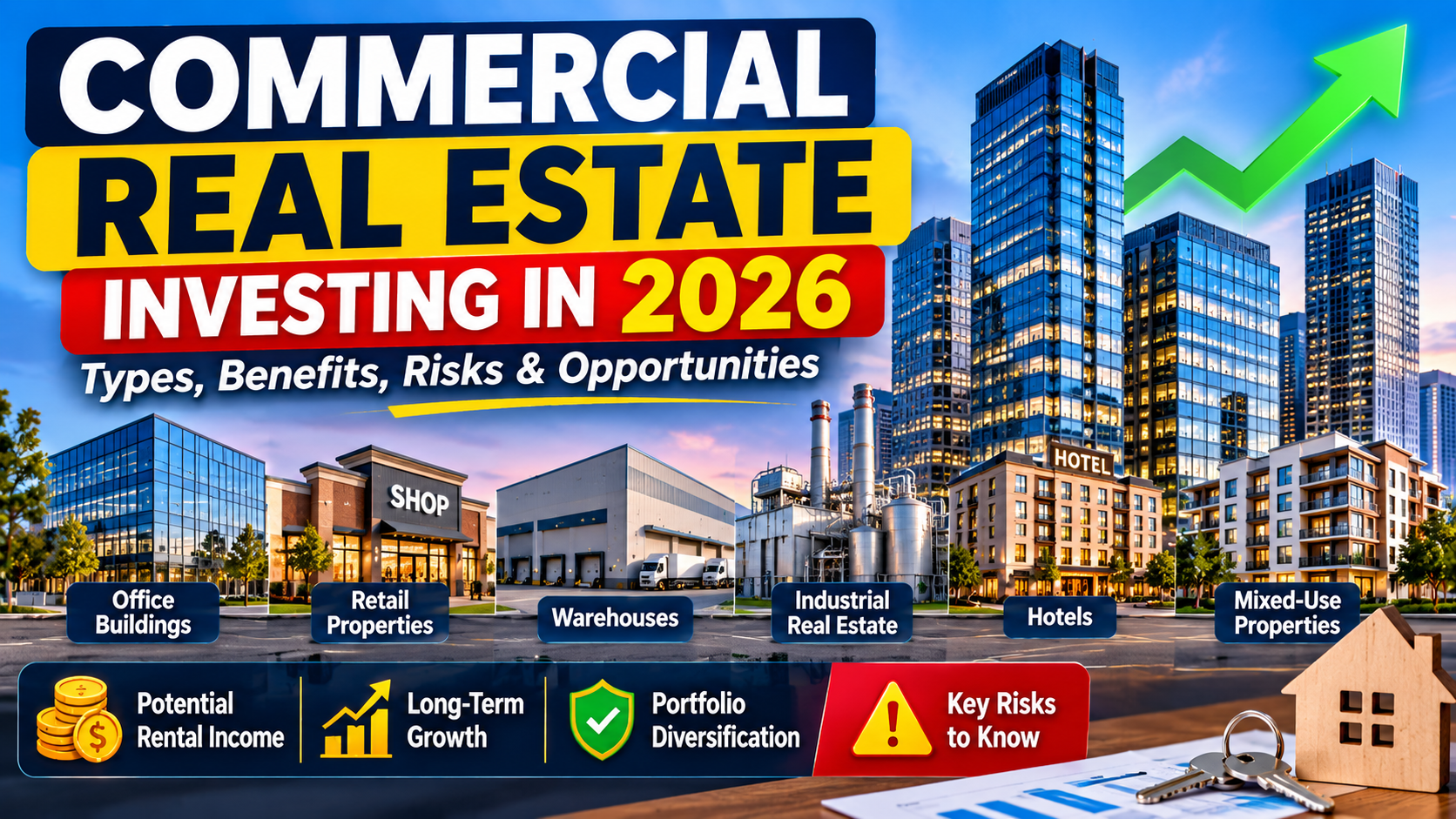
Commercial real estate is an important part of the global property market, offering investors opportunities to earn rental income, build long-term wealth, and diversify their investment portfolios. From office buildings and shopping centers to warehouses, industrial facilities, and hotels, commercial properties support businesses and economic activity across many industries.
In 2026, commercial real estate investors face a changing environment shaped by borrowing costs, business expansion, online shopping, remote work, logistics demand, and evolving tenant expectations. Some property types may benefit from growing demand, while others face challenges from changing work habits, higher operating expenses, or excess supply.
Understanding these factors is essential before purchasing a commercial property or investing through a real estate investment trust (REIT). This guide explains how commercial real estate works, the main property categories, potential benefits, investment risks, and practical strategies for evaluating opportunities.
What Is Commercial Real Estate?
Commercial real estate (CRE) refers to property primarily used for business, income-generating, or investment purposes. Examples include office buildings, retail spaces, warehouses, industrial facilities, hotels, and certain types of multifamily housing, depending on the market and classification system.
Unlike residential property purchased mainly for personal use, commercial property is often evaluated according to its income-producing potential. Investors may earn money through lease payments, increases in property value, or improvements that increase occupancy and rental income.
Commercial properties can be owned by individuals, partnerships, private investment firms, real estate funds, or publicly traded companies.
The financial performance of a commercial property often depends on several factors:
Location and accessibility.
Tenant demand and occupancy rates.
Rental income and lease conditions.
Maintenance and operating expenses.
Financing costs.
Property condition and management quality.
Local economic activity and competition.
Commercial real estate is not a guaranteed source of profit. Poor property selection, high borrowing costs, vacancies, and unexpected repairs can reduce returns or cause financial losses.
Main Types of Commercial Real Estate
Commercial property includes several categories, each with different income opportunities, costs, and risks.
1. Office Buildings
Office properties provide workspace for businesses, professional services, and other organizations. They range from small office units to large buildings in central business districts.
Office investments are commonly evaluated based on occupancy, lease duration, tenant quality, location, and the cost of maintaining the building.
Modern office buildings with convenient transportation, reliable infrastructure, and flexible layouts may attract businesses seeking high-quality workplaces. However, remote and hybrid work arrangements have changed office requirements in many markets.
Investors should examine local vacancy rates, new office supply, lease renewals, and tenant demand before buying an office property.
2. Retail Properties
Retail commercial real estate includes shopping centers, storefronts, supermarkets, restaurants, and other spaces where businesses sell products or services.
Retail properties may benefit from high foot traffic, strong visibility, convenient parking, and access to established residential communities.
However, performance varies by location and tenant category. Online shopping has created challenges for some traditional retailers, while service-based businesses, restaurants, and convenience-oriented stores may have different space requirements.
Investors should examine tenant financial stability, lease terms, local competition, and the mix of businesses operating in a retail property.
3. Industrial Real Estate
Industrial properties include manufacturing facilities, distribution centers, warehouses, and specialized industrial buildings.
Demand for these properties can be influenced by logistics networks, manufacturing activity, inventory management, and the growth of e-commerce.
Warehouses near major highways, ports, airports, or population centers may be attractive to businesses that need efficient distribution. Nevertheless, location alone does not guarantee success. Building specifications, transport access, utility capacity, and tenant requirements can all affect demand.
Investors should also consider whether a property can accommodate different tenants if the existing occupant leaves.
4. Multifamily Properties
Multifamily real estate includes apartment buildings and residential complexes containing multiple rental units.
Although these properties provide housing rather than traditional business premises, larger multifamily assets are often included in commercial real estate investment portfolios.
Income depends on occupancy, rents, maintenance expenses, property management, and local housing demand. A building with many units may spread vacancy risk across multiple tenants, although it still faces broader market and operating risks.
Investors should assess local rental affordability, competing developments, property condition, and applicable landlord-tenant laws.
5. Hospitality Properties
Hospitality real estate includes hotels, resorts, motels, and certain other accommodation facilities.
These properties can generate revenue from room bookings and additional services, but performance may fluctuate with tourism, business travel, seasonality, and broader economic conditions.
Hotels also tend to require active management, staffing, maintenance, and ongoing investment in facilities.
Investors should understand whether a potential investment is based on property ownership, hotel operating profits, or a combination of both. These are related but different sources of financial performance.
6. Mixed-Use Developments
Mixed-use properties combine several uses within one development, such as apartments, retail stores, offices, restaurants, and leisure facilities.
These projects may appeal to residents, businesses, and visitors because multiple services are available in one location.
However, mixed-use developments can be more complex to manage. Different tenants may have different lease terms, operating requirements, and exposure to market conditions.
Before investing, buyers should review the property's legal structure, expense allocation, tenant mix, and the financial performance of each component.
How Commercial Real Estate Investing Works
Commercial real estate investing generally involves acquiring a property, generating income from tenants or operations, managing expenses, and potentially selling the asset later.
Investors may purchase a property directly, buy it through a partnership, or invest through a fund or REIT.
Direct Property Ownership
Direct ownership gives investors greater control over leasing, property improvements, and management decisions. It also makes them responsible for financing, repairs, vacancies, legal compliance, and other operating obligations.
Commercial properties may require significant upfront capital, making this approach less accessible to beginners.
Real Estate Investment Trusts
A real estate investment trust, or REIT, allows investors to gain exposure to real estate through a company or trust that owns, operates, or finances property.
Some REITs specialize in commercial categories such as offices, retail centers, industrial facilities, or hotels. Publicly traded REITs can generally be purchased through brokerage accounts, subject to market access and local regulations.
REITs may offer a more accessible way to invest in commercial real estate without directly managing a building. However, share prices fluctuate, distributions are not guaranteed, and investment fees and financial leverage can affect returns.
Investors should review a REIT's holdings, debt levels, management, fees, and risk disclosures before investing.
Benefits of Commercial Real Estate Investing
Commercial property can provide several potential benefits, but outcomes depend on the asset, location, purchase price, and investment strategy.
Potential for Rental Income
Commercial properties may generate recurring rental income through leases with businesses and other tenants.
Some leases require tenants to pay certain expenses in addition to base rent, while other arrangements leave more operating costs with the property owner. The specific lease structure determines how expenses are divided.
Investors should evaluate the lease carefully rather than assuming all commercial leases work the same way.
Long-Term Capital Appreciation
A commercial property may increase in value if rental income improves, demand grows, occupancy increases, or the surrounding area becomes more desirable.
Property improvements and better management can sometimes increase income and support a higher valuation.
However, appreciation is not guaranteed. Changes in interest rates, tenant demand, local development, or operating costs may reduce a property's market value.
Longer Lease Terms
Some commercial properties have leases that extend over several years, potentially offering greater income visibility than short-term rental arrangements.
Long leases can also create challenges. A tenant may experience financial difficulties, seek renegotiation, or leave when the agreement expires. Investors should consider tenant creditworthiness and lease expiration schedules.
Portfolio Diversification
Commercial real estate can provide exposure to property markets and business sectors alongside stocks, bonds, and other assets.
Diversification may help reduce reliance on a single investment, but it does not eliminate risk. Investors who concentrate their holdings in one property type, city, or tenant can remain vulnerable to local problems.
How to Evaluate a Commercial Property Investment
A commercial property's appearance and location are not enough to determine whether it is a good investment. Financial analysis is essential.
Calculate Net Operating Income
Net operating income (NOI) is a key measure used to evaluate income-producing real estate.
It is generally calculated by subtracting operating expenses from effective property income, before debt service and income taxes.
For example, assume a commercial property has the following annual figures:
Potential rental income: $180,000
Vacancy and credit losses: $10,000
Operating expenses: $50,000
Effective income after vacancy and credit losses is $170,000.
Net operating income is:
$170,000 − $50,000 = $120,000
This calculation provides an estimate of the income generated by the property before mortgage payments and income taxes. Actual analysis should also account for appropriate reserves and property-specific expenses.
Understand the Capitalization Rate
The capitalization rate, commonly called the cap rate, compares a property's net operating income with its market value or purchase price.
Cap rate = Net operating income ÷ Property value × 100
Suppose a commercial property is priced at $1.5 million and generates annual net operating income of $120,000.
The cap rate is:
$120,000 ÷ $1,500,000 × 100 = 8%
This simplified example produces an 8% capitalization rate. It does not mean the investor will earn an 8% total return, because financing, taxes, capital expenditures, and eventual selling costs can change the outcome.
Cap rates should be compared with similar properties in the same market. A higher cap rate may indicate higher risk, weaker demand, or a property that requires substantial work.
Review Occupancy and Tenant Quality
A property with high occupancy can still be financially vulnerable if a major tenant is approaching lease expiration or struggling to pay rent.
Review the tenant roster, lease duration, renewal options, rent increases, payment history, and concentration of rental income.
If one tenant provides most of the property's revenue, losing that tenant could materially affect its financial performance.
Assess Building Condition and Future Costs
Commercial buildings can require expensive repairs to roofs, elevators, heating and cooling systems, electrical equipment, parking areas, and other infrastructure.
A professional property inspection can help identify defects and estimate future expenses.
Investors should include realistic capital expenditure reserves in their financial models instead of assuming the building will operate without major repairs.
Major Risks of Commercial Real Estate
Commercial real estate has specific risks that investors should understand before committing capital.
Economic Downturns
When businesses reduce operations or households cut spending, demand for office space, retail locations, and some industrial properties may weaken.
Lower occupancy and rent reductions can reduce property income. The effect varies by sector and local economic conditions.
Vacancy and Tenant Default
When a tenant leaves, the owner may lose rental income while paying ongoing property expenses.
Finding a replacement tenant can require advertising, negotiations, legal fees, renovations, and rent incentives.
Investors should assess how long it could take to lease vacant space and whether they have sufficient cash reserves to cover the gap.
Interest Rate and Debt Risk
Commercial properties are often purchased using a combination of equity and debt.
Borrowing can increase potential returns, but it also increases financial obligations. Higher interest rates, refinancing difficulties, or lower property valuations can place pressure on an investor's finances.
Before borrowing, investors should assess debt payments under different scenarios, including lower occupancy and reduced rental income.
Illiquidity
Selling a commercial property can take months or longer, depending on its size, condition, pricing, financing environment, and buyer demand.
This makes commercial real estate less liquid than many publicly traded investments.
Investors should avoid committing money that may be needed quickly for other financial obligations.
Regulatory and Environmental Issues
Zoning restrictions, building codes, accessibility requirements, environmental regulations, permits, and tax rules can affect a property's value and operating costs.
Some industrial or older properties may require additional environmental assessment. Investors should verify relevant legal records and obtain appropriate professional advice before purchasing.
Commercial Real Estate Trends to Watch in 2026
Commercial real estate does not move as one unified market. Trends differ between property types, cities, and economic conditions.
E-Commerce and Warehouse Demand
Online retail and supply-chain requirements continue to influence the need for distribution and logistics facilities. However, investors should examine local supply, transportation access, tenant demand, and building suitability rather than assuming every warehouse will perform well.
Changes in Office Demand
Hybrid work and changing business needs have affected office space requirements in many markets.
Some businesses may prioritize modern buildings with flexible layouts and convenient amenities, while older properties may require substantial investment to remain competitive.
Local vacancy rates and actual leasing activity are more useful than broad assumptions about the future of office space.
Retail Property Adaptation
Retail properties increasingly compete through location, convenience, services, and the overall customer experience.
Some centers may benefit from grocery stores, restaurants, healthcare services, or entertainment offerings. Others may face declining demand because of competition or changes in consumer behavior.
Investors should study the tenant mix and local customer base before purchasing retail property.
Technology and Property Management
Digital leasing platforms, building-management systems, energy monitoring, and data-analysis tools can help property owners improve operations.
Technology may support better maintenance planning and tenant communication, but it also requires investment and effective implementation.
The financial benefit should be evaluated against the cost of installing, operating, and maintaining these systems.
Financing and Property Valuations
Borrowing costs influence property affordability and investor returns. Higher financing expenses can reduce the amount buyers are willing or able to pay.
Investors should stress-test financial projections using different interest rates, occupancy levels, rental growth assumptions, and exit valuations.
A realistic investment model should remain understandable even when market conditions are less favorable than expected.
How Beginners Can Enter Commercial Real Estate
Beginners do not necessarily need to purchase an entire office building or shopping center to gain exposure to the sector.
1. Define your investment objective. Decide whether you want recurring income, long-term appreciation, or diversified real estate exposure.
2. Determine your budget. Include transaction fees, professional advice, repairs, operating reserves, and financing obligations.
3. Research the local market. Examine comparable rents, occupancy, tenant demand, property supply, and recent transactions.
4. Choose an investment structure. Compare direct ownership, partnerships, property funds, and REITs. Each has different costs, control rights, and risks.
5. Conduct due diligence. Review ownership records, leases, building condition, permits, financial statements, and relevant legal obligations.
6. Evaluate conservative scenarios. Test whether the investment remains financially manageable if rent falls, vacancies rise, or expenses increase.
7. Monitor performance. Track rental income, operating costs, tenant renewals, debt obligations, and market changes.
Investors should seek qualified legal, tax, and financial advice where appropriate, particularly when purchasing complex commercial assets or entering a partnership.
Commercial Real Estate vs. Residential Real Estate
Commercial and residential property investments differ in their typical tenants, leases, costs, and management requirements.
Factor | Commercial real estate | Residential real estate |
|---|---|---|
Typical tenants | Businesses and organizations | Individuals and households |
Lease structure | Often negotiated business leases | Often residential rental agreements |
Income drivers | Business demand, occupancy, lease terms | Housing demand, rents, occupancy |
Management | May involve specialized systems and services | Varies with property size and type |
Key risks | Tenant concentration, vacancies, refinancing | Vacancies, repairs, tenant and regulatory risks |
Entry cost | Can be high for direct ownership | Varies widely by market and property |
These are general differences. Some residential investments are large and complex, while some small commercial properties may be relatively straightforward to manage.
Neither category is automatically more profitable. Investors should compare the specific property's income, costs, risks, and suitability for their financial situation.
Frequently Asked Questions
Is commercial real estate a good investment in 2026?
It may be suitable for investors seeking income or long-term property exposure, but performance depends on the asset, purchase price, financing, tenant demand, and local market conditions. No investment return is guaranteed.
What are the most common types of commercial real estate?
Common categories include office buildings, retail properties, industrial facilities, warehouses, hospitality properties, mixed-use developments, and certain multifamily properties.
How do commercial real estate investors make money?
Investors may earn rental income, benefit from increases in property value, improve the property's operating performance, or receive distributions through certain property investment funds and REITs.
What is a good cap rate for commercial real estate?
There is no universally ideal cap rate. Appropriate rates vary by location, property type, tenant quality, lease terms, financing environment, and perceived risk. Comparisons should use similar properties and consistent assumptions.
Can beginners invest in commercial real estate with a small budget?
Depending on local regulations and brokerage access, publicly traded REITs may allow beginners to gain exposure without purchasing an entire building. Direct ownership generally requires more capital and additional management responsibilities.
What is the biggest risk in commercial real estate?
Risks vary by property. Major concerns include prolonged vacancies, tenant defaults, falling property values, unexpected repairs, high debt costs, and difficulty selling when funds are needed.
Conclusion
Commercial real estate offers investors several potential ways to earn income and build long-term wealth, from office buildings and retail centers to warehouses, hotels, and diversified REITs. Each category has its own demand drivers, operating requirements, and financial risks.
Successful investing requires more than identifying an attractive building. Investors need to examine rental income, occupancy, tenant quality, operating expenses, financing costs, legal obligations, and future capital requirements.
In 2026, careful market research and conservative financial analysis are particularly important because commercial property conditions vary significantly across locations and sectors. Beginners should start with a clear investment objective, verify all relevant documents, and avoid relying on guaranteed-return claims.
The best commercial real estate investment is not necessarily the property with the highest advertised yield. It is the opportunity whose risks, costs, income potential, and holding period align with the investor's financial goals.
Disclaimer: This article is for educational and informational purposes only and does not constitute financial, legal, tax, or investment advice. Commercial real estate investments involve risk, and actual results may differ from estimates. Consult qualified professionals before making investment decisions.