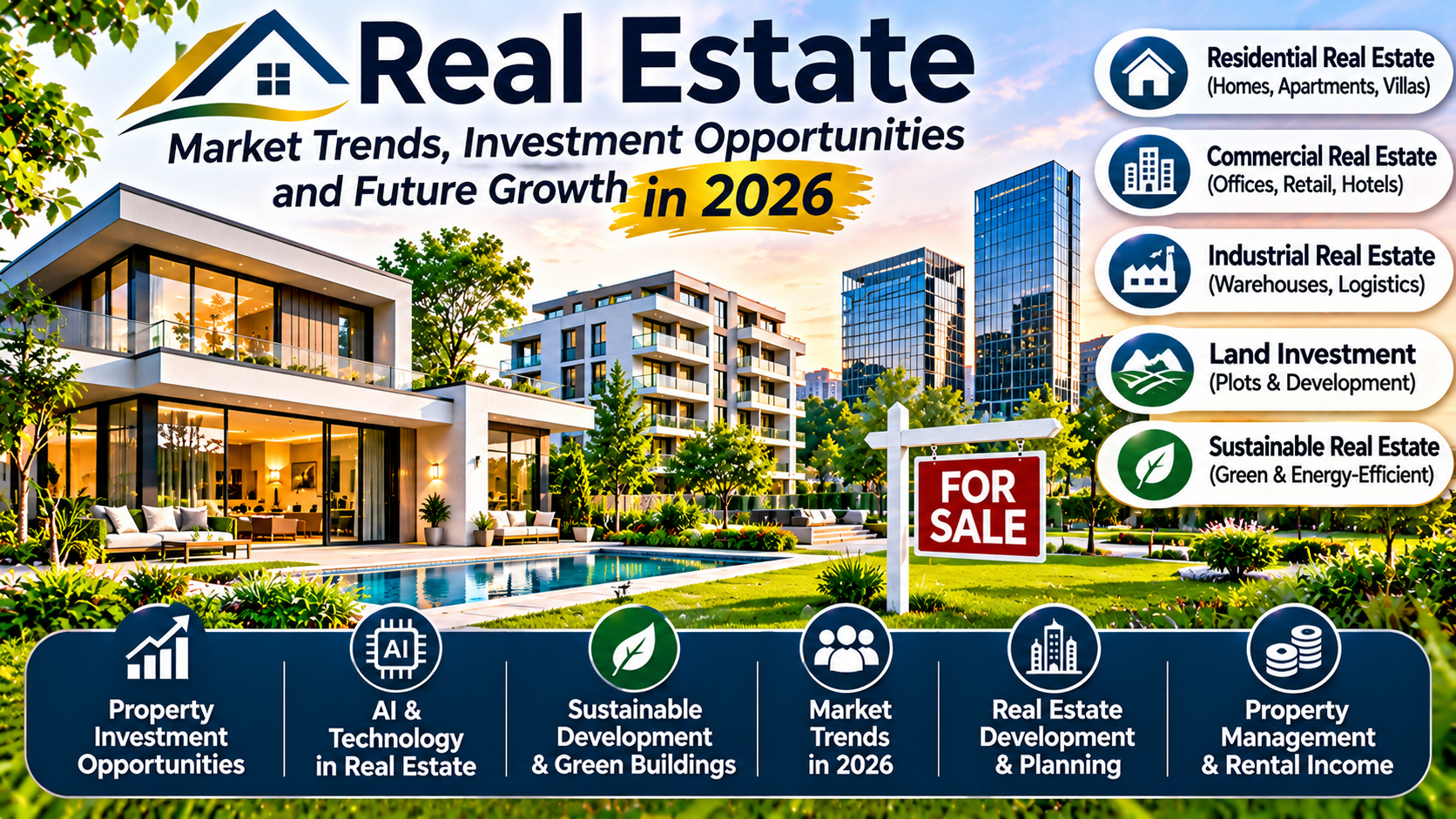
Real estate remains one of the most important sectors of the global economy, connecting housing, business, infrastructure, finance, and urban development. From residential homes and luxury apartments to commercial buildings, industrial warehouses, and modern mixed-use developments, property plays a significant role in how people live, work, and invest.
In 2026, the real estate industry is experiencing important changes. Technology is transforming property searches and management, sustainability is influencing construction decisions, and investors are becoming more selective about locations and property types. Demand for housing, logistics facilities, digital infrastructure, and well-positioned commercial properties is creating new opportunities across different markets.
Whether someone wants to purchase a first home, build a property portfolio, invest in rental housing, or develop commercial projects, understanding the market is essential.
This guide explores the real estate industry in 2026, including property types, investment strategies, market trends, technology, risks, and future opportunities.
1. What Is Real Estate?
Real estate refers to land, buildings, and permanent structures attached to land. It includes properties used for residential, commercial, industrial, agricultural, and other purposes.
The real estate industry includes several connected activities:
Buying and selling properties
Renting and leasing buildings
Property development and construction
Real estate investment and financing
Property management
Real estate brokerage and consulting
Land acquisition and planning
Real estate can generate income through rental payments, property appreciation, development projects, and other property-related business activities.
2. Major Types of Real Estate
Understanding the different property categories helps buyers and investors select opportunities that match their financial goals.
Residential Real Estate
Residential real estate includes properties designed for individuals and families.
Examples include:
Single-family houses
Apartments and condominiums
Townhouses
Luxury villas
Residential plots
Multi-family housing
Student accommodation
Residential property is often purchased for personal use or rental income. Demand is influenced by population growth, household income, employment, mortgage availability, and housing affordability.
Commercial Real Estate
Commercial real estate includes properties used primarily for business activities.
Common examples include:
Office buildings
Shopping centers
Retail stores
Hotels
Restaurants
Business parks
Medical offices
Commercial properties can generate rental income through leases with businesses and organizations. Their performance depends on location, tenant demand, operating costs, and economic conditions.
Industrial Real Estate
Industrial real estate supports manufacturing, storage, transportation, and distribution.
Examples include:
Manufacturing facilities
Industrial parks
Distribution centers
Cold-storage facilities
Logistics warehouses
Production facilities
The growth of online shopping, manufacturing, and supply-chain infrastructure has increased interest in strategically located industrial properties.
Land and Agricultural Real Estate
Land investment involves purchasing undeveloped or agricultural land for future use, development, farming, or long-term ownership.
Potential categories include:
Agricultural land
Residential development plots
Commercial development land
Industrial land
Mixed-use development sites
Land investments require careful research because access to roads, utilities, legal ownership, zoning, and development approvals can significantly influence value.
Special-Purpose Real Estate
Some properties serve specific industries or communities.
Examples include:
Hospitals and healthcare facilities
Schools and universities
Senior living communities
Data centers
Sports facilities
Religious buildings
These properties may require specialized construction, management, financing, and regulatory approvals.
3. Global Real Estate Market Outlook in 2026
The global property market is showing signs of recovery, but conditions differ significantly between countries, cities, and property categories.
Industry research from DWS describes a shift toward a new growth phase, with opportunities influenced by supply constraints, rental demand, demographics, and technology. It also emphasizes that choosing the right property sector and location is increasingly important. https://www.dws.com/insights/research/real-estate-research/global-real-estate-strategic-outlook-2026/
Several factors are shaping the market:
Interest rates and financing: Borrowing costs influence mortgage affordability, development budgets, and investor returns.
Housing supply: Limited housing availability in certain markets can support rental demand and encourage renovation or new development.
Urbanization: Growing cities create demand for residential communities, transportation infrastructure, retail facilities, and business spaces.
Employment and economic growth: Job creation can increase demand for housing, office space, and commercial services.
Investor confidence: Property investment activity depends on market stability, asset prices, financing conditions, and expected returns.
The 2026 market should not be viewed as a uniform global boom. Opportunities are increasingly dependent on local conditions and individual property quality.
4. Real Estate Investment Opportunities
Real estate offers several ways to participate in the property market. Each investment strategy has different financial requirements, risks, and potential returns.
Rental Property Investment
Rental property investment involves purchasing a property and leasing it to tenants.
Potential advantages include:
Recurring rental income
Long-term ownership of a physical asset
Potential property appreciation
Opportunities to improve property value
Investors should evaluate rental demand, vacancy rates, maintenance costs, taxes, insurance, and tenant quality before purchasing.
Residential Property Development
Residential development involves purchasing land or existing buildings and creating housing for sale or rent.
Projects may include apartment buildings, housing communities, townhouses, and affordable residential developments.
Successful development requires market research, construction planning, financing, permits, and professional project management.
Commercial Property Investment
Commercial property investment can provide income through business leases.
Investors may consider office buildings, retail spaces, medical properties, and business centers. However, tenant stability and lease conditions are important factors when assessing the investment.
Industrial and Logistics Properties
Warehouses, distribution centers, and industrial facilities are increasingly important to modern supply chains.
E-commerce, manufacturing, automation, and changing distribution networks can create demand for strategically located facilities.
Real Estate Investment Trusts (REITs)
Real Estate Investment Trusts allow investors to access real estate portfolios through publicly traded or privately structured investment vehicles, depending on the market.
REITs may provide exposure to residential buildings, shopping centers, offices, warehouses, healthcare properties, and other assets.
They can offer a more accessible alternative to directly purchasing property, although their prices and distributions can fluctuate.
5. How to Evaluate a Real Estate Investment
Before investing, buyers should assess both the property and the market surrounding it.
Important evaluation factors include:
Factor | What to examine |
|---|---|
Location | Accessibility, infrastructure, and nearby facilities |
Property price | Whether the asking price is supported by comparable sales |
Rental demand | Tenant availability and local demand |
Property condition | Repairs, structural quality, and maintenance |
Legal status | Ownership documents, title, and approvals |
Operating expenses | Taxes, insurance, service charges, and repairs |
Financing | Interest rates, repayment terms, and borrowing costs |
Resale potential | Future demand and market liquidity |
Understanding Rental Yield
Rental yield measures the annual rental income relative to the property's purchase price.
Gross Rental Yield Formula:
Gross Rental Yield = (Annual Rental Income ÷ Property Purchase Price) × 100
For example:
Property purchase price: $200,000
Monthly rent: $1,500
Annual rental income: $18,000
Gross rental yield:
($18,000 ÷ $200,000) × 100 = 9%
This is an illustrative calculation, not a guarantee of actual investment returns. Net yield will be lower after expenses, vacancies, taxes, and maintenance.
6. Technology Transforming the Real Estate Industry
Technology is changing how real estate businesses advertise properties, communicate with buyers, evaluate investments, and manage buildings.
Artificial Intelligence
Artificial intelligence can support:
Property price analysis
Market forecasting
Customer service
Lead generation
Investment research
Property recommendations
Automated administrative tasks
AI tools can help agents and investors process information more efficiently, but their predictions should be checked against reliable market data.
Virtual Tours and 3D Property Viewing
Virtual tours allow potential buyers and tenants to explore properties remotely.
This technology can help international buyers, busy professionals, and property agencies reach customers who cannot immediately visit a location.
Real Estate Platforms
Online property platforms make it easier to search for properties, compare prices, contact agents, and review listings.
Digital platforms are also helping agencies generate leads and build relationships with potential customers.
Smart Building Technology
Smart buildings use connected systems to improve property operations.
Examples include:
Smart lighting
Automated temperature controls
Security systems
Energy monitoring
Smart access systems
Predictive maintenance
These technologies can improve building management and help reduce unnecessary operating costs.
7. Sustainable Real Estate and Green Construction
Sustainability is becoming an important consideration in property development and management.
Modern buyers, tenants, developers, and investors increasingly evaluate energy efficiency, water usage, building materials, and environmental performance.
Important sustainable real estate practices include:
Energy-efficient construction: Buildings designed to reduce energy consumption through insulation, efficient lighting, and ventilation.
Renewable energy: Solar panels and other renewable energy systems can reduce dependence on conventional electricity sources.
Water conservation: Rainwater harvesting, efficient plumbing, and water recycling can support responsible resource management.
Sustainable materials: Recycled, locally sourced, and lower-impact building materials can reduce environmental effects.
Green building certifications: Certification systems such as LEED provide frameworks for evaluating building sustainability.
Sustainable design can support long-term property performance, although its financial benefits depend on construction costs, location, operating conditions, and tenant demand.
8. Real Estate Marketing Strategies in 2026
Effective marketing is essential for property developers, real estate agencies, brokers, and property owners.
Search Engine Optimization
SEO helps real estate websites appear in search engine results when potential customers look for properties or property-related services.
Useful strategies include:
Location-specific landing pages
Optimized property descriptions
Informative real estate articles
Local keyword targeting
Technical SEO
Internal linking
High-quality backlinks
For example, a property agency could target searches such as "apartments for sale in Lahore" or "commercial property investment opportunities."
Social Media Marketing
Platforms such as Facebook, Instagram, TikTok, LinkedIn, and YouTube allow real estate businesses to showcase properties and reach potential customers.
Effective content includes:
Property walkthrough videos
Short-form property tours
Construction updates
Neighborhood guides
Buyer education
Market reports
Video Marketing
High-quality property videos help buyers understand a property's layout, design, surroundings, and features.
Drone footage, professional photography, and virtual tours can make property listings more informative and engaging.
Content Marketing
Real estate businesses can build credibility by publishing educational articles about property investment, financing, buying processes, legal documentation, and market trends.
9. Real Estate Market in Pakistan
Pakistan's real estate sector includes residential housing, commercial developments, agricultural land, industrial properties, and housing schemes.
Major urban markets such as Lahore, Karachi, Islamabad, and Faisalabad have different property dynamics depending on employment, population growth, infrastructure, affordability, and local development activity.
Potential areas of market interest include:
Affordable residential housing
Apartment developments
Commercial plazas and business centers
Industrial and warehouse facilities
Mixed-use projects
Agricultural and development land
Important Considerations for Pakistani Property Buyers
Property buyers should conduct thorough due diligence before making payments.
Important checks include:
Verify the seller's ownership and title documents.
Check the relevant land record and transfer process.
Confirm the housing scheme or project has the required approvals.
Review outstanding taxes, dues, and liabilities.
Inspect the property's physical condition and location.
Use a qualified legal professional for complex transactions.
Obtain written agreements and official payment receipts.
Buyers should verify approvals with the relevant development authority or government department rather than relying only on advertisements or claims made by property agents.
10. Major Challenges Facing the Real Estate Industry
Despite its opportunities, real estate involves risks that can affect buyers, developers, and investors.
High Property Prices
Expensive land, construction materials, and labor can make housing unaffordable in many locations.
Interest Rate Changes
Higher financing costs can reduce purchasing power and make development projects more expensive.
Legal and Regulatory Issues
Ownership disputes, incomplete documentation, zoning restrictions, and delayed approvals can create financial and legal complications.
Market Volatility
Property prices do not always increase. Economic uncertainty, oversupply, and changing demand can reduce property values.
Construction Delays
Projects may face delays because of financing problems, contractor issues, material shortages, or regulatory requirements.
Property Management Problems
Vacancies, tenant disputes, maintenance costs, and unexpected repairs can reduce rental income.
11. Major Trends Shaping Real Estate in 2026
Several trends are influencing the direction of the industry.
Trend | Potential impact |
|---|---|
AI-powered property analysis | Faster research and decision support |
Smart homes | Greater automation and convenience |
Sustainable construction | More attention to energy and resource efficiency |
Flexible workspaces | Changing demand for office environments |
E-commerce growth | Continued interest in logistics facilities |
Digital property platforms | Easier property discovery and marketing |
Affordable housing | Increased focus on accessible residential options |
Data centers | Growing interest in digital infrastructure |
Mixed-use developments | Combining residential, retail, and business facilities |
Research from PwC and the Urban Land Institute highlights changing investment preferences, with digital infrastructure, housing-related assets, and technology-enabled operations attracting attention. https://www.pwc.com/gx/en/industries/financial-services/real-estate/emerging-trends-real-estate/etre-global-outlook.html
12. Leading Companies in the Real Estate Industry
The global real estate industry includes property developers, brokerage firms, investment managers, and commercial real estate service providers.
Some widely recognized companies include:
CBRE Group: Commercial real estate services, property management, and investment advisory.
JLL: Real estate services, leasing, property management, and investment management.
Cushman & Wakefield: Commercial property advisory and real estate services.
Colliers: Commercial real estate services and investment management.
Savills: International property services and real estate consultancy.
Prologis: Global logistics and industrial real estate.
Related Companies: Real estate development and property investment.
These companies operate in different segments and markets. Their inclusion does not represent an investment recommendation.
13. How to Start a Real Estate Business
Starting a real estate business requires market knowledge, professional relationships, planning, and a clear business model.
Step 1: Choose Your Business Model
Decide whether you want to operate as a real estate agency, property management company, development business, investment firm, or property marketing service.
Step 2: Research Your Market
Study property prices, customer demand, competitors, local development, and investment activity.
Step 3: Understand Legal Requirements
Register the business where required and understand relevant licensing, taxation, property transaction, and regulatory rules.
Step 4: Build a Professional Network
Develop relationships with property owners, buyers, developers, contractors, lawyers, financial institutions, and other agents.
Step 5: Establish Your Digital Presence
Create a professional website, optimize it for search engines, and establish social media profiles.
Step 6: Develop a Marketing Strategy
Use property listings, SEO, video marketing, educational content, and customer referrals to attract potential clients.
Step 7: Build Customer Trust
Provide accurate property information, transparent pricing, verified documentation, and professional customer service.
14. The Future of Real Estate Beyond 2026
The future of real estate will be shaped by technology, demographics, infrastructure, sustainability, and changing consumer expectations.
Artificial intelligence may become more deeply integrated into property valuation, investment analysis, leasing, and building management. Smart buildings may offer more automated services, while digital platforms may simplify property transactions.
Residential markets will continue to respond to affordability and household needs. Commercial property will evolve as businesses reconsider office requirements, retail strategies, and logistics operations. Data centers and other specialized infrastructure may also become increasingly important as digital services expand.
The most successful real estate businesses will likely be those that understand local demand, manage costs, adopt useful technology, and respond to changing customer expectations.
15. Frequently Asked Questions
What is real estate?
Real estate refers to land, buildings, and permanent structures. It includes residential, commercial, industrial, agricultural, and special-purpose properties.
Is real estate a good investment in 2026?
Real estate may offer opportunities through rental income, property development, and long-term appreciation. However, returns depend on location, purchase price, financing, demand, and operating expenses.
What are the main types of real estate?
The main categories are residential, commercial, industrial, land, agricultural, and special-purpose real estate.
How can beginners invest in real estate?
Beginners should start by learning about property valuation, rental demand, legal documentation, financing, and local market conditions. They should establish a budget and research properties carefully before purchasing.
What is rental yield?
Rental yield is the annual rental income expressed as a percentage of the property's purchase price. Gross yield does not account for expenses such as taxes, maintenance, and vacancies.
How is AI changing real estate?
AI is helping real estate businesses analyze property data, support valuations, automate customer communication, improve marketing, and manage building operations.
What are the risks of real estate investment?
Major risks include falling property prices, vacancies, legal disputes, financing costs, construction delays, unexpected maintenance, and changes in market demand.
What is sustainable real estate?
Sustainable real estate focuses on reducing the environmental impact of buildings through energy efficiency, responsible materials, water conservation, and improved building design.
Conclusion
Real estate in 2026 offers opportunities across residential housing, commercial properties, industrial facilities, land development, and specialized infrastructure. However, the industry is becoming increasingly dependent on careful market research, financial planning, legal due diligence, and effective property management.
Technology, sustainability, and changing customer expectations are transforming how properties are developed, marketed, purchased, and managed. For buyers and investors, understanding these changes can help identify suitable opportunities while avoiding unnecessary risks.
A successful real estate strategy should focus on property quality, location, affordability, genuine market demand, and long-term financial sustainability.