South Korea is home to some of Asia's most influential entrepreneurs, technology leaders, industrialists, and business families. From Samsung's global electronics empire to Hyundai's automotive industry, the country has developed companies that compete in international markets and influence millions of consumers.
South Korea's richest people have built their fortunes through semiconductors, electronics, automobiles, biotechnology, financial services, private equity, and entertainment-related businesses.
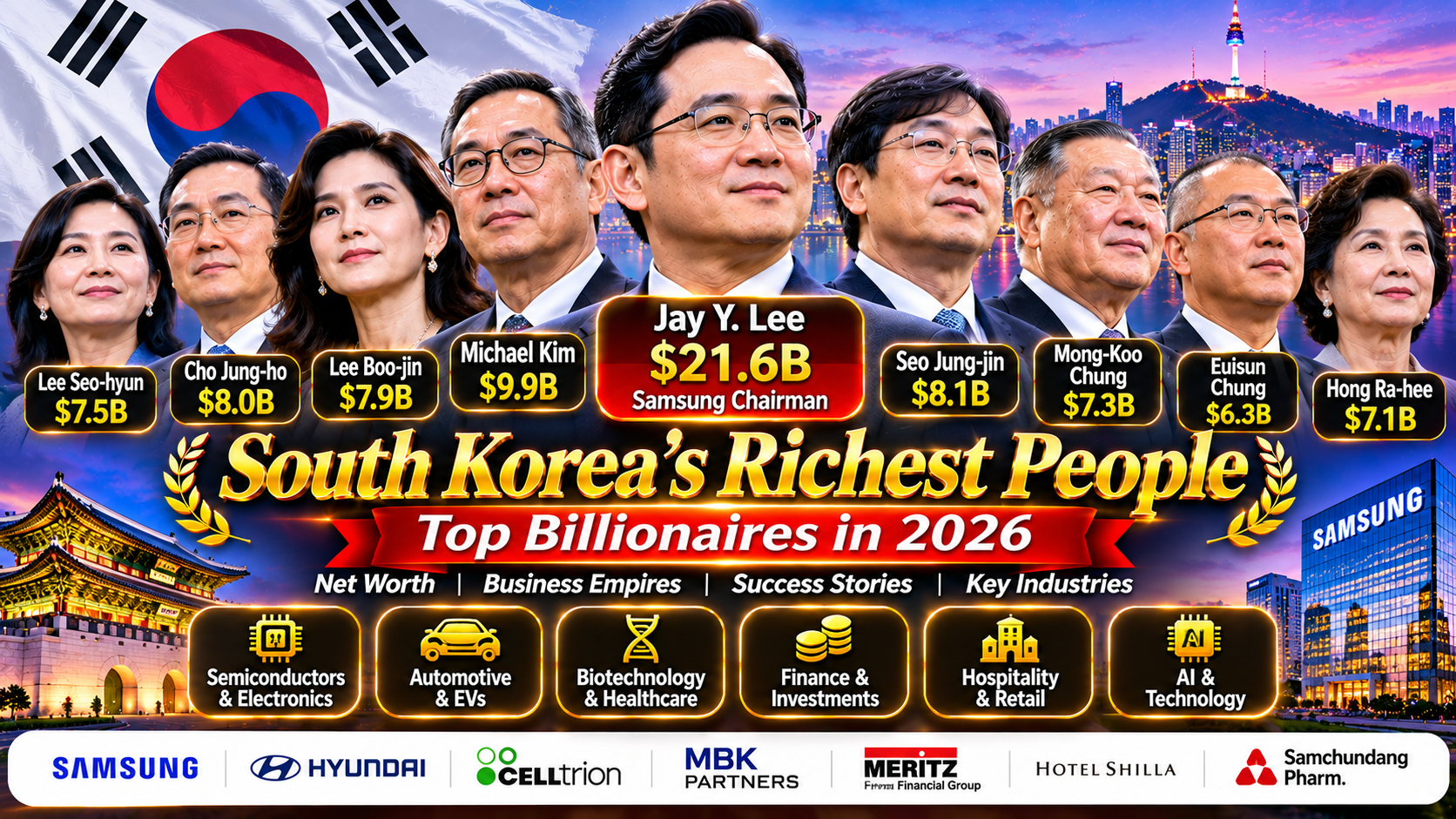
In 2026, Jay Y. Lee, chairman of Samsung Electronics, reclaimed the position of South Korea's richest person on Forbes' annual Korea's 50 Richest list. His rise was supported by strong demand for memory chips used in artificial intelligence infrastructure.
Other leading billionaires include Michael Kim of MBK Partners, Seo Jung-jin of Celltrion, Cho Jung-ho of Meritz Financial Group, and members of the Samsung and Hyundai business families.
This article explores South Korea's richest people in 2026, their estimated net worth, business empires, entrepreneurial journeys, and the industries creating wealth in one of Asia's most technologically advanced economies.
South Korea's Richest People in 2026: Top 10 Billionaires
According to Forbes' Korea's Richest 2026 ranking, the combined wealth of the country's 50 richest individuals and families reached approximately $175 billion, a 77% increase from the previous year's $99 billion.
The ranking was published on April 13, 2026, using stock prices and exchange rates from March 27, 2026.
Rank | Billionaire | Estimated net worth | Main source of wealth |
|---|---|---|---|
1 | Jay Y. Lee | $21.6 billion | Samsung Electronics |
2 | Michael Kim | $9.9 billion | MBK Partners |
3 | Seo Jung-jin | $8.1 billion | Celltrion |
4 | Cho Jung-ho | $8.0 billion | Meritz Financial Group |
5 | Lee Boo-jin | $7.9 billion | Hotel Shilla and Samsung holdings |
6 | Lee Seo-hyun | $7.5 billion | Samsung-related holdings |
7 | Mong-Koo Chung | $7.3 billion | Hyundai Motor Group |
8 | Hong Ra-hee | $7.1 billion | Samsung-related holdings |
9 | Euisun Chung | $6.3 billion | Hyundai Motor Group |
10 | Yoon Dae-in | $5.9 billion | Samchundang Pharm |
These figures are Forbes' annual ranking estimates, not live November 2026 valuations. Real-time billionaire estimates can be substantially different as share prices change.
1. Jay Y. Lee – South Korea's Richest Person
Estimated net worth: $21.6 billion
Jay Y. Lee, also known as Lee Jae-yong, is the executive chairman of Samsung Electronics and one of the most influential business leaders in South Korea.
Samsung is one of the world's largest technology companies, with operations in smartphones, semiconductors, televisions, home appliances, displays, and other electronic products.
Lee comes from the family that built Samsung into a global business empire. His father, Lee Kun-hee, played a major role in transforming the company into an international technology leader.
How Jay Y. Lee built his fortune
His wealth is closely connected to his family's ownership interests in Samsung and related companies.
Samsung Electronics has become particularly important to the global semiconductor industry. Its memory chips are used in computers, smartphones, servers, and AI infrastructure.
The growth of artificial intelligence has increased demand for advanced memory technologies and semiconductor manufacturing equipment.
Samsung's global business influence
Samsung's operations include:
Semiconductor manufacturing
Smartphones and mobile devices
Television and display technology
Home appliances
Memory chips
Electronics components
Forbes reported that Jay Y. Lee added $13.8 billion to his estimated wealth in the year measured for its 2026 annual ranking, the largest dollar increase among those on the list.
His return to the top position demonstrates the growing financial influence of semiconductor technology and artificial intelligence.
2. Michael Kim – The Private Equity Billionaire
Estimated net worth: $9.9 billion
Michael Kim, also known as Kim Byung-ju, is the co-founder of MBK Partners, one of Asia's major private equity investment firms.
Unlike technology entrepreneurs who build consumer products, private equity investors create wealth by acquiring businesses, improving their operations, restructuring companies, and managing investment portfolios.
How MBK Partners creates wealth
MBK Partners invests in businesses across Asia and manages funds for institutional investors.
Its investment activities have included companies in retail, healthcare, financial services, and other industries.
Private equity firms generally generate returns through a combination of company growth, operational improvements, strategic acquisitions, and successful exits.
Why Michael Kim is important
His position demonstrates the growing role of financial investment businesses in South Korea's billionaire economy.
Investment firms can influence the ownership and development of major companies without necessarily operating consumer-facing brands themselves.
Michael Kim ranked second on Forbes' 2026 Korea Richest list, with an estimated fortune of $9.9 billion.
3. Seo Jung-jin – The Celltrion Founder
Estimated net worth: $8.1 billion
Seo Jung-jin is the co-founder of Celltrion, a major South Korean biotechnology and pharmaceutical company.
Celltrion has developed a strong international presence through biologic medicines and biosimilar products.
Biosimilars are highly similar versions of already approved biological medicines. They can help increase treatment options and competition in the pharmaceutical market.
How Celltrion built its business
The biotechnology industry requires investment in research, development, manufacturing, clinical studies, and regulatory approvals.
Celltrion expanded its business by developing biological medicines and entering international healthcare markets.
Its operations include:
Biosimilar development
Biopharmaceutical manufacturing
Research and development
International pharmaceutical distribution
Healthcare innovation
Seo Jung-jin's fortune increased as Celltrion shares performed strongly during the period covered by Forbes' annual ranking.
His business journey demonstrates how biotechnology and pharmaceutical innovation can create substantial business value.
4. Cho Jung-ho – The Financial Services Billionaire
Estimated net worth: $8.0 billion
Cho Jung-ho is the chairman of Meritz Financial Group, a major South Korean financial services organization.
The group operates across insurance, financial investment, and related financial services.
The business of financial services
Financial companies create value through insurance premiums, investment management, financial products, risk management, and other services.
Meritz Financial Group has developed a significant position in South Korea's financial sector.
Cho's fortune demonstrates that banking, insurance, and investment businesses can create major wealth alongside technology and manufacturing companies.
5. Lee Boo-jin – A Leading Samsung Family Businesswoman
Estimated net worth: $7.9 billion
Lee Boo-jin is a prominent South Korean businesswoman and the president and CEO of Hotel Shilla.
She is the daughter of former Samsung chairman Lee Kun-hee and the sister of Jay Y. Lee.
Her business activities are closely associated with hospitality, luxury retail, and tourism-related services.
Hotel Shilla and luxury retail
Hotel Shilla operates in the hospitality and duty-free retail industries.
Its business activities include:
Luxury hotel operations
Duty-free shopping
Travel retail
Hospitality services
Consumer experiences
South Korea has developed a strong international reputation in tourism, beauty, fashion, and consumer brands.
Lee Boo-jin's business position reflects the importance of these industries within the country's wider economy.
6. Lee Seo-hyun – The Samsung-Linked Business Leader
Estimated net worth: $7.5 billion
Lee Seo-hyun is another prominent member of the Samsung family.
She has been associated with Samsung-related business interests and has held leadership roles in the family's wider corporate ecosystem.
Her wealth is primarily connected to holdings associated with the Samsung business group.
Samsung's business influence
Samsung is more than a smartphone manufacturer. Its wider business ecosystem includes electronics, construction, engineering, financial services, and other activities.
The group's international operations and extensive supply chains have helped establish it as one of the most recognizable corporate names in Asia.
Lee Seo-hyun's position in the billionaire rankings highlights the role of family ownership and corporate shareholdings in South Korea's wealth structure.
7. Mong-Koo Chung – The Hyundai Motor Group Leader
Estimated net worth: $7.3 billion
Mong-Koo Chung is the former chairman of Hyundai Motor Group and one of the most influential figures in South Korea's automotive industry.
During his leadership, Hyundai and Kia strengthened their international presence and developed into major global automobile brands.
How Hyundai became a global automotive business
Hyundai Motor Group manufactures vehicles for customers around the world.
Its business activities include:
Passenger vehicles
Electric vehicles
Automotive components
Vehicle manufacturing
Mobility technologies
Automotive research and development
The company has invested in electric mobility, hydrogen technology, robotics, and advanced manufacturing.
Chung's wealth reflects the importance of the automotive industry and the growth of Korean manufacturing.
8. Hong Ra-hee – The Samsung Family Billionaire
Estimated net worth: $7.1 billion
Hong Ra-hee is the widow of Samsung chairman Lee Kun-hee and the mother of Jay Y. Lee.
She has been one of the most influential figures associated with the Samsung family.
Her fortune is primarily linked to Samsung-related shareholdings and family assets.
Her role in South Korea's business landscape
Hong Ra-hee is also known for her involvement in the arts and cultural sector.
She has been associated with the Leeum Museum of Art, an institution established by the Samsung Foundation of Culture.
Her position among South Korea's richest people demonstrates the influence of inherited corporate ownership and long-term family investments.
9. Euisun Chung – The Hyundai Motor Group Chairman
Estimated net worth: $6.3 billion
Euisun Chung is the executive chairman of Hyundai Motor Group and a major figure in the future development of the automotive industry.
He has helped guide Hyundai's expansion into electric vehicles, robotics, autonomous driving, and advanced mobility technologies.
Hyundai's transition toward future mobility
The global automotive industry is undergoing major changes.
Electric vehicles, battery technology, software, artificial intelligence, and autonomous systems are changing how vehicles are designed and manufactured.
Hyundai is investing in these technologies to strengthen its international position.
Euisun Chung's business interests reflect the financial opportunities associated with the global transition toward advanced mobility.
10. Yoon Dae-in – The Pharmaceutical Entrepreneur
Estimated net worth: $5.9 billion
Yoon Dae-in is associated with Samchundang Pharm, a South Korean pharmaceutical company.
His fortune reflects the growing importance of pharmaceutical research, healthcare products, and biotechnology.
The importance of pharmaceutical innovation
Pharmaceutical businesses develop products for medical treatment, healthcare management, and disease prevention.
Successful companies require research capabilities, manufacturing infrastructure, regulatory approvals, and international market access.
South Korea's pharmaceutical and biotechnology industries have gained increasing attention as companies develop new medicines and expand their international operations.
Yoon Dae-in's position demonstrates that healthcare innovation is another important source of billionaire wealth in South Korea.
Industries Creating Billionaire Wealth in South Korea
South Korea's richest people have developed their fortunes across different industries. Several sectors have become especially important to the country's economy.
1. Semiconductors and artificial intelligence
Semiconductors are among South Korea's most important industries.
Samsung Electronics and SK hynix are major participants in the global memory chip market.
AI systems require advanced computing infrastructure and specialized memory technologies. As demand for AI data centers increases, semiconductor manufacturers have opportunities to expand their businesses.
The rise of Jay Y. Lee's fortune illustrates the importance of this sector.
2. Automobiles and electric vehicles
Hyundai Motor Group has helped South Korea become a major global automotive manufacturing center.
The industry is moving toward electric vehicles, connected cars, autonomous systems, and advanced mobility technologies.
These developments are creating opportunities for vehicle manufacturers, battery suppliers, and technology companies.
3. Biotechnology and pharmaceuticals
South Korea has developed a growing biotechnology and pharmaceutical industry.
Celltrion is an important example of a company that has expanded internationally through biopharmaceutical products.
Research, manufacturing, biosimilars, and new medicine development are important areas of business activity.
4. Finance and private equity
Financial institutions and investment firms are also major contributors to South Korea's billionaire economy.
Companies in insurance, banking, asset management, and private equity create wealth through investment portfolios and financial services.
Michael Kim and Cho Jung-ho demonstrate the importance of this sector.
5. Hospitality, beauty, and consumer products
South Korea has developed globally recognized consumer industries, including cosmetics, entertainment, fashion, and tourism.
The international popularity of Korean culture has increased interest in Korean brands and consumer experiences.
These industries create opportunities for entrepreneurs who can develop recognizable products and reach international customers.
South Korea's New Billionaire Economy: AI, Robotics and Advanced Technology
One of the most important developments in South Korea's economy is the growing connection between artificial intelligence and advanced manufacturing.
The country's established technology companies are investing in industries that could shape future economic growth.
Artificial intelligence
AI is becoming increasingly important in semiconductors, software, healthcare, finance, manufacturing, and consumer technology.
South Korean businesses are developing AI-related hardware, software, and services.
Robotics
Robotics companies are developing automated systems for factories, logistics, healthcare, and other industries.
Hyundai Motor Group has also increased its interest in robotics and future mobility.
Advanced semiconductors
AI applications require powerful computing systems, creating demand for advanced memory and semiconductor technologies.
South Korean manufacturers have an important role in supplying components used in global technology infrastructure.
Electric vehicles and batteries
The development of electric vehicles is creating opportunities for automotive companies, battery manufacturers, and technology suppliers.
South Korea has established a significant position in the international battery supply chain.
Challenges Facing South Korea's Richest Business Leaders
Despite their success, South Korea's largest companies face several challenges.
International competition
Samsung, Hyundai, and other Korean businesses compete with major companies from the United States, China, Japan, and Europe.
Semiconductor market cycles
The semiconductor industry experiences periods of high demand and oversupply. Changes in global technology spending can affect revenue and company valuations.
Economic uncertainty
Inflation, interest rates, international trade, and currency movements can influence investment and consumer demand.
Demographic challenges
South Korea faces a low birth rate and an aging population. These trends can affect its future workforce, consumer market, and economic growth.
Technology disruption
AI, automation, and emerging technologies are changing established industries. Businesses must continue investing in research and innovation to remain competitive.
Who Could Become South Korea's Next Billionaire Success Story?
South Korea's next generation of billionaires may emerge from industries that are still developing.
Some potential areas include:
Artificial intelligence and software
Semiconductor equipment
Biotechnology and healthcare
Robotics and automation
Electric vehicles
Battery technology
Digital finance
Beauty and consumer technology
New businesses are also exploring opportunities in gaming, fintech, e-commerce, and digital entertainment.
However, future billionaire rankings are uncertain. Building a successful company requires more than a promising industry. Entrepreneurs need strong products, effective management, reliable funding, and sustainable customer demand.
Conclusion
South Korea's richest people in 2026 represent a diverse group of business leaders who have built their fortunes through technology, finance, healthcare, manufacturing, and international investments.
Jay Y. Lee's position at the top reflects the growing importance of Samsung and the semiconductor industry. Michael Kim demonstrates the financial influence of private equity, while Seo Jung-jin represents the growth of biotechnology.
The Chung family highlights South Korea's automotive strength, while other Samsung family members demonstrate the long-term influence of major corporate shareholdings.
As artificial intelligence, robotics, electric vehicles, and advanced manufacturing continue to develop, South Korea's billionaire landscape may change significantly.
For entrepreneurs, investors, and business observers, these business stories offer insight into the industries and strategies shaping South Korea's future economy.
Frequently Asked Questions (FAQs)
1. Who is the richest person in South Korea in 2026?
Jay Y. Lee, executive chairman of Samsung Electronics, ranked first on Forbes' Korea's 50 Richest 2026 list with an estimated net worth of $21.6 billion.
2. Who is the second-richest person in South Korea?
Michael Kim, co-founder of MBK Partners, ranked second with an estimated fortune of $9.9 billion.
3. Who is Seo Jung-jin?
Seo Jung-jin is the co-founder of Celltrion, a major South Korean biotechnology and pharmaceutical company.
4. What is Jay Y. Lee famous for?
Jay Y. Lee is best known for leading Samsung Electronics, one of the world's largest technology and semiconductor companies.
5. Who is South Korea's richest woman?
Lee Boo-jin ranked as the richest woman on Forbes' 2026 Korea's 50 Richest list, with an estimated fortune of $7.9 billion.
6. Who is the richest Hyundai businessman?
Mong-Koo Chung and Euisun Chung are among the wealthiest figures associated with Hyundai Motor Group. Their rankings and estimated fortunes differ.
7. How many billionaires are there in South Korea?
The number depends on the ranking and measurement date. Forbes' 2026 Korea's 50 Richest list included 50 individuals and families, with a combined estimated fortune of $175 billion.
8. Which industries create the most billionaire wealth in South Korea?
Semiconductors, electronics, automobiles, biotechnology, finance, private equity, and consumer industries are important sources of billionaire wealth.
9. Why is Samsung so important to South Korea's economy?
Samsung is a major international technology group with businesses in semiconductors, smartphones, electronics, displays, and other industries. Its operations support exports, investment, employment, and technological development.
10. Is Hyundai a South Korean company?
Yes. Hyundai Motor Group is headquartered in South Korea and operates internationally in automobile manufacturing and mobility technologies.
11. Who is Michael Kim?
Michael Kim is the co-founder of MBK Partners, an Asia-focused private equity investment firm.
12. Is South Korea producing new technology billionaires?
Yes. Entrepreneurs in semiconductors, AI equipment, biotechnology, gaming, and digital finance are creating new businesses that may contribute to future billionaire wealth.
13. What makes South Korea's economy different?
South Korea has a strong combination of advanced manufacturing, technology exports, global consumer brands, industrial conglomerates, and research-driven businesses.
14. Can AI create more billionaires in South Korea?
AI could create substantial opportunities in semiconductors, software, robotics, automation, and data infrastructure. However, future wealth creation cannot be guaranteed.
15. Where can readers find South Korea's latest billionaire rankings?
Forbes publishes its annual Korea's Richest ranking and updates individual billionaire estimates through its Real-Time Billionaires platform. Other financial publications also provide wealth rankings using their own methodologies.