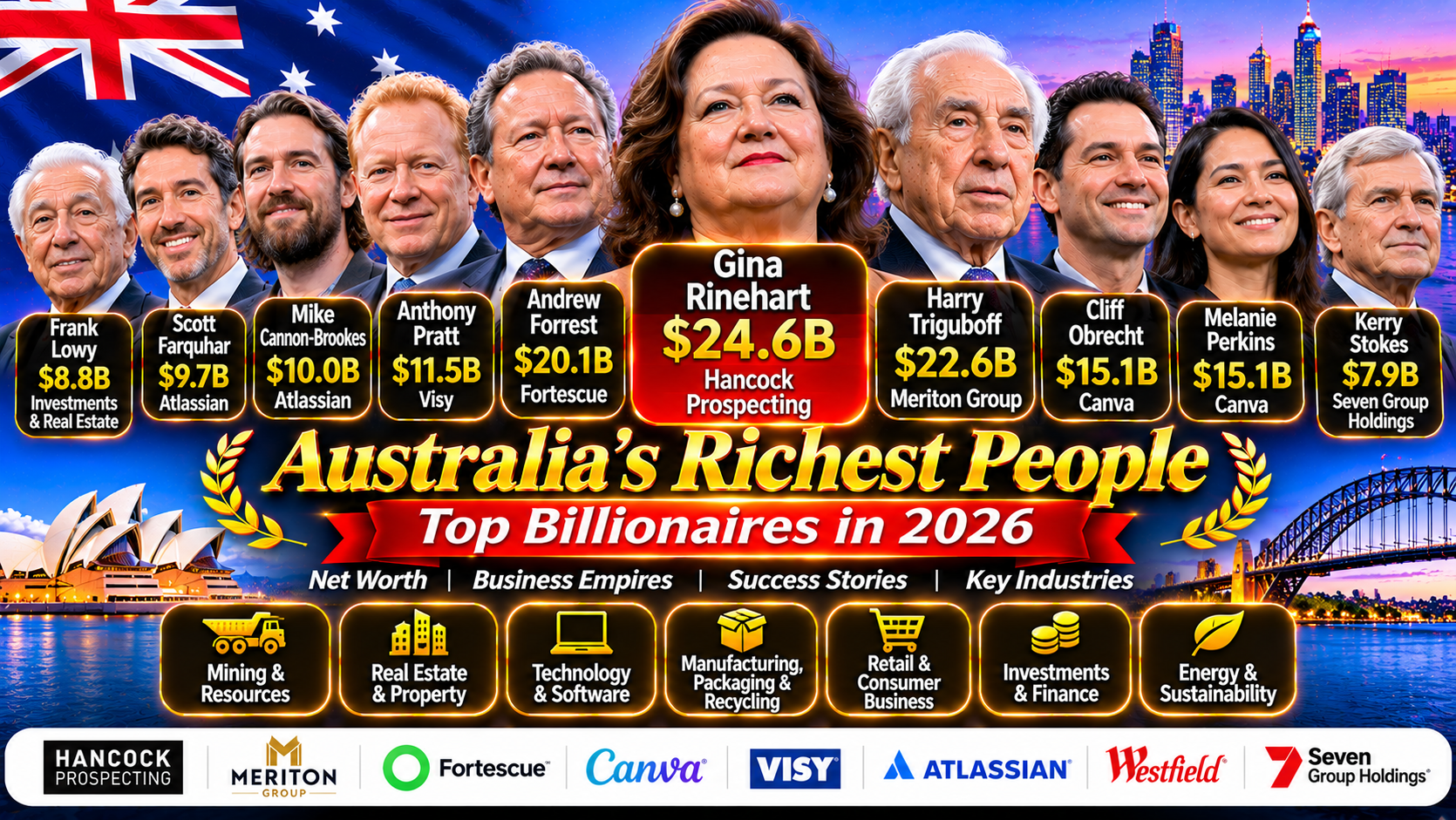
Australia is home to some of the world's most successful mining magnates, technology entrepreneurs, property developers, investors, and business families. From massive iron ore operations and global software companies to real estate empires and consumer brands, Australia's wealthiest people have built businesses with influence across international markets.
In 2026, mining entrepreneur Gina Rinehart remains Australia's richest person according to Forbes' Australia’s 50 Richest ranking. Harry Triguboff, Andrew Forrest, Canva co-founders Cliff Obrecht and Melanie Perkins, and technology entrepreneur Mike Cannon-Brookes are also among the country's wealthiest business leaders.
Australia's billionaire economy is particularly interesting because its fortunes come from a combination of natural resources, property development, technology, manufacturing, retail, and financial investments.
This article explores Australia's richest people in 2026, their estimated net worth, the companies behind their fortunes, their entrepreneurial journeys, and the industries shaping Australia's economic future.
Top 10 Richest People in Australia in 2026
The following ranking is based on Forbes' Australia's 50 Richest 2026, published in February 2026. It includes individual and family fortunes.
Rank | Person or family | Estimated net worth (USD) | Main business |
|---|---|---|---|
1 | Gina Rinehart | $24.6 billion | Hancock Prospecting |
2 | Harry Triguboff | $22.6 billion | Meriton Group |
3 | Andrew Forrest and family | $20.1 billion | Fortescue |
4 | Cliff Obrecht and Melanie Perkins | $15.1 billion | Canva |
5 | Anthony Pratt | $11.5 billion | Visy |
6 | Mike Cannon-Brookes | $10 billion | Atlassian |
7 | Scott Farquhar | $9.7 billion | Atlassian |
8 | Frank Lowy | $8.8 billion | Investments and real estate |
9 | Kerry Stokes | $7.9 billion | Seven Group Holdings |
10 | Bianca Rinehart and siblings | $7.5 billion | Hancock Prospecting |
Figures are Forbes estimates, not live net worth values. The ranking includes some family fortunes.
1. Gina Rinehart – $24.6 Billion
Industry: Mining, iron ore, and natural resources
Company: Hancock Prospecting
Gina Rinehart is Australia's richest person in 2026 and one of the most influential figures in the global mining industry.
She is the executive chairwoman of Hancock Prospecting, a privately owned Australian company with major interests in iron ore, coal, mineral exploration, agriculture, and other natural resources.
Rinehart inherited control of the business following the death of her father, Lang Hancock, in 1992. Rather than simply maintaining the family's existing operations, she expanded the company's interests and helped establish it as a major force in Australia's resources sector.
How did Gina Rinehart build her fortune?
One of the most important developments in Hancock Prospecting's growth was the establishment of the Roy Hill iron ore project in Western Australia.
The project required substantial financing and infrastructure investment. It eventually became an important source of iron ore exports to international markets, particularly Asia.
Her business interests also extend beyond iron ore.
Hancock Prospecting has investments in:
Iron ore mining.
Coal and mineral exploration.
Rare earths.
Natural gas.
Agriculture and cattle production.
International mining investments.
Rinehart's wealth is closely connected to the value of mining assets, commodity prices, and international demand for natural resources.
Forbes estimated her fortune at $24.6 billion in 2026, retaining her position at the top of Australia's wealth ranking.
2. Harry Triguboff – $22.6 Billion
Industry: Real estate and property development
Company: Meriton Group
Harry Triguboff is one of Australia's most successful property developers and the founder of Meriton Group.
He built his fortune through residential property development, particularly apartment buildings in major Australian cities.
Australia's population growth, urban expansion, and demand for housing have created opportunities for large property development businesses.
Triguboff recognized the commercial potential of apartment living and developed a business around building residential properties for Australian households.
What makes Meriton successful?
Meriton has become a major name in Australian residential development.
Its business activities include:
Residential apartment developments.
High-rise buildings.
Property investments.
Hospitality and serviced apartments.
Large-scale urban projects.
The company has developed properties across Sydney and other Australian markets.
In 2026, Forbes estimated Triguboff's net worth at $22.6 billion, placing him second among Australia's richest people.
His success demonstrates how long-term property development and strategic investment can create substantial wealth.
3. Andrew Forrest and Family – $20.1 Billion
Industry: Mining, metals, and energy
Company: Fortescue
Andrew Forrest, widely known as Twiggy Forrest, is an Australian mining entrepreneur and the founder of Fortescue.
He built his fortune through the iron ore industry, establishing Fortescue as one of the world's major iron ore producers.
The company operates mining and infrastructure assets in Western Australia's Pilbara region.
How did Andrew Forrest become wealthy?
Forrest recognized the commercial opportunities created by international demand for iron ore, particularly from industrial economies such as China.
Fortescue developed mining operations, rail infrastructure, and port facilities to support large-scale exports.
His business interests have also expanded into energy and industrial decarbonization.
Fortescue has been investing in technologies and projects associated with:
Renewable electricity.
Green hydrogen.
Energy storage.
Industrial decarbonization.
Mining technology.
The company's energy strategy reflects growing interest in reducing emissions from heavy industry.
Forbes estimated Forrest and his family's wealth at $20.1 billion in 2026, placing them third in the national ranking.
4. Cliff Obrecht and Melanie Perkins – $15.1 Billion
Industry: Technology and graphic design software
Company: Canva
Cliff Obrecht and Melanie Perkins are among Australia's most successful technology entrepreneurs.
They co-founded Canva, a design platform that allows individuals, businesses, educators, and organizations to create visual content without requiring advanced graphic design skills.
Canva began in Australia and grew into an internationally recognized technology company.
How did Canva become a global success?
The founders identified a problem in traditional graphic design software: many tools were complicated for ordinary users.
Their solution was to create an accessible online design platform.
Canva provides tools for creating:
Social media graphics.
Presentations.
Posters and flyers.
Marketing materials.
Business documents.
Educational resources.
Videos and other visual content.
The company has expanded its products with artificial intelligence features and additional collaboration tools.
In 2026, Canva reached a reported peak valuation of $42 billion in August, helping increase the combined wealth of its co-founders.
Forbes estimated Cliff Obrecht and Melanie Perkins' combined fortune at $15.1 billion.
Their journey demonstrates how a relatively simple idea can become a global technology business when combined with product innovation and international expansion.
5. Anthony Pratt – $11.5 Billion
Industry: Manufacturing, packaging, and recycling
Company: Visy
Anthony Pratt is one of Australia's most influential manufacturing entrepreneurs.
He is associated with Visy, a major packaging and recycling company with operations in Australia and international markets.
The company produces packaging materials and operates recycling facilities that support businesses across different industries.
What does Visy do?
Visy's operations include:
Cardboard packaging.
Paper manufacturing.
Recycling.
Sustainable packaging solutions.
Industrial manufacturing.
Supply-chain services.
Packaging is essential for food, retail, e-commerce, manufacturing, and logistics.
As businesses seek more sustainable packaging solutions, recycling and material recovery have become increasingly important.
Pratt's business success demonstrates how an industrial company can develop a significant market position by providing essential services to other businesses.
His estimated fortune reached $11.5 billion in Forbes' 2026 ranking.
6. Mike Cannon-Brookes – $10 Billion
Industry: Software and enterprise technology
Company: Atlassian
Mike Cannon-Brookes is an Australian technology entrepreneur and co-founder of Atlassian.
He established the company with Scott Farquhar after meeting him at university.
Atlassian develops software that helps organizations manage projects, collaborate, plan work, and coordinate technical teams.
Atlassian's international success
The company's products include:
Jira for project and software development management.
Confluence for team documentation and collaboration.
Jira Service Management for IT service operations.
Trello for organizing tasks and projects.
Atlassian's software is used by organizations around the world, from small businesses to major international companies.
Its growth demonstrates the commercial potential of subscription-based software and digital collaboration tools.
Forbes estimated Cannon-Brookes' fortune at $10 billion in 2026.
Although technology markets can experience significant share-price fluctuations, Atlassian remains one of Australia's best-known global software companies.
7. Scott Farquhar – $9.7 Billion
Industry: Software and technology
Company: Atlassian
Scott Farquhar is the co-founder of Atlassian and one of Australia's wealthiest technology entrepreneurs.
He built the company alongside Mike Cannon-Brookes, helping transform a software startup into an internationally recognized enterprise technology business.
The founders initially focused on providing software development tools that could improve collaboration and productivity.
Their company later expanded its product portfolio to serve businesses across multiple industries.
What contributed to Scott Farquhar's wealth?
His fortune is primarily associated with his ownership and investment interests in Atlassian.
The company's international growth has been supported by:
Subscription-based software products.
Enterprise customers.
Cloud-based services.
Global expansion.
Product innovation.
Farquhar's business journey shows how software companies can create substantial wealth by solving practical problems for organizations.
Forbes estimated his fortune at $9.7 billion in 2026.
8. Frank Lowy – $8.8 Billion
Industry: Real estate and investments
Frank Lowy is one of Australia's most recognized business entrepreneurs.
He is widely known for building the Westfield shopping centre empire, which became one of the world's most recognizable shopping mall businesses.
Lowy established his business in Australia and expanded into major commercial property markets.
Westfield became a significant name in the shopping centre industry, with large retail developments attracting international brands and millions of shoppers.
How did Frank Lowy build his wealth?
His business journey involved:
Shopping centre development.
Commercial property investment.
Retail real estate.
International expansion.
Long-term investment management.
Westfield's international business was eventually sold to Unibail-Rodamco in 2018 in a major global property transaction.
Lowy's fortune remains associated with his business interests and investments.
Forbes estimated his net worth at $8.8 billion in 2026.
9. Kerry Stokes – $7.9 Billion
Industry: Media, investments, and diversified business
Company: Seven Group Holdings
Kerry Stokes is an Australian businessman with investments across media, industrial services, construction equipment, and other commercial activities.
He is closely associated with Seven Group Holdings, a diversified company with interests in several sectors.
The business has exposure to Australia's industrial and infrastructure markets, including equipment distribution and related services.
Major business interests
Seven Group Holdings has interests connected to:
Industrial equipment.
Construction and mining services.
Media.
Energy-related services.
Investments.
Stokes also has a longstanding association with Australian television and media through Seven West Media.
His estimated wealth reached approximately $7.9 billion in Forbes' 2026 ranking.
His business interests demonstrate the value of diversification across different parts of the Australian economy.
10. Bianca Rinehart and Siblings – $7.5 Billion
Industry: Mining and natural resources
Company: Hancock Prospecting
Bianca Rinehart and her siblings appear among Australia's wealthiest family fortunes through their interests associated with Hancock Prospecting.
Their wealth is connected to the family's long-standing involvement in the Australian mining industry.
Hancock Prospecting holds interests in iron ore, mineral exploration, energy, and agricultural operations.
Why is the Rinehart family so wealthy?
The family's fortune is supported by valuable natural-resource assets and business interests developed over several decades.
The mining industry has played an important role in Australia's economic development, particularly through international exports of iron ore and other commodities.
The family's position in the ranking also illustrates how inherited ownership and long-term business investments can contribute to substantial wealth across generations.
Forbes estimated Bianca Rinehart and her siblings' combined fortune at $7.5 billion in 2026.
Industries Creating Australia's Biggest Fortunes
Australia's wealthiest people have built their fortunes across several major economic sectors. These industries demonstrate the country's strengths in natural resources, property development, technology, manufacturing, and investment.
1. Mining and natural resources
Mining is one of the most important sources of Australian billionaire wealth.
The country has significant deposits of iron ore, coal, gold, lithium, and other minerals.
Mining businesses benefit from international demand for raw materials used in manufacturing, construction, energy, and industrial production.
Companies associated with Gina Rinehart and Andrew Forrest demonstrate the scale of commercial opportunities in this sector.
2. Real estate and property development
Australia's major cities have created opportunities for residential and commercial property developers.
Housing demand, population growth, urban development, and commercial property investments have helped establish large real estate fortunes.
Harry Triguboff and Frank Lowy are examples of entrepreneurs who built substantial wealth through property-related businesses.
3. Technology and artificial intelligence
Technology has become an increasingly important source of Australian wealth.
Canva and Atlassian demonstrate how software businesses can develop global customer bases from Australian beginnings.
The growth of artificial intelligence, cloud computing, cybersecurity, and data centers could create further opportunities for technology entrepreneurs.
4. Manufacturing and recycling
Manufacturing remains an important part of Australia's business landscape.
Packaging, industrial equipment, recycling, and logistics services support companies across the economy.
Anthony Pratt's Visy illustrates how industrial businesses can become major commercial organizations.
5. Retail and consumer businesses
Retail businesses benefit from household spending, consumer demand, and international distribution.
Australia has developed successful companies across supermarkets, pharmacies, fashion, hospitality, and online commerce.
6. Finance and investment
Financial services and investment businesses also contribute to Australia's wealth landscape.
Investment firms, private equity, wealth management, and financial technology provide opportunities for entrepreneurs and investors.
How Australia's Richest People Built Their Wealth
Although Australia's wealthiest individuals operate in different industries, their business journeys reveal several common strategies.
Building businesses around essential needs
Some of Australia's biggest fortunes come from industries that provide products and services required by other businesses.
Mining companies supply raw materials, packaging companies support manufacturing and retail, and software companies improve business productivity.
Recognizing international opportunities
Australian entrepreneurs have frequently expanded beyond their domestic market.
Canva, Atlassian, and major mining businesses demonstrate how international customers can support substantial commercial growth.
Investing in long-term assets
Mining projects, property developments, industrial facilities, and software platforms often require significant initial investment.
Successful business owners build value through long-term operations, strategic expansion, and efficient management.
Adapting to technological change
Technology is changing traditional industries.
Mining companies are investing in automation, software businesses are developing AI tools, and manufacturing companies are exploring more efficient production and recycling methods.
Diversifying business interests
Many wealthy Australians have interests across multiple companies and industries.
Diversification can provide exposure to different economic opportunities, although it does not eliminate investment risk.
What Could Shape Australia's Billionaire Economy in the Future?
Australia's economy is changing as technology, international trade, population growth, and energy requirements create new commercial opportunities.
Several industries could influence future wealth creation.
Artificial intelligence and data centers: AI adoption is increasing demand for computing infrastructure, electricity, cooling systems, and advanced technology services.
Critical minerals: Lithium, rare earths, and other minerals are important for batteries, electronics, renewable energy, and advanced manufacturing.
Renewable energy: Solar, wind, energy storage, and electricity infrastructure could attract substantial investment.
Technology startups: Software, cybersecurity, financial technology, and AI businesses may create opportunities for new entrepreneurs.
Healthcare and biotechnology: Healthcare services, medical technology, pharmaceuticals, and biotechnology could benefit from changing population needs.
Real estate and infrastructure: Housing, logistics, commercial property, and transport infrastructure remain important areas for long-term investment.
These sectors may create opportunities, but future business success will depend on market conditions, competition, financing, regulation, and innovation.
Challenges Facing Australia's Wealthiest Business Leaders
Even the country's largest business empires face significant challenges.
1. Commodity price fluctuations
Mining companies are exposed to changes in international prices for iron ore, lithium, coal, and other resources.
A decline in commodity prices can affect revenue, profitability, and company valuations.
2. Housing affordability and property market changes
Property developers face changing interest rates, construction costs, housing demand, and regulatory requirements.
3. Technology competition
Australian technology businesses compete with large international software companies and rapidly developing AI platforms.
4. Energy transition
Mining and industrial companies face pressure to reduce emissions and adapt to changing energy requirements.
5. International economic uncertainty
Trade restrictions, global conflicts, inflation, currency movements, and changing financial conditions can affect Australian companies operating internationally.
The ability to manage these challenges will influence the long-term performance of Australia's largest businesses.
Conclusion: Who Is the Richest Person in Australia in 2026?
According to Forbes' Australia's 50 Richest 2026 ranking, Gina Rinehart is Australia's richest person, with an estimated fortune of $24.6 billion.
Harry Triguboff ranks second with $22.6 billion, while Andrew Forrest and his family hold third place with approximately $20.1 billion.
Their business empires represent the diversity of Australia's economy, from mining and real estate to technology, manufacturing, retail, and financial investments.
Australia's wealthiest entrepreneurs demonstrate how long-term investment, international expansion, innovation, and strategic business management can create major commercial success.
As artificial intelligence, critical minerals, renewable energy, and digital infrastructure continue to develop, new opportunities may emerge for Australian entrepreneurs and established business groups.
The country's richest people are not simply wealthy individuals. They are connected to companies and industries that play an important role in Australia's position in the global economy.
Frequently Asked Questions (FAQs)
1. Who is the richest person in Australia in 2026?
According to Forbes' Australia’s 50 Richest 2026 ranking, Gina Rinehart is Australia's richest person, with an estimated net worth of $24.6 billion.
2. Who are the top three richest people in Australia?
The top three are Gina Rinehart, Harry Triguboff, and Andrew Forrest and family.
3. How much is Gina Rinehart worth in 2026?
Forbes estimated Gina Rinehart's wealth at approximately $24.6 billion in its February 2026 ranking.
4. Who is the richest woman in Australia?
Gina Rinehart is Australia's richest woman and the country's wealthiest individual in the Forbes 2026 ranking.
5. Who owns Hancock Prospecting?
Hancock Prospecting is a privately owned Australian resources company controlled by Gina Rinehart.
6. How did Harry Triguboff become wealthy?
Harry Triguboff built his fortune through Meriton Group, particularly residential apartment development and property investments.
7. Who founded Canva?
Canva was co-founded by Melanie Perkins, Cliff Obrecht, and Cameron Adams.
8. Who are the richest technology entrepreneurs in Australia?
Notable technology entrepreneurs include Canva co-founders Melanie Perkins and Cliff Obrecht, Atlassian co-founders Mike Cannon-Brookes and Scott Farquhar, and other leaders in Australia's technology sector.
9. What is Andrew Forrest famous for?
Andrew Forrest is an Australian mining entrepreneur and the founder of Fortescue, a major iron ore producer with interests in energy and industrial decarbonization.
10. What industries create the most billionaire wealth in Australia?
Mining, real estate, technology, manufacturing, retail, and financial investments are major sources of billionaire wealth in Australia.
11. Is Australia a wealthy country?
Australia is a high-income developed economy with substantial natural resources, advanced financial services, strong institutions, and major international trade relationships.
12. Who is the richest family in Australia?
The Rinehart family has substantial wealth through its interests in Hancock Prospecting. However, rankings may distinguish individual fortunes from family wealth.
13. How are billionaire net worth estimates calculated?
Net worth estimates generally include company ownership, publicly traded shares, private business valuations, property, and other investments. Market prices and currency exchange rates can change the estimates.
14. Does Australia have technology billionaires?
Yes. Australia's technology sector includes major entrepreneurs associated with software, digital design, data centers, and other technology businesses.
15. Will Australia produce more billionaires in the future?
Australia could produce additional billionaires through growth in artificial intelligence, technology, critical minerals, renewable energy, healthcare, and infrastructure. However, future wealth rankings cannot be predicted with certainty.