China has become one of the world's most influential centers of wealth creation, producing billionaires across technology, artificial intelligence, e-commerce, manufacturing, finance, and consumer products. From the founder of TikTok's parent company to the entrepreneurs behind DeepSeek, Tencent, Alibaba, and major manufacturing groups, China's richest people have built businesses that reach customers around the world.
The country's billionaire landscape is also changing. Artificial intelligence, advanced semiconductors, robotics, and electric vehicles are creating new opportunities, while traditional industries such as real estate and consumer manufacturing face significant challenges.
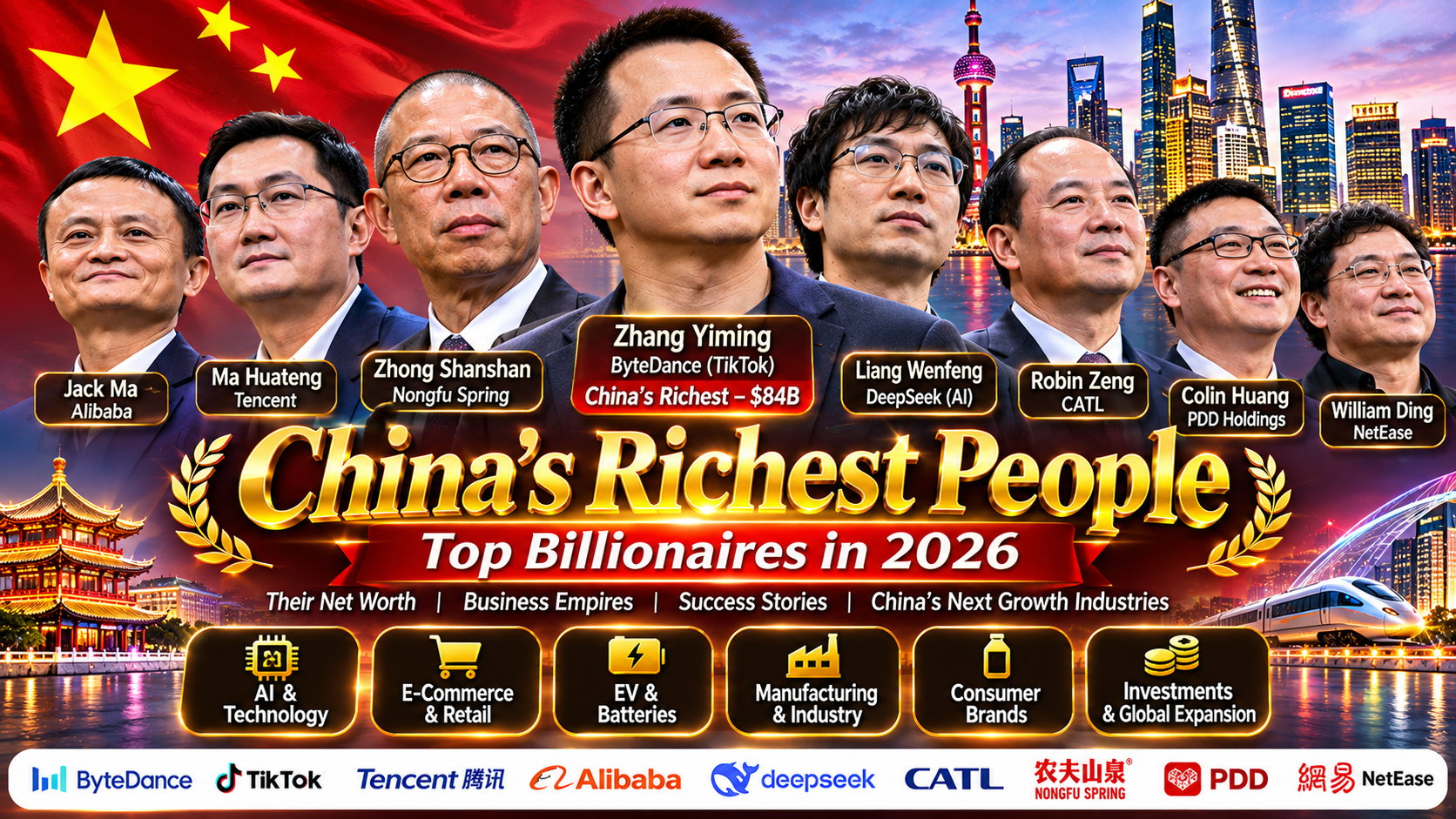
In 2026, Zhang Yiming, co-founder of ByteDance, became China's richest person, according to Forbes' China Richest list. His rise reflects the growing influence of technology and artificial intelligence on China's business economy.
This article explores China's richest people in 2026, their estimated fortunes, the companies behind their success, and the industries shaping the country's next generation of wealth.
China's Richest People in 2026: Top 10 Billionaires
The following ranking is based on Forbes' China Richest 2026 list, published in November. The estimates use share prices and exchange rates from October 16, 2026, and are not guaranteed current valuations.
Rank | Billionaire | Estimated net worth | Main source of wealth |
|---|---|---|---|
1 | Zhang Yiming | $84 billion | ByteDance |
2 | Zhong Shanshan | $60.2 billion | Beverages and pharmaceuticals |
3 | Liang Wenfeng | $46 billion | DeepSeek and AI |
4 | Robin Zeng | $45.8 billion | CATL and batteries |
5 | Ma Huateng | $45.3 billion | Tencent |
6 | William Ding | $42.3 billion | NetEase |
7 | He Xiangjian | $37.1 billion | Midea Group |
8 | Colin Huang | $28.5 billion | PDD Holdings |
9 | Jack Ma | $26.1 billion | Alibaba |
10 | Chen Jianhua | $25.2 billion | Hengli Group |
These estimates represent a particular ranking snapshot. Other wealth reports use different dates, valuation methods, and definitions of mainland China, Hong Kong, and Greater China.
1. Zhang Yiming – China's Richest Person
Estimated net worth: $84 billion
Zhang Yiming is the co-founder of ByteDance, the technology company behind TikTok and China's popular short-video platform Douyin. His rise to the top of China's billionaire rankings demonstrates how digital platforms can create enormous business value.
Born in 1983, Zhang developed an interest in technology and software before establishing ByteDance in 2012. The company developed recommendation systems that analyze user interests and deliver personalized content.
TikTok eventually became a major international social media platform, helping ByteDance establish a global presence.
How Zhang Yiming built his fortune
His wealth is primarily connected to his ownership stake in ByteDance. The company operates across social media, digital advertising, content distribution, and artificial intelligence.
ByteDance has also invested heavily in AI technologies and products. Its AI expansion has become an important factor in the company's business strategy and valuation.
Zhang's success demonstrates the commercial potential of combining technology, user engagement, data analysis, and global distribution.
2. Zhong Shanshan – The Bottled Water Billionaire
Estimated net worth: $60.2 billion
Zhong Shanshan is the founder of Nongfu Spring, one of China's best-known bottled water and beverage companies. He has also built wealth through pharmaceutical investments.
Unlike technology billionaires, Zhong developed his fortune in consumer products and essential goods.
Nongfu Spring became widely recognized through its bottled water, packaged beverages, and tea products. Its business benefits from the enormous demand for convenient drinking water and consumer beverages.
Business strategy behind his success
Zhong's business approach focuses on consumer demand, product branding, distribution, and manufacturing.
Bottled water may appear to be a simple product, but building a successful beverage company requires substantial investment in production facilities, logistics, quality control, and retail distribution.
His business journey demonstrates that consumer essentials can support large companies when they achieve strong brand recognition and efficient distribution.
3. Liang Wenfeng – The Artificial Intelligence Billionaire
Estimated net worth: $46 billion
Liang Wenfeng is the founder of DeepSeek, a Chinese artificial intelligence company that has attracted international attention.
DeepSeek became widely discussed for its AI models and its approach to developing competitive artificial intelligence systems.
Liang's rise highlights the growing financial importance of AI research, advanced computing, and software development.
Why DeepSeek matters
Artificial intelligence is becoming an important part of the global technology industry. Businesses are investing in AI tools for research, customer support, programming, automation, content creation, and data analysis.
DeepSeek has helped increase international interest in China's AI capabilities.
Liang's position among China's richest people reflects how quickly the AI sector can influence business valuations and create new wealth.
4. Robin Zeng – The Battery Industry Billionaire
Estimated net worth: $45.8 billion
Robin Zeng is the founder and chairman of Contemporary Amperex Technology Co. Limited, widely known as CATL.
CATL is one of the world's leading manufacturers of lithium-ion batteries, particularly for electric vehicles and energy storage systems.
The global transition toward electric mobility has increased demand for advanced battery technologies.
CATL's business influence
CATL supplies battery products and technologies to major automotive manufacturers. Its business operates in an industry where innovation, manufacturing capacity, energy density, battery safety, and cost efficiency are critical.
The company's growth demonstrates how industrial technology can create enormous wealth.
As electric vehicles and renewable energy systems develop, battery manufacturers remain important participants in the global energy transition.
5. Ma Huateng – The Founder of Tencent
Estimated net worth: $45.3 billion
Ma Huateng, also known as Pony Ma, is the co-founder of Tencent, one of China's largest technology companies.
Tencent operates across online gaming, digital entertainment, social networking, financial technology, cloud computing, and artificial intelligence.
Its popular products include WeChat, a platform that combines messaging, social networking, payments, and other digital services.
How Tencent built its business empire
Tencent's success comes from developing an interconnected digital ecosystem.
Its gaming operations generate revenue from popular titles, while WeChat connects users with businesses, services, payments, and digital content.
Tencent has also invested in other technology companies and expanded its cloud and AI capabilities.
Ma Huateng's fortune demonstrates the importance of building digital platforms that become part of everyday life.
6. William Ding – The NetEase Founder
Estimated net worth: $42.3 billion
William Ding, also known as Ding Lei, is the founder of NetEase, a major Chinese internet and technology company.
NetEase is widely recognized for online gaming, digital entertainment, music services, education technology, and internet products.
Gaming has been a major source of its commercial success.
The business of online gaming
The gaming industry generates revenue through game purchases, subscriptions, in-game purchases, licensing, and international distribution.
NetEase has developed games for Chinese and international audiences, building a business around digital entertainment.
William Ding's success shows how intellectual property, game development, and long-term user engagement can support a major technology company.
7. He Xiangjian – The Midea Group Founder
Estimated net worth: $37.1 billion
He Xiangjian founded Midea Group, one of China's leading home appliance manufacturers.
Midea produces products such as air conditioners, refrigerators, washing machines, kitchen appliances, and other household technologies.
The company has expanded internationally and developed a presence in industrial automation and robotics.
How Midea became a global business
Midea's growth reflects China's strength in manufacturing and global supply chains.
Its business model combines large-scale production, product innovation, international distribution, and operational efficiency.
The company illustrates how a manufacturer can expand from domestic operations into international markets.
8. Colin Huang – The Founder of PDD Holdings
Estimated net worth: $28.5 billion
Colin Huang is the founder of PDD Holdings, the company behind Pinduoduo and the international shopping platform Temu.
Pinduoduo became popular through its social commerce model, which encourages users to discover products and participate in group-buying offers.
Temu expanded the company's international presence by connecting consumers with a wide range of affordable products.
The growth of social commerce
Traditional online shopping often depends on product searches and individual purchases. Social commerce adds social interaction, recommendations, promotions, and group-based shopping experiences.
PDD Holdings has used these features to attract customers and compete in the global e-commerce market.
Colin Huang's success highlights the financial potential of innovative online retail models.
9. Jack Ma – The Alibaba Co-Founder
Estimated net worth: $26.1 billion
Jack Ma is one of China's most internationally recognized entrepreneurs and the co-founder of Alibaba Group.
Alibaba transformed online commerce in China through platforms connecting businesses, manufacturers, suppliers, and consumers.
Its business operations include e-commerce, cloud computing, logistics-related services, and digital technology.
Alibaba's influence on global commerce
Alibaba helped businesses access online marketplaces and reach customers at a scale that was difficult through traditional retail channels.
Its platforms supported the growth of digital commerce and international trade.
Although Jack Ma stepped away from executive leadership, his entrepreneurial legacy remains closely associated with the development of China's internet economy.
10. Chen Jianhua – The Hengli Group Billionaire
Estimated net worth: $25.2 billion
Chen Jianhua is associated with Hengli Group, a major Chinese industrial and manufacturing conglomerate.
The group has business interests in petrochemicals, textiles, polyester, and related industrial operations.
Its growth reflects the importance of large-scale manufacturing and industrial supply chains in China's economy.
Why industrial manufacturing creates wealth
Manufacturing companies can build substantial value through production capacity, technological improvements, supply-chain management, exports, and long-term relationships with customers.
Hengli Group represents a different path to wealth from social media and internet companies.
Its success demonstrates that traditional industrial businesses remain important contributors to China's billionaire economy.
How China's Richest People Build Their Wealth
China's billionaire economy is not based on one industry. Its wealthiest entrepreneurs have developed businesses across technology, consumer goods, manufacturing, e-commerce, and financial services.
Several strategies appear repeatedly.
1. Building technology platforms
Companies such as ByteDance and Tencent have created digital platforms used by millions of people.
These platforms can generate revenue through advertising, subscriptions, entertainment, digital services, and commercial partnerships.
2. Investing in artificial intelligence
AI has become one of the most important growth areas in China's technology sector.
Companies are developing AI models, semiconductors, robotics, automation tools, and enterprise software.
The rapid rise of AI entrepreneurs demonstrates how new technology can create significant business opportunities.
3. Expanding into international markets
International expansion allows companies to reach more customers and reduce dependence on a single domestic market.
Chinese businesses have expanded across e-commerce, electric vehicles, batteries, consumer products, and digital entertainment.
4. Developing manufacturing capabilities
Manufacturing remains a major source of wealth in China.
Companies that develop efficient production systems, competitive pricing, advanced technologies, and global distribution networks can build substantial market positions.
5. Creating recognizable consumer brands
Nongfu Spring and Midea demonstrate how strong consumer brands can create long-term commercial value.
Brand trust, product quality, distribution, and customer loyalty remain important factors in business growth.
China's New Billionaire Economy: AI, Robotics and Semiconductors
One of the most important developments in China's wealth landscape is the growing influence of advanced technology.
Artificial intelligence is attracting investment from established companies and new entrepreneurs. Semiconductor manufacturers are working to develop advanced chips, while robotics companies are exploring automation and humanoid machines.
These sectors could influence China's future industrial competitiveness.
Artificial intelligence
AI businesses are developing large language models, image-generation systems, enterprise applications, and intelligent assistants.
Companies that develop commercially useful AI products may benefit from growing demand across multiple industries.
Semiconductors
Semiconductors are essential for smartphones, computers, electric vehicles, data centers, and AI infrastructure.
China's semiconductor industry is receiving significant attention because advanced chips are strategically important for technology development.
Robotics
Robotics companies are developing machines for manufacturing, logistics, research, and other applications.
The growth of automation could create opportunities for companies that combine software, sensors, hardware, and AI.
Challenges Facing China's Wealthiest Entrepreneurs
Despite their success, China's richest business leaders operate in a complex economic environment.
Economic uncertainty
Changes in consumer demand, economic growth, interest rates, and international trade can affect business performance.
Regulatory changes
Technology, finance, education, and other industries operate under regulatory frameworks that can influence business models and expansion plans.
International competition
Chinese companies compete with international businesses in AI, electric vehicles, smartphones, e-commerce, batteries, and other industries.
Property market pressures
The property sector has faced significant challenges, affecting consumer confidence, investment, and related industries.
Market volatility
Many billionaire fortunes depend on company shares and private business valuations. A change in market sentiment can quickly increase or reduce estimated net worth.
China's Richest People and Their Influence on the Global Economy
China's billionaires influence industries well beyond the country's borders.
ByteDance has transformed global short-form video and social media. Tencent has become a major force in gaming and digital services. CATL plays an important role in electric vehicle batteries, while Midea operates in international appliance and manufacturing markets.
These companies demonstrate how Chinese entrepreneurs have helped shape global technology, consumer markets, and industrial supply chains.
Their influence is also visible in research and development, international investment, employment, manufacturing, and digital innovation.
Who Could Become China's Next Billionaire Success Story?
The next generation of Chinese billionaires may emerge from industries that are still developing.
Artificial intelligence, semiconductor manufacturing, robotics, biotechnology, clean energy, and advanced materials are potential areas of opportunity.
However, success is not guaranteed. Businesses must develop competitive products, manage costs, build customer trust, and respond to market and regulatory changes.
Entrepreneurs who solve important problems and build sustainable companies may become influential business leaders in the years ahead.
Conclusion
China's richest people in 2026 represent a diverse collection of entrepreneurs who have built businesses across technology, manufacturing, consumer products, e-commerce, and artificial intelligence.
Zhang Yiming's rise to the top reflects the growing importance of digital platforms and AI. Zhong Shanshan demonstrates the strength of consumer brands, while Liang Wenfeng represents the emerging influence of artificial intelligence. Robin Zeng's success highlights the global importance of battery manufacturing.
Together, these entrepreneurs illustrate how China's economy continues to evolve.
The country's next generation of wealth creators may come from AI, robotics, semiconductors, clean energy, and other advanced industries. For investors, business owners, and technology observers, China's billionaire landscape offers an important view of the industries shaping the future global economy.
Frequently Asked Questions (FAQs)
1. Who is the richest person in China in 2026?
Zhang Yiming, co-founder of ByteDance, ranked first on Forbes' China Richest 2026 list, with an estimated net worth of $84 billion.
2. What is Zhang Yiming famous for?
Zhang Yiming is best known for co-founding ByteDance, the company behind TikTok and Douyin.
3. Who is the second-richest person in China?
Zhong Shanshan ranked second on Forbes' 2026 China Richest list, with an estimated fortune of $60.2 billion.
4. Who is Liang Wenfeng?
Liang Wenfeng is the founder of DeepSeek, an artificial intelligence company that has attracted worldwide attention.
5. Is Jack Ma still one of China's richest people?
Yes. Jack Ma remained among China's ten richest people on the Forbes 2026 ranking, with an estimated fortune of $26.1 billion.
6. Who founded Tencent?
Tencent was co-founded by Ma Huateng, also known as Pony Ma, and other partners.
7. Which Chinese billionaire owns ByteDance?
Zhang Yiming co-founded ByteDance and remains its major billionaire shareholder.
8. Who is the richest Chinese entrepreneur in artificial intelligence?
Liang Wenfeng, the founder of DeepSeek, is among the most prominent AI-related billionaires in China's 2026 rankings.
9. Which industries create the most billionaires in China?
Technology, manufacturing, consumer products, e-commerce, artificial intelligence, batteries, and pharmaceuticals are important sources of billionaire wealth.
10. Who is Robin Zeng?
Robin Zeng is the founder of CATL, a major global battery manufacturer serving the electric vehicle and energy storage industries.
11. How many billionaires are there in China?
The number depends on the ranking and its geographical definition. Forbes and Hurun use different methodologies and measurement dates, so their totals are not directly interchangeable.
12. Why is China producing so many technology billionaires?
China has a large consumer market, extensive manufacturing capabilities, strong technology businesses, and significant investment in digital products and advanced industries.
13. Who is the richest woman in China?
The answer depends on the ranking, date, and whether the list covers mainland China or Greater China. Wealth rankings should be checked against the specific publication's latest methodology.
14. Can China's AI industry create more billionaires?
AI may create new wealth through software, semiconductors, robotics, cloud computing, and enterprise applications. However, future billionaire rankings cannot be predicted with certainty.
15. Are China's richest people richer than America's richest people?
The answer depends on whether individual fortunes or combined national billionaire wealth are being compared. Rankings and totals also vary by publication and measurement date.