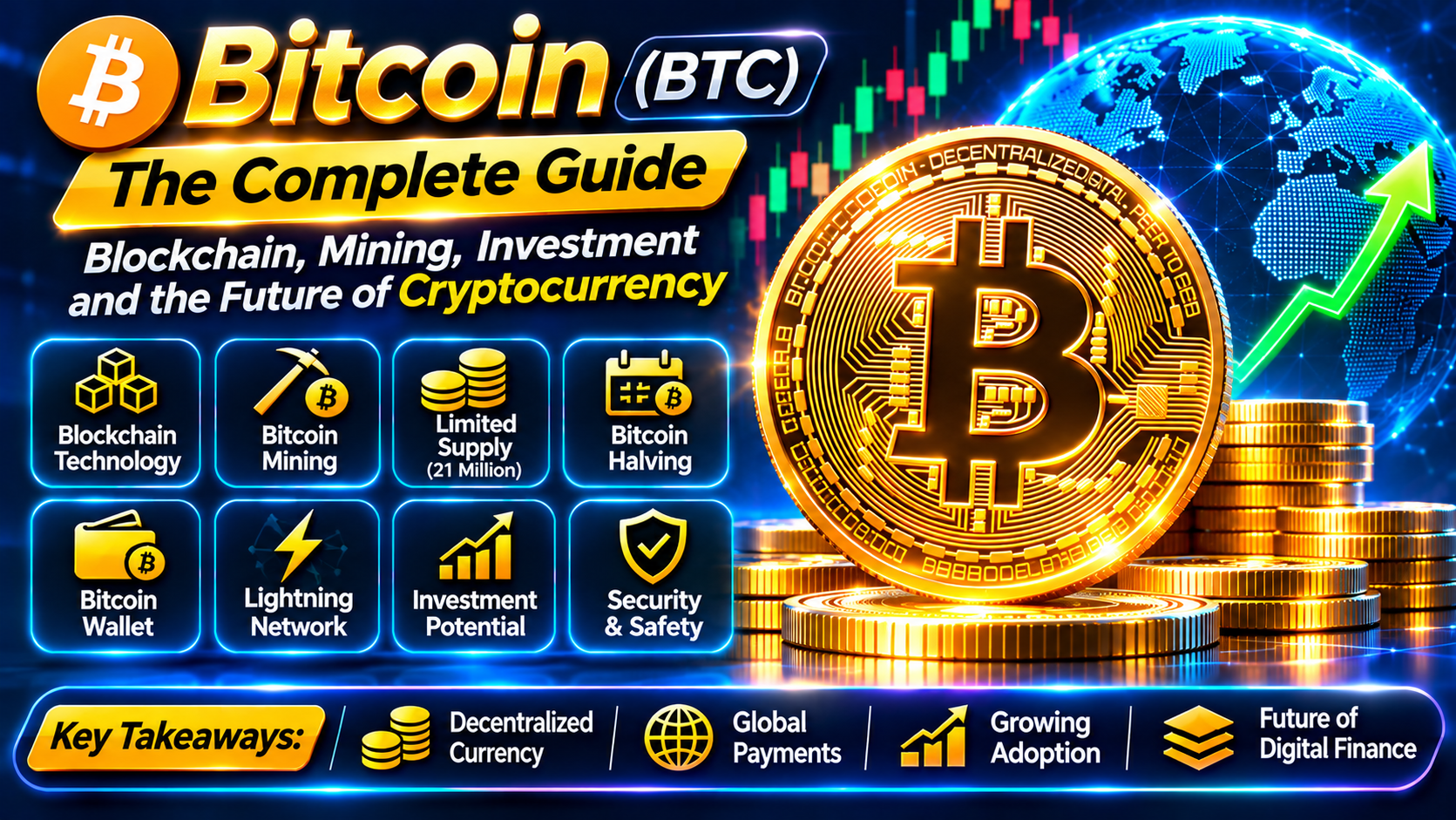
Bitcoin has become one of the most recognized financial innovations of the digital age. Since its introduction in 2009, Bitcoin has transformed the way people think about money, digital payments, investments, and financial independence. What started as an experimental decentralized payment system has developed into a global financial asset attracting individual investors, technology companies, institutional investors, and financial organizations.
Unlike traditional currencies controlled by central banks, Bitcoin operates through a decentralized network supported by computers around the world. Its technology allows people to transfer digital value without depending on a traditional banking intermediary.
Over the years, Bitcoin has gained worldwide recognition because of its limited supply, blockchain technology, decentralized structure, and growing participation in financial markets.
As digital finance continues to evolve, Bitcoin remains at the center of discussions about the future of money and the global cryptocurrency industry.
What Is Bitcoin?
Bitcoin (BTC) is a decentralized digital currency that allows users to send and receive value through a peer-to-peer network. It uses cryptography and blockchain technology to secure transactions and maintain a public record of transfers.
Bitcoin was introduced in 2009 by an individual or group using the name Satoshi Nakamoto. Its original purpose was to create an electronic payment system that could operate without requiring a central financial authority.
Unlike traditional currencies, Bitcoin does not have a central bank responsible for issuing or managing its supply. Instead, its monetary rules are maintained through software and verified by network participants.
Bitcoin is also divisible into smaller units called satoshis. One Bitcoin contains 100 million satoshis, allowing users to transact with small fractions rather than purchasing an entire coin.
How Does Bitcoin Work?
Bitcoin operates through a decentralized blockchain network. Blockchain acts as a public digital ledger that records confirmed transactions in chronological order.
When someone sends Bitcoin, the transaction is created through a cryptocurrency wallet and authorized using a private key. The transaction is then broadcast to the Bitcoin network.
Network participants verify the transaction according to Bitcoin's rules. Miners use computational power to compete in adding valid blocks to the blockchain through a process known as proof of work.
Once a block is accepted by the network, its transactions become part of the blockchain's permanent transaction history.
The process provides several important features:
Decentralization: No single bank or organization controls the entire network.
Transparency: Public blockchain transactions can be independently verified.
Security: Cryptographic mechanisms protect transactions and ownership.
Limited Supply: Bitcoin has a maximum supply of 21 million coins.
Global Accessibility: Bitcoin transactions can be initiated across international borders.
Why Does Bitcoin Have a Limited Supply?
One of Bitcoin's most distinctive characteristics is its predetermined maximum supply of 21 million coins.
Unlike traditional currencies, which can be issued by central banks under monetary policies, Bitcoin follows a programmed issuance schedule.
New Bitcoin enters circulation through mining rewards. However, the number of new coins issued as rewards decreases through an event known as Bitcoin halving.
Halving reduces the block subsidy by 50% approximately every four years, following every 210,000 blocks.
The most recent halving occurred in April 2024, reducing the block reward from 6.25 BTC to 3.125 BTC.
This predictable supply structure is one reason Bitcoin is frequently compared with scarce assets such as gold.
However, limited supply does not guarantee that Bitcoin's market price will increase. Demand, market conditions, liquidity, regulation, and investor sentiment also influence its value.
Bitcoin Mining: How New Bitcoins Are Created
Bitcoin mining is an essential process that helps secure the network and validate transactions.
Miners use specialized computer equipment to perform calculations and compete to discover valid blocks. The successful miner receives a block reward and transaction fees according to the network's rules.
Mining performs two important functions:
Transaction Verification: It helps confirm transactions and maintain agreement across the decentralized network.
Network Security: Proof of work makes attempts to rewrite transaction history computationally expensive.
Bitcoin mining requires specialized hardware, electricity, cooling systems, and technical expertise. Mining profitability depends on electricity prices, equipment efficiency, mining difficulty, and Bitcoin's market value.
The industry has also attracted attention because of its electricity consumption and environmental impact. Mining companies are increasingly discussing energy efficiency and alternative power sources.
Bitcoin as a Digital Investment Asset
Bitcoin has developed into a major digital asset traded across international cryptocurrency markets.
Many investors are attracted to Bitcoin because of its limited supply, global accessibility, decentralized structure, and growing institutional recognition.
Some investors view it as a potential long-term store of value, while others trade it to benefit from short-term market movements.
Institutional participation has also become an important part of Bitcoin's development. Financial companies offer cryptocurrency-related investment products, custody services, and trading infrastructure.
In the United States, the introduction of spot Bitcoin exchange-traded products in 2024 created additional regulated investment channels for eligible investors.
However, Bitcoin remains a highly volatile asset. Its market price can experience substantial fluctuations, and investors can lose a significant portion of their capital.
Factors That Influence Bitcoin Prices
Bitcoin's market value is influenced by multiple economic, technological, and financial factors.
1. Supply and Demand
Bitcoin's limited supply interacts with changing market demand. Increased buying interest can create upward price pressure, while significant selling activity can push prices lower.
2. Institutional Investment
Institutional participation, investment products, and large-scale purchases can influence Bitcoin liquidity and market sentiment.
3. Global Economic Conditions
Inflation, interest rates, monetary policy, and international economic developments can affect investor appetite for digital assets.
4. Government Regulations
Cryptocurrency policies differ across countries. Changes involving taxation, exchange licensing, digital asset custody, and investment products can influence market confidence.
5. Market Sentiment
News, social media discussions, trading activity, and investor expectations can create rapid price movements.
Understanding these factors is important for anyone researching Bitcoin as a financial asset.
Bitcoin and Traditional Banking
Bitcoin introduced an alternative approach to transferring and managing digital value.
Traditional banking systems depend on financial institutions to maintain accounts, process transfers, and manage payment infrastructure.
Bitcoin allows users to send value directly between compatible digital wallets without requiring a traditional bank to approve each transaction.
This does not mean Bitcoin completely replaces banking services. Traditional financial institutions provide additional services such as lending, deposit protection, credit facilities, and regulated payment systems.
Instead, Bitcoin represents an alternative financial network that operates alongside existing financial infrastructure.
Banks and financial technology companies are also exploring blockchain-related technologies to improve financial settlement, custody, and digital asset services.
Bitcoin Security: How to Protect Digital Assets
Security is one of the most important considerations for Bitcoin owners.
Bitcoin transactions are protected through cryptographic mechanisms, but wallets, exchanges, and individual devices can still be vulnerable to security problems.
Investors should follow several important precautions:
Use reputable cryptocurrency wallets and exchanges.
Enable two-factor authentication wherever available.
Keep private keys and recovery phrases confidential.
Consider hardware wallets for long-term storage.
Verify wallet addresses before sending transactions.
Avoid suspicious investment offers and phishing links.
Never share recovery phrases with strangers or supposed support representatives.
Bitcoin transactions are generally irreversible once confirmed. Sending funds to an incorrect address or falling victim to a scam can result in permanent financial losses.
Advantages and Disadvantages of Bitcoin
Bitcoin offers several potential benefits, but it also comes with important limitations.
Advantages
Decentralized Network: Bitcoin operates without a central organization controlling the entire payment system.
Limited Supply: Its maximum supply is capped at 21 million coins.
Global Transfers: Users can transfer Bitcoin internationally through the network.
Transparent Transactions: Public blockchain records can be independently verified.
Digital Ownership: Users can control their Bitcoin through private cryptographic keys.
Disadvantages
High Volatility: Bitcoin prices can change significantly within short periods.
Transaction Fees: Network fees may increase during periods of high demand.
Energy Consumption: Proof-of-work mining requires substantial computational resources and electricity.
Security Responsibilities: Users must protect their wallets and private keys.
Regulatory Differences: Legal treatment varies across countries and jurisdictions.
Bitcoin Adoption Around the World
Bitcoin adoption has expanded across several regions, although the level of acceptance differs significantly between countries.
Some businesses accept Bitcoin as a payment option, while others explore its use for digital asset management and financial innovation.
Institutional investors have also increased their participation through investment products, trading platforms, and cryptocurrency custody services.
In developing economies, Bitcoin attracts attention because of its potential for cross-border transfers and access to digital financial networks.
However, local regulations, internet access, transaction costs, and price volatility remain important considerations.
The Future of Bitcoin
Bitcoin's future will depend on several developments across the financial and technology industries.
Institutional participation could continue influencing its market structure. Improvements in wallet technology and payment infrastructure may also make Bitcoin easier to use.
The Lightning Network, a payment layer built on top of Bitcoin, aims to support faster and lower-cost transactions by processing certain payments away from the main blockchain.
Other important developments include improved custody solutions, regulatory clarity, mining efficiency, and broader financial infrastructure.
Bitcoin may also continue to influence discussions about monetary systems, digital ownership, and alternative financial assets.
However, its future market performance is uncertain. Technological adoption does not guarantee higher prices, and investors should evaluate both opportunities and risks.
Conclusion
Bitcoin has transformed the global financial landscape by introducing a decentralized digital currency supported by blockchain technology.
Its fixed supply, peer-to-peer structure, proof-of-work security, and international accessibility have made it one of the most influential digital assets in the cryptocurrency industry.
From individual investors to major financial institutions, Bitcoin continues to attract attention as the digital economy develops.
Although challenges involving volatility, regulation, energy consumption, and security remain, Bitcoin has established an important position in discussions about the future of money.
As financial technology continues to evolve, Bitcoin's role in digital payments, investment markets, and global financial innovation will remain an important subject for businesses, investors, and technology enthusiasts.
Frequently Asked Questions (FAQs)
1. What is Bitcoin in simple words?
Bitcoin is a decentralized digital currency that allows people to transfer value through a blockchain network without depending on a traditional bank.
2. Who created Bitcoin?
Bitcoin was introduced in 2009 by an individual or group using the pseudonym Satoshi Nakamoto.
3. How many Bitcoins will ever exist?
Bitcoin has a maximum supply of 21 million coins.
4. What is Bitcoin mining?
Bitcoin mining is the process of using computational power to validate transactions, secure the network, and add new blocks to the blockchain.
5. Is Bitcoin a real currency?
Bitcoin is a digital asset and payment network. Its legal classification and acceptance as a currency vary between countries.
6. Can someone buy less than one Bitcoin?
Yes. Bitcoin is divisible into 100 million satoshis, so users do not need to purchase an entire Bitcoin.
7. Why does Bitcoin have value?
Bitcoin's market value is influenced by demand, limited supply, network adoption, liquidity, market sentiment, and investor expectations.
8. Is Bitcoin a safe investment?
Bitcoin carries significant risks, including market volatility, scams, cybersecurity threats, and regulatory uncertainty. Investors should conduct independent research.
9. What is the difference between Bitcoin and Ethereum?
Bitcoin primarily focuses on decentralized digital money, while Ethereum provides a programmable blockchain platform that supports smart contracts and decentralized applications.
10. Can Bitcoin transactions be reversed?
Confirmed Bitcoin transactions are generally irreversible. Users should carefully verify the recipient address and transaction details before sending funds.
11. What is Bitcoin halving?
Bitcoin halving is an event that reduces the mining block subsidy by 50% approximately every four years, slowing the creation of new bitcoins.
12. What is the Lightning Network?
The Lightning Network is a payment layer designed to enable faster and potentially lower-cost Bitcoin transactions.
13. Can Bitcoin be used for international payments?
Yes. Bitcoin can be transferred between compatible wallets across international borders, subject to local laws and network fees.
14. Is Bitcoin completely anonymous?
No. Bitcoin transactions are publicly recorded on the blockchain. Wallet addresses are pseudonymous, but transaction activity can sometimes be linked to identifiable users.
15. What is the future of Bitcoin?
Bitcoin may see further development in institutional investment, payment infrastructure, custody services, and financial applications. However, its future adoption and market price are not guaranteed.
Disclaimer: This article is for educational and informational purposes only. It does not constitute financial or investment advice.