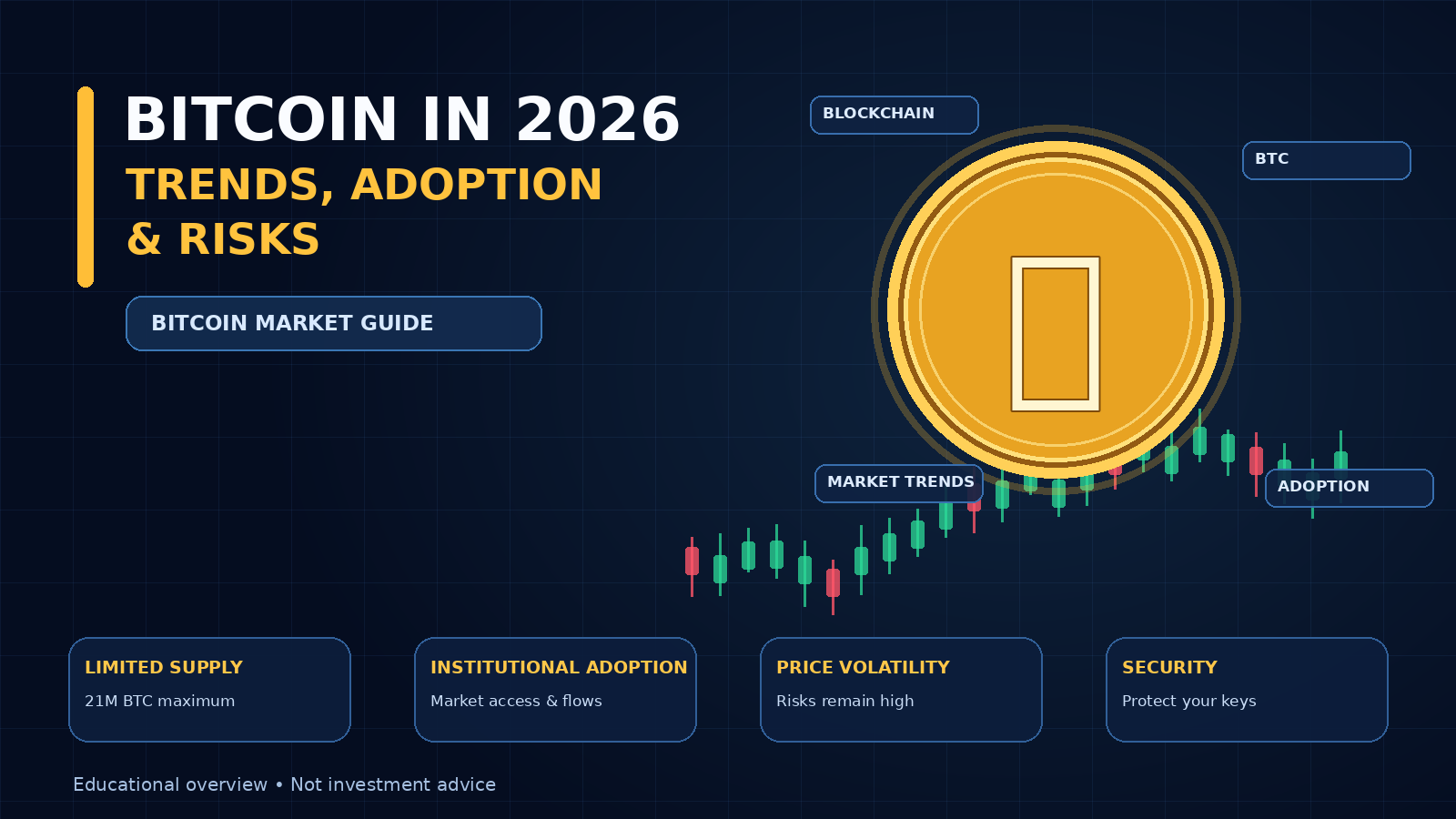
Bitcoin continues to play a major role in the digital asset industry. Originally introduced as a decentralized digital currency, Bitcoin has evolved into an asset followed by individual investors, financial institutions, technology companies, and policymakers.
In 2026, discussions about Bitcoin increasingly involve institutional investment, exchange-traded funds (ETFs), financial regulation, and its potential role in investment portfolios. At the same time, market volatility and economic uncertainty continue to influence its price.
For readers who want to understand Bitcoin beyond daily price movements, this guide explores the factors shaping its adoption, its potential benefits, and the risks that investors should consider.
What Makes Bitcoin Different?
Bitcoin is a decentralized digital asset that operates on a peer-to-peer network. Unlike traditional currencies, it is not issued by a central bank, and its monetary policy is governed by the Bitcoin protocol.
Its main characteristics include:
Limited supply: Bitcoin's protocol sets a maximum supply of 21 million BTC.
Decentralized operation: Independent participants maintain and verify the network.
Public transaction records: Confirmed transactions are recorded on a blockchain.
Predictable issuance: New bitcoin enters circulation through mining, with issuance decreasing over time.
Global accessibility: Users with compatible technology can send and receive bitcoin, subject to local laws and practical limitations.
These characteristics distinguish Bitcoin from traditional financial assets, but they do not guarantee that its market price will rise.
Bitcoin Market Trends in 2026
Bitcoin's market performance is influenced by several interconnected factors. Understanding these drivers can help readers interpret market developments without relying on short-term predictions.
1. Institutional Investment
Financial institutions have become an important part of the Bitcoin market. Investment products, including spot Bitcoin ETFs in eligible jurisdictions, give some investors exposure to bitcoin through traditional financial accounts.
Institutional participation can influence demand, liquidity, and market sentiment. However, institutional investors can also reduce exposure, and investment flows may change rapidly.
2. Economic Conditions
Bitcoin is affected by broader financial conditions. Interest rates, inflation, bond yields, currency movements, and investor appetite for risk can all influence demand for digital assets.
When investors become more cautious, they may reduce exposure to volatile investments. During periods of stronger risk appetite, demand for Bitcoin may increase. Neither relationship is consistent enough to predict prices with certainty.
3. Cryptocurrency Regulation
Regulatory decisions can affect how exchanges operate, which investment products are available, and how institutions access digital assets.
Clearer rules may support participation by businesses that need defined compliance requirements. Conversely, restrictive policies or legal uncertainty can create obstacles for market participants.
Regulation remains an important factor to watch as governments and financial authorities continue developing digital asset frameworks.
4. Bitcoin's Supply Schedule
Bitcoin has a predetermined issuance schedule. Mining rewards decrease through events known as halvings, reducing the rate at which new bitcoin is created.
This predictable supply is one reason Bitcoin is often compared with scarce assets. However, a reduction in new supply does not automatically create higher prices. Demand, liquidity, and market expectations remain essential.
5. Corporate Bitcoin Holdings
Some companies hold bitcoin as part of their treasury or investment strategy. These decisions can increase institutional exposure to the asset, but they also create risks related to financing costs, share-price volatility, debt obligations, and changes in investor sentiment.
Corporate purchases should not be interpreted as proof that Bitcoin is guaranteed to appreciate.
Why Are Investors Interested in Bitcoin?
Bitcoin attracts interest for several reasons.
A limited supply model: Some investors view Bitcoin's maximum supply as an alternative to assets whose supply can expand through monetary policy.
Portfolio diversification: Some investors consider bitcoin alongside stocks, bonds, commodities, and other assets. However, Bitcoin can be highly volatile, and its price may fall at the same time as other risky investments.
Financial innovation: Bitcoin has helped drive development in digital asset custody, payment infrastructure, and regulated investment products.
Independent ownership: Self-custody allows users to control their own private keys without relying entirely on a financial intermediary. This also makes users responsible for securing those keys.
Global transfers: Bitcoin can be transferred between compatible wallets without using conventional banking rails for every stage of a transaction. Network fees, confirmation times, and local restrictions still matter.
These features explain why Bitcoin receives attention, but individual investors should evaluate whether it suits their needs and financial circumstances.
What Risks Could Affect Bitcoin?
Bitcoin remains a high-risk asset. Before investing, readers should understand several important concerns.
Price Volatility
Bitcoin can experience significant price increases and declines over short periods. Investors may lose a substantial portion of their capital, even if they believe in the technology's long-term potential.
Regulatory Uncertainty
Changes to trading rules, taxation, custody requirements, or financial regulations can affect market access and investor confidence.
Security Threats
Cryptocurrency exchanges and wallets can be targeted by cybercriminals. Users can also lose access to their holdings if they lose private keys or recovery phrases.
Market Speculation
Online hype, exaggerated price predictions, and misleading promotions can encourage poor financial decisions. No person or platform can guarantee Bitcoin investment returns.
Liquidity and Leverage
Large transactions may affect prices in less liquid markets. Leveraged trading can increase losses and lead to forced liquidations during sudden market movements.
Technology and Operational Risks
Bitcoin's network has a long operating history, but users still face risks from fraudulent websites, insecure devices, exchange failures, and mistakes when sending funds.
How to Research Bitcoin Before Investing
Investors should conduct independent research instead of making decisions based on a single price chart or social media prediction.
Consider the following steps:
Understand the technology. Learn how Bitcoin transactions, wallets, mining, and private keys work.
Check market information. Review price history, trading volume, liquidity, and market capitalization from reputable data providers.
Follow credible reporting. Pay attention to regulatory developments, institutional activity, and broader economic conditions.
Evaluate your financial position. Consider whether you can tolerate substantial losses without affecting essential expenses.
Protect your assets. Use strong account security, verify wallet addresses, and never disclose private keys or recovery phrases.
Avoid guaranteed-profit claims. Treat promises of fixed returns, secret trading systems, or risk-free Bitcoin profits as warning signs.
Research can help people understand risk, but it cannot eliminate uncertainty.
Bitcoin's Potential Role in the Future of Finance
Bitcoin may continue to influence how financial institutions, businesses, and individuals think about digital ownership and monetary systems.
Regulated investment products could make Bitcoin accessible to a wider group of investors in some markets. Improved custody services may also help institutions manage digital assets within existing financial operations.
However, broader adoption will depend on multiple factors, including regulation, market infrastructure, security, investor demand, and competition from other financial technologies.
Bitcoin's future is not predetermined. Its long-term importance will depend on how people use it, how markets value it, and how financial systems respond to the opportunities and challenges it presents.
Frequently Asked Questions
Is Bitcoin still relevant in 2026?
Bitcoin remains a major digital asset and an important part of discussions about cryptocurrency markets, institutional investment, and blockchain technology. Its future performance, however, is uncertain.
What affects the Bitcoin price?
Supply and demand, institutional investment flows, interest rates, regulatory developments, liquidity, and market sentiment can all affect Bitcoin's price.
Can Bitcoin become worthless?
Bitcoin has an established network and market, but no investment is completely protected from loss. Its value could decline significantly if demand falls or confidence deteriorates.
Is Bitcoin suitable for beginners?
Beginners can study Bitcoin, but buying it involves financial risk. Anyone considering an investment should understand volatility, custody, scams, and local legal requirements first.
Does Bitcoin guarantee protection against inflation?
No. Although Bitcoin has a limited maximum supply, its market price can fluctuate dramatically. It is not guaranteed to preserve purchasing power during inflationary periods.
Final Thoughts
Bitcoin remains an influential digital asset in 2026, with institutional investment, regulation, economic conditions, and its fixed issuance schedule shaping market discussions.
Its potential benefits should be considered alongside volatility, security concerns, and the possibility of significant financial losses. Investors should focus on understanding the technology and assessing their own risk tolerance rather than relying on price predictions.
For BullNext readers, the most valuable approach is to follow credible market developments, verify information independently, and make financial decisions based on research rather than hype.