Bitcoin has become one of the most widely recognized digital assets in the world. Since its launch in 2009, it has attracted attention from individual investors, technology enthusiasts, financial institutions, and businesses exploring digital payments. However, despite its popularity, many people still have questions about how Bitcoin works, where it comes from, and whether it is a suitable investment.
Unlike traditional currencies, Bitcoin operates on a decentralized network rather than being issued by a central bank. Its technology allows transactions to be recorded on a public blockchain, creating a different approach to transferring and holding digital value.
In this guide, we explain Bitcoin in simple terms, explore its advantages and disadvantages, and discuss important considerations for anyone interested in learning about this digital asset.
What Is Bitcoin?
Bitcoin (BTC) is a decentralized digital currency introduced in 2009 under the name Satoshi Nakamoto, a pseudonym whose real-world identity remains unconfirmed. Its original design described a peer-to-peer electronic cash system that could transfer value without requiring a traditional financial intermediary for every transaction.
Bitcoin operates through a network of computers that follow a shared set of rules. Transactions are recorded on a public blockchain, allowing network participants to verify transaction history.
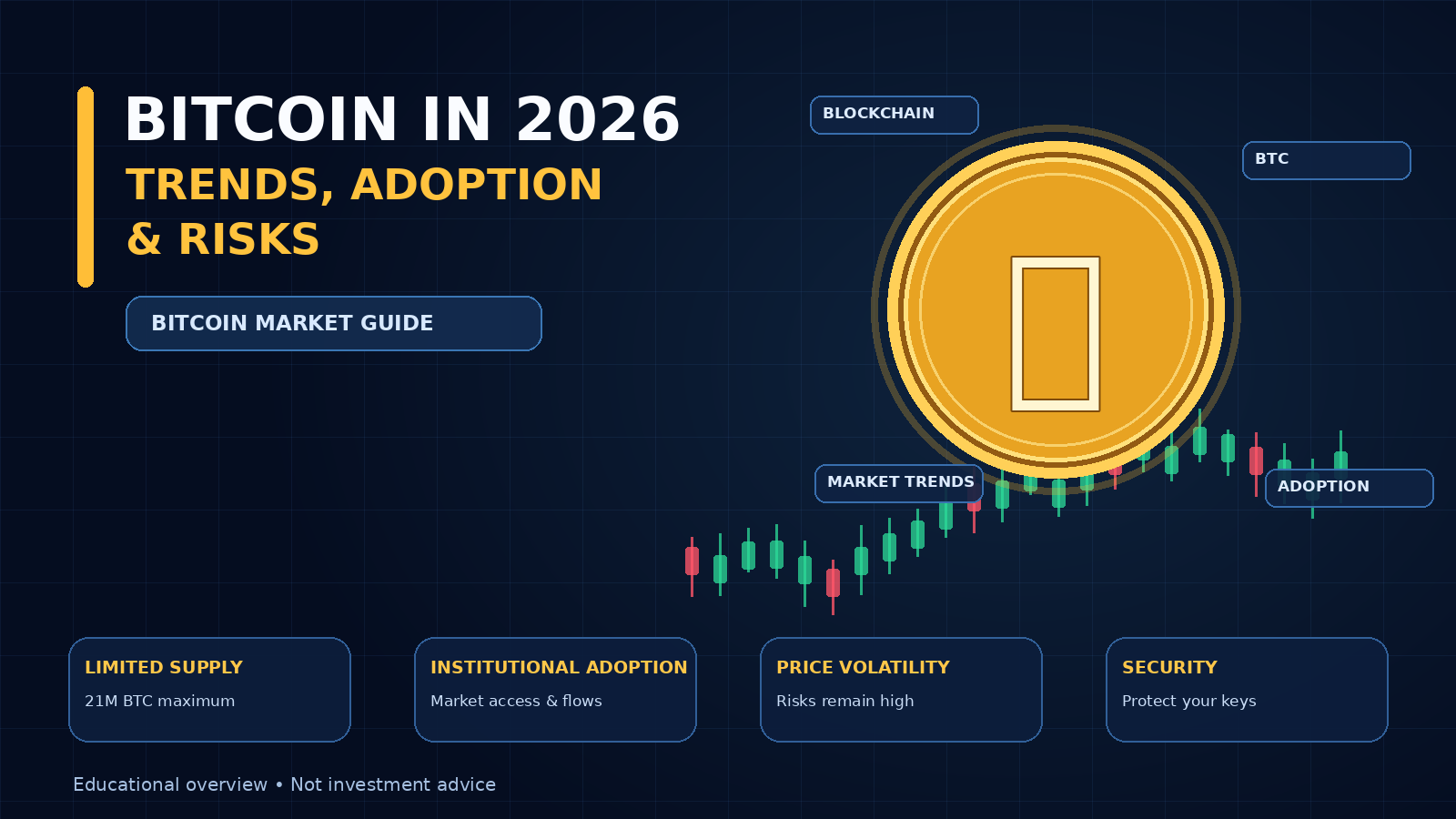
One of Bitcoin's defining features is its limited supply. The protocol sets a maximum supply of 21 million BTC. New bitcoins enter circulation through a process called mining, with the rate of issuance decreasing through scheduled events known as halvings.
Bitcoin is not the same as money held in a bank account. Users can control their own bitcoin through private cryptographic keys, or they can rely on a third-party service to hold it on their behalf.
How Does Bitcoin Work?
Bitcoin combines blockchain technology, cryptography, and a decentralized network to record and validate transactions.
1. Bitcoin Blockchain
The Bitcoin blockchain is a public ledger containing a history of confirmed transactions. Transactions are grouped into blocks, which are linked together in chronological order.
Network participants can independently verify the ledger using Bitcoin's rules. Altering old records would require overcoming substantial computational and network-security obstacles, although no technology should be described as completely risk-free.
The blockchain helps participants agree on which transactions have been confirmed without relying on a single central record keeper.
2. Bitcoin Wallets
A Bitcoin wallet allows users to manage the keys needed to access and spend their bitcoin.
Common wallet options include:
Mobile wallets: Convenient for everyday transactions.
Desktop wallets: Software installed on a computer.
Hardware wallets: Devices designed to keep private keys isolated from internet-connected environments.
Custodial wallets: Services where a company holds the keys on behalf of customers.
Each option has different security and convenience trade-offs. People using self-custody must protect their recovery information because losing access to their keys can mean losing access to their funds.
3. Bitcoin Transactions
When someone sends bitcoin, their wallet creates and signs a transaction using the relevant private keys. The transaction is broadcast to the network, where it can be checked and included in a block.
Bitcoin miners compete to add new blocks through a process called proof of work. Once a transaction is included in a block, additional blocks can increase confidence that it will remain part of the accepted transaction history.
Confirmation times and transaction fees vary according to network activity and the fee selected by the sender.
4. Bitcoin Mining
Bitcoin mining is the process by which specialized computers perform computational work to compete for the right to add new blocks.
Successful miners can receive newly issued bitcoin and transaction fees, subject to the protocol's rules. Mining also helps secure the network by making it costly to rewrite transaction history.
However, mining requires specialized equipment, electricity, cooling, and technical knowledge. Profitability depends on factors such as energy costs, hardware efficiency, network difficulty, and the market price of bitcoin.
For most beginners, purchasing mining equipment without detailed cost analysis is not a simple or guaranteed way to earn money.
Why Does Bitcoin Have a Limited Supply?
Bitcoin's protocol establishes a maximum supply of 21 million coins. New bitcoin is issued as a reward for mining blocks, and this reward decreases approximately every four years through a halving event.
The reduced issuance rate is an important part of Bitcoin's design. Supporters believe that predictable supply makes bitcoin different from currencies whose supply can be expanded through monetary policy.
However, limited supply alone does not guarantee a higher price. Bitcoin's market value also depends on demand, adoption, liquidity, investor expectations, regulation, and broader economic conditions.
A scarce asset can still lose value if buyers are unwilling to pay previous prices.
What Determines the Price of Bitcoin?
Bitcoin's price is determined by buying and selling activity across the markets where it trades. Several factors can influence its value.
Market demand: Increased interest from individuals, businesses, or investment funds may affect buying activity.
Supply expectations: Bitcoin's issuance schedule and limited maximum supply influence how market participants assess its long-term availability.
Economic conditions: Interest rates, inflation expectations, liquidity, and investor appetite for risk can affect demand for volatile assets.
Regulation: Government policies, court decisions, tax rules, and restrictions on trading or payments can influence market sentiment.
Institutional participation: Investment products and institutional access can affect market demand and liquidity, but institutional interest does not guarantee future price increases.
News and sentiment: Security incidents, major announcements, social media discussions, and market speculation can cause rapid price movements.
Bitcoin's price can rise or fall sharply, sometimes within hours. Historical performance does not guarantee future results.
Potential Benefits of Bitcoin
Bitcoin has several features that attract interest, although each comes with limitations.
1. Decentralized Network
Bitcoin does not rely on a single organization to maintain its transaction ledger. Its network is maintained by distributed participants operating according to shared rules.
2. Predictable Supply
The 21-million-coin limit distinguishes Bitcoin from currencies that do not have a fixed maximum supply under their monetary systems.
3. Global Accessibility
Bitcoin can be transferred between compatible wallets across borders, provided users have access to the necessary technology and comply with applicable laws.
4. Transparent Transactions
Bitcoin's public blockchain allows transaction records to be inspected. However, transparency does not automatically reveal the real-world identity behind a wallet address.
5. Self-Custody
Users can hold their own private keys instead of relying entirely on a bank or cryptocurrency exchange. This provides greater direct control but also places responsibility for security on the owner.
6. Financial Innovation
Bitcoin has contributed to broader discussions about digital ownership, peer-to-peer payments, and alternative financial infrastructure.
These benefits do not make Bitcoin suitable for every person or every financial goal.
Risks of Investing in Bitcoin
Before buying bitcoin, it is important to understand the risks that can affect both its price and the security of your holdings.
High Price Volatility
Bitcoin's price can change dramatically over short periods. Investors may lose a substantial portion of their investment, and there is no guaranteed recovery after a market decline.
Scams and Fake Investment Platforms
Fraudsters may advertise guaranteed profits, fake mining packages, celebrity endorsements, or cryptocurrency trading schemes. Be cautious of anyone promising fixed daily returns or pressuring you to send bitcoin to a private wallet.
Exchange and Custody Risks
An exchange or wallet provider may experience a cyberattack, financial failure, withdrawal restrictions, or operational problems. Keeping bitcoin with a third party means relying on that provider's security and financial controls.
Lost Private Keys
Bitcoin transactions generally cannot be reversed through a central authority. If a user loses the keys or recovery information required to access a self-custody wallet, the bitcoin may become permanently inaccessible.
Regulatory Changes
Laws governing cryptocurrency ownership, exchanges, payments, and taxes differ by country and can change. Users should check current local requirements before buying, selling, or accepting bitcoin.
Environmental Considerations
Bitcoin mining uses electricity to perform proof-of-work calculations. Its environmental impact depends on the energy sources used, mining efficiency, and other factors.
How to Buy Bitcoin: A Beginner's Guide
The process of buying bitcoin varies by country and platform, but the following steps provide a useful starting point.
Step 1: Research the rules in your country.
Before making a purchase, confirm the current legal and regulatory position, including any restrictions on exchanges, payments, or financial services.
Step 2: Choose a platform carefully.
Compare available services based on their legal status, reputation, security practices, fees, withdrawal options, and customer support. Do not assume that a popular platform is automatically safe or available in your jurisdiction.
Step 3: Understand the total cost.
Buying bitcoin may involve trading fees, deposit charges, withdrawal fees, and a difference between buying and selling prices. Check the total cost rather than looking only at the advertised fee.
Step 4: Secure your account.
Use a unique password and enable multifactor authentication where available. Beware of fake websites, suspicious links, and messages claiming to represent customer support.
Step 5: Decide how to store your bitcoin.
You may use a custodial service or a self-custody wallet. Each approach has different responsibilities. If using self-custody, learn how to protect recovery phrases before transferring meaningful funds.
Step 6: Start cautiously.
If you decide to buy bitcoin, avoid borrowing money or using funds needed for rent, food, education, medical expenses, or other essential obligations. Only risk money you can afford to lose.
This guide is educational and does not recommend any specific exchange or investment.
Is Bitcoin Legal in Pakistan?
People in Pakistan should verify the latest official rules before purchasing, selling, transferring, or operating a business involving bitcoin.
Cryptocurrency regulation can change, and the legal treatment of holding digital assets may differ from the rules governing cryptocurrency exchanges, payment services, or commercial activities.
Before using a platform, consult current guidance from relevant Pakistani authorities and confirm that the service is permitted to operate for your intended activity. Also consider tax, banking, and reporting requirements where applicable.
Do not rely solely on social media posts or an exchange's advertising to determine whether a particular activity is lawful.
Bitcoin vs. Traditional Currency
Bitcoin and traditional currencies operate differently.
Feature | Bitcoin | Traditional currency |
|---|---|---|
Issuance | Follows Bitcoin protocol rules | Generally managed by central banks and monetary authorities |
Maximum supply | Capped at 21 million BTC | Usually no fixed lifetime maximum |
Transaction record | Public blockchain | Records maintained by financial institutions and payment systems |
Price stability | Highly volatile | Varies by currency; generally more stable for everyday pricing |
Reversing payments | Generally difficult once confirmed | Some payment systems allow disputes or reversals |
Access | Requires compatible technology and network access | Depends on available banking and payment infrastructure |
Neither system is ideal for every use case. Traditional currency remains central to salaries, taxes, and everyday pricing, while Bitcoin offers a different model for digital asset ownership and transfers.
Bitcoin vs. Ethereum: What's the Difference?
Bitcoin and Ethereum are two well-known blockchain ecosystems, but they were designed with different priorities.
Bitcoin focuses on a decentralized monetary network and the transfer of bitcoin. Its protocol prioritizes a relatively narrow set of functions and predictable issuance.
Ethereum supports a broader programmable blockchain environment. Its native asset, ether (ETH), is used for network fees and other purposes within the ecosystem. Ethereum supports smart contracts that developers use to build decentralized applications.
Both assets carry market risk, and their prices can fluctuate significantly. Their technology, use cases, and risk profiles are not interchangeable.
Is Bitcoin a Good Long-Term Investment?
Bitcoin may appeal to people who believe in its long-term role as a digital asset, but it remains a volatile and uncertain investment.
Before making a decision, consider your financial situation, investment horizon, ability to tolerate losses, and need for accessible savings. Avoid investing simply because a price has risen or because online commentators predict that it will rise further.
It may also help to understand the difference between investing and speculation. A thoughtful investment decision considers risk, valuation, alternatives, and portfolio exposure. Speculation often relies more heavily on short-term price movements and uncertain expectations.
No strategy can guarantee a profit from bitcoin, and even experienced market participants can make significant losses.
Frequently Asked Questions About Bitcoin
Who created Bitcoin?
Bitcoin was introduced by an individual or group using the name Satoshi Nakamoto. The creator's real-world identity has not been conclusively established.
How many bitcoins will ever exist?
Bitcoin's protocol sets a maximum supply of 21 million BTC. New issuance decreases through scheduled halvings, so the remaining coins enter circulation gradually.
Can Bitcoin be converted into cash?
Depending on local laws and available services, bitcoin may be exchanged for traditional currency through supported platforms or other permitted arrangements. Fees, withdrawal limits, and eligibility vary.
Can I buy a fraction of a bitcoin?
Yes. Bitcoin is divisible, so users do not need to purchase a whole bitcoin. The smallest standard unit is called a satoshi, equal to 0.00000001 BTC.
Is Bitcoin mining profitable?
Profitability depends on electricity costs, equipment efficiency, network difficulty, mining rewards, and bitcoin's market price. Mining can be unprofitable, especially when operating costs are high.
Can Bitcoin transactions be reversed?
Bitcoin transactions generally cannot be reversed by a central authority after confirmation. If bitcoin is sent to the wrong address or a scammer, recovering it may be difficult or impossible.
Is Bitcoin anonymous?
Bitcoin is better described as pseudonymous rather than fully anonymous. Transactions are publicly recorded, and wallet activity may sometimes be linked to real-world identities through external information.
Final Thoughts
Bitcoin introduced a different approach to digital value by combining a decentralized network, a public blockchain, and a predetermined issuance schedule. These features have made it an important subject in financial technology and digital asset discussions.
However, Bitcoin also presents significant challenges, including price volatility, scams, custody risks, and changing regulations. Understanding these risks is just as important as understanding the technology.
For beginners, the most sensible first step is to learn how Bitcoin works, research local requirements, protect account credentials, and avoid promises of guaranteed profits. Making informed decisions requires independent research and a realistic understanding of the possibility of financial loss.