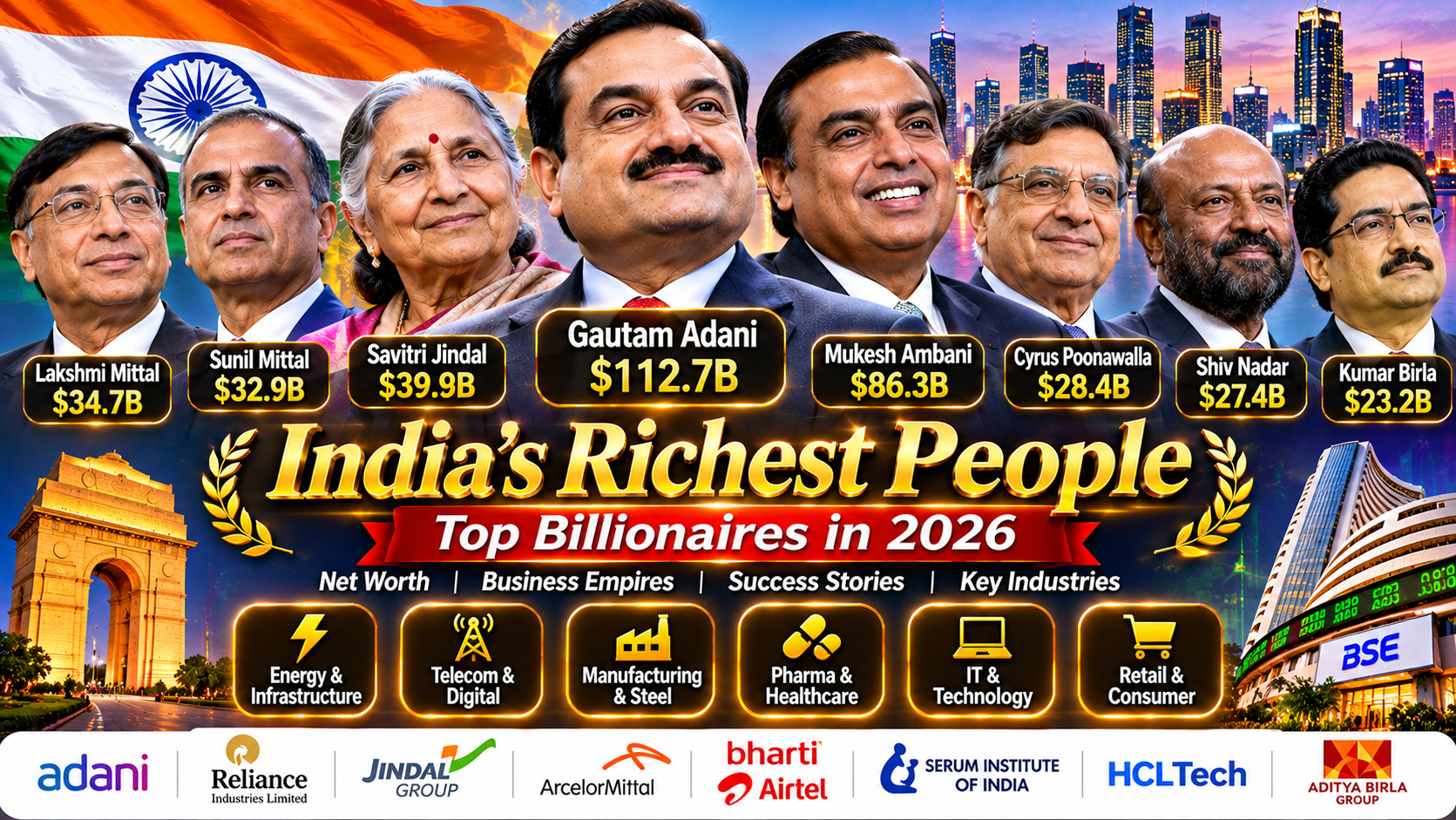
India is home to some of the world's most influential entrepreneurs, industrialists, technology leaders, and business families. From infrastructure and telecommunications to pharmaceuticals, steel, software, and consumer products, India's wealthiest people have built companies that play important roles in the global economy.
In 2026, Gautam Adani reclaimed the No. 1 position on Forbes' India’s Richest list, moving ahead of Reliance Industries chairman Mukesh Ambani. Their fortunes reflect the scale of India's corporate economy and the influence of its largest business groups.
But India's billionaire landscape extends far beyond these two names. Savitri Jindal, Lakshmi Mittal, Sunil Mittal, Cyrus Poonawalla, Shiv Nadar, and other business leaders have built enormous fortunes across different industries.
This article explores India's richest people in 2026, their estimated net worth, companies, entrepreneurial journeys, and the sectors contributing to India's growing business influence.
Top 10 Richest People in India in 2026
According to Forbes' India's Richest 2026 list, the combined wealth of the 100 people and families featured was approximately $1 trillion. Forbes calculated the estimates using share prices and exchange rates as of September 11, 2026.
Forbes+1
Rank | Billionaire / family | Estimated net worth | Main business |
|---|---|---|---|
1 | Gautam Adani & family | $112.7 billion | Adani Group |
2 | Mukesh Ambani | $86.3 billion | Reliance Industries |
3 | Savitri Jindal | $39.8 billion | O.P. Jindal Group |
4 | Lakshmi Mittal | $34.7 billion | ArcelorMittal |
5 | Sunil Mittal & family | $32.9 billion | Bharti Enterprises |
6 | Cyrus Poonawalla | $28.4 billion | Serum Institute of India |
7 | Shiv Nadar | $27.4 billion | HCL Technologies |
8 | Dilip Shanghvi | $26.3 billion | Sun Pharmaceutical Industries |
9 | Kumar Birla | $23.2 billion | Aditya Birla Group |
10 | Hinduja family | $21.2 billion | Hinduja Group |
These are Forbes' September 2026 estimates, not live net-worth figures. Other rankings may produce different results because of their valuation dates and methodologies.
Forbes+1
1. Gautam Adani – India's Richest Person in 2026
Estimated net worth: $112.7 billion
Gautam Adani is the founder and chairman of the Adani Group, one of India's largest business conglomerates. His business interests include ports, airports, energy, infrastructure, logistics, mining, and other industrial operations.
Adani started his entrepreneurial journey in trading before expanding into infrastructure and large-scale industrial projects. His group became an important participant in India's economic development through investments in transportation, energy, and logistics.
How Gautam Adani built his fortune
The Adani Group's expansion has been driven by major infrastructure projects and investments across multiple industries.
Its businesses include:
Adani Ports and logistics operations
Airport management
Renewable energy
Power generation and transmission
Industrial infrastructure
Mining and natural resources
In 2026, Adani returned to the top of Forbes' India Richest ranking after three years in second place. Forbes attributed the increase in his family fortune partly to a rise in the value of Adani Group holdings.
Forbes+1
His business journey demonstrates the financial scale that infrastructure and energy companies can achieve.
2. Mukesh Ambani – The Reliance Industries Billionaire
Estimated net worth: $86.3 billion
Mukesh Ambani is the chairman and managing director of Reliance Industries, one of India's largest diversified business groups.
Reliance has operations in energy, petrochemicals, retail, telecommunications, digital services, and other sectors. The company's businesses serve millions of consumers and support important parts of India's industrial economy.
The success of Reliance Industries
One of Ambani's most significant business developments was the expansion of Jio, which transformed India's telecommunications market.
Jio helped make mobile internet services more accessible to a large number of Indian consumers. Reliance also expanded its retail operations, digital platforms, and energy businesses.
Mukesh Ambani ranked second on Forbes' 2026 India Richest list. Forbes reported that his estimated fortune declined during the measurement period, partly reflecting pressures affecting Reliance's share performance.
Forbes+1
3. Savitri Jindal – India's Richest Woman
Estimated net worth: $39.8 billion
Savitri Jindal is associated with the O.P. Jindal Group, a major Indian industrial business group with interests in steel, energy, infrastructure, and manufacturing.
She became a prominent figure in Indian business following the death of her husband, industrialist O.P. Jindal. The family business has continued to operate across several major industrial sectors.
Business interests and influence
The Jindal business ecosystem includes companies involved in:
Steel production
Power generation
Energy infrastructure
Industrial manufacturing
Metal processing
Savitri Jindal ranked third on Forbes' 2026 list and remained India's richest woman in that ranking. Her fortune is connected to family business holdings across the industrial group.
Forbes+1
Her position highlights the important role of family-owned industrial businesses in India's wealth landscape.
4. Lakshmi Mittal – The Global Steel Billionaire
Estimated net worth: $34.7 billion
Lakshmi Mittal is an internationally recognized steel magnate and the founder of the business that became ArcelorMittal, one of the world's largest steel producers.
His business journey is an example of how an entrepreneur can build a global industrial company through international expansion, acquisitions, and operational improvements.
How Mittal built a global steel business
Steel is essential for construction, automobiles, transportation, machinery, and infrastructure. Mittal recognized the opportunities in the global steel market and expanded through acquisitions and international operations.
His estimated fortune increased significantly in Forbes' 2026 ranking, making him one of the year's biggest gainers by percentage among India's richest people.
Forbes+1
5. Sunil Mittal – The Telecommunications Entrepreneur
Estimated net worth: $32.9 billion
Sunil Mittal is the founder of Bharti Enterprises and a leading figure in India's telecommunications industry.
Bharti Airtel became one of India's major mobile and broadband service providers. The company expanded its services to international markets and developed a strong position in telecommunications.
The growth of Bharti Airtel
The telecommunications sector has become essential to modern economies. Mobile networks support digital payments, e-commerce, online education, entertainment, business communication, and cloud services.
Mittal's success reflects the commercial opportunities created by the rapid expansion of digital connectivity.
6. Cyrus Poonawalla – The Vaccine Industry Billionaire
Estimated net worth: $28.4 billion
Cyrus Poonawalla is the founder of the Serum Institute of India, one of the world's largest vaccine manufacturers by production volume.
The company has played an important role in producing vaccines for diseases affecting children and adults across different countries.
How the Serum Institute became a global healthcare business
The pharmaceutical and vaccine industries require substantial investment in research, manufacturing facilities, quality systems, regulatory compliance, and distribution.
The Serum Institute developed large-scale production capabilities and international partnerships, making it a major participant in global public health.
Poonawalla's wealth demonstrates how healthcare manufacturing can create both commercial value and significant social impact.
7. Shiv Nadar – The Founder of HCL Technologies
Estimated net worth: $27.4 billion
Shiv Nadar founded HCL, one of India's major technology companies.
HCL developed from a computer hardware business into a global technology services organization offering software, IT infrastructure, engineering, and digital transformation services.
India's IT industry and global business
Indian technology companies have built international businesses by providing software development, consulting, cloud services, cybersecurity, and enterprise technology solutions.
HCL became an important part of this growth, serving customers across multiple industries.
Shiv Nadar's entrepreneurial journey highlights India's contribution to the global technology services market.
8. Dilip Shanghvi – The Pharmaceutical Entrepreneur
Estimated net worth: $26.3 billion
Dilip Shanghvi is the founder of Sun Pharmaceutical Industries, one of India's largest pharmaceutical companies.
He established the business in 1983 and expanded it into an international pharmaceutical organization.
The growth of Sun Pharma
Sun Pharma produces medicines across several therapeutic areas and operates in markets around the world.
The pharmaceutical industry offers opportunities through research, manufacturing, generic medicines, branded products, and international distribution.
Shanghvi's success demonstrates the importance of building a competitive healthcare business with strong manufacturing and distribution capabilities.
9. Kumar Mangalam Birla – The Aditya Birla Group Leader
Estimated net worth: $23.2 billion
Kumar Mangalam Birla leads the Aditya Birla Group, a diversified multinational business group with operations in metals, cement, textiles, financial services, and telecommunications-related businesses.
The group has a long history and operates across multiple countries.
A diversified business strategy
Diversification allows large companies to participate in different industries and customer markets.
The Aditya Birla Group has developed businesses in industrial materials, consumer products, infrastructure-related sectors, and financial services.
Birla's wealth reflects the value of a large and diversified corporate organization.
10. The Hinduja Family – A Multinational Business Empire
Estimated net worth: $21.2 billion
The Hinduja family controls a diversified international business group with operations across several industries.
Its business interests include automotive manufacturing, financial services, energy, infrastructure, and other commercial activities.
How the Hinduja Group expanded internationally
The group's development reflects the importance of international trade, long-term investments, and diversified business operations.
Family ownership and business management have helped the group maintain a presence across different markets.
The Hinduja family ranked tenth in Forbes' 2026 India Richest list, with an estimated fortune of $21.2 billion.
Forbes
Industries Creating Billionaire Wealth in India
India's richest people have built their fortunes in different industries. Their businesses also reveal which sectors have played major roles in the country's economic development.
1. Infrastructure and energy
Infrastructure is one of the most important sources of large-scale business wealth in India. Ports, airports, electricity generation, renewable energy, and logistics require substantial investment and long-term planning.
The Adani Group is a prominent example of an Indian conglomerate operating across these sectors.
2. Telecommunications and digital services
India's growing internet population has created opportunities for telecommunications companies, digital platforms, and technology providers.
Bharti Airtel and Reliance Jio have helped expand mobile connectivity, while digital services have created new business opportunities.
3. Pharmaceuticals and healthcare
India is an important global pharmaceutical manufacturing center. Companies such as Sun Pharma and Serum Institute have developed international operations by supplying medicines and vaccines.
4. Steel and industrial manufacturing
Steel is essential for construction, transportation, automobiles, and infrastructure. Industrial groups associated with Lakshmi Mittal and Savitri Jindal demonstrate the financial importance of manufacturing.
5. Information technology
Indian technology companies provide software, consulting, cybersecurity, cloud computing, and business services to customers worldwide.
HCL and other technology businesses helped establish India's reputation as a major global IT services destination.
6. Retail and consumer markets
India's large population creates substantial demand for food, clothing, electronics, household products, and digital shopping services.
Companies that build strong brands and efficient distribution networks can develop significant commercial value.
India's Billionaire Economy: What Is Changing in 2026?
India's billionaire landscape is evolving as new technologies and industries create business opportunities.
The 2026 M3M Hurun India Rich List identified 391 dollar billionaires in the country and reported that artificial intelligence had emerged as a distinct wealth-creation sector in its ranking. Its methodology and figures differ from Forbes' list.
Top-10-listing News - The Indian Express+1
Some important developments include:
Artificial intelligence: AI software, automation, data infrastructure, and enterprise applications are attracting investment.
Renewable energy: Solar power, wind energy, battery storage, and electricity infrastructure are developing rapidly.
Digital commerce: Online shopping, digital payments, and logistics continue to create opportunities.
Healthcare: Pharmaceuticals, medical technology, diagnostics, and biotechnology remain important growth areas.
Advanced manufacturing: Electronics, automobiles, industrial equipment, and semiconductors are attracting business investment.
These industries may produce influential entrepreneurs in the future, although future billionaire rankings cannot be predicted with certainty.
Challenges Facing India's Richest Business Leaders
Even the largest business groups face risks that can affect their financial performance.
Market volatility: Many billionaire fortunes depend on publicly traded shares. Changes in stock prices can significantly affect estimated wealth.
Regulatory requirements: Businesses in finance, telecommunications, energy, healthcare, and infrastructure must comply with complex regulations.
International competition: Indian companies compete with global businesses in technology, manufacturing, pharmaceuticals, and consumer products.
Economic conditions: Inflation, interest rates, currency movements, and consumer spending can influence business growth.
Technology disruption: Artificial intelligence and automation are changing traditional industries and creating pressure to innovate.
These challenges demonstrate why maintaining a large business empire requires more than financial resources. Companies also need effective management, innovation, customer trust, and long-term planning.
Who Could Become India's Next Billionaire Success Story?
India's next generation of wealthy entrepreneurs may emerge from technology and industries that are still developing.
Artificial intelligence, semiconductor manufacturing, electric vehicles, renewable energy, biotechnology, robotics, and financial technology are potential areas of opportunity.
Startups are also developing products for India's large domestic market and international customers.
However, not every startup becomes a successful company. Sustainable growth depends on solving real problems, building useful products, managing costs, and developing a reliable business model.
Conclusion
India's richest people in 2026 represent the country's diverse business strengths. Gautam Adani leads Forbes' ranking through his infrastructure and energy businesses, while Mukesh Ambani has built a major business empire across telecommunications, retail, and energy.
Savitri Jindal, Lakshmi Mittal, Sunil Mittal, Cyrus Poonawalla, Shiv Nadar, Dilip Shanghvi, Kumar Birla, and the Hinduja family demonstrate the importance of manufacturing, healthcare, technology, and diversified business operations.
Their journeys reveal how entrepreneurship, investment, innovation, and long-term business development can create substantial wealth.
As India continues to develop its technology, infrastructure, manufacturing, and healthcare sectors, the country's billionaire landscape will likely continue to evolve.
Frequently Asked Questions (FAQs)
1. Who is the richest person in India in 2026?
Gautam Adani ranked first on Forbes' India’s 100 Richest 2026 list, with an estimated family fortune of $112.7 billion.
2. Who is the second-richest person in India?
Mukesh Ambani ranked second on Forbes' 2026 list, with an estimated net worth of $86.3 billion.
3. Who is India's richest woman?
Savitri Jindal ranked as India's richest woman on Forbes' 2026 list, with an estimated fortune of $39.8 billion.
4. What is Gautam Adani famous for?
Gautam Adani is known for founding the Adani Group, which operates in infrastructure, ports, airports, energy, logistics, and other industries.
5. What is Mukesh Ambani's main business?
Mukesh Ambani leads Reliance Industries, which operates in energy, telecommunications, retail, digital services, and other sectors.
6. Who is the richest Indian businessman in the technology industry?
Shiv Nadar, founder of HCL, is one of India's most prominent technology billionaires. Technology rankings can differ depending on how business holdings and family wealth are counted.
7. Who is Lakshmi Mittal?
Lakshmi Mittal is a steel industry entrepreneur associated with ArcelorMittal, one of the world's largest steel producers.
8. Who founded the Serum Institute of India?
Cyrus Poonawalla founded the Serum Institute of India, a major vaccine manufacturing company.
9. How many billionaires are there in India?
The total depends on the ranking and measurement date. The M3M Hurun India Rich List 2026 reported 391 dollar billionaires.
10. Which industries create the most wealth in India?
Major wealth-generating industries include infrastructure, energy, telecommunications, pharmaceuticals, steel, manufacturing, information technology, and retail.
11. Is Gautam Adani richer than Mukesh Ambani?
According to Forbes' September 2026 India Richest ranking, Gautam Adani was ahead of Mukesh Ambani. Other rankings can differ.
12. How do Indian billionaires build their wealth?
Many build wealth through company ownership, entrepreneurship, investments, manufacturing, infrastructure projects, technology, and international business expansion.
13. Which Indian business groups are internationally recognized?
Major examples include Adani Group, Reliance Industries, Tata Group, Bharti Enterprises, Aditya Birla Group, HCL, and the Hinduja Group.
14. Can artificial intelligence create new billionaires in India?
AI could create substantial business opportunities in software, automation, semiconductors, robotics, and enterprise technology. However, becoming a billionaire is not guaranteed.
15. Where can readers find India's latest billionaire rankings?
Forbes, Hurun India, and Fortune India publish wealth rankings using different valuation dates and methodologies. Readers should check the publication date before comparing estimates.