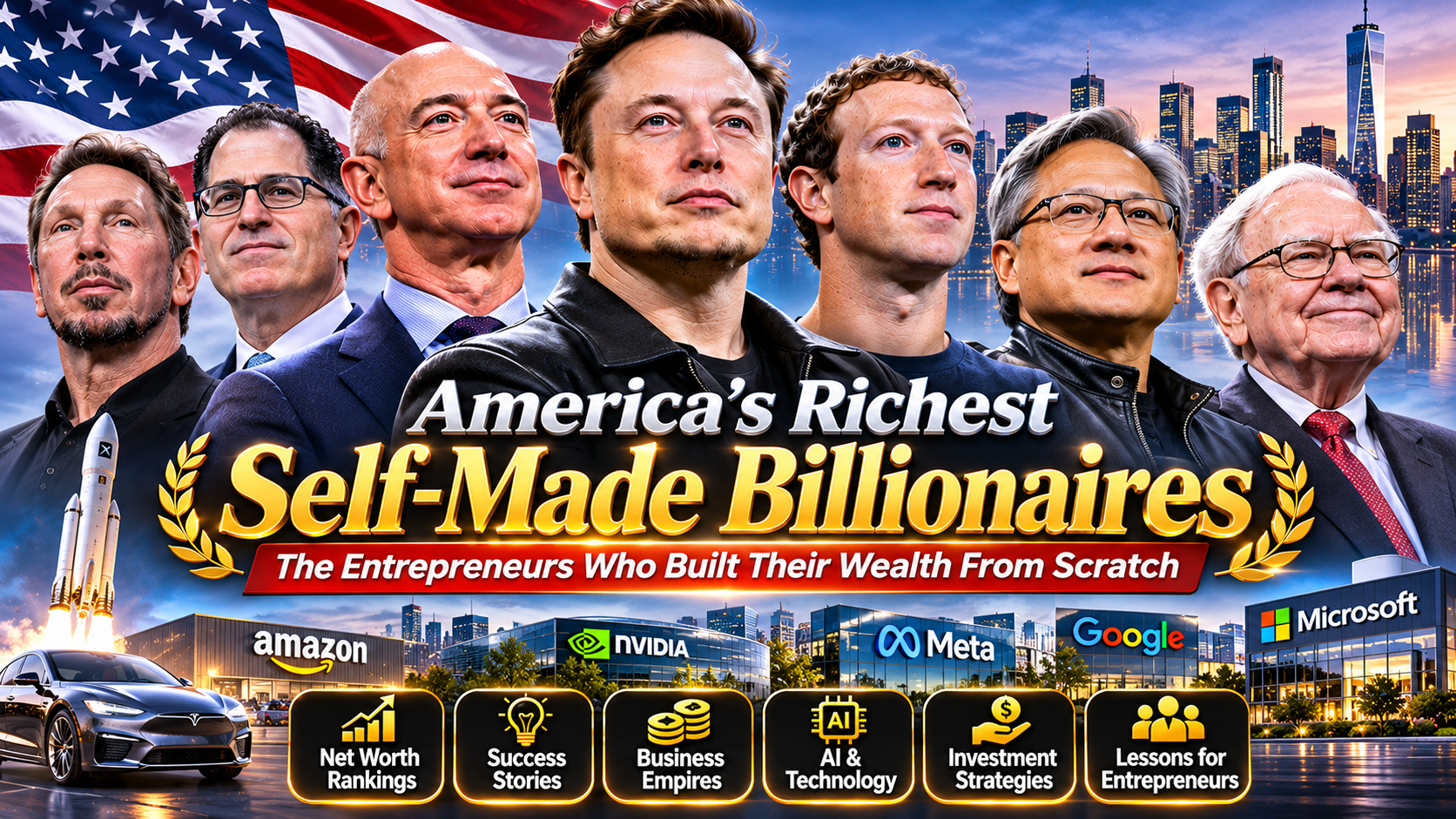
America has produced some of the most successful entrepreneurs, investors, and business leaders in modern history. From technology founders who transformed the internet to investors who built financial empires, self-made billionaires have played a major role in shaping the American economy.
Their stories often begin with a simple idea, a small business, a career opportunity, or a willingness to take a financial risk. Over time, some turned those beginnings into companies worth hundreds of billions of dollars.
Names such as Elon Musk, Jeff Bezos, Larry Ellison, Michael Dell, Jensen Huang, and Warren Buffett represent different approaches to building extraordinary wealth. Some revolutionized technology, others transformed retail and finance, while others identified opportunities in industries that were previously overlooked.
According to Forbes' September 2026 Forbes 400 ranking, 71% of the people on the list were classified as self-made. The 400 wealthiest Americans had a combined estimated fortune of $8 trillion, demonstrating the enormous scale of business wealth in the United States.
This article explores America's richest self-made billionaires, their business journeys, industries, investment strategies, and lessons for aspiring entrepreneurs.
1. What Does Self-Made Billionaire Mean?
A self-made billionaire is an individual who has accumulated substantial wealth through personal business activities, investments, entrepreneurship, or professional achievements rather than primarily inheriting an existing fortune.
Self-made does not necessarily mean someone started with absolutely nothing. Some entrepreneurs received education, family support, professional opportunities, or early financial assistance.
However, their wealth is generally associated with businesses or investments they developed, founded, or significantly expanded themselves.
Common paths to self-made billionaire status include:
Founding technology companies
Building international retail businesses
Creating financial investment firms
Developing manufacturing companies
Investing in valuable businesses
Building software and digital platforms
Creating products with worldwide demand
The key factor is the creation or accumulation of wealth through an individual's own business and investment activities.
2. America's Richest Self-Made Billionaires in 2026
The Forbes 400 ranking published on September 15, 2026, provides a snapshot of America's wealthiest individuals using estimated asset values as of September 4, 2026.
The following table highlights prominent self-made billionaires among the highest-ranked Americans.
Billionaire | Estimated net worth | Main business |
|---|---|---|
Elon Musk | $908 billion | Tesla, SpaceX |
Jeff Bezos | $378 billion | Amazon |
Larry Page | $278 billion | |
Michael Dell | $263 billion | Dell Technologies |
Sergey Brin | $256 billion | |
Mark Zuckerberg | $212 billion | Meta |
Larry Ellison | $204 billion | Oracle |
Jensen Huang | $199 billion | Nvidia |
Steve Ballmer | $156 billion | Microsoft |
Warren Buffett | $144 billion | Berkshire Hathaway |
<text color="secondary" size="xs">Source: Forbes 400, September 2026. Figures are estimates based on September 4 asset valuations and are not live net worth figures.</text>
These entrepreneurs and business leaders built their fortunes through different business models. Their success demonstrates the financial potential of technology, software, e-commerce, semiconductors, and long-term investing.
3. Elon Musk: From Entrepreneur to America's Richest Billionaire
<AsyncImage query="Elon Musk professional portrait Tesla SpaceX" aspectRatio="16:9" width="100%"/>
Elon Musk is one of the most recognizable entrepreneurs in the world. His business interests include electric vehicles, aerospace, artificial intelligence, and digital platforms.
He became widely known through his leadership and ownership interests in several technology companies.
Major Businesses
Tesla
SpaceX
xAI
X
Tesla helped accelerate the adoption of electric vehicles, while SpaceX developed reusable rocket technology and commercial space services.
Musk's approach involves investing in industries with ambitious technological challenges and potentially large markets.
His estimated fortune reached $908 billion in Forbes' September 2026 Forbes 400 snapshot, placing him at the top of the ranking.
Business Lessons
Musk's business journey highlights the importance of technological innovation, ambitious product development, long-term investment, and willingness to operate in highly competitive industries.
4. Jeff Bezos: Building Amazon Into a Global Business Empire
<AsyncImage query="Jeff Bezos Amazon founder professional portrait" aspectRatio="16:9" width="100%"/>
Jeff Bezos founded Amazon in 1994 as an online bookstore. What started as a relatively small internet business eventually became one of the world's largest e-commerce and technology companies.
Amazon expanded into several major industries:
E-commerce
Cloud computing
Digital advertising
Logistics
Entertainment
Artificial intelligence infrastructure
One of its most important businesses is Amazon Web Services (AWS), which provides cloud computing services to organizations around the world.
Bezos focused on customer convenience, business expansion, technology investment, and long-term growth.
His success demonstrates how an online business can evolve into an international organization by continuously expanding its products and services.
5. Larry Page and Sergey Brin: The Entrepreneurs Behind Google
<AsyncImage query="Larry Page Sergey Brin Google founders professional portrait" aspectRatio="16:9" width="100%"/>
Larry Page and Sergey Brin co-founded Google in 1998 while studying at Stanford University.
Their search technology transformed how people access information online. Google eventually became part of Alphabet, a global technology company with operations across multiple industries.
Its business interests include:
Search engines
Digital advertising
Cloud computing
Artificial intelligence
Mobile technology
Advanced research
Page and Brin accumulated enormous wealth through their ownership stakes in Alphabet.
Their journey demonstrates how solving a major information problem can create a company with worldwide influence.
6. Michael Dell: Turning a Small Computer Business Into a Global Company
<AsyncImage query="Michael Dell Dell Technologies founder portrait" aspectRatio="16:9" width="100%"/>
Michael Dell founded his computer business in 1984 while he was a student at the University of Texas.
His early business model focused on selling personal computers directly to customers, allowing the company to develop a closer relationship with buyers and manage its distribution process.
Dell Technologies eventually expanded into:
Personal computers
Business servers
Storage systems
Enterprise technology
IT infrastructure
Cloud and data center solutions
Michael Dell's story demonstrates the value of understanding customer needs, improving distribution, and developing technology products for growing markets.
7. Mark Zuckerberg: Creating a Social Media Empire
<AsyncImage query="Mark Zuckerberg Meta CEO professional portrait" aspectRatio="16:9" width="100%"/>
Mark Zuckerberg launched Facebook in 2004 while studying at Harvard University.
The platform initially connected university students, but it gradually expanded into one of the world's largest social networking services.
Facebook's parent company became Meta Platforms in 2021.
Meta's major platforms and business areas include:
Facebook
Instagram
WhatsApp
Digital advertising
Artificial intelligence
Virtual and augmented reality
Zuckerberg built his fortune through company ownership and the global expansion of digital communication platforms.
His journey illustrates the importance of understanding user behavior and developing products that can attract enormous audiences.
8. Larry Ellison: Building Oracle Into a Software Giant
<AsyncImage query="Larry Ellison Oracle founder professional portrait" aspectRatio="16:9" width="100%"/>
Larry Ellison co-founded Oracle in 1977, helping establish one of the world's most influential enterprise software companies.
Oracle became a major provider of database software, business applications, and cloud infrastructure.
Its services support organizations across industries such as finance, healthcare, retail, manufacturing, and government.
Ellison's wealth is strongly connected to his ownership of Oracle.
His career demonstrates that enterprise technology can create enormous value even when the products operate largely behind the scenes.
9. Jensen Huang: The Semiconductor Entrepreneur Behind Nvidia
<AsyncImage query="Jensen Huang Nvidia CEO portrait black leather jacket" aspectRatio="16:9" width="100%"/>
Jensen Huang co-founded Nvidia in 1993 and helped transform the company into a major force in semiconductor technology.
Nvidia initially became widely known for graphics processing units used in gaming and visual computing.
Its technology later became important for artificial intelligence, scientific computing, robotics, and data centers.
The company's business areas include:
Graphics processing units
AI computing infrastructure
Data center technology
Automotive computing
Robotics
Software platforms
The growing demand for AI computing has made Nvidia one of the most influential semiconductor businesses in the world.
Huang's success highlights the importance of recognizing technological opportunities before they become mainstream.
10. Steve Ballmer: From Microsoft Executive to Billionaire
<AsyncImage query="Steve Ballmer former Microsoft CEO professional portrait" aspectRatio="16:9" width="100%"/>
Steve Ballmer joined Microsoft in 1980 and became one of the company's most important early business leaders.
He served as Microsoft's chief executive officer from 2000 to 2014.
During his time at Microsoft, the company expanded its enterprise software, Windows, Office, gaming, and cloud-related businesses.
Ballmer accumulated significant wealth through his Microsoft ownership and business career.
His story shows that enormous fortunes can also be created by early participation and long-term ownership in a successful company, not only by founding one.
11. Warren Buffett: America's Famous Self-Made Investment Billionaire
<AsyncImage query="Warren Buffett Berkshire Hathaway portrait" aspectRatio="16:9" width="100%"/>
Warren Buffett is widely recognized as one of the most successful investors in history.
He built his fortune through decades of investing and leadership at Berkshire Hathaway.
His investment philosophy emphasizes:
Understanding a company's business model
Evaluating financial strength
Investing in businesses with competitive advantages
Considering management quality
Maintaining a long-term perspective
Avoiding unnecessary speculation
Berkshire Hathaway owns or has investments in businesses across insurance, energy, manufacturing, transportation, and consumer products.
Buffett's career demonstrates that disciplined investing and long-term ownership can create extraordinary wealth.
12. America's Richest Self-Made Woman
<AsyncImage query="Diane Hendricks ABC Supply businesswoman portrait" aspectRatio="16:9" width="100%"/>
Diane Hendricks is one of America's most successful self-made businesswomen.
She co-founded ABC Supply, a major distributor of roofing, siding, windows, and other building materials.
The company grew into a leading supplier serving contractors and construction professionals throughout the United States.
Her business journey demonstrates that extraordinary wealth can be created in industries that do not always receive the same public attention as technology or entertainment.
According to Forbes' 2026 Forbes 400 announcement, Hendricks remained America's richest self-made woman.
Her success highlights the importance of understanding a market, building distribution capabilities, and developing long-term customer relationships.
13. Other Remarkable Self-Made American Billionaires
America's self-made business success stories extend far beyond the technology industry.
Several other entrepreneurs have created enormous companies in manufacturing, retail, energy, finance, and consumer products.
Harold Hamm
Harold Hamm built his fortune in the energy industry. He started a trucking business serving oilfields before expanding into oil exploration and production.
Shahid Khan
Shahid Khan immigrated to the United States and built a manufacturing business that became a major supplier of automotive components.
He later expanded into sports ownership, including the Jacksonville Jaguars and Fulham Football Club.
Oprah Winfrey
Oprah Winfrey built a media empire through television, production, publishing, and business ownership.
Her journey from poverty to international success makes her one of America's most recognized self-made entrepreneurs.
Jan Koum
Jan Koum immigrated to the United States from Ukraine and co-founded WhatsApp.
Facebook acquired WhatsApp in a multibillion-dollar deal, creating one of the most significant technology entrepreneurship success stories.
Mark Cuban
Mark Cuban built his fortune through technology entrepreneurship, investments, and media businesses.
His sale of Broadcast.com to Yahoo helped establish his position among America's successful self-made businesspeople.
These examples show that wealth creation is possible across many different industries and backgrounds.
14. Industries Creating America's New Self-Made Billionaires
The industries producing wealthy American entrepreneurs continue to evolve.
Artificial Intelligence
AI is creating opportunities in software, automation, robotics, semiconductors, and enterprise services.
Technology and Software
Cloud computing, cybersecurity, business software, and digital platforms continue to support large-scale businesses.
Financial Services
Investment firms, financial technology, trading platforms, and asset management businesses remain important sources of wealth.
Manufacturing
Industrial production, automotive components, construction materials, and advanced manufacturing continue to create successful entrepreneurs.
Energy
Oil, gas, renewable energy, battery technology, and energy infrastructure provide opportunities for business development.
E-Commerce and Retail
Online stores, consumer brands, logistics, and specialized retail businesses can reach large customer markets.
Healthcare
Biotechnology, medical equipment, healthcare services, and pharmaceutical innovation may create significant business opportunities.
The common theme is not a particular industry. It is the ability to build a company that provides valuable products or services to a large market.
15. How Self-Made Billionaires Build Their Fortunes
Although their businesses are different, successful entrepreneurs often share several wealth-building strategies.
1. They Focus on Solving Problems
Many successful companies begin by addressing an existing customer problem.
A business may improve convenience, reduce costs, save time, or provide a product that was previously unavailable.
2. They Build Valuable Companies
Company ownership is a major source of billionaire wealth.
When a business grows and its market value increases, the value of the founder's ownership stake may increase as well.
3. They Think About Scalability
A scalable business can expand its customer base without increasing costs at the same rate.
Technology platforms, software companies, and digital services often have this advantage.
4. They Reinvest in Growth
Reinvesting profits into research, employees, equipment, marketing, and infrastructure can strengthen a business.
5. They Build Strong Teams
Successful businesses require skilled employees, experienced managers, engineers, financial professionals, and effective leadership.
6. They Adapt to Market Changes
Companies must respond to changing customer expectations, competition, technology, and economic conditions.
7. They Think Long Term
Many successful entrepreneurs spend years developing their businesses before achieving significant financial results.
16. The American Dream and Self-Made Wealth
The idea of the American Dream is closely associated with the possibility of improving one's financial position through education, work, entrepreneurship, and opportunity.
Self-made billionaires are often presented as examples of this idea.
However, their stories also reveal that success is influenced by many factors, including access to education, capital, business networks, economic conditions, and personal circumstances.
Not every entrepreneur has the same opportunities, and becoming a billionaire is exceptionally rare.
The most meaningful lesson is that business growth often comes from creating value, building relationships, taking calculated risks, and remaining committed to long-term goals.
17. Challenges Faced by Self-Made Billionaires
Building a large business is not easy.
Even successful entrepreneurs face substantial risks and obstacles.
Financial Risk: Starting and expanding a business requires capital, and investments can lose value.
Competition: Established companies and new competitors can challenge even successful brands.
Economic Uncertainty: Recessions, inflation, interest rates, and changing consumer demand can affect business performance.
Technology Changes: Companies must continue innovating to avoid losing their competitive position.
Regulation: Businesses operating in finance, healthcare, technology, and energy must navigate complex legal requirements.
Leadership Pressure: Managing large organizations requires difficult decisions involving employees, customers, investors, and business partners.
These challenges demonstrate why building a successful company requires more than a good idea.
18. What Can Aspiring Entrepreneurs Learn From America's Richest Self-Made Billionaires?
The stories of America's wealthiest entrepreneurs offer several practical lessons.
Start by identifying a genuine customer problem.
Understand the industry before investing significant capital.
Develop products and services that provide measurable value.
Build a recognizable and trustworthy brand.
Use technology to improve productivity.
Monitor cash flow and operating expenses.
Hire people with complementary skills.
Reinvest strategically rather than expanding without a plan.
Learn from unsuccessful projects.
Build a sustainable business instead of chasing quick profits.
Entrepreneurs do not need to become billionaires to benefit from these principles.
Creating a profitable business, employing people, serving customers, and developing valuable products are meaningful achievements.
19. The Future of America's Self-Made Billionaires
The next generation of American billionaires may emerge from industries that are still developing.
Artificial intelligence, robotics, biotechnology, clean energy, cybersecurity, advanced manufacturing, and space technology could create new opportunities.
AI is especially important because it is transforming the way businesses operate.
Companies that develop useful AI tools, computing infrastructure, specialized software, and automation systems may become increasingly valuable.
However, technological excitement does not guarantee commercial success.
Future business leaders will need to develop products that customers actually use, build sustainable revenue, protect their intellectual property, and manage risks responsibly.
The next major American business empire may come from a completely different industry than the ones that created today's wealthiest entrepreneurs.
Conclusion
America's richest self-made billionaires demonstrate how entrepreneurship, technology, investments, and business ownership can create extraordinary wealth.
From Elon Musk's technology ventures and Jeff Bezos's e-commerce empire to Jensen Huang's semiconductor business and Warren Buffett's investment strategy, each entrepreneur followed a different path.
Their journeys reveal that wealth creation is not limited to one industry or business model. It can emerge from solving customer problems, building valuable companies, investing strategically, and developing products that serve large markets.
According to Forbes' 2026 Forbes 400 ranking, self-made individuals accounted for 71% of the list, highlighting the importance of entrepreneurship and business ownership in America's wealth landscape.
For aspiring entrepreneurs, the most valuable lesson is not simply to pursue billionaire status. It is to create something useful, develop a strong business model, manage resources wisely, and build long-term value.
Frequently Asked Questions (FAQs)
1. Who is America's richest self-made billionaire in 2026?
Elon Musk ranked as America's richest individual in the September 2026 Forbes 400 list, with an estimated net worth of $908 billion.
2. Who are the richest self-made billionaires in America?
Prominent examples include Elon Musk, Jeff Bezos, Larry Page, Sergey Brin, Michael Dell, Mark Zuckerberg, Larry Ellison, Jensen Huang, Steve Ballmer, and Warren Buffett.
3. What does self-made billionaire mean?
A self-made billionaire is someone who accumulated substantial wealth through personal business activities, investments, entrepreneurship, or professional achievements rather than primarily inheriting an existing fortune.
4. Who is America's richest self-made woman?
Diane Hendricks was identified by Forbes as America's richest self-made woman in its 2026 Forbes 400 announcement.
5. How many self-made billionaires are in America?
Forbes reported that 71% of the people on its 2026 Forbes 400 list were classified as self-made. This refers to the 400 wealthiest Americans, not the entire billionaire population.
6. How did Elon Musk build his wealth?
Musk built his wealth through ownership and leadership interests in companies including Tesla, SpaceX, and other technology ventures.
7. How did Jeff Bezos become a billionaire?
Jeff Bezos founded Amazon as an online bookstore and expanded it into a global e-commerce and technology company.
8. Is Warren Buffett a self-made billionaire?
Yes. Buffett accumulated his fortune through long-term investing and his leadership of Berkshire Hathaway.
9. Which industries create the most self-made billionaires in America?
Technology, finance, software, manufacturing, retail, energy, and real estate are among the major wealth-producing industries.
10. Can immigrants become self-made billionaires in America?
Yes. Entrepreneurs such as Shahid Khan and Jan Koum demonstrate how immigrants have built successful American businesses.
11. Does becoming a billionaire require starting a technology company?
No. Billionaires have built fortunes through manufacturing, retail, energy, finance, construction, real estate, and many other industries.
12. How important is business ownership in building wealth?
Business ownership can be extremely important because a founder's equity stake may increase in value as the company grows.
13. Can artificial intelligence create new billionaires?
AI may create new business opportunities in software, robotics, computing infrastructure, healthcare, and automation, although success is not guaranteed.
14. What can small business owners learn from billionaires?
They can learn about customer value, innovation, financial management, long-term planning, strategic investment, and building strong teams.
15. Where can readers find America's richest billionaire rankings?
Forbes publishes the annual Forbes 400 ranking and maintains a real-time billionaire ranking that tracks estimated wealth changes.