South Korea is home to some of Asia's most successful entrepreneurs, technology leaders, investors, and business families. From Samsung and Hyundai to Celltrion and MBK Partners, the country's leading business empires have built global influence across technology, automobiles, biotechnology, finance, and manufacturing.
In 2026, South Korea's wealthiest individuals experienced a remarkable increase in their fortunes. The artificial intelligence boom created strong demand for semiconductors and advanced chipmaking equipment, helping major technology companies and their shareholders benefit from rising market valuations.
According to Forbes' Korea's 50 Richest 2026, the combined wealth of the country's 50 richest individuals and families reached approximately $175 billion, an increase of 77% from $99 billion in 2025. Samsung Electronics executive chairman Jay Y. Lee reclaimed the number-one position with an estimated fortune of $21.6 billion.
The ranking also includes major investors, healthcare entrepreneurs, automotive industry leaders, and members of the Samsung and Hyundai business families.
This article explores South Korea's top 10 richest people in 2026, their estimated net worth, business backgrounds, and the industries behind their success.
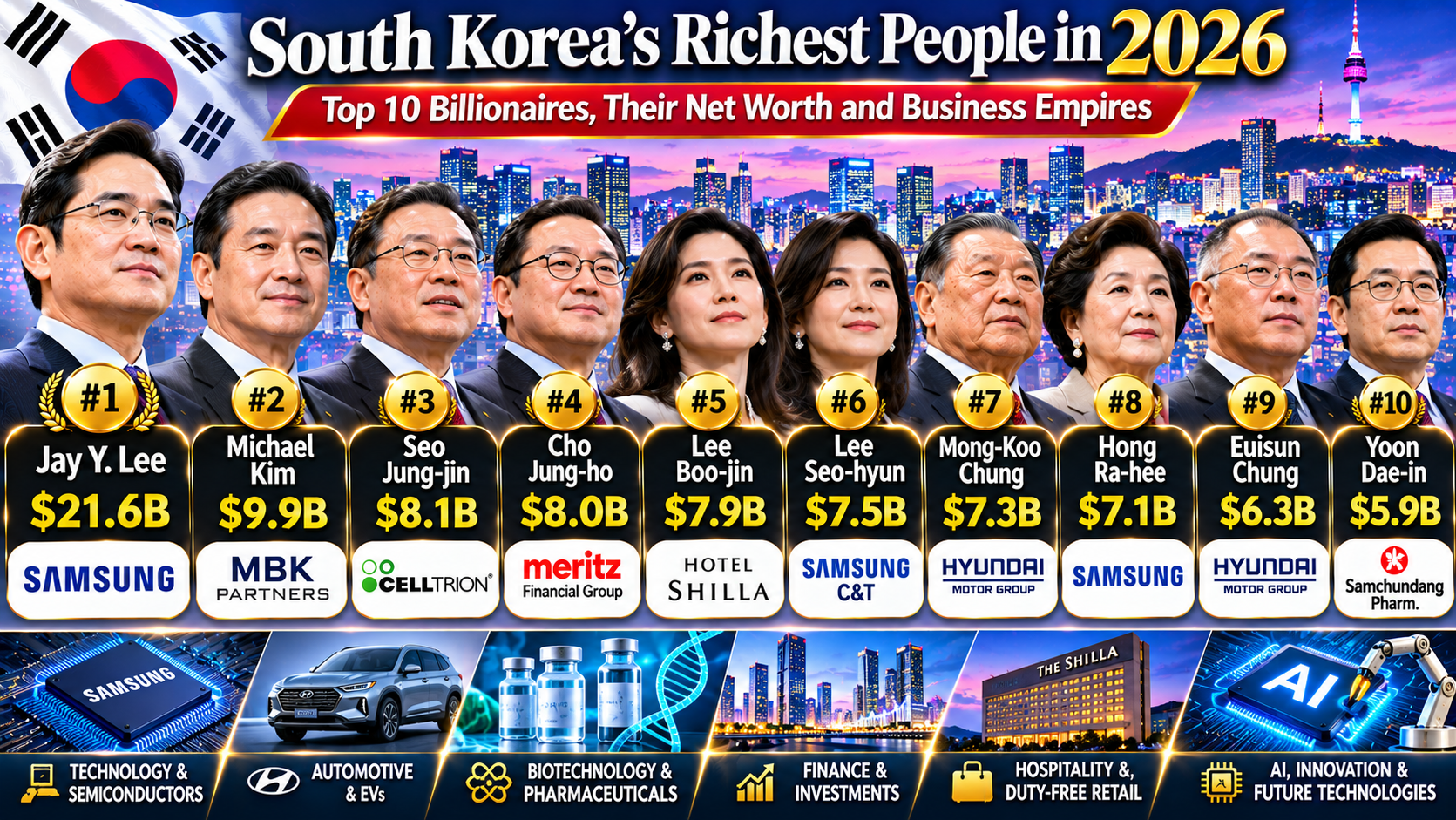
Top 10 Richest People in South Korea in 2026
The following figures are from Forbes' 2026 annual Korea rich list. They are estimates based on share prices and exchange rates as of March 27, 2026.
Rank | Name | Estimated net worth | Main source of wealth |
|---|---|---|---|
1 | Jay Y. Lee | $21.6 billion | Samsung |
2 | Michael Kim | $9.9 billion | MBK Partners |
3 | Seo Jung-jin | $8.1 billion | Celltrion |
4 | Cho Jung-ho | $8.0 billion | Meritz Financial Group |
5 | Lee Boo-jin | $7.9 billion | Hotel Shilla and Samsung holdings |
6 | Lee Seo-hyun | $7.5 billion | Samsung |
7 | Mong-Koo Chung | $7.3 billion | Hyundai Motor Group |
8 | Hong Ra-hee | $7.1 billion | Samsung holdings |
9 | Euisun Chung | $6.3 billion | Hyundai Motor Group |
10 | Yoon Dae-in | $5.9 billion | Samchundang Pharm |
1. Jay Y. Lee – $21.6 Billion
Jay Y. Lee, also known as Lee Jae-yong, ranks first among South Korea's richest people in 2026. With an estimated net worth of $21.6 billion, he is the executive chairman of Samsung Electronics and one of the country's most influential business leaders.
Samsung is one of the world's largest technology companies, with operations spanning smartphones, semiconductors, televisions, displays, home appliances, and other electronics. Its memory-chip business has become especially important as demand for artificial intelligence infrastructure continues to grow.
AI systems require powerful computing infrastructure and advanced memory technologies. Samsung's position in the semiconductor industry has therefore played a significant role in its business prospects and the value of its shareholders' investments.
Jay Y. Lee became the leader of Samsung's business group following the death of his father, Lee Kun-hee. He has been associated with the group's efforts to strengthen its semiconductor operations and expand investment in future technologies, including artificial intelligence and biotechnology.
His return to the top of the 2026 wealth ranking reflects the strong performance of South Korea's technology sector.
Main source of wealth: Samsung Electronics and related holdings
Industry: Technology, semiconductors, and electronics
2. Michael Kim – $9.9 Billion
Michael Kim, also known as Kim Byung-ju, ranks second with an estimated fortune of $9.9 billion. He is the cofounder of MBK Partners, one of Asia's major private equity investment firms.
Private equity firms raise capital from institutional investors and other sources to acquire stakes in businesses. They may improve operations, restructure companies, expand their markets, and eventually sell investments to generate returns.
MBK Partners has built a substantial investment presence across Asia, including South Korea, Japan, and Greater China. Its portfolio has included businesses in retail, healthcare, financial services, and other sectors.
Michael Kim's wealth reflects his role in developing a major investment platform rather than building a single consumer-facing company.
His position also demonstrates the importance of financial markets and private investment in South Korea's business environment. Private equity can provide capital for acquisitions and corporate restructuring, although individual investments can carry considerable financial risk.
Main source of wealth: MBK Partners
Industry: Private equity and financial investments
3. Seo Jung-jin – $8.1 Billion
Seo Jung-jin ranks third among South Korea's richest people in 2026, with an estimated fortune of $8.1 billion. He is the cofounder and chairman of Celltrion, a major South Korean biopharmaceutical company.
Celltrion is known for developing and manufacturing biological medicines, including biosimilars. Biosimilars are highly similar versions of already approved biological medicines and can help expand access to important treatments.
The company has grown its international presence through pharmaceutical development, manufacturing, regulatory approvals, and partnerships. Its products serve markets in multiple regions.
The biotechnology industry has become an increasingly important part of South Korea's economy. Companies in this sector invest in research, clinical development, manufacturing facilities, and global distribution.
Celltrion's expansion plans and stronger share performance helped increase Seo Jung-jin's estimated fortune in the 2026 ranking.
His business journey highlights the opportunities available to entrepreneurs who combine scientific research with international commercial strategies.
Main source of wealth: Celltrion
Industry: Biotechnology and healthcare
4. Cho Jung-ho – $8 Billion
Cho Jung-ho ranks fourth with an estimated net worth of $8 billion. He is associated with Meritz Financial Group, one of South Korea's major financial services businesses.
Meritz Financial Group operates across financial services, including insurance, securities, and asset management. These businesses provide products and services to individuals, corporations, and institutional investors.
South Korea's financial industry is an important part of its modern economy. Banks, insurers, investment companies, and securities firms help businesses raise capital, manage risk, and finance economic activity.
Cho Jung-ho's fortune is connected to his ownership and business interests in the financial group. His position among the country's wealthiest people reflects the scale of South Korea's financial sector and the value of major financial institutions.
Main source of wealth: Meritz Financial Group
Industry: Finance, insurance, and investments
5. Lee Boo-jin – $7.9 Billion
Lee Boo-jin ranks fifth with an estimated fortune of $7.9 billion. She is the president and chief executive of Hotel Shilla and a member of the Samsung founding family.
Hotel Shilla is a major South Korean hospitality and duty-free retail company. Its operations include hotels, travel retail, and duty-free shopping services.
Duty-free retail is closely connected to tourism and international travel. Travellers purchase cosmetics, fragrances, fashion products, luxury goods, and other items through airport and downtown retail locations.
Lee Boo-jin is the daughter of the late Samsung chairman Lee Kun-hee and the sister of Jay Y. Lee and Lee Seo-hyun. Her wealth includes Samsung-related family holdings as well as her business interests.
Her leadership at Hotel Shilla places her within South Korea's competitive hospitality and travel retail industries.
The company's performance is influenced by international passenger traffic, tourism demand, consumer spending, and competition in the global duty-free market.
Main source of wealth: Hotel Shilla and Samsung-related holdings
Industry: Hospitality, duty-free retail, and technology investments
6. Lee Seo-hyun – $7.5 Billion
Lee Seo-hyun ranks sixth with an estimated fortune of $7.5 billion. She is a member of the Samsung family and has held leadership roles within Samsung-related businesses.
She rejoined Samsung C&T in 2024 as president of strategic planning after several years away from a leading executive role. Samsung C&T operates across construction, trading, fashion, and resort-related businesses.
Lee Seo-hyun also oversees the Samsung Welfare Foundation and has been involved with the Leeum Museum of Art in Seoul.
Her professional background includes fashion and brand development. She previously worked with Cheil Industries and was involved in the development of fashion brands and business initiatives.
Her fortune is largely connected to Samsung-related holdings and family wealth. Her position illustrates the importance of family ownership and diversified corporate interests in South Korea's business landscape.
Main source of wealth: Samsung-related holdings
Industry: Technology, fashion, and diversified investments
7. Mong-Koo Chung – $7.3 Billion
Mong-Koo Chung ranks seventh among South Korea's wealthiest people in 2026, with an estimated net worth of $7.3 billion. He is the honorary chairman of Hyundai Motor Group and a major figure in the development of South Korea's automotive industry.
During his leadership, Hyundai Motor Group expanded its international operations and strengthened its position in the global automobile market.
Hyundai and Kia have become major international vehicle brands, competing across passenger cars, sport utility vehicles, commercial vehicles, and electric vehicles.
Mong-Koo Chung is widely associated with the group's emphasis on product quality, manufacturing capabilities, and international expansion. His leadership period helped transform Hyundai into a major global automotive manufacturer.
His wealth is connected to investments and shareholdings in companies associated with Hyundai Motor Group.
The automotive industry is now undergoing a major transformation, with electric vehicles, software, robotics, and autonomous driving technologies influencing future investment decisions.
Main source of wealth: Hyundai Motor Group
Industry: Automotive and manufacturing
8. Hong Ra-hee – $7.1 Billion
Hong Ra-hee ranks eighth with an estimated fortune of $7.1 billion. She is a prominent member of the Samsung family and the widow of former Samsung chairman Lee Kun-hee.
Hong Ra-hee is also known for her involvement in the arts and cultural sector. She previously served as director of the Leeum, Samsung Museum of Art in Seoul, which is recognized for its collection of traditional Korean and international contemporary art.
A significant part of her wealth is connected to Samsung-related shareholdings. The value of these investments can change as the stock market moves.
The performance of Samsung Electronics and other affiliated companies has therefore been an important influence on the wealth of members of the Lee family.
Hong Ra-hee's position in the ranking demonstrates how corporate ownership, family investments, and long-term shareholdings can contribute to substantial wealth.
Main source of wealth: Samsung-related holdings
Industry: Technology and investments
9. Euisun Chung – $6.3 Billion
Euisun Chung ranks ninth with an estimated net worth of $6.3 billion. He is the chairman of Hyundai Motor Group and represents the next generation of leadership in the Hyundai business family.
Under his leadership, Hyundai Motor Group has continued to develop its international automotive operations while investing in electric vehicles, hydrogen technologies, robotics, and mobility services.
The transition toward electric mobility has become one of the most important changes in the global automobile industry. Manufacturers are investing in battery technology, vehicle software, charging infrastructure, and new production systems.
Hyundai has expanded its electric vehicle lineup and developed new technologies to compete in international markets.
Euisun Chung's wealth is connected to his investments and holdings in companies associated with Hyundai Motor Group.
His position reflects the continued importance of South Korea's automotive sector and its ability to compete in a rapidly changing global market.
Main source of wealth: Hyundai Motor Group
Industry: Automotive, electric vehicles, and mobility technology
10. Yoon Dae-in – $5.9 Billion
Yoon Dae-in completes the top 10 with an estimated fortune of $5.9 billion. He is associated with Samchundang Pharm, a South Korean pharmaceutical company.
The pharmaceutical sector is becoming an increasingly important source of wealth in South Korea. Companies are developing medicines, improving manufacturing technologies, and seeking opportunities in international healthcare markets.
Samchundang Pharm attracted attention in 2026 through its work on pharmaceutical development and its S-PASS platform. The company has been associated with interest in oral drug delivery, including products targeting the growing market for weight-management treatments.
The global pharmaceutical industry is highly competitive. Businesses must invest in research, clinical evidence, regulatory processes, manufacturing, and partnerships to bring new products to market.
Yoon Dae-in's position in the 2026 ranking highlights the growing influence of South Korea's biotechnology and pharmaceutical entrepreneurs.
Main source of wealth: Samchundang Pharm
Industry: Pharmaceuticals and healthcare
Industries Creating Wealth in South Korea
South Korea's wealthiest individuals have built their fortunes across several major industries. The 2026 ranking shows the importance of established conglomerates as well as newer businesses in technology and healthcare.
1. Technology and Semiconductors
Technology is one of the country's most important wealth-generating sectors. Samsung Electronics is a global leader in memory chips and consumer electronics, while other South Korean companies manufacture semiconductor components and production equipment.
The expansion of artificial intelligence has increased demand for advanced memory products, high-performance computing, and semiconductor manufacturing technologies.
2. Automotive and Electric Vehicles
Hyundai Motor Group has helped establish South Korea as an important global automotive manufacturing centre.
The industry is now investing in electric vehicles, batteries, robotics, autonomous driving, and connected mobility. These developments are creating new opportunities for manufacturers and technology suppliers.
3. Biotechnology and Pharmaceuticals
Companies such as Celltrion and Samchundang Pharm represent the growth of South Korea's pharmaceutical and biotechnology industries.
Research, biosimilar development, drug delivery systems, and international partnerships are important areas of investment.
4. Finance and Private Equity
Michael Kim and Cho Jung-ho demonstrate the role of finance and investment in creating major fortunes.
Private equity, insurance, securities, and asset management businesses help direct capital toward companies and investment opportunities.
5. Hospitality and Retail
Hotel Shilla illustrates the connection between South Korea's tourism industry and international retail.
As travel and consumer demand change, hospitality and duty-free businesses continue to adapt their operations and customer strategies.
How South Korea's Richest People Built Their Fortunes
Several common themes appear in the business stories of South Korea's wealthiest people.
Long-term business development: Samsung and Hyundai demonstrate how companies can grow over several generations through investment, manufacturing, and international expansion.
Technology and innovation: Semiconductor development and artificial intelligence have become major drivers of corporate growth and investor interest.
Global expansion: South Korean companies have developed international customer bases, manufacturing facilities, partnerships, and distribution networks.
Diversification: Many wealthy business families hold investments across multiple companies and industries, reducing their dependence on a single business.
Research and development: Biotechnology, pharmaceuticals, electric vehicles, and advanced manufacturing require sustained investment in research and technology.
South Korea's Economic Outlook and the Future of Billionaire Wealth
South Korea's economic future is closely connected to technology, exports, manufacturing, and international trade. The country has developed strong positions in semiconductors, automobiles, electronics, shipbuilding, and advanced industrial production.
Artificial intelligence is creating new opportunities for semiconductor manufacturers. AI systems require large amounts of computing power and advanced memory products, increasing demand for technologies developed by companies such as Samsung.
The automotive industry is also changing. Electric vehicles, battery technology, robotics, and software-based mobility services are likely to remain important areas of investment.
Healthcare and biotechnology offer another source of potential growth. South Korean pharmaceutical companies are working to expand their international presence through research, manufacturing, and partnerships.
However, wealth creation is not guaranteed. Companies face challenges such as global competition, changing consumer demand, market volatility, regulatory requirements, and international trade conditions.
The fortunes of South Korea's richest people can also change significantly because many are closely connected to publicly traded companies. Their net worth estimates may rise or fall as share prices move.
Frequently Asked Questions About South Korea's Richest People
Who is the richest person in South Korea in 2026?
According to Forbes' 2026 Korea's 50 Richest list, Jay Y. Lee is the richest person, with an estimated net worth of $21.6 billion.
What is Jay Y. Lee's net worth in 2026?
Forbes estimated Jay Y. Lee's wealth at $21.6 billion for its 2026 annual Korea ranking, based on market prices as of March 27, 2026.
Who is the second-richest person in South Korea?
Michael Kim, cofounder of MBK Partners, ranks second with an estimated fortune of $9.9 billion.
Who is the richest woman in South Korea in 2026?
Lee Boo-jin ranks as the highest-placed woman in the Forbes 2026 top 10, with an estimated fortune of $7.9 billion. She is president and CEO of Hotel Shilla.
How much are South Korea's 50 richest people worth collectively?
Forbes reported that the combined wealth of South Korea's 50 richest reached approximately $175 billion in 2026, up 77% from the previous year's $99 billion.
Which industries create the most billionaires in South Korea?
Major industries include technology, semiconductors, automobiles, biotechnology, pharmaceuticals, finance, private equity, and retail.
Is Samsung the biggest source of billionaire wealth in South Korea?
Samsung-related holdings account for several fortunes in the 2026 ranking, including those of Jay Y. Lee, Lee Boo-jin, Lee Seo-hyun, and Hong Ra-hee. However, other major sources include finance, biotechnology, and automotive businesses.
Are these net worth figures updated in real time?
No. The figures in this article are Forbes' estimates for its annual 2026 Korea rich list, using market prices and exchange rates as of March 27, 2026. Live wealth estimates can differ as stock prices and valuations change.
Conclusion
South Korea's richest people in 2026 represent the country's strength in technology, manufacturing, finance, biotechnology, and international business.
Jay Y. Lee leads the ranking with an estimated $21.6 billion, followed by investor Michael Kim and biotechnology entrepreneur Seo Jung-jin. The list also includes major figures from the Samsung and Hyundai business families, highlighting the continuing influence of South Korea's large corporate groups.
The artificial intelligence boom has played a major role in the country's rising billionaire wealth, particularly through demand for semiconductors and advanced manufacturing equipment. At the same time, pharmaceuticals, electric vehicles, financial services, and global retail continue to create opportunities.
As South Korea develops its technology and export industries, its leading entrepreneurs and business families are likely to remain important figures in the global economy.