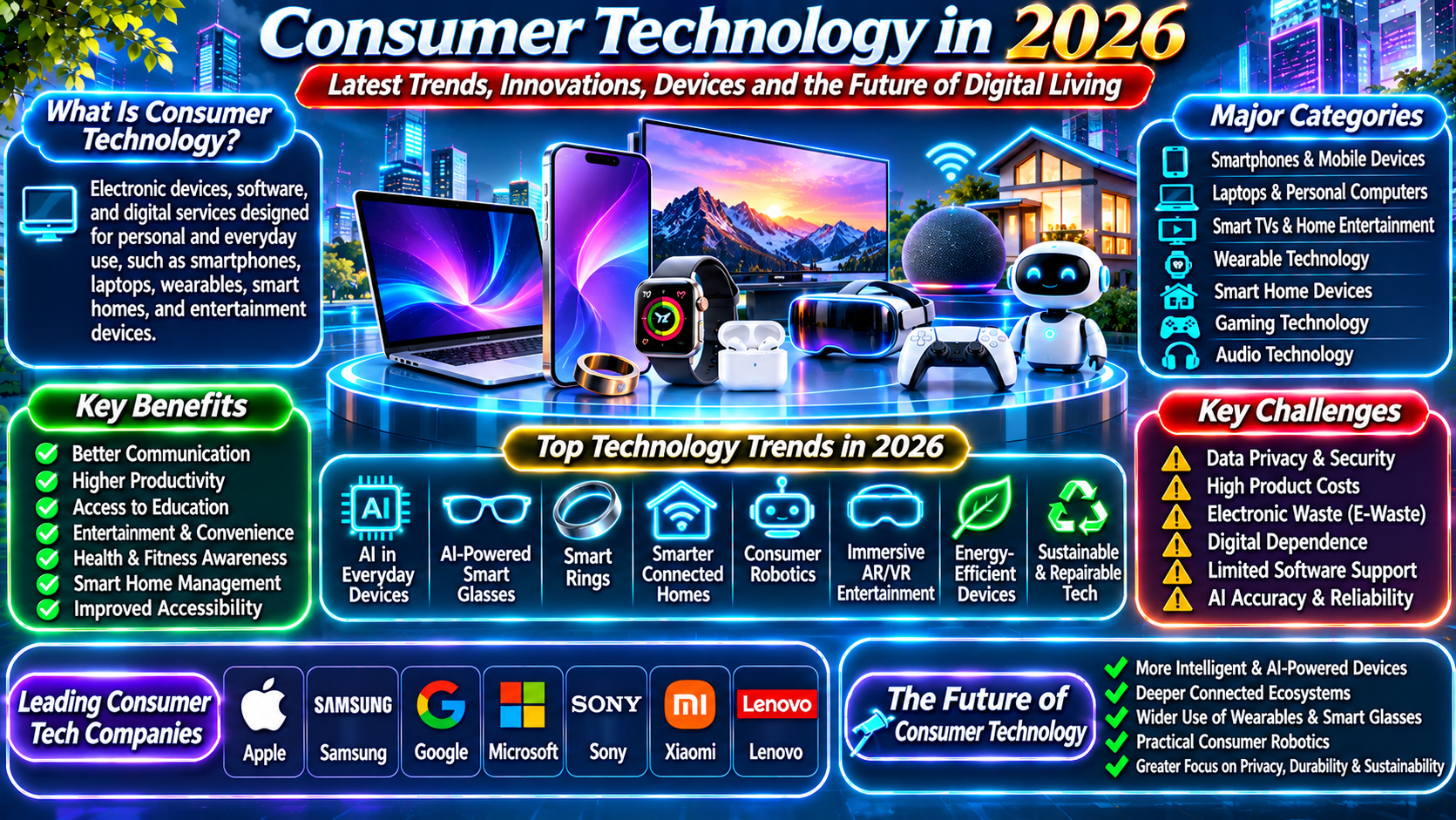
Consumer technology refers to electronic devices, digital products, and software designed for personal and everyday use. These technologies help people communicate, access information, manage their homes, enjoy entertainment, improve productivity, and stay connected.
The term covers a wide range of products, including smartphones, laptops, tablets, smart televisions, gaming consoles, headphones, wearable devices, cameras, smart appliances, and virtual reality equipment.
Consumer technology also includes software and digital services such as mobile applications, streaming platforms, online shopping systems, cloud storage, and artificial intelligence assistants.
Unlike technologies developed exclusively for industrial or enterprise environments, consumer technology focuses on products that individuals and households can use directly.
Its development is influenced by changing lifestyles, consumer preferences, technological innovation, affordability, and demand for convenience.
Major Categories of Consumer Technology
Consumer technology includes several major product categories, each designed to serve different everyday needs.
1. Smartphones and Mobile Devices
Smartphones are among the most important consumer technology products. They combine communication, internet access, photography, entertainment, navigation, and productivity features in a single portable device.
Modern smartphones offer advanced processors, high-resolution cameras, biometric security, artificial intelligence features, and fast wireless connectivity.
Major manufacturers include Apple, Samsung, Google, Xiaomi, OnePlus, and other global brands.
Smartphones are also becoming central control devices for connected homes, wearable products, digital payments, and online services.
2. Laptops and Personal Computers
Laptops and desktop computers remain essential tools for education, professional work, entertainment, and creative activities.
Modern computers are designed for different user requirements, including office productivity, gaming, programming, video editing, and artificial intelligence workloads.
Important developments include:
More efficient processors.
Improved battery performance.
Higher-resolution displays.
Faster solid-state storage.
Better graphics capabilities.
AI-enabled computing features.
The growing demand for AI-powered applications is also influencing how manufacturers design processors and computer hardware.
3. Smart TVs and Home Entertainment
Smart televisions connect to the internet and allow users to access streaming services, online applications, gaming platforms, and digital content.
Modern televisions offer technologies such as OLED, QLED, Mini LED, and advanced image processing.
Consumers are increasingly interested in larger displays, improved picture quality, better sound systems, and personalized entertainment experiences.
Streaming devices, wireless speakers, soundbars, and home theater systems also contribute to this category.
4. Wearable Technology
Wearable technology includes electronic devices designed to be worn on the body.
Common examples include smartwatches, fitness trackers, smart rings, wireless earbuds, and smart glasses.
These devices can provide notifications, activity tracking, communication features, and selected health-related measurements.
The category is expanding beyond traditional wrist-based devices as manufacturers explore new form factors and AI-powered capabilities.
5. Smart Home Devices
Smart home technology connects household devices to digital networks, allowing users to monitor and control them through applications, voice assistants, or automated routines.
Examples include:
Smart lighting.
Connected thermostats.
Smart security cameras.
Video doorbells.
Smart locks.
Connected refrigerators.
Robot vacuum cleaners.
Smart speakers.
These products can improve convenience and help households manage energy use, security, and daily activities.
6. Gaming Technology
Gaming technology includes consoles, gaming PCs, controllers, monitors, headsets, and virtual reality systems.
Modern gaming products focus on graphics performance, processing power, faster displays, immersive audio, and online multiplayer experiences.
Cloud gaming and subscription-based gaming services are also changing how consumers access digital games.
7. Audio Technology
Consumer audio products include headphones, earbuds, wireless speakers, microphones, and home audio systems.
Recent developments include active noise cancellation, spatial audio, open-ear headphones, improved wireless connectivity, and voice assistant integration.
Audio devices are increasingly designed to support communication, entertainment, accessibility, and everyday productivity.
Latest Consumer Technology Trends in 2026
Consumer technology is evolving through improvements in artificial intelligence, connectivity, computing hardware, sensors, and digital services.
Several developments are particularly important in 2026.
1. Artificial Intelligence in Everyday Devices
Artificial intelligence is becoming an important feature of smartphones, computers, wearable devices, and smart home products.
AI features can help users summarize information, edit photographs, translate languages, organize tasks, improve search, and interact with digital assistants.
Some devices can process selected AI tasks directly on their hardware, while others rely on cloud-based systems.
This combination of on-device and cloud processing can support different requirements involving speed, privacy, and computing capacity.
However, AI features are most useful when they solve genuine consumer problems rather than simply adding unnecessary complexity.
2. AI-Powered Smart Glasses
Smart glasses are emerging as an interesting category within consumer technology.
These devices may combine conventional eyewear with cameras, microphones, speakers, voice assistants, and selected augmented reality features.
Potential applications include:
Hands-free photography.
Voice-based assistance.
Real-time translation.
Navigation support.
Audio playback.
Contextual information.
Accessibility assistance.
The market is also moving toward lightweight glasses that look more like traditional eyewear rather than bulky virtual reality headsets.
Battery life, privacy, comfort, and practical everyday usefulness will influence wider adoption.
3. Wearables Beyond Fitness Tracking
Wearable technology is expanding beyond step counting and basic fitness measurements.
Smartwatches, smart rings, and advanced earbuds can offer features related to activity, sleep, heart-rate monitoring, and other wellness measurements, depending on the device.
Some products also provide AI-assisted summaries and personalized activity insights.
Consumers should understand that wearable measurements are not automatically equivalent to medical diagnoses. Health-related decisions should be discussed with qualified healthcare professionals.
4. Smarter Connected Homes
Smart home products are increasingly moving toward connected ecosystems instead of operating as isolated gadgets.
The Matter standard is an important development because it aims to improve interoperability among compatible smart home products and platforms.
This can make it easier for consumers to connect devices from different manufacturers.
Smart home systems can also support automated lighting, temperature control, security alerts, energy monitoring, and household routines.
The overall objective is to create a more convenient and connected living environment.
5. On-Device AI Processing
On-device AI allows supported artificial intelligence tasks to run directly on a smartphone, computer, or other electronic device.
This approach can reduce dependence on cloud services for certain functions.
Potential advantages include faster responses, offline functionality for supported tasks, and reduced transmission of some personal information.
However, on-device processing is limited by hardware performance, battery capacity, memory, and the complexity of the AI model.
6. Smart Rings and New Wearable Designs
Smart rings are attracting interest as smaller alternatives to traditional wearable devices.
They can provide selected activity and wellness measurements in a compact design.
Their advantages may include discreet appearance, lightweight construction, and convenient everyday use.
The category also faces challenges involving battery life, sizing, comfort, sensor accuracy, and the need to provide clear value compared with smartwatches.
7. Consumer Robotics
Consumer robotics is expanding through products designed to perform household and personal tasks.
Examples include robot vacuum cleaners, lawn-mowing robots, window-cleaning devices, and experimental home assistant robots.
Artificial intelligence and improved sensors can help these devices understand their environments and respond to changing conditions.
The long-term potential includes more advanced household automation, although cost, reliability, safety, and practical usefulness remain important considerations.
8. More Immersive Entertainment
Virtual reality, augmented reality, and mixed reality are changing how consumers interact with digital content.
These technologies can support gaming, education, virtual meetings, creative applications, and interactive entertainment.
Developments in display quality, motion tracking, spatial computing, and device comfort may improve user experiences.
However, price and practical everyday applications will influence how widely these products are adopted.
9. Energy-Efficient Consumer Electronics
Consumers are increasingly considering energy efficiency when purchasing electronic devices and household appliances.
Energy-efficient products can help reduce electricity consumption and operating costs.
Manufacturers are improving processor efficiency, display technologies, battery systems, and power management.
This trend is especially relevant for products that remain connected or operate for long periods, such as refrigerators, televisions, air conditioners, and networking devices.
10. Repairability and Sustainable Technology
Sustainability is becoming an important consideration in consumer electronics.
Consumers and regulators are paying more attention to product durability, repairability, battery replacement, recycling, and electronic waste.
Manufacturers are exploring longer software support periods, improved repair options, recycled materials, and more efficient production processes.
The ability to repair and maintain a device can influence its long-term value.
How Artificial Intelligence Is Transforming Consumer Technology
Artificial intelligence is changing how consumers interact with electronic products.
Traditional devices mainly followed direct commands and predefined instructions. AI-enabled products can offer more personalized and context-aware experiences.
AI in Smartphones
Smartphones use AI for photography, voice recognition, text assistance, translation, image editing, and personalized recommendations.
Some devices can also summarize notifications, organize information, and support more advanced voice interactions.
AI in Computers
AI-enabled computers can support writing, programming, research, image creation, transcription, and productivity workflows.
Specialized processors, including neural processing units (NPUs), help supported devices execute certain AI tasks locally.
AI in Smart Homes
Smart home systems can use AI to understand patterns and support automated routines.
For example, a compatible system may adjust lighting, suggest energy-saving settings, or help users manage connected appliances.
AI in Entertainment
AI can help improve image quality, personalize recommendations, generate content, and support interactive gaming experiences.
These features are changing how consumers discover and experience digital entertainment.
AI in Wearables
AI-powered wearable products may help users understand activity patterns, organize wellness information, and interact with digital assistants.
Privacy, measurement accuracy, and transparency are especially important when devices process sensitive personal information.
Leading Consumer Technology Companies
Several major companies influence the global consumer technology market through hardware, software, digital services, and connected ecosystems.
Apple
Apple develops smartphones, computers, tablets, wearable devices, and digital services.
Its major product categories include the iPhone, Mac, iPad, Apple Watch, AirPods, and Apple Vision Pro.
The company focuses on hardware-software integration, ecosystem connectivity, privacy features, and user experience.
Samsung Electronics
Samsung is a major manufacturer of smartphones, televisions, displays, home appliances, memory products, and consumer electronics.
Its Galaxy smartphone and wearable ecosystems, along with its television and home appliance businesses, serve consumers across international markets.
Google provides consumer technology through Android, Pixel devices, Google Home, Chrome, and digital services.
The company also develops AI technologies that support search, productivity, photography, and connected-device experiences.
Microsoft
Microsoft is an important consumer and computing technology company.
Its products include Windows, Surface devices, Xbox, Microsoft 365, and cloud-connected software services.
The company is also integrating AI capabilities across its software ecosystem.
Sony
Sony develops consumer electronics, entertainment products, cameras, audio equipment, and gaming systems.
Its PlayStation ecosystem, imaging technology, televisions, and audio products are important parts of its consumer technology business.
Xiaomi
Xiaomi produces smartphones, tablets, wearable devices, televisions, and smart home products.
Its connected-device ecosystem includes products designed to work together through software and mobile applications.
Lenovo
Lenovo is a major computer manufacturer offering laptops, desktops, tablets, workstations, and gaming devices.
Its consumer products serve students, professionals, families, and gaming users.
Benefits of Consumer Technology
Consumer technology offers several advantages that improve everyday life.
1. Better Communication
Smartphones, video calling applications, messaging services, and social platforms make it easier to communicate with friends, families, and colleagues across different locations.
2. Improved Productivity
Laptops, tablets, productivity applications, and AI assistants help users complete tasks, organize information, and manage their time.
3. Easier Access to Education
Digital learning platforms, educational applications, online libraries, and video tutorials provide access to learning resources beyond traditional classrooms.
4. Entertainment and Convenience
Streaming services, gaming systems, smart televisions, and wireless audio products provide convenient access to entertainment.
5. Health and Fitness Awareness
Wearable devices can help users monitor selected activity and wellness indicators, encouraging greater awareness of everyday habits.
6. Smart Home Management
Connected household devices allow users to manage lighting, security, temperature, and appliances through compatible applications and automation systems.
7. Accessibility
Features such as voice control, screen readers, live captions, magnification, and translation tools can make technology more accessible to people with different needs.
Challenges Facing the Consumer Technology Industry
Despite its advantages, consumer technology also creates challenges for individuals, manufacturers, and society.
1. Data Privacy
Smart devices may collect personal information, location data, photographs, voice recordings, and usage patterns.
Consumers should understand what information a product collects, how it is used, and which privacy controls are available.
2. Cybersecurity Risks
Connected devices can become targets for cyberattacks if they use weak passwords, outdated software, or insecure network connections.
Manufacturers should provide security updates, while consumers should use strong passwords and enable available security protections.
3. High Product Costs
Advanced smartphones, computers, televisions, and wearable devices can be expensive.
Consumers may also face additional costs through subscriptions, accessories, repairs, and software services.
4. Electronic Waste
Frequent device replacement contributes to electronic waste.
Old batteries, circuit boards, displays, and other components require responsible collection, recycling, and disposal.
5. Digital Dependence
Excessive dependence on smartphones, social media, gaming, and digital entertainment can affect productivity and daily routines.
Balanced technology use is important.
6. Short Product Lifecycles
Some devices receive limited software support or become difficult to repair after a few years.
Consumers increasingly need to consider durability, warranty coverage, replacement parts, and update policies before purchasing products.
7. AI Accuracy and Reliability
AI-powered consumer products may sometimes produce incorrect information or misunderstand instructions.
Users should verify important information instead of assuming that every AI-generated answer is accurate.
How to Choose the Right Consumer Technology
Selecting the right technology requires more than comparing specifications or choosing the newest product.
Consumers should consider their actual needs and long-term ownership costs.
1. Identify Your Requirements
Before buying a device, consider what you need it to accomplish.
A student may prioritize battery life and portability, while a gamer may need a powerful processor and dedicated graphics.
2. Compare Specifications
Important specifications depend on the device category.
For smartphones, consumers may compare processor performance, camera quality, display, battery, storage, and software support.
For laptops, memory, processor, storage, display quality, weight, and battery life may be more important.
3. Check Software Support
A device with long-term security and operating system updates can offer better value.
Consumers should review the manufacturer's published support policy.
4. Consider Compatibility
Devices should work with the applications, operating systems, accessories, and other products that consumers already use.
Compatibility can make a major difference in everyday convenience.
5. Evaluate Security and Privacy
Review security features, privacy settings, data collection policies, and available software updates.
6. Compare Total Ownership Costs
The purchase price is only one part of the total cost.
Subscriptions, accessories, repairs, batteries, warranties, and replacement parts should also be considered.
Consumer Technology Trends and Market Outlook in 2026
The consumer technology market is developing through a combination of innovation and economic pressures.
Artificial intelligence is creating new opportunities for manufacturers, but consumers still expect practical improvements that justify the cost of upgrading their devices.
According to NielsenIQ's January 2026 market outlook, global consumer technology and durable-goods sales were estimated to have reached approximately $1.3 trillion in 2025. Its forecast for 2026 anticipated a relatively flat global market, with growth varying across regions and product categories.
This illustrates an important industry reality: technological innovation does not always translate into immediate increases in consumer spending.
Other market developments include:
Greater interest in AI-enabled consumer devices.
Continued expansion of connected home products.
New wearable formats such as smart rings and glasses.
Increasing attention to repairability and sustainability.
Competition around battery life and device performance.
More emphasis on security and customer trust.
The industry is therefore balancing innovation with affordability, reliability, and practical consumer value.
What Is the Future of Consumer Technology?
The future of consumer technology will be shaped by artificial intelligence, connected devices, robotics, advanced computing, and personalized digital experiences.
Smartphones may continue evolving into central AI-powered assistants that connect users with applications, services, and other devices.
Wearable technology may expand into new designs that provide more convenient access to information and wellness measurements. Smart home systems may become easier to manage as interoperability improves.
Consumer robotics could also become more useful as sensors, AI systems, and hardware capabilities develop.
At the same time, consumers are likely to demand stronger privacy protections, longer software support, more durable devices, and better repair options.
The next stage of consumer technology will not be defined only by faster processors or larger displays. Its success will depend on how effectively products solve everyday problems.
Frequently Asked Questions About Consumer Technology
1. What is consumer technology?
Consumer technology refers to electronic devices, software, and digital services designed for personal and household use. Examples include smartphones, laptops, smart televisions, wearables, gaming consoles, and smart home devices.
2. What are examples of consumer technology?
Examples include smartphones, tablets, personal computers, wireless headphones, smartwatches, digital cameras, gaming consoles, smart appliances, and virtual reality headsets.
3. What are the latest consumer technology trends in 2026?
Important trends include AI-powered devices, smart glasses, smart rings, connected homes, on-device AI, consumer robotics, energy-efficient electronics, and sustainable product design.
4. How is AI changing consumer technology?
AI is improving photography, voice assistance, translation, productivity, personalization, home automation, and selected wellness features across consumer devices.
5. Which companies are leading the consumer technology industry?
Major companies include Apple, Samsung, Google, Microsoft, Sony, Xiaomi, and Lenovo. Different companies lead different product categories and markets.
6. What is wearable technology?
Wearable technology consists of electronic devices designed to be worn on the body, including smartwatches, fitness trackers, smart rings, and smart glasses.
7. What is smart home technology?
Smart home technology connects household devices to digital networks so users can monitor, control, and automate selected home functions.
8. What are the disadvantages of consumer technology?
Challenges include privacy risks, cybersecurity threats, high prices, electronic waste, digital dependence, limited software support, and potential AI inaccuracies.
9. Why is consumer technology important?
Consumer technology improves communication, education, productivity, entertainment, accessibility, and convenience. It also supports innovation across the wider digital economy.
10. What is the future of consumer technology?
The future is expected to involve more intelligent devices, advanced wearables, connected homes, consumer robotics, improved digital accessibility, and stronger attention to privacy and sustainability.
Conclusion
Consumer technology continues to shape modern lifestyles by making digital services and electronic devices more accessible, connected, and useful.
From smartphones and laptops to wearable devices, smart homes, gaming systems, and AI-powered applications, technology is becoming increasingly integrated into everyday activities.
In 2026, artificial intelligence, connected ecosystems, smart glasses, consumer robotics, and energy-efficient devices are among the developments influencing the industry.
However, successful innovation requires more than adding new features. Manufacturers must also focus on affordability, security, privacy, durability, and practical value.
As consumer expectations evolve, companies that develop reliable and genuinely useful products will be better positioned to shape the future of the global technology market.