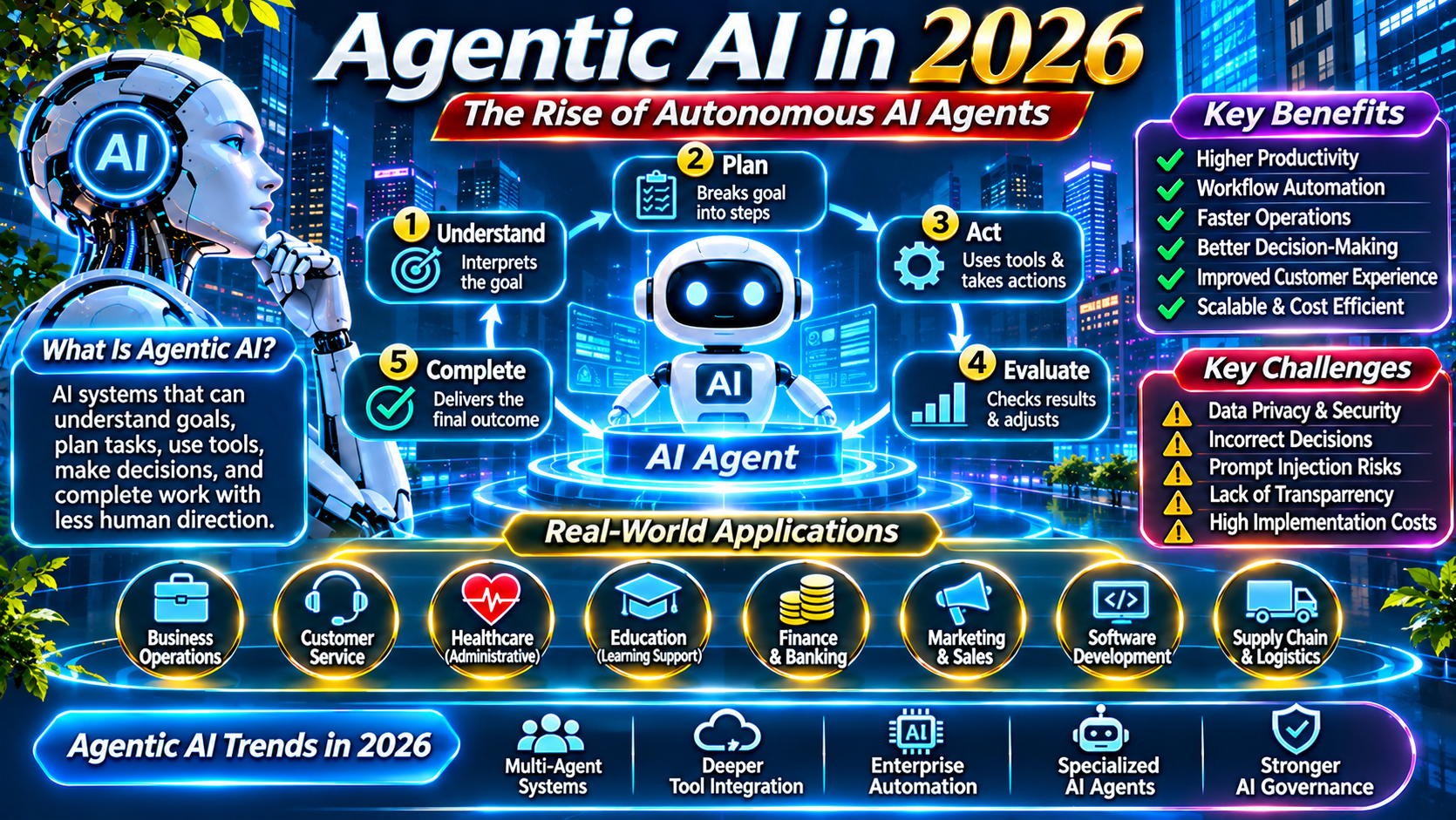
Agentic AI refers to artificial intelligence systems that can pursue specific goals with a degree of independence. Instead of simply responding to a prompt, these systems can interpret an objective, develop a plan, select appropriate tools, perform actions, evaluate results, and adjust their approach when necessary.
The term comes from the word agency, which describes the ability to act toward a particular purpose. Agentic AI applies this concept to intelligent software systems.
For example, a traditional AI chatbot might explain how to organize a business meeting. An agentic AI system could potentially check calendars, identify suitable time slots, prepare invitations, send approved messages, and update the meeting schedule.
This ability to move from generating information to carrying out tasks makes agentic AI an important development in modern technology.
The Organisation for Economic Co-operation and Development (OECD) has examined how AI agents and agentic AI are defined. Its 2026 research highlights autonomy, goal-directed behavior, interaction with environments, task coordination, and collaboration as important characteristics. The terminology is still evolving, so not every product marketed as an AI agent has the same level of autonomy.
How Does Agentic AI Work?
Agentic AI combines several technologies and software components to complete tasks. Large language models often provide reasoning and language understanding, while APIs, external tools, databases, and memory systems allow agents to interact with digital environments.
A typical agentic AI workflow follows a continuous process.
1. Understanding the Goal
The process begins when a user or business provides an objective. The system interprets the request and identifies what needs to be accomplished.
For example, a company might ask an AI agent to investigate customer complaints from the previous week and prepare a performance report.
2. Planning the Tasks
After understanding the objective, the system breaks it into smaller steps. It determines what information is needed, which tools should be used, and what sequence of actions is appropriate.
A reporting agent might need to collect customer feedback, organize complaint categories, compare performance data, and prepare a summary.
3. Accessing Information
The agent gathers relevant information from authorized sources. These may include company databases, documents, customer relationship management platforms, websites, spreadsheets, or other connected applications.
The quality and accuracy of this information directly affect the reliability of the agent's decisions.
4. Taking Action
Once the system has developed a plan, it can use connected tools to perform specific actions. Depending on its permissions, it might update records, create documents, organize information, or initiate a workflow.
Actions involving money, confidential information, or important business decisions should generally require appropriate human approval.
5. Evaluating Results
The agent checks whether its actions achieved the intended result. If something is incomplete, it may gather additional information, revise its plan, or try another permitted approach.
This process can continue until the objective is achieved or the system determines that human assistance is necessary.
Main Components of Agentic AI
Several technical components work together to make agentic AI possible.
Large Language Models
Large language models (LLMs) help agents understand natural language, interpret instructions, analyze information, and develop plans. They provide an important reasoning capability within many modern agentic systems.
Memory
Memory allows an agent to retain relevant information about an ongoing task. It can help the system remember previous actions, user instructions, task progress, and important context.
Some systems maintain short-term memory during a session, while others use external storage to preserve information over longer periods.
Planning and Reasoning
Planning helps an agent break complex objectives into manageable tasks. Reasoning helps it evaluate options, identify relevant information, and determine which action should come next.
Tools and APIs
Tools connect AI agents to external software and services. Through authorized APIs and integrations, agents can interact with databases, email platforms, calendars, business applications, and other digital systems.
Feedback and Monitoring
Feedback helps agents evaluate the outcomes of their actions. Monitoring systems allow organizations to inspect performance, identify errors, and maintain control over automated processes.
Types of Agentic AI Systems
Agentic AI can be implemented in different ways depending on the complexity of a task and the level of independence required.
1. Single-Agent Systems
A single-agent system uses one AI agent to complete a defined objective. It may collect information, plan tasks, use tools, and produce a final result.
For example, an AI research assistant could collect information from approved sources and prepare a structured report.
2. Multi-Agent Systems
Multi-agent systems use multiple specialized agents that work together. Each agent may have a particular responsibility, while an orchestration system coordinates their activities.
A marketing workflow might include:
A research agent that identifies relevant topics.
A content agent that prepares drafts.
An SEO agent that checks keywords and page structure.
A review agent that checks quality and consistency.
The agents can exchange information and coordinate their work to complete a larger objective.
3. Workflow-Based Agents
Workflow-based agents operate within predefined processes. They can make decisions and select actions while following specific business rules.
For example, a customer support agent might classify incoming requests, retrieve order information, and route complicated cases to human employees.
4. Autonomous Agents
More autonomous systems can manage longer tasks with less continuous supervision. They may adapt their plans when circumstances change and coordinate several actions before reporting the result.
However, autonomy should always operate within clearly defined permissions, safety limits, and monitoring arrangements.
Agentic AI vs. Traditional AI vs. Generative AI
Although these technologies are related, they serve different purposes.
Feature | Traditional AI | Generative AI | Agentic AI |
|---|---|---|---|
Main purpose | Analyze and predict | Generate content | Complete goal-oriented tasks |
Typical output | Prediction or classification | Text, images, audio, or code | Actions and completed workflows |
Decision-making | Often predefined | Usually prompt-driven | Can plan and adapt |
Tool usage | Depends on implementation | Sometimes available | Central to many systems |
Autonomy | Usually limited | Usually limited | Can be higher |
Example | Fraud detection model | AI writing assistant | Agent that investigates and handles an approved workflow |
Traditional AI is commonly used to recognize patterns, classify information, and make predictions. Generative AI creates new content in response to instructions. Agentic AI builds on these capabilities by allowing systems to plan and execute sequences of actions.
The categories can overlap. A generative AI model may be part of an agentic system, but generating content alone does not make a system agentic.
Benefits of Agentic AI
Agentic AI offers several potential advantages for businesses, professionals, and organizations.
1. Greater Productivity
Agents can handle repetitive, multistep tasks that would otherwise require employees to move between different applications. This can reduce manual work and allow teams to concentrate on activities that require human judgment.
2. Faster Business Operations
An agent can collect information, organize tasks, and initiate approved actions without waiting for every step to be completed manually. This can improve turnaround times in suitable workflows.
3. Improved Customer Experience
Customer service agents can retrieve relevant information, classify requests, and help resolve routine problems. More complicated cases can be transferred to human representatives.
4. Better Information Management
Businesses generate large amounts of information across documents, emails, databases, and applications. Agentic AI can help collect, organize, and summarize this information.
5. Workflow Automation
Agentic AI can connect several activities into one coordinated process. This is particularly useful when a task involves multiple systems and decisions.
6. Scalability
Once a workflow has been tested and properly configured, an organization may be able to use it across more teams or business processes. Scaling still requires sufficient infrastructure, monitoring, and access controls.
Real-World Applications of Agentic AI
Agentic AI has potential applications across many industries. Its value depends on whether a task can be clearly defined, supported by reliable information, and performed safely using available tools.
1. Agentic AI in Business and Enterprise Operations
Businesses can use AI agents to coordinate routine operations, organize information, and support internal workflows.
Possible applications include employee onboarding, invoice processing, report preparation, document management, and administrative support.
For example, an onboarding agent could prepare a checklist, collect approved documents, schedule training sessions, and notify relevant departments. Sensitive employment decisions would remain under appropriate human supervision.
2. Agentic AI in Customer Service
Customer service is one of the areas where agentic AI could make a significant difference.
An AI agent may be able to:
Understand a customer's request.
Retrieve relevant account information.
Check an order or service status.
Identify possible solutions.
Complete permitted account actions.
Escalate complicated cases to a human representative.
This approach can make routine support processes more efficient while allowing employees to focus on unusual or sensitive cases.
3. Agentic AI in Healthcare
Healthcare organizations can explore agentic AI for administrative and information-management tasks.
Potential applications include appointment coordination, medical document organization, administrative workflow management, and assisting healthcare professionals with information retrieval.
However, clinical decisions require qualified medical professionals. AI agents should not independently diagnose patients, prescribe treatments, or make high-impact healthcare decisions without appropriate clinical oversight and safeguards.
4. Agentic AI in Finance and Banking
Financial institutions can use AI agents to support transaction monitoring, document review, customer inquiries, and internal reporting.
For example, an agent could gather information related to a suspicious transaction, organize relevant records, and prepare a report for a compliance officer.
Financial transfers, lending decisions, and other high-impact activities require strict authorization, security, and accountability controls.
5. Agentic AI in Marketing
Marketing teams can use agents to coordinate research, content planning, campaign analysis, and reporting.
A marketing workflow could involve:
Researching audience interests.
Identifying potential content topics.
Preparing content briefs.
Checking SEO requirements.
Organizing campaign calendars.
Analyzing performance reports.
Human review remains important for brand voice, factual accuracy, originality, and final publishing decisions.
6. Agentic AI in Software Development
Software development agents can support coding, testing, debugging, documentation, and code review.
A developer might assign an agent a clearly defined task, such as investigating a software error or preparing a test suite. The agent can inspect relevant files, suggest changes, run permitted tests, and report its findings.
Code changes should be reviewed and tested before being deployed to production environments.
7. Agentic AI in Education
Educational organizations can explore AI agents for learning support, administrative assistance, and educational resource management.
An agent could help students organize study schedules, identify relevant learning materials, or provide explanations based on approved course content.
Teachers and educational professionals should remain responsible for assessment, student welfare, and important academic decisions.
8. Agentic AI in Supply Chain Management
Supply chains involve several connected processes, including inventory management, procurement, transportation, and demand planning.
Agentic AI could help monitor inventory levels, identify possible shortages, compare supplier information, and prepare recommendations.
Organizations may also use agents to coordinate routine procurement workflows, subject to financial approval and supplier controls.
Agentic AI Tools and Technology Platforms
The agentic AI ecosystem includes model providers, software platforms, development frameworks, and integration technologies.
Examples of technologies and platforms include:
Microsoft Copilot Studio: A platform for creating and managing AI agents that work with business data and applications.
Google Cloud AI technologies: Tools and services that support the development and deployment of AI applications and agents.
IBM watsonx: Enterprise AI technologies for building, managing, and governing AI applications.
LangChain: A development framework used to build applications that connect language models with tools and other components.
AutoGen: An open-source framework for developing applications involving multiple AI agents.
CrewAI: A framework for coordinating AI agents with different roles and responsibilities.
Model Context Protocol (MCP): An open protocol designed to connect AI applications with external tools and data sources.
These technologies have different purposes and capabilities. Organizations should evaluate their security, integration requirements, technical maturity, costs, and support before selecting a platform.
Challenges and Risks of Agentic AI
Despite its potential, agentic AI introduces important technical, operational, and security challenges.
1. Data Privacy and Security
Agents may access business databases, customer records, documents, and external applications. If permissions are not properly configured, sensitive information could be exposed or misused.
Organizations should apply strong access controls, encryption, identity management, and data protection policies.
2. Incorrect Decisions
AI agents can misunderstand instructions, misinterpret information, or produce incorrect results. When a system can take actions, these errors may have consequences beyond an inaccurate answer.
Testing, verification, and human approval are particularly important for sensitive workflows.
3. Prompt Injection Attacks
An agent may process information from external websites, emails, or documents. Malicious instructions hidden in this content could attempt to manipulate the system into performing unauthorized actions.
Organizations should treat external information as untrusted, isolate permissions, and implement security controls around tool usage.
4. Lack of Transparency
Complex agentic systems may involve several models, tools, and automated decisions. It can become difficult to understand why a particular action was taken.
Clear logs, monitoring, documentation, and audit trails help improve transparency.
5. High Implementation Costs
Developing and operating agentic AI may require model access, software integrations, infrastructure, testing, security controls, and specialist employees.
Businesses should assess the expected return on investment before deploying complex systems.
6. Accountability
Organizations must determine who is responsible when an AI agent makes a mistake. Responsibility should not be left unclear between developers, platform providers, system operators, and business owners.
Clear ownership and escalation procedures are essential.
How Businesses Can Implement Agentic AI
Organizations interested in agentic AI should adopt a gradual and carefully managed approach.
Step 1: Identify a Suitable Business Problem
Start with a repetitive, well-defined process that consumes significant employee time. Avoid beginning with high-risk tasks involving major financial, legal, or safety consequences.
Step 2: Define the Agent's Responsibilities
Establish what the agent is expected to accomplish, what information it can access, and which actions it is permitted to perform.
Step 3: Select the Right Technology
Choose a suitable model, development framework, or enterprise platform based on the organization's technical requirements, budget, and security needs.
Step 4: Connect Reliable Data Sources
Provide access only to relevant, accurate, and authorized information. Poor-quality data can lead to unreliable decisions.
Step 5: Establish Human Oversight
Define which activities can happen automatically and which require human approval. Financial transactions, external communications, sensitive records, and important business decisions may need additional checks.
Step 6: Test Before Deployment
Run the system in a controlled environment. Test normal situations, unexpected inputs, security threats, and failure scenarios.
Step 7: Monitor and Improve Performance
Measure accuracy, completion rates, processing time, costs, and error frequency. Review agent activity regularly and update permissions or workflows when necessary.
Agentic AI Trends to Watch in 2026
Agentic AI development is moving toward more capable systems that can coordinate tools, manage longer workflows, and collaborate with other agents.
1. Multi-Agent Collaboration
More systems are being designed around specialized agents that work together. One agent may conduct research while another analyzes data and a third prepares a final report.
Coordination and clear responsibility will become increasingly important as these systems grow more complex.
2. Enterprise AI Automation
Organizations are exploring how agents can support processes across departments. Rather than automating a single isolated task, businesses may connect several workflows into a coordinated system.
3. Improved AI Tool Integration
Protocols and integration technologies are making it easier for AI applications to interact with external tools and data sources. This can help developers create more flexible systems.
4. Stronger AI Governance
As agents gain access to more applications and decision-making authority, organizations will need better controls for permissions, monitoring, identity, and accountability.
5. Human-Agent Collaboration
The future of agentic AI is not necessarily about removing people from every process. In many cases, the most useful systems will combine automated task execution with human judgment and approval.
6. More Specialized AI Agents
Instead of relying on one general-purpose agent for everything, organizations may use specialized agents for finance, marketing, customer service, research, and software development.
What Is the Future of Agentic AI?
The future of agentic AI will depend on improvements in reasoning, reliability, security, integration, and governance.
As models become more capable and software platforms provide better connections to business tools, AI agents may be able to manage increasingly complex tasks. Organizations could use them to coordinate projects, support customer relationships, analyze business operations, and automate routine administrative work.
However, greater autonomy does not automatically mean better performance. An agent that can access more systems and perform more actions also creates additional opportunities for mistakes, security incidents, and unintended consequences.
The most successful implementations will likely combine capable AI systems with clear objectives, limited permissions, reliable data, transparent monitoring, and human oversight.
Agentic AI should therefore be viewed as a developing technology with significant potential rather than a complete replacement for human expertise.
Frequently Asked Questions About Agentic AI
1. What is agentic AI in simple words?
Agentic AI is artificial intelligence that can work toward a goal by planning tasks, using digital tools, taking actions, and checking results with limited human supervision.
2. How is agentic AI different from generative AI?
Generative AI primarily creates content such as text, images, and code. Agentic AI can use AI models and connected tools to plan and perform multiple actions toward a specific objective.
3. What are AI agents?
AI agents are software systems that can receive information, make decisions, and take actions to achieve defined goals. They may operate independently or as part of a larger multi-agent system.
4. Is agentic AI fully autonomous?
Not necessarily. Agentic AI systems have different levels of autonomy. Some require frequent human approval, while others can perform longer workflows independently within predefined permissions.
5. What industries can benefit from agentic AI?
Industries that may benefit include healthcare, finance, education, retail, manufacturing, marketing, logistics, customer service, and software development.
6. What are the biggest risks of agentic AI?
Important risks include data exposure, unauthorized actions, incorrect decisions, prompt injection, limited transparency, and unclear accountability.
7. Can small businesses use agentic AI?
Yes. Small businesses can explore agents for customer support, research, administrative work, content planning, and routine reporting. They should begin with affordable, low-risk applications and carefully review the results.
8. Will agentic AI replace human workers?
Agentic AI may automate some repetitive tasks and change the responsibilities of certain roles. However, human judgment, creativity, communication, supervision, and accountability will remain important across many professions.
9. What is a multi-agent AI system?
A multi-agent system consists of multiple AI agents that coordinate their work. Each agent may handle a specialized task, while the overall system works toward a shared objective.
10. Why is agentic AI important in 2026?
Agentic AI is important because it expands the role of artificial intelligence from generating information to carrying out coordinated tasks. It offers new opportunities for automation, productivity, and business transformation.
Conclusion
Agentic AI represents an important step in the development of artificial intelligence. By combining reasoning, planning, memory, and tool access, these systems can move beyond simple responses and help complete complex, multistep tasks.
Its applications in business operations, customer service, finance, healthcare administration, marketing, education, and software development demonstrate its potential to transform digital workflows.
Nevertheless, successful adoption requires more than advanced technology. Organizations must prioritize security, reliable information, clear permissions, human oversight, and accountability.
As agentic AI continues to develop in 2026 and beyond, businesses that understand both its capabilities and limitations will be better prepared to use it responsibly and effectively.