Artificial intelligence is evolving beyond systems that simply answer questions, generate content, or analyze information. A new generation of AI technology can plan tasks, use digital tools, interact with software, and take multiple steps toward achieving a defined objective. This approach is known as Agentic AI.
Agentic AI is becoming an important topic in business technology because it can help organizations automate complex workflows, coordinate tasks across different systems, and support faster decision-making. Unlike a traditional chatbot that mainly responds to individual prompts, an AI agent may be able to break a goal into smaller tasks, select appropriate tools, evaluate results, and continue working toward the intended outcome within defined limits.
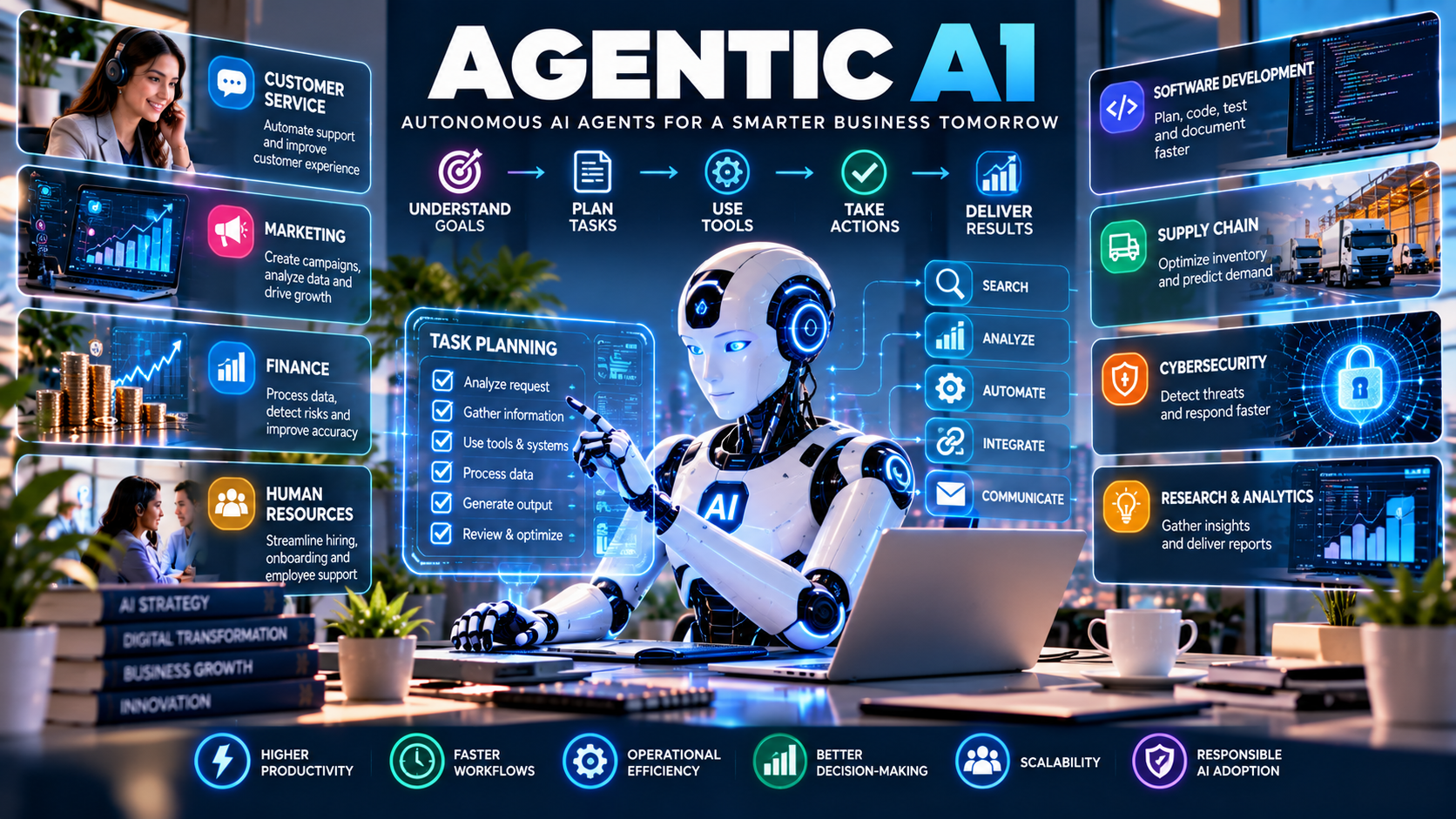
Businesses are exploring Agentic AI in customer service, marketing, software development, finance, supply chain management, cybersecurity, and internal operations. These applications can improve productivity when they are designed around real business needs and supported by appropriate safeguards.
However, autonomous AI systems also introduce challenges involving accuracy, security, privacy, cost, and human oversight. Understanding how Agentic AI works and how to implement it responsibly can help organizations prepare for the next stage of AI adoption.
What Is Agentic AI?
Agentic AI refers to AI systems designed to pursue specific goals by planning actions, using available tools, gathering information, and adapting their approach based on results.
An agent may receive a high-level objective, determine the steps needed to achieve it, and carry out selected actions through approved software or services.
For example, a business might use an AI agent to help prepare a weekly sales report. The agent could retrieve authorized sales data, summarize performance, compare results with previous periods, and prepare a draft report for an employee to review.
The defining feature is not simply that the system uses artificial intelligence. It is that the system can coordinate multiple steps toward an objective rather than only generating a single response.
Agentic AI systems can vary significantly in their capabilities. Some follow structured workflows with limited autonomy, while others can plan more flexibly and use multiple tools. Their actual abilities depend on the underlying models, available integrations, permissions, and system design.
Agentic AI should not be confused with fully independent human-like intelligence. These systems can make mistakes, misunderstand instructions, and require supervision, especially when their actions affect important business operations.
How Does Agentic AI Work?
Agentic AI typically combines an AI model with instructions, tools, access to relevant information, and a process for managing tasks and evaluating results.
Although implementations differ, many systems follow a similar workflow.
1. Goal Identification
The agent receives a defined objective, such as organizing customer support requests, researching market information, or preparing a business report.
Clear objectives help the system determine what success should look like.
2. Task Planning
The agent breaks the objective into smaller tasks and identifies the information, tools, or actions required to complete them.
A complex objective may involve several stages, such as retrieving data, analyzing it, checking results, and preparing an output.
3. Information Gathering
The agent retrieves information from approved sources, which may include documents, databases, websites, or business applications.
The quality and permissions of these sources are important because incorrect or unauthorized information can undermine the entire workflow.
4. Tool Use and Action
Depending on its configuration, the agent may interact with software, search for information, create drafts, update records, or initiate predefined workflows.
Actions should remain within the permissions granted to the agent. Sensitive or irreversible activities may require human approval.
5. Evaluation and Adjustment
The agent evaluates the results of its actions and determines whether further steps are needed.
For example, if a report is missing a required field, the system may retrieve the missing information before producing the final draft.
This process can improve task completion, but it does not guarantee correctness. Validation rules and human review remain important.
6. Completion and Reporting
The agent presents its results, explains relevant actions, or requests approval for the next step.
Businesses should maintain appropriate records of important actions so that employees can understand what happened and investigate errors when necessary.
Agentic AI vs. Traditional AI
Agentic AI is related to other AI technologies, but its emphasis on multi-step action makes it different from many traditional applications.
Feature | Traditional AI application | Agentic AI system |
|---|---|---|
Primary purpose | Predicts, classifies, analyzes, or generates outputs | Pursues a goal through coordinated steps |
Workflow | Often performs a specific task when prompted | May plan and execute multiple connected tasks |
Tool usage | May have limited or predefined integrations | Can use multiple approved tools as part of a workflow |
Adaptation | Depends on the system's design | May adjust its next steps based on intermediate results |
Autonomy | Often limited to a single operation | Can operate with varying levels of delegated autonomy |
Oversight | Depends on the application and its risk | Especially important when the agent can take consequential actions |
These categories are not mutually exclusive. An Agentic AI system may use traditional machine learning, generative AI, search systems, and rule-based automation together.
Agentic AI vs. Generative AI
Generative AI creates content such as text, images, summaries, and code. Agentic AI focuses on using AI capabilities to complete goals through a sequence of actions.
For example, a generative AI tool can draft a customer email when prompted. An agentic workflow may retrieve the relevant customer information, draft the email, check it against approved guidelines, and send it for employee approval.
Generative AI can therefore be one component of an Agentic AI system.
The distinction is important for businesses because generating an answer and taking action based on that answer involve different levels of responsibility and risk.
Key Applications of Agentic AI in Business
Agentic AI can support a wide range of business processes, especially when tasks involve multiple steps, information sources, and software tools.
1. Customer Service Automation
Customer service teams handle questions, complaints, order updates, product inquiries, and support requests.
An AI agent may classify an incoming request, retrieve information from an approved knowledge base, check order status, prepare a response, and route complex cases to a human representative.
This can reduce repetitive work and help employees focus on issues requiring judgment or personal attention.
However, businesses should provide clear escalation paths for sensitive, unusual, or unresolved customer problems.
2. Marketing and Content Operations
Marketing departments coordinate research, content production, campaign planning, audience analysis, and performance reporting.
Agentic AI can assist with tasks such as researching a topic, organizing content briefs, drafting campaign materials, collecting approved analytics, and preparing reports.
For example, a marketing workflow could gather campaign performance data, identify changes in engagement, and prepare recommendations for a marketing manager to review.
Human oversight is important for factual accuracy, brand consistency, copyright considerations, and compliance with advertising policies.
3. Sales and Lead Management
Sales teams often spend time researching prospects, updating customer relationship management systems, preparing meeting notes, and organizing follow-ups.
An AI agent may summarize available prospect information, prepare a draft outreach message, record meeting details, or recommend the next step based on approved sales processes.
Such systems can reduce administrative effort and help teams maintain more consistent records.
Any external communication or material change to customer records should follow the organization's permission and approval policies.
4. Software Development
Software development involves planning, writing code, testing, debugging, documenting, and maintaining applications.
Agentic AI tools can assist developers by examining code, proposing changes, running approved tests, identifying errors, and preparing documentation.
Some systems can coordinate several development tasks, but their output must be reviewed for correctness, security, maintainability, and compatibility with the existing software.
AI-generated code should not be deployed to production without appropriate testing and review.
5. Finance and Accounting
Finance teams handle invoices, expenses, reporting, reconciliation, budgeting, and financial analysis.
Agentic AI may help collect documents, extract relevant details, identify discrepancies, prepare draft reports, and organize records for review.
For example, an agent could compare invoice information against purchase orders and flag mismatches for an accountant.
Payments, financial transfers, and changes to important financial records should require strong controls and authorization appropriate to the risk.
6. Human Resources
Human resources departments manage onboarding, employee questions, training resources, policy information, and workforce administration.
AI agents may help answer routine questions using approved HR documents, prepare onboarding checklists, or organize training materials.
Applications involving recruitment, performance evaluation, compensation, or employment decisions require particular care. Businesses should assess fairness, privacy, accuracy, and legal requirements while keeping accountable human decision-makers involved.
7. Supply Chain Management
Supply chain operations require coordination among suppliers, inventory systems, warehouses, logistics providers, and sales teams.
Agentic AI may help monitor inventory information, summarize supplier updates, flag potential delays, and prepare recommendations for replenishment or scheduling.
For example, an agent could identify a potential stock shortage, compare available supplier information, and suggest options for a purchasing manager.
Important purchasing or logistics decisions should consider real-time data, contractual requirements, and operational constraints.
8. Cybersecurity Operations
Cybersecurity teams investigate suspicious activity, review alerts, examine system logs, and coordinate incident response.
AI agents can help gather relevant evidence, summarize related alerts, identify affected systems, and recommend investigation steps.
In carefully controlled environments, an agent may execute predefined defensive actions, such as isolating a test device or disabling a temporary account under an approved policy.
Because security actions can disrupt business operations, organizations should use strict permissions, audit logs, approval requirements, and rollback procedures.
9. Research and Business Intelligence
Businesses often need to gather information from multiple sources, compare findings, and prepare reports for decision-makers.
Agentic AI can help structure research tasks, retrieve approved information, summarize documents, compare findings, and organize results.
For reliable business research, agents should distinguish verified information from assumptions, preserve source references, and flag uncertainty instead of inventing missing details.
10. IT and Internal Operations
IT departments manage employee access, software requests, troubleshooting, system monitoring, and internal support.
An AI agent may classify support tickets, retrieve troubleshooting instructions, gather diagnostic information, and suggest appropriate next steps.
Routine requests can sometimes be handled through controlled automation, while changes to production systems or access permissions may require human approval.
Benefits of Agentic AI for Businesses
When implemented appropriately, Agentic AI can provide several operational benefits.
Improved Productivity
AI agents can coordinate multiple tasks and reduce the manual effort involved in repetitive workflows.
This may allow employees to focus on problem-solving, relationship management, strategic planning, and other work that requires human judgment.
Faster Workflow Completion
An agent can move through connected steps without requiring an employee to manually initiate every operation.
The time saved depends on the complexity of the task, the quality of integrations, and the need for human review.
Better Information Coordination
Agentic systems can retrieve and organize information from multiple approved sources, helping employees develop a more complete view of a task or situation.
Greater Operational Consistency
Well-designed workflows can apply the same procedures and validation checks across repeated tasks.
This can reduce some forms of manual variation, although systems still need monitoring to detect recurring errors.
Scalability
Businesses may use agents to help manage growing volumes of support requests, documents, research tasks, or internal workflows.
Scaling successfully requires adequate infrastructure, clear permissions, performance monitoring, and cost controls.
Support for Employee Decision-Making
Agents can summarize information, compare options, and prepare recommendations, giving employees more time to evaluate important decisions.
The final decision should remain with the appropriate person when the task involves significant financial, legal, safety, or human consequences.
Challenges and Risks of Agentic AI
Agentic AI introduces risks beyond those associated with systems that only generate text or predictions because agents may interact with software and take actions.
1. Incorrect Actions
An agent may misunderstand its objective, use incorrect information, or take an inappropriate action.
Organizations should define clear success criteria, test workflows thoroughly, and restrict actions that could cause significant harm.
2. Excessive Autonomy
Giving an agent broad permissions can create unnecessary risk. An error in a low-risk task may be manageable, while an error involving payments, confidential data, or production systems can be much more serious.
Businesses should grant only the permissions required for the task and require approval for consequential actions.
3. Data Privacy Risks
Agents may access customer records, employee information, business documents, or confidential communications.
Organizations should enforce access controls, limit data exposure, review provider data-handling practices, and establish clear retention policies.
4. Prompt Injection and Untrusted Information
An agent may encounter malicious instructions embedded in webpages, emails, documents, or other content it processes.
If the system treats untrusted content as instructions, it may attempt unauthorized actions or expose information.
Businesses should separate trusted instructions from retrieved content, restrict tool permissions, validate actions, and test for these attack scenarios.
5. Difficulty Monitoring Complex Workflows
When an agent performs many steps, it can be difficult to identify where a mistake occurred unless the system records its actions and decisions.
Audit trails, monitoring, structured outputs, and clear escalation procedures can improve accountability.
6. Integration Challenges
Connecting an agent to existing software may require technical work, permission management, data mapping, and testing.
Organizations should begin with a limited workflow and expand only after the integration proves reliable.
7. Unpredictable Costs
Some agentic workflows require multiple model calls, tool interactions, or repeated attempts to complete a task.
Businesses should establish usage limits, monitor operating costs, and evaluate whether the results justify the expense.
8. Employee Trust and Adoption
Employees may be uncertain about how agents work, whether their outputs can be trusted, or how the technology affects their responsibilities.
Clear communication, practical training, employee involvement, and transparent performance evaluation can support responsible adoption.
How to Implement Agentic AI Successfully
A structured implementation process can help organizations benefit from Agentic AI while controlling operational and security risks.
Step 1: Identify a Suitable Business Workflow
Start with a specific, repetitive process that has clear inputs, expected outputs, and measurable results.
Examples include preparing internal reports, categorizing support tickets, or gathering information for a sales team.
Avoid starting with a workflow that involves many irreversible decisions or unclear responsibilities.
Step 2: Map the Existing Process
Document the steps employees currently follow, the systems involved, the information required, and the points where decisions are made.
This helps determine which activities are suitable for automation and which should remain under human control.
Step 3: Define the Agent's Responsibilities
Specify what the agent should achieve, what information it can access, which tools it can use, and what actions are prohibited.
Clear boundaries help prevent the system from taking actions outside its intended role.
Step 4: Select Appropriate Technology
Evaluate AI platforms and agent frameworks based on their capabilities, integration options, security features, monitoring tools, reliability, and total cost.
Consider whether an existing business application already offers suitable agentic capabilities.
Step 5: Establish Permissions and Approval Rules
Use least-privilege access, meaning that the agent receives only the permissions necessary for its assigned work.
Require human approval for actions such as sending sensitive external communications, making payments, changing important records, or modifying production systems.
Step 6: Test in a Controlled Environment
Test the agent with realistic examples, incomplete information, unusual requests, and potentially malicious inputs.
Check whether it follows instructions, handles errors appropriately, respects permissions, and produces reliable outputs.
Step 7: Monitor Performance
Track completion rates, error rates, time saved, human intervention, security incidents, and operating costs.
Review unsuccessful tasks to understand whether the problem came from the model, instructions, data, integration, or workflow design.
Step 8: Expand Gradually
If the pilot delivers reliable results, consider extending the system to additional tasks or departments.
Use lessons from each deployment to improve controls, employee training, and technical design.
Agentic AI and Human Oversight
Human oversight is essential when AI agents can make decisions or take actions that affect people, money, sensitive information, or critical systems.
The appropriate level of oversight depends on the risk of the task.
For low-risk activities, such as summarizing public information or organizing draft documents, automated execution may be acceptable after suitable testing.
For moderate-risk tasks, an agent may prepare recommendations or draft changes that an employee reviews before approval.
For high-risk actions, such as transferring funds, making consequential employment decisions, or changing critical infrastructure, strong human authorization and additional safeguards are necessary.
Businesses should also define how employees can stop an agent, reverse an action, report unexpected behavior, and investigate incidents.
The goal is not to eliminate human involvement. It is to delegate appropriate tasks while maintaining clear accountability.
How to Measure the Success of Agentic AI
Organizations should evaluate agentic projects using metrics tied to the original business objective.
Useful indicators include:
Task completion rate: The proportion of assigned tasks completed successfully.
Accuracy: Whether outputs and actions meet defined quality standards.
Time saved: The reduction in time required to complete the workflow.
Human intervention rate: How frequently employees must correct or take over tasks.
Error and rework rate: The frequency of incorrect actions or outputs requiring correction.
Cost per completed task: The total operating cost relative to successful results.
Security and compliance: Whether the agent respects permissions and applicable policies.
User satisfaction: How employees or customers evaluate the resulting experience.
A system that completes tasks quickly but creates many errors may not provide meaningful business value.
Businesses should compare the complete cost and quality of the agentic workflow with the existing process before deciding whether to scale it.
The Future of Agentic AI
Agentic AI is likely to become more integrated into business software, digital assistants, and enterprise workflows.
AI agents may increasingly coordinate tasks across customer relationship management platforms, office applications, databases, development tools, and internal knowledge systems.
Organizations may also deploy multiple specialized agents that collaborate on defined tasks, with each agent handling a particular role. These arrangements can improve task coordination but also introduce additional complexity in monitoring, permissions, and accountability.
Advances in reasoning, tool use, and workflow management may make agents more capable of handling complex tasks. However, greater capability does not remove the need for testing, security controls, and human supervision.
Businesses that adopt Agentic AI successfully will likely focus on practical applications, reliable integrations, transparent performance measures, and responsible delegation of authority.
The most effective systems will not necessarily be the most autonomous. They will be the ones that complete useful work reliably while operating within clear limits.
Conclusion
Agentic AI represents an important development in artificial intelligence because it enables systems to plan and coordinate multiple actions toward defined objectives. By combining AI models with approved tools, information sources, and workflow controls, businesses can explore new ways to automate customer service, marketing, finance, software development, cybersecurity, and internal operations.
However, greater autonomy introduces additional responsibilities. Organizations must address accuracy, privacy, security, cost, and accountability before allowing agents to perform consequential tasks.
A practical approach begins with a well-defined business problem, limited permissions, controlled testing, human oversight, and measurable performance goals.
As agentic technologies continue to evolve, businesses that combine automation with sound governance and human expertise can use AI agents to improve efficiency, support decision-making, and create sustainable business value.
Frequently Asked Questions About Agentic AI
What is Agentic AI in simple terms?
Agentic AI is a type of AI system designed to work toward a goal by planning steps, using approved tools, gathering information, and taking actions within defined limits.
How is Agentic AI different from a chatbot?
A traditional chatbot often responds to individual prompts. An AI agent may complete a multi-step workflow by gathering information, using tools, evaluating results, and deciding what step to take next.
What are examples of Agentic AI?
Examples include agents that organize support tickets, prepare business reports, assist with software testing, gather research, coordinate approved workflows, and help investigate cybersecurity alerts.
What are the benefits of Agentic AI?
Potential benefits include improved productivity, faster workflow completion, more consistent processes, better information coordination, and the ability to manage repetitive tasks at greater scale.
What are the risks of Agentic AI?
Risks include incorrect actions, excessive permissions, privacy breaches, prompt injection, integration problems, unpredictable costs, and difficulties monitoring complex workflows.
Can Agentic AI work without human supervision?
Some agents can operate autonomously for limited, low-risk tasks. However, systems that affect money, confidential information, important business records, or people's rights should have appropriate safeguards and human oversight.
Is Agentic AI suitable for small businesses?
Yes. Small businesses can explore agents for tasks such as document organization, customer support, internal research, and report preparation. They should start with manageable use cases and establish clear permissions and review procedures.
What is the future of Agentic AI?
Agentic AI is expected to become more integrated into business applications and workflows. Future systems may coordinate more complex tasks, but reliability, security, governance, and human accountability will remain essential.