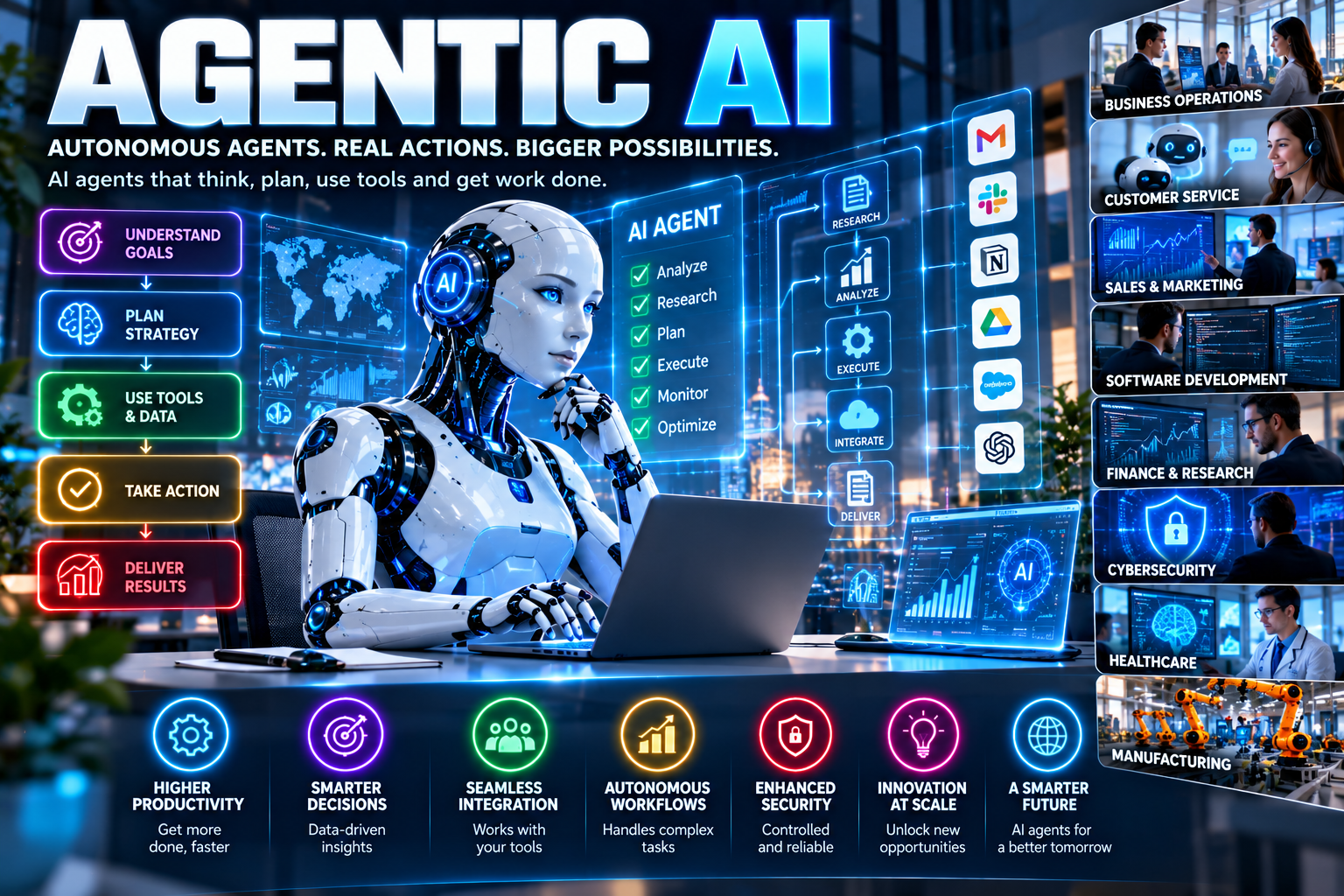
Artificial intelligence is moving into a new phase. Traditional AI systems can answer questions, analyze information, generate content, and make predictions, while a newer category known as Agentic AI is designed to go further by planning tasks, using tools, interacting with software, and taking actions to achieve defined goals.
Agentic AI is becoming an important area of research and business development because it changes the role of AI from simply providing information to actively participating in workflows.
The OECD's 2026 research describes agentic AI as an emerging area with systems capable of autonomous or semi-autonomous action, while NIST describes agentic AI as systems capable of independently making decisions, adapting to environments, and interacting dynamically with users and systems.
What Is Agentic AI?
Agentic AI refers to AI systems that can pursue goals through multiple steps rather than simply responding to a single instruction.
A conventional chatbot might answer:
"What are the latest sales figures?"
An agentic system could potentially retrieve the relevant data, analyze it, identify significant changes, prepare a report, and send the report to an authorized person.
The key difference is action.
Agentic AI can combine capabilities such as:
Reasoning
Planning
Memory
Tool use
Data retrieval
Decision-making
Adaptation
Task execution
Interaction with software
NIST describes AI agents as systems capable of autonomous decision-making and action with limited human supervision to accomplish complex goals.
How Is Agentic AI Different From Traditional AI?
Traditional AI systems are often designed to perform specific tasks.
For example:
A recommendation engine suggests products.
A chatbot answers questions.
A fraud model identifies suspicious transactions.
A language model generates text.
Agentic AI can combine several capabilities into a longer workflow.
An agent may receive a goal, determine the steps required, use available tools, evaluate results, adjust its approach, and continue until the task is completed or human intervention is required.
This does not mean every AI agent is fully autonomous. Many systems operate within clearly defined permissions and require human approval for important actions.
How Agentic AI Works
An agentic AI system typically combines several components.
1. AI Model
A large language model or another AI model provides reasoning, language understanding, planning, and decision-making capabilities.
2. Goals
The system receives an objective that defines what it is expected to accomplish.
3. Memory and Context
The agent may retain relevant information during a task or access authorized information from databases and business systems.
4. Tools
Agents can connect to tools such as:
Search systems
Databases
APIs
Email
Calendars
Business software
Code environments
Analytics platforms
5. Planning
The agent determines which actions may be necessary to achieve the goal.
6. Execution
The system performs approved actions through connected tools.
7. Feedback
The agent evaluates the results and may adjust its next steps.
This creates a loop:
Goal → Plan → Act → Observe → Evaluate → Act Again
Agentic AI and AI Agents
The terms "agentic AI" and "AI agents" are closely related but can be used somewhat differently.
An AI agent is generally a software system designed to act toward a goal.
Agentic AI describes the broader capability or behavior of systems that can reason, plan, adapt, and act with some degree of autonomy.
The OECD notes that definitions vary across research and industry, but common characteristics include autonomy, goal-directed behavior, environmental interaction, planning, adaptation, and action.
Agentic AI in Business
Businesses are among the most important potential users of agentic AI.
An enterprise agent could potentially work across multiple business systems to perform tasks that previously required several manual steps.
Examples include:
Preparing reports
Researching customers
Updating CRM records
Scheduling meetings
Processing documents
Supporting employees
Analyzing business data
Managing routine workflows
Assisting software development
NIST has specifically identified enterprise AI agents for workforce efficiency, security, and software development as potential real-world use cases.
Agentic AI in Customer Service
Customer service is a natural application for AI agents.
A basic chatbot may answer frequently asked questions. An agentic customer-service system could potentially:
Understand a customer's request.
Retrieve account information.
Check an order or service status.
Identify the relevant policy.
Recommend an action.
Complete an authorized transaction.
Document the interaction.
Escalate the issue when human assistance is required.
This can potentially reduce repetitive work while allowing human representatives to focus on complex situations.
Agentic AI in Sales
Sales teams can use AI agents to support prospect research and administrative tasks.
An agent could potentially:
Research a company
Analyze public information
Prepare an account brief
Update a CRM
Draft personalized outreach
Schedule meetings
Summarize previous conversations
Human sales professionals can then review important information and maintain the customer relationship.
Agentic AI in Marketing
Marketing workflows often contain repetitive research and content tasks.
Agentic AI can potentially assist with:
Market research
Competitor analysis
Content planning
Campaign analysis
Audience research
SEO research
Social-media workflows
Performance reporting
A marketing agent could gather information from approved sources, analyze campaign data, prepare recommendations, and create a report for human review.
Agentic AI in Software Development
Software engineering is another important area for AI agents.
Agents can potentially:
Read code
Identify bugs
Write code
Run tests
Debug problems
Review changes
Update documentation
Create pull requests
Stanford's 2026 AI Index reported major progress in AI agents completing computer-based tasks, although agents still failed a substantial share of structured benchmark attempts.
This illustrates an important point: increasing capability does not eliminate the need for testing and human oversight.
Agentic AI in Cybersecurity
AI agents can also assist cybersecurity teams.
Potential applications include:
Investigating security alerts
Analyzing logs
Identifying suspicious activity
Researching vulnerabilities
Preparing incident reports
Recommending defensive actions
Automating selected response procedures
NIST has identified AI-agent security as a distinct area requiring attention because agents can interact with data, tools, and applications.
An agent with excessive permissions could potentially create significant risks, making authorization and identity controls especially important.
Agentic AI in Finance
Financial organizations can use agents for selected analytical and administrative processes.
Potential applications include:
Financial research
Document analysis
Expense processing
Report preparation
Risk monitoring
Fraud investigation
Compliance support
Customer-service workflows
Because financial decisions can have significant consequences, organizations may require strong controls and human review.
Agentic AI in Healthcare
Healthcare organizations may eventually use AI agents for administrative and research workflows.
Potential applications include:
Scheduling
Document organization
Research assistance
Patient communication
Medical literature analysis
Administrative support
Clinical workflow assistance
High-impact healthcare applications require particularly careful validation, privacy protections, authorization, and professional oversight.
Multi-Agent AI Systems
Some advanced systems use multiple AI agents instead of one.
For example, a business workflow might contain:
A research agent
An analysis agent
A writing agent
A verification agent
A reporting agent
Each agent can specialize in a different part of the workflow.
A coordinator system can then manage the overall process.
Multi-agent architectures may be useful for complex tasks, but they can also increase system complexity and make monitoring more difficult.
Agentic AI and Automation
Traditional automation generally follows predefined workflows.
For example:
If an invoice arrives → extract the information → enter it into the accounting system.
Agentic automation can potentially handle less structured situations.
For example:
Review incoming invoices, identify unusual cases, determine what information is missing, retrieve authorized records, and prepare exceptions for human review.
This flexibility is one reason agentic AI is attracting attention across enterprise environments.
Agentic AI and Productivity
One of the major promises of agentic AI is increased productivity.
Instead of asking an employee to perform ten individual actions, a user may eventually be able to provide a goal and allow an agent to handle several steps.
Potential benefits include:
Less repetitive work
Faster information processing
Reduced administrative workload
Faster research
Improved workflow coordination
More scalable operations
However, productivity gains depend on reliability, integration, data quality, and how well organizations redesign workflows around AI.
The Security Challenge
Agentic AI creates a new security problem because agents can potentially take actions, not simply generate information.
A traditional AI assistant may provide an incorrect answer.
An agent with system access could potentially make an incorrect change.
For example, an improperly configured agent could:
Send the wrong email
Modify a database
Delete information
Share sensitive data
Change a system configuration
Use unauthorized credentials
NIST has emphasized that AI agents require appropriate identity and authorization controls because they may access diverse data, tools, and applications.
Agent Identity and Authorization
As AI agents become more capable, organizations need to determine:
Who is the agent?
What is it allowed to access?
What actions can it perform?
Who authorized those actions?
Can the organization audit what happened?
NIST's 2026 work on agent identity and authorization specifically examines identification, authorization, auditing, non-repudiation, and controls related to agent security.
This could become an important part of enterprise cybersecurity.
Human Oversight
Human oversight remains important, particularly when agents perform high-impact actions.
Organizations can design different levels of autonomy.
Human Approval
The agent prepares an action, but a person must approve it.
Human-on-the-Loop
The agent operates automatically while humans monitor performance and can intervene.
Restricted Autonomy
The agent can perform specific low-risk actions but cannot access sensitive systems.
Higher Autonomy
The agent can execute broader workflows under predefined policies and controls.
The appropriate level depends on the task, potential consequences, and organization's risk tolerance.
Challenges of Agentic AI
Agentic AI has several technical and organizational challenges.
Reliability
Agents may make incorrect decisions or take inappropriate actions.
Hallucinations
AI models can produce false information that an agent might use in a workflow.
Security
Connected agents create additional attack surfaces.
Permissions
Excessive access can increase the potential impact of mistakes or attacks.
Privacy
Agents may interact with sensitive organizational and personal data.
Monitoring
Organizations need ways to understand what agents are doing and why.
Integration
Agents must work reliably with existing software and data systems.
Cost
Complex agentic systems can require substantial computing resources and engineering effort.
Agentic AI and Responsible AI
Responsible AI becomes even more important when systems can act independently.
Organizations should consider:
Transparency
Accountability
Security
Privacy
Fairness
Reliability
Human oversight
Auditability
The OECD published its Due Diligence Guidance for Responsible AI in 2026, providing practical guidance for enterprises using AI in line with responsible business conduct and AI principles.
How Businesses Can Implement Agentic AI
Organizations interested in agentic AI can begin with controlled use cases.
Step 1: Identify a Specific Problem
Start with a business workflow rather than simply adopting AI because it is new.
Step 2: Define the Agent's Goal
Clearly establish what the agent is expected to accomplish.
Step 3: Limit Permissions
Give the agent only the access it actually needs.
Step 4: Connect Approved Tools
Allow access only to trusted applications, databases, APIs, and systems.
Step 5: Establish Human Review
Require approval for high-impact actions.
Step 6: Test the System
Evaluate accuracy, reliability, security, and failure modes.
Step 7: Monitor Activity
Maintain logs and audit agent actions.
Step 8: Measure Business Value
Track productivity, cost, quality, response time, and other relevant metrics.
Step 9: Expand Gradually
Increase autonomy only after the system demonstrates reliable performance.
The Future of Agentic AI
Agentic AI is still developing, but research and enterprise experimentation are accelerating.
The OECD published a dedicated paper on Agentic AI in Organisations in September 2026, examining real-world deployments, benefits, challenges, and governance approaches based on practitioner interviews.
NIST also launched an AI Agent Standards Initiative in 2026 focused on secure, interoperable, and trustworthy AI-agent ecosystems.
These developments suggest that the future of agentic AI will depend not only on improving model capabilities but also on building reliable standards, security mechanisms, identity systems, evaluation methods, and governance frameworks.
Agentic AI vs. Traditional Automation
Feature | Traditional Automation | Agentic AI |
|---|---|---|
Workflow | Predefined | Can adapt |
Decision-making | Rule-based | AI-assisted |
Flexibility | Limited | Higher |
Tool use | Preconfigured | Can dynamically select tools |
Adaptation | Usually limited | Can respond to changing context |
Human input | Often required at defined steps | Can vary by task |
Complexity | Best for predictable processes | Potentially useful for dynamic workflows |
Risk | Usually easier to constrain | Requires stronger controls |
Agentic AI does not necessarily replace traditional automation. In many organizations, both approaches can work together.
Final Thoughts
Agentic AI represents an important evolution in artificial intelligence.
Instead of simply answering questions or generating content, AI agents can potentially plan, use tools, interact with software, and complete multi-step tasks toward defined goals.
This creates opportunities across customer service, sales, marketing, software development, cybersecurity, finance, healthcare, research, and business operations.
At the same time, greater autonomy introduces greater responsibility.
Organizations need to carefully manage identity, authorization, data access, security, monitoring, testing, and human oversight. NIST's current work emphasizes that secure agent adoption requires attention to identity and authorization alongside the underlying AI technology.
The future of Agentic AI will therefore depend on two things developing together: more capable AI systems and stronger mechanisms for controlling how those systems act.
FAQs About Agentic AI
What is Agentic AI?
Agentic AI refers to AI systems capable of pursuing goals through planning, reasoning, tool use, adaptation, and autonomous or semi-autonomous action.
What is an AI agent?
An AI agent is a software system that can perceive information, reason about a goal, use tools, and take actions to accomplish a task.
How is Agentic AI different from generative AI?
Generative AI primarily creates outputs such as text, images, or code. Agentic AI can use AI models as part of a system that plans and executes multi-step actions.
Can Agentic AI work without humans?
Some agents can operate with limited human supervision, but the appropriate level of autonomy depends on the task and its potential consequences.
What are common Agentic AI use cases?
Common and emerging use cases include customer service, research, software development, cybersecurity, sales, marketing, data analysis, scheduling, and business-process automation.
Is Agentic AI safe?
Agentic AI can be designed with security and governance controls, but autonomous systems introduce additional risks involving permissions, data access, reliability, and unintended actions.
What is multi-agent AI?
Multi-agent AI uses multiple specialized agents that collaborate on different parts of a larger task.
What is the future of Agentic AI?
Agentic AI is expected to become increasingly integrated with business software, digital services, cybersecurity systems, research environments, and automated workflows as reliability, interoperability, identity, and security improve.