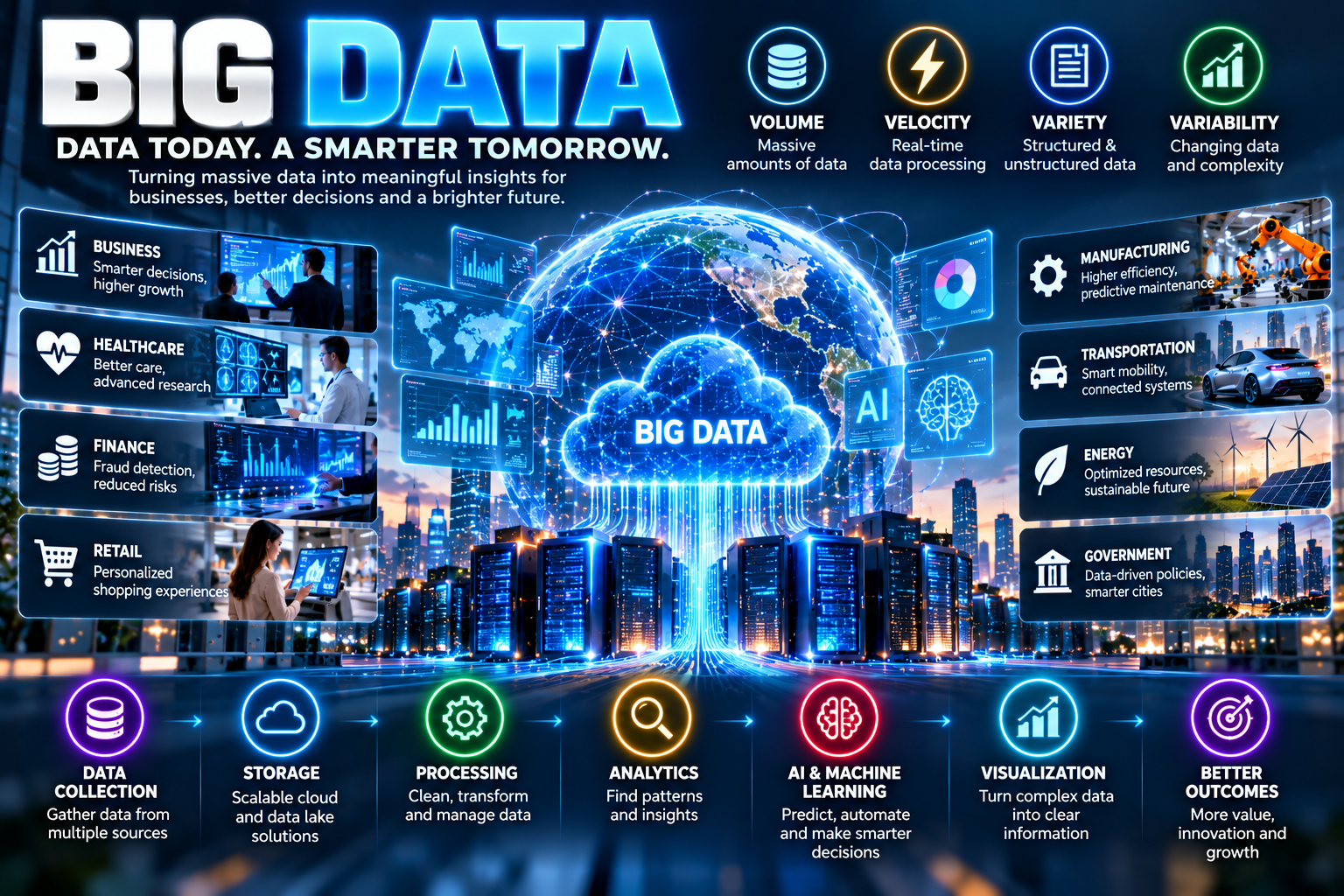
Data has become one of the most important resources in the modern digital economy. Businesses, governments, healthcare organizations, financial institutions, retailers, manufacturers, and technology companies generate enormous amounts of information every day.
From online searches and social media interactions to financial transactions, connected devices, mobile applications, sensors, websites, and enterprise systems, modern organizations continuously create and collect data.
This enormous and complex collection of information is commonly described as Big Data.
According to the National Institute of Standards and Technology (NIST), Big Data refers to extensive datasets characterized by factors such as volume, variety, velocity, and variability that require scalable architectures for efficient storage, processing, and analysis.
Big Data is not simply about having a large database. It is about developing the infrastructure, technologies, analytical methods, and governance practices needed to turn enormous and diverse datasets into useful information.
What Is Big Data?
Big Data describes datasets that are too large, fast-changing, diverse, or complex to be handled efficiently using traditional data-processing approaches.
These datasets can include:
Customer transactions
Website activity
Social media interactions
Video and audio
Images
Financial records
Sensor information
GPS and location data
Machine-generated information
Healthcare records
IoT device data
Business databases
Scientific research data
Big Data becomes valuable when organizations can analyze these datasets to identify patterns, discover relationships, predict trends, and support better decisions.
NIST's Big Data framework emphasizes scalable architectures and technologies that allow organizations to process extensive datasets across different computing environments.
The Main Characteristics of Big Data
Big Data is often explained through several characteristics known as the Vs of Big Data.
1. Volume
Volume refers to the enormous quantity of data being generated and stored.
Large companies may process millions or billions of records involving customers, transactions, devices, products, and operations.
Traditional databases may struggle when datasets become extremely large, making scalable storage and processing systems increasingly important.
2. Velocity
Velocity refers to the speed at which data is created, transmitted, and processed.
Examples include:
Real-time financial transactions
Website clicks
Online purchases
GPS signals
Social media activity
Industrial sensors
Security alerts
Organizations increasingly need systems capable of analyzing information while it is being generated rather than waiting for large batches of data to accumulate.
3. Variety
Data comes in many different formats.
Structured data can be stored in traditional tables and databases, while unstructured data can include videos, images, documents, emails, audio, and social media content.
Big Data technologies help organizations combine information from multiple sources and formats.
4. Variability
Data can change in volume, format, meaning, and behavior over time.
A business may experience seasonal increases in customer activity, while an online platform can suddenly receive millions of interactions following a major event.
Managing this variability requires flexible infrastructure.
What Is Big Data Analytics?
Big Data analytics involves using technologies and analytical techniques to examine large datasets and discover meaningful insights.
The OECD describes big data analysis as the use of technologies and techniques such as data mining and machine learning to analyze large datasets from an organization's own sources or external sources.
Big Data analytics can involve:
Statistical analysis
Data mining
Machine learning
Predictive analytics
Artificial intelligence
Natural language processing
Data visualization
Pattern recognition
Anomaly detection
The goal is not simply to collect more information. The goal is to extract useful knowledge from it.
How Big Data Works
A typical Big Data environment involves several stages.
Data Collection
The first step is collecting information from multiple sources.
Businesses may gather data from websites, applications, customer relationship systems, payment platforms, sensors, social media, and internal databases.
Data Storage
Large datasets require scalable storage infrastructure.
Organizations may use cloud platforms, distributed databases, data lakes, data warehouses, and other systems designed to handle large volumes of information.
Data Processing
Raw data often needs to be cleaned, transformed, organized, and processed before it can be analyzed.
Processing may happen in batches or in real time depending on the application.
Data Analysis
Analytical tools examine the information to identify patterns, relationships, trends, and anomalies.
Data Visualization
Dashboards, charts, maps, and reports can make complex datasets easier for people to understand.
Decision-Making
The final stage is using insights to support business, scientific, operational, or policy decisions.
Big Data and Artificial Intelligence
Big Data and artificial intelligence are closely connected.
AI systems often require large amounts of high-quality data for training, evaluation, prediction, and decision-making.
At the same time, AI can help organizations analyze datasets that would be difficult for humans to examine manually.
This creates a cycle:
More Data → Better Analysis → Better Insights → Better Decisions
However, simply having massive amounts of data does not guarantee better AI results. Data quality, relevance, governance, security, and appropriate processing are also important.
In 2026, data infrastructure is increasingly important for AI and advanced analytics. The OECD highlights the importance of high-quality data infrastructure for combining datasets, supporting advanced analytics, machine learning, and large-scale computing.
Big Data in Business
Businesses use Big Data to understand customers, improve operations, identify opportunities, and manage risks.
Customer Analytics
Companies can analyze purchasing behavior, browsing activity, customer feedback, and engagement patterns.
This can help businesses understand what customers want and how their behavior changes.
Marketing
Big Data can support:
Audience segmentation
Campaign analysis
Customer behavior analysis
Personalized recommendations
Advertising optimization
Marketing attribution
Sales
Sales teams can analyze customer histories, purchasing patterns, leads, and market data to identify potential opportunities.
Operations
Organizations can use data to identify inefficient processes, monitor performance, and optimize resources.
Risk Management
Financial institutions and other organizations can analyze large datasets to identify unusual patterns and potential risks.
Big Data in Healthcare
Healthcare generates enormous amounts of information.
Examples include:
Electronic health records
Medical imaging
Laboratory results
Wearable-device information
Genomic data
Clinical research
Hospital operations
Big Data analytics can support medical research, operational planning, population-health analysis, and the evaluation of treatments.
However, healthcare data can contain highly sensitive personal information. Strong privacy, security, access controls, and governance are therefore essential.
The OECD emphasizes that health data can support healthcare quality and scientific innovation while requiring appropriate governance to manage privacy and security risks.
Big Data in Finance
Financial organizations generate massive amounts of transaction and market information.
Big Data can be used for:
Fraud detection
Risk analysis
Market research
Customer analytics
Credit assessment
Transaction monitoring
Algorithmic analysis
Real-time analysis can be particularly valuable when financial institutions need to identify unusual transactions or rapidly changing market conditions.
Big Data in Retail and E-Commerce
Retailers can analyze customer activity across physical stores, websites, applications, and digital platforms.
Big Data can help businesses understand:
Product demand
Customer preferences
Pricing behavior
Inventory levels
Shopping patterns
Seasonal trends
Supply-chain performance
Recommendation systems are another major application. Online platforms can analyze previous interactions to suggest products, content, or services that may be relevant to users.
Big Data in Manufacturing
Manufacturing companies increasingly use sensors and connected equipment to collect information from production systems.
This can support:
Predictive maintenance
Quality control
Production optimization
Equipment monitoring
Supply-chain management
Energy management
Instead of waiting for equipment to fail, organizations can analyze sensor data for patterns that may indicate potential problems.
Big Data and the Internet of Things
The Internet of Things (IoT) connects physical devices to digital networks.
Examples include:
Smart appliances
Industrial sensors
Connected vehicles
Wearable devices
Smart buildings
Energy systems
Security equipment
These devices can continuously generate information.
When combined with Big Data infrastructure, IoT information can help organizations monitor systems and understand activity at large scale.
Big Data and Cloud Computing
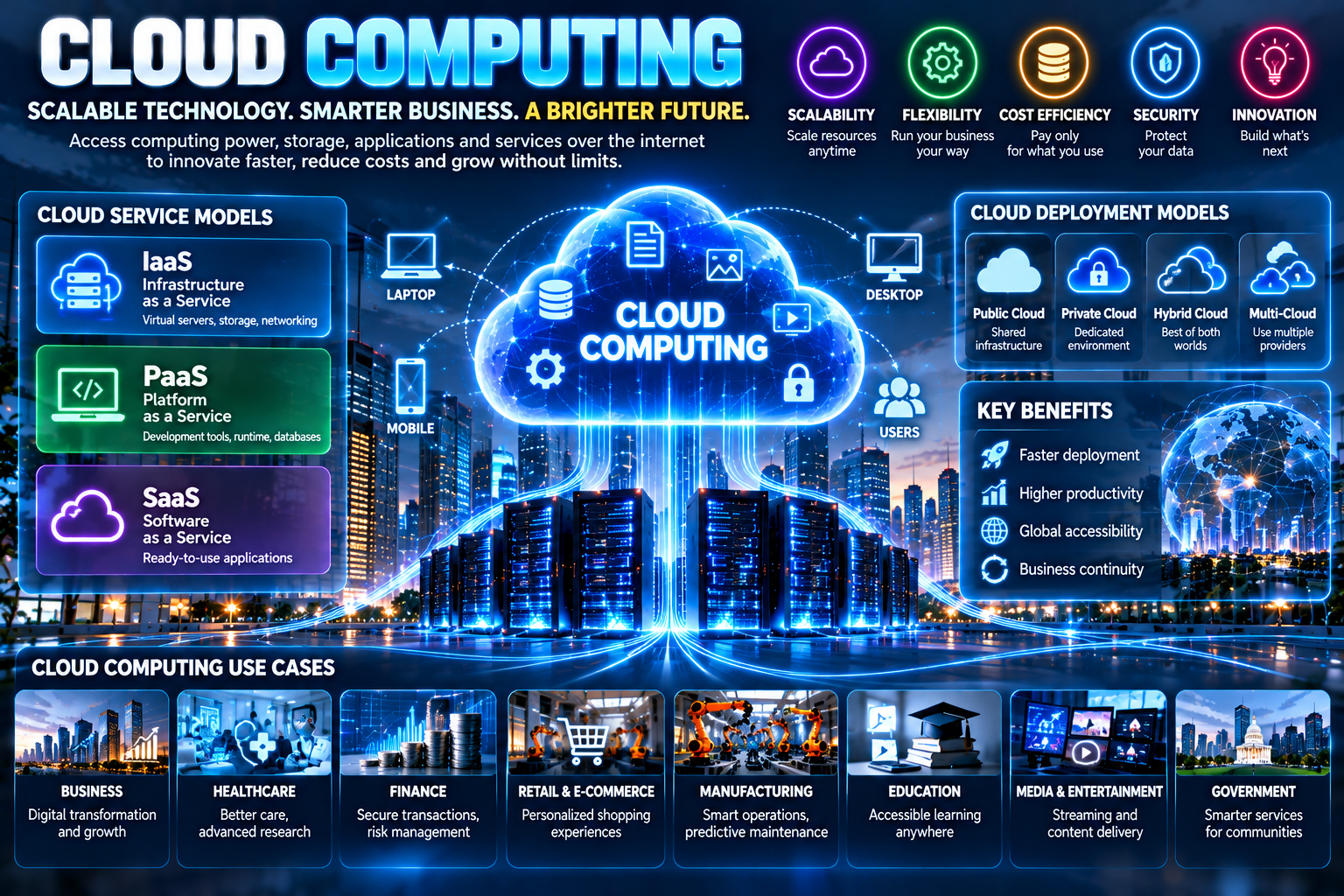
Cloud computing has become an important part of modern Big Data infrastructure.
Cloud platforms can provide scalable computing power and storage without requiring organizations to maintain all infrastructure themselves.
This allows businesses to increase or decrease resources according to their requirements.
Modern data strategies may also combine cloud, private infrastructure, and on-premises systems.
IBM's 2026 discussion of data trends highlights hybrid-cloud architectures, zero-copy data access, real-time processing, and AI-ready data as important areas for enterprise data infrastructure.
Big Data and Data Lakes
A data lake is a storage environment designed to hold large amounts of raw data in different formats.
Organizations can store structured, semi-structured, and unstructured information and process it for different analytical applications.
Data lakes can be useful when organizations need flexible access to large and diverse datasets.
However, poorly managed data lakes can become difficult to navigate. Strong metadata, organization, governance, and security are therefore important.
Big Data and Data Warehouses
Data warehouses are generally designed for structured data and analytical workloads.
They can help organizations combine information from different business systems and create consistent reporting environments.
Many organizations use both data warehouses and data lakes depending on their analytical requirements.
Data Quality Matters
More data does not automatically mean better insights.
Poor-quality information can contain:
Duplicate records
Missing values
Incorrect information
Outdated information
Inconsistent formats
Biased datasets
If poor-quality data is used for analytics or AI, the resulting conclusions can also be unreliable.
This makes data quality one of the most important components of a successful Big Data strategy.
Big Data Governance
Data governance refers to the policies, processes, technologies, and responsibilities used to manage data.
Good governance addresses issues such as:
Data ownership
Data quality
Privacy
Security
Access control
Compliance
Data retention
Metadata
Data sharing
The OECD describes data governance as encompassing technical, policy, and regulatory frameworks for managing data throughout its lifecycle.
Big Data Security
Large data environments can become attractive targets for cyberattacks.
Organizations must protect data against:
Unauthorized access
Data breaches
Malware
Insider threats
Account compromise
Data theft
Ransomware
Security measures can include encryption, identity management, authentication, monitoring, access controls, network security, and incident-response procedures.
Privacy and Big Data
Big Data can create privacy challenges because datasets may contain information about individuals.
Organizations should carefully consider:
What data is collected
Why it is collected
How long it is retained
Who can access it
How it is shared
How it is protected
Responsible data practices can help organizations use information while reducing unnecessary privacy risks.
Challenges of Big Data
Despite its potential, Big Data creates several challenges.
High Infrastructure Costs
Large-scale storage and processing can require significant investments in technology and skilled personnel.
Data Fragmentation
Information may be distributed across multiple systems, departments, applications, and cloud environments.
Skills Shortage
Organizations need professionals who understand data engineering, analytics, statistics, machine learning, cybersecurity, and governance.
Security Risks
The larger the data environment, the more complex security management can become.
Privacy Concerns
Organizations must manage personal and sensitive information responsibly.
Data Quality
Incorrect or incomplete information can undermine analytical results.
Complexity
Large data environments can become difficult to manage without clear architecture and governance.
Big Data and Real-Time Analytics
Traditional analytics often focuses on historical information.
Real-time analytics focuses on analyzing information as it arrives.
This can be useful for applications such as:
Fraud detection
Cybersecurity
Online recommendations
Financial monitoring
Industrial systems
Logistics
Connected vehicles
Customer support
As organizations increasingly operate digital services around the clock, real-time data processing can become an important capability.
Big Data and Predictive Analytics
Predictive analytics uses historical and current information to identify patterns that may help estimate future outcomes.
Businesses can use predictive analytics for:
Demand forecasting
Customer behavior
Equipment maintenance
Risk assessment
Inventory planning
Sales forecasting
Predictions are not guarantees. Their reliability depends on the quality of the data, analytical methods, assumptions, and changing conditions.
The Future of Big Data
The future of Big Data is increasingly connected to artificial intelligence, automation, cloud computing, edge computing, and advanced analytics.
Organizations are working toward data environments where information can be accessed and analyzed more efficiently across systems.
AI agents and generative AI are also increasing the importance of well-organized enterprise data. IBM's 2026 analysis notes that fragmented data, governance gaps, and limited access to structured and unstructured information can make it difficult for organizations to move AI projects from experimentation into production.
The future may therefore be less about simply collecting more data and more about making existing data accessible, trustworthy, secure, interoperable, and useful.
How Businesses Can Build a Big Data Strategy
Organizations considering Big Data can start with a structured approach:
Define business objectives
Determine what problems the organization wants data to solve.Identify data sources
Map internal and external sources.Improve data quality
Remove duplicates and address missing or inconsistent information.Build scalable infrastructure
Select appropriate storage and computing technologies.Establish governance
Define ownership, access, privacy, security, and quality standards.Develop analytics capabilities
Use statistical analysis, machine learning, visualization, and AI where appropriate.Measure outcomes
Connect data projects to measurable business or operational objectives.Continuously improve
Review performance, costs, security, and data quality as requirements evolve.
Big Data vs Traditional Data
Feature | Traditional Data | Big Data |
|---|---|---|
Scale | Usually smaller | Very large |
Sources | Often limited | Multiple and diverse |
Formats | Mostly structured | Structured and unstructured |
Processing | Conventional systems | Scalable/distributed systems |
Analysis | Standard reporting | Advanced analytics and AI |
Speed | Often batch-based | Batch and real-time |
Infrastructure | Traditional databases | Cloud, distributed and scalable architectures |
Final Thoughts
Big Data has transformed the way organizations collect information, understand customers, manage operations, identify risks, and develop new products and services.
Its importance comes not from the amount of data alone but from the ability to transform complex datasets into useful insights.
As AI, IoT, cloud computing, and real-time analytics continue to develop, organizations will increasingly need strong data foundations. Scalable infrastructure, high-quality information, responsible governance, privacy protection, and cybersecurity will remain central to successful Big Data strategies.
The future of Big Data is ultimately about turning massive amounts of information into better knowledge, smarter decisions, and more useful digital services.
FAQs About Big Data
What is Big Data?
Big Data refers to extensive datasets characterized by factors such as volume, variety, velocity, and variability that require scalable technologies for storage, processing, and analysis.
What are the main characteristics of Big Data?
The commonly discussed characteristics include volume, velocity, variety, and variability. Other frameworks may add additional characteristics depending on the application.
What is Big Data analytics?
Big Data analytics involves using technologies and techniques such as data mining, machine learning, statistical analysis, and other analytical methods to extract insights from large datasets.
How is Big Data used in business?
Businesses use Big Data for customer analytics, marketing, sales, fraud detection, forecasting, operations, supply-chain management, personalization, and strategic decision-making.
Is Big Data the same as AI?
No. Big Data refers to large and complex datasets and the infrastructure used to manage them. AI refers to systems and techniques that perform tasks such as prediction, classification, reasoning, or generation. AI can use Big Data, but the two concepts are not the same.
Why is data governance important?
Data governance helps organizations manage data quality, access, security, privacy, compliance, and responsible use throughout the data lifecycle.
What is the future of Big Data?
Big Data is expected to become increasingly connected with AI, real-time analytics, cloud computing, IoT, advanced data infrastructure, and automated data processing.