Data has become one of the most valuable resources in the modern digital economy. Every day, people create enormous amounts of information through smartphones, websites, social media, online purchases, financial transactions, connected devices, applications, and business systems.
This massive and constantly growing collection of information is known as Big Data.
Big Data is more than simply having a large amount of information. It involves collecting, storing, processing, analyzing, and understanding data that can be too large, complex, or rapidly changing for traditional systems to handle efficiently.
Organizations across industries are using Big Data to understand customers, improve operations, predict trends, reduce risks, develop products, and make better decisions. Combined with artificial intelligence and machine learning, Big Data is becoming an increasingly powerful force behind digital transformation.
What Is Big Data?
Big Data refers to extremely large and complex datasets that are generated at high speed and from many different sources.
Traditional databases can manage structured information such as customer names, product prices, and transaction records. Big Data environments may also include emails, images, videos, social media posts, sensor readings, website activity, location information, machine data, and other forms of digital information.
The value of Big Data does not come from its size alone. The real opportunity is discovering useful patterns and insights within that information.
For example, a retailer can analyze millions of customer interactions to understand purchasing behavior. A manufacturer can examine equipment data to identify potential maintenance problems. A financial institution can analyze transaction patterns to identify unusual activity.
The Five Vs of Big Data
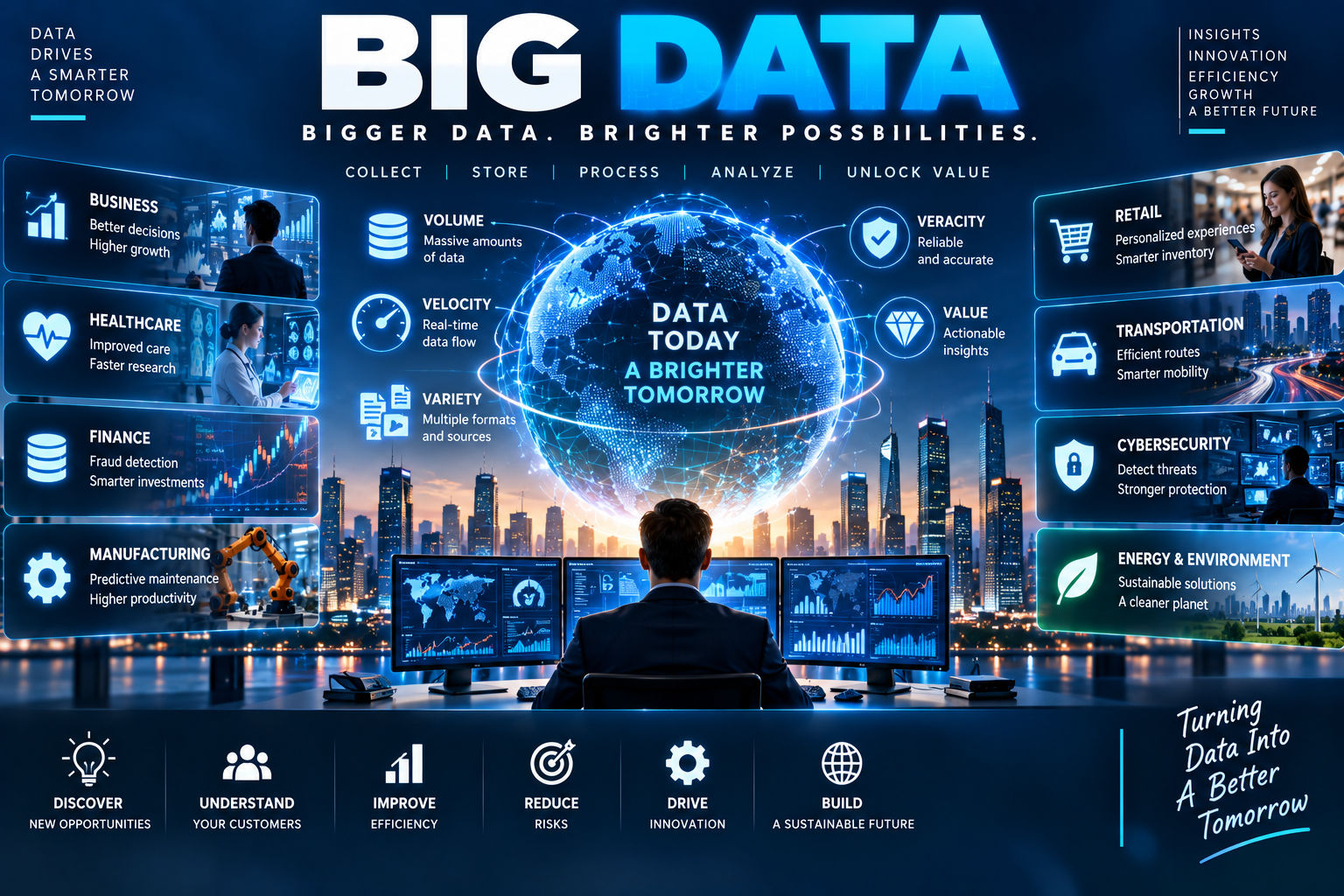
Big Data is often described using five major characteristics known as the 5 Vs.
1. Volume
Volume refers to the enormous quantity of data being generated and stored.
Organizations may manage terabytes, petabytes, or even larger quantities of information.
2. Velocity
Velocity describes the speed at which data is created, collected, and processed.
Financial transactions, social media activity, sensors, and online interactions can generate information continuously.
3. Variety
Data comes in many formats.
Structured data can be stored in tables and databases, while unstructured data may include text, images, audio, video, documents, and social media content.
4. Veracity
Veracity refers to the reliability and quality of data.
Incorrect, incomplete, duplicated, or misleading information can produce poor analysis. Businesses therefore need strong data-quality processes.
5. Value
Value represents the useful insights and outcomes that organizations can obtain from their data.
Collecting enormous amounts of information has little benefit if the data cannot support meaningful decisions.
Why Is Big Data Important?
Big Data allows organizations to make decisions based on evidence rather than assumptions.
Businesses can analyze customer behavior, market trends, operational performance, and financial information to identify opportunities and risks.
Data can also help organizations understand what is working and what needs improvement.
For example, a company may discover that customers frequently abandon an online shopping cart because of a complicated checkout process. By analyzing customer behavior, the company can identify the problem and improve the purchasing experience.
Big Data can therefore turn everyday digital activity into actionable business intelligence.
Big Data and Artificial Intelligence
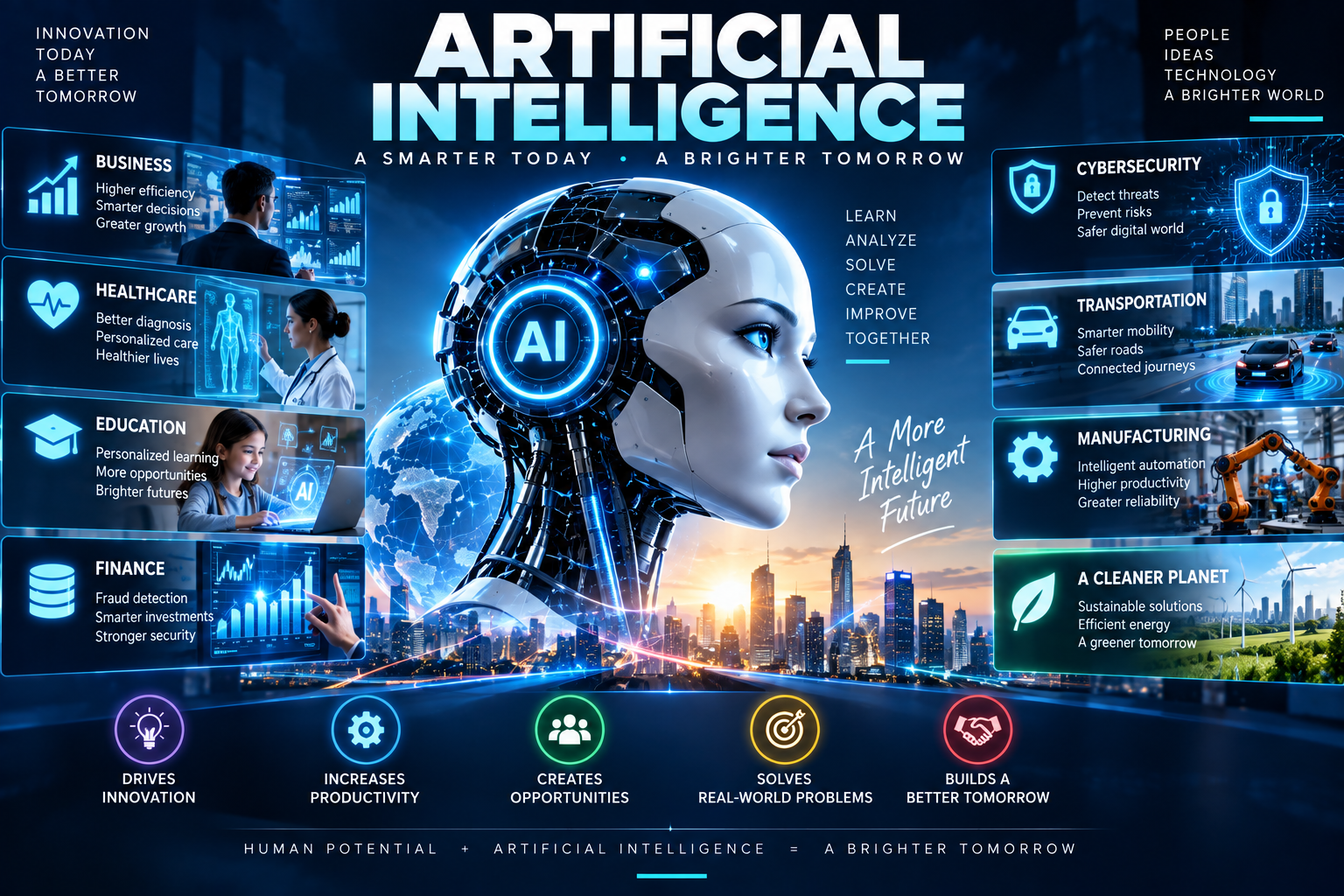
Artificial intelligence and Big Data are closely connected.
Many AI and machine-learning systems require large quantities of data for training, evaluation, and improvement.
Big Data provides the information, while AI can help identify patterns and generate predictions from that information.
For example, a business may collect years of sales data. A machine-learning model can analyze the information and identify patterns associated with seasonal demand.
The combination of Big Data and AI can enable businesses to automate analysis and make increasingly sophisticated predictions.
Big Data in Business
Businesses across industries use Big Data for many purposes.
Companies can analyze sales data to understand product performance. Customer data can reveal preferences and purchasing patterns. Operational data can help identify inefficiencies.
Marketing departments can use data to understand audiences and evaluate campaigns.
Management teams can use analytics to monitor business performance and identify emerging trends.
The ability to access relevant information quickly can provide organizations with a competitive advantage.
However, data should not replace human judgment. Business leaders still need to understand context, risks, market conditions, and customer needs.
Big Data in Retail
Retail is one of the clearest examples of Big Data in action.
Retailers collect information from online stores, physical locations, loyalty programs, mobile applications, advertising campaigns, and customer interactions.
Analyzing this information can help retailers understand what products customers are interested in and when demand may increase.
Big Data can also support inventory planning. If historical and current information suggests that demand for a particular product is likely to rise, retailers can adjust inventory accordingly.
Personalization is another important application. Data analysis can help businesses provide customers with more relevant product recommendations and marketing messages.
Big Data in Healthcare
Healthcare organizations generate large quantities of information through medical records, research, imaging, laboratory systems, wearable devices, and administrative processes.
Big Data analytics can help researchers identify patterns across large populations and support scientific research.
Healthcare organizations can also analyze operational data to improve scheduling, resource allocation, and administrative efficiency.
When combined with AI, large datasets may help researchers identify patterns that could support the development of new treatments or improve understanding of diseases.
However, healthcare data is highly sensitive. Privacy, security, consent, accuracy, and responsible data management are essential.
Big Data in Finance
The financial industry depends heavily on data.
Banks, investment companies, insurance providers, and other financial institutions process enormous numbers of transactions and customer interactions.
Big Data analytics can help identify unusual transaction patterns, support fraud detection, assess risks, and improve financial forecasting.
Investment professionals can analyze market information and historical data to support research and decision-making.
Financial organizations must also protect sensitive information from unauthorized access and comply with applicable regulations.
Big Data in Manufacturing
Manufacturing companies are increasingly using connected equipment and sensors to collect information from production environments.
This creates opportunities for predictive maintenance.
Instead of waiting for a machine to fail, organizations can analyze equipment data and identify patterns that may indicate a developing problem.
Big Data can also help manufacturers monitor production quality, optimize processes, reduce waste, and improve supply-chain planning.
As smart factories become more connected, data is becoming an increasingly important component of modern manufacturing.
Big Data in Transportation
Transportation networks generate huge amounts of information from vehicles, GPS systems, traffic sensors, logistics platforms, and customer activity.
Big Data can help organizations optimize routes, monitor traffic, forecast demand, and improve logistics.
Delivery companies can analyze historical information to determine efficient routes and estimate delivery times.
Public transportation authorities can use data to understand passenger demand and improve scheduling.
The combination of Big Data, AI, and connected infrastructure could create increasingly intelligent transportation systems.
Big Data and Marketing
Marketing has been transformed by data analytics.
Instead of targeting large audiences using limited information, businesses can analyze customer behavior and identify more specific groups.
Data can help marketers understand which channels generate engagement, which products attract attention, and which campaigns produce results.
Customer analytics can also support personalization.
However, businesses need to balance personalization with privacy. Customers increasingly expect companies to explain how their information is collected and used.
Responsible data practices can help maintain customer trust.
Big Data and Cybersecurity
Cybersecurity systems generate enormous amounts of information from networks, devices, applications, authentication systems, and security tools.
Analyzing this data manually can be difficult.
Big Data platforms can help security teams process large numbers of events and identify patterns that may indicate suspicious activity.
When combined with machine learning, analytics systems can potentially identify unusual behavior and prioritize security alerts.
This can help security professionals focus their attention on the most important threats.
Big Data Technologies
Organizations use a range of technologies to manage Big Data.
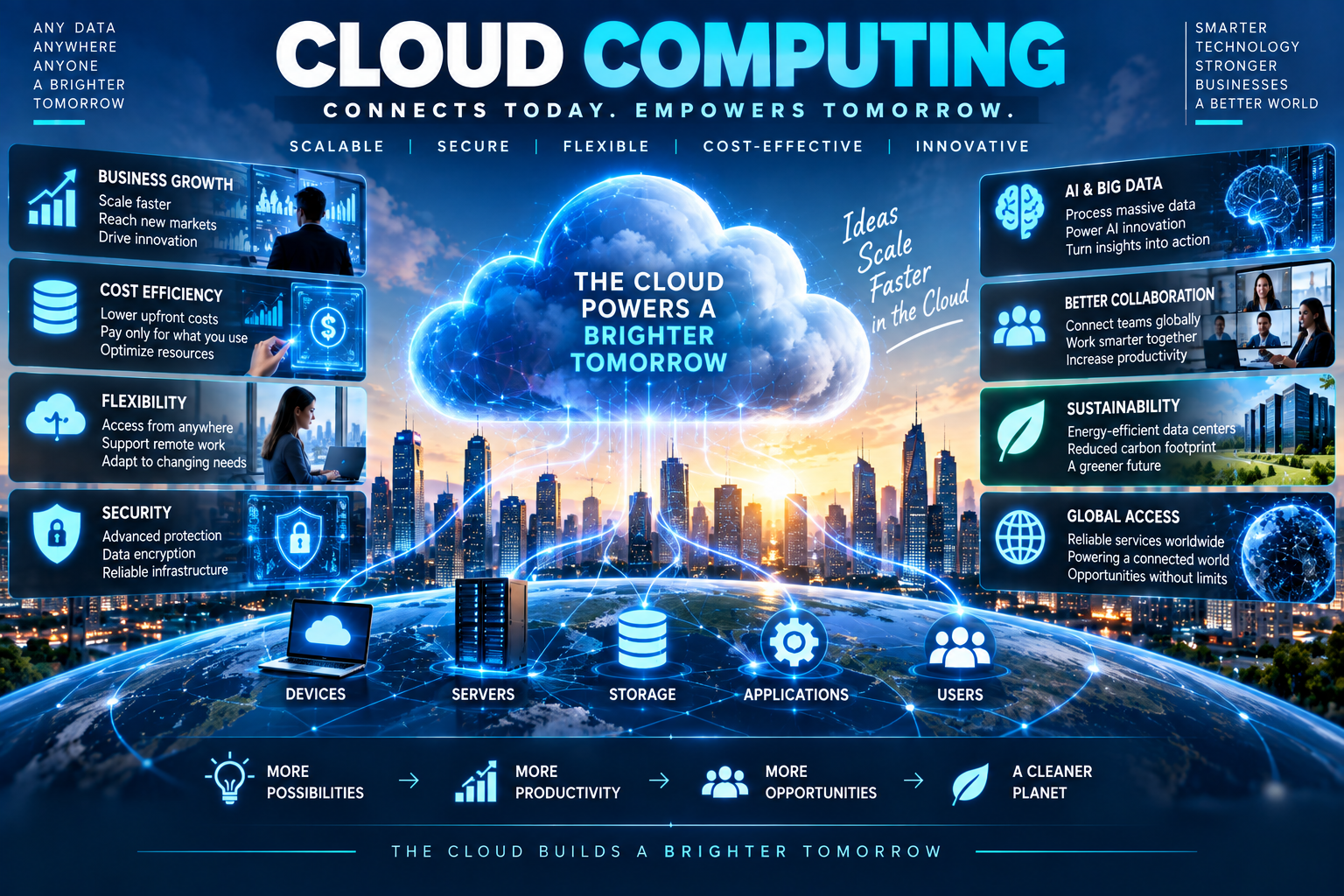
Cloud computing allows companies to store and process large quantities of information without necessarily maintaining all infrastructure themselves.
Distributed computing allows large workloads to be divided across multiple systems.
Data warehouses and data lakes provide different approaches for storing and analyzing information.
Modern analytics platforms can combine information from multiple sources and make it available to business users.
Artificial intelligence and machine learning tools can then analyze the information and generate insights.
The technology used depends on the organization's data volume, business requirements, security needs, and budget.
Challenges of Big Data
Big Data creates significant opportunities, but it also introduces challenges.
Data Quality
Poor-quality information can produce unreliable results.
Businesses need processes to identify inaccurate, duplicated, outdated, or incomplete data.
Privacy
Organizations often handle sensitive personal and business information. Data must be collected and used responsibly.
Security
Large data repositories can become attractive targets for cybercriminals. Strong access controls, encryption, monitoring, and security practices are important.
Storage and Processing
Managing enormous datasets can require significant computing resources and specialized infrastructure.
Skills
Organizations need employees who understand data engineering, analytics, statistics, AI, cybersecurity, and business strategy.
Data Silos
Information stored separately across different departments can make it difficult to develop a complete picture of the business.
Big Data and Data Privacy
As organizations collect more information, privacy has become a major concern.
Businesses need to understand what information they collect, why they collect it, how long they retain it, and who can access it.
Customers increasingly expect transparency.
Organizations should establish clear policies for data management and ensure that employees understand how sensitive information should be handled.
Privacy should be considered during the design of data systems rather than treated as an afterthought.
The Future of Big Data
The future of Big Data will be strongly connected to artificial intelligence, cloud computing, automation, and connected devices.
The growth of the Internet of Things will generate additional data from homes, factories, vehicles, healthcare devices, and infrastructure.
AI systems will increasingly analyze information in real time, allowing businesses to respond to changing conditions more quickly.
Edge computing may also become more important by allowing certain data processing to occur closer to where information is generated.
Real-time analytics could help organizations make faster decisions in areas such as logistics, cybersecurity, manufacturing, and financial services.
At the same time, data governance and privacy will become increasingly important as the volume and sensitivity of information continue to grow.
How Businesses Can Use Big Data Successfully
Organizations should begin with business objectives rather than simply collecting as much data as possible.
A company should first identify the problems it wants to solve and determine which information can help answer those questions.
Next, it should establish reliable systems for collecting, storing, securing, and analyzing data.
Organizations should also invest in employee skills and data literacy.
Most importantly, businesses should focus on turning information into action.
The goal of Big Data is not to have the largest possible dataset. The goal is to generate useful insights that improve decisions and create measurable value.
Conclusion
Big Data has become a fundamental part of the modern digital economy.
Businesses, governments, researchers, and organizations are generating and processing enormous amounts of information every day. When managed effectively, this data can reveal patterns, improve operations, support innovation, and help organizations make better decisions.
Big Data is particularly powerful when combined with artificial intelligence and machine learning. Together, these technologies can transform raw information into predictions, recommendations, and automated insights.
However, the future of Big Data is not only about technology. Data quality, privacy, security, governance, and responsible use will be equally important.
Organizations that learn how to manage data effectively while respecting privacy and maintaining trust will be better positioned to compete in an increasingly data-driven world.
Big Data is ultimately valuable because of what it enables people and organizations to understand and accomplish. The ability to transform massive amounts of information into meaningful action will remain one of the defining capabilities of the digital age.
Frequently Asked Questions About Big Data
1. What is Big Data?
Big Data refers to extremely large, complex, and rapidly generated datasets that require specialized technologies and methods to collect, store, process, and analyze.
2. What are the 5 Vs of Big Data?
The five commonly discussed characteristics are Volume, Velocity, Variety, Veracity, and Value.
3. Why is Big Data important?
Big Data helps organizations discover patterns, understand customers, improve operations, predict trends, manage risks, and make more informed decisions.
4. How is Big Data used in business?
Businesses use Big Data for marketing, customer analytics, sales forecasting, inventory management, fraud detection, operational optimization, and strategic decision-making.
5. What is the relationship between Big Data and AI?
Big Data provides large quantities of information that AI and machine-learning systems can analyze to identify patterns, make predictions, and support automated decision-making.
6. What are examples of Big Data?
Examples include social media activity, online transactions, sensor data, medical records, GPS information, website activity, financial transactions, images, videos, and business records.
7. What are the biggest challenges of Big Data?
Major challenges include data quality, privacy, cybersecurity, storage costs, processing requirements, data integration, and a shortage of specialized skills.
8. Is Big Data useful for small businesses?
Yes. Small businesses can use data analytics to understand customers, track sales, improve marketing, manage inventory, and make better operational decisions.
9. How does Big Data improve customer experience?
Businesses can analyze customer behavior and feedback to identify preferences, improve products and services, personalize experiences, and resolve recurring problems.
10. What is the future of Big Data?
Big Data is likely to become increasingly connected with AI, machine learning, cloud computing, Internet of Things devices, real-time analytics, and automation, while privacy and data governance become increasingly important.