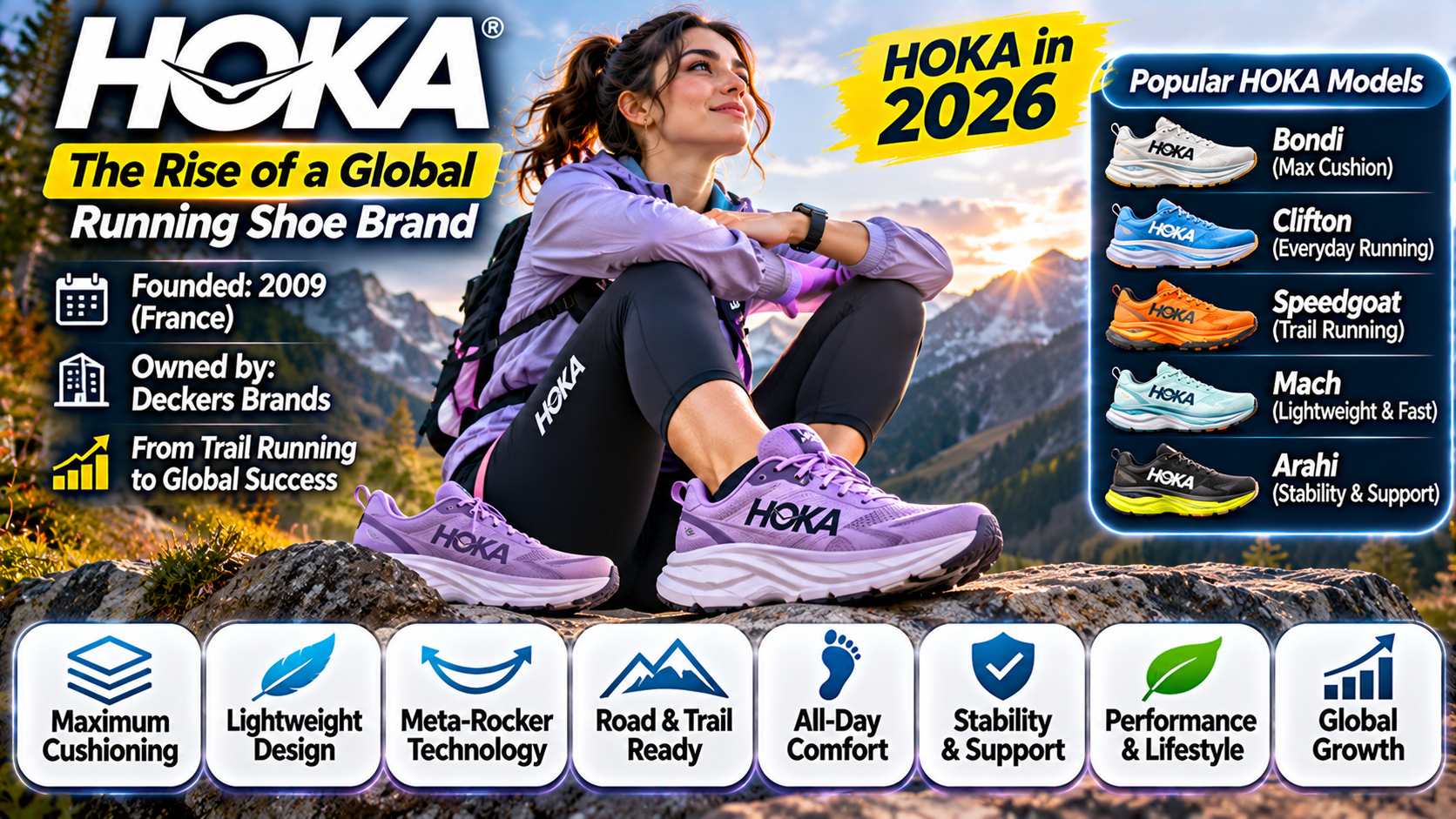
The global athletic footwear industry has changed significantly as consumers increasingly look for shoes that combine comfort, performance, durability, and modern design. Among the brands attracting attention from runners, athletes, fitness enthusiasts, and everyday consumers is HOKA.
Known for its distinctive thick midsoles, lightweight construction, and cushioned ride, HOKA has developed a strong identity in the running and outdoor footwear market. Its shoes were initially designed for demanding mountain running conditions, but the brand has expanded into road running, trail running, hiking, fitness, and lifestyle footwear.
What began as an unconventional approach to running shoe design has become an internationally recognized footwear business. In 2026, HOKA continues to compete in the premium athletic footwear market through product innovation, athlete-focused marketing, and international expansion.
This guide explores HOKA's history, popular shoe collections, technology, benefits, limitations, and business strategy.
1. What Is HOKA?
HOKA is a premium athletic footwear brand specializing in running, trail running, hiking, and lifestyle shoes. It is particularly recognized for its oversized midsoles, substantial cushioning, and designs intended to deliver a smooth running experience.
The brand was originally called HOKA ONE ONE. It later adopted the shorter HOKA name for its branding and marketing.
HOKA's product range includes:
Road running shoes
Trail running shoes
Walking shoes
Hiking footwear
Performance racing shoes
Fitness and training footwear
Lifestyle sneakers
Selected apparel and accessories
HOKA aims to serve different types of athletes, from professional runners to beginners and people who simply enjoy walking and outdoor activities.
2. The History of HOKA: From Mountain Running to Global Recognition
HOKA was founded in 2009 in France by Nicolas Mermoud and Jean-Luc Diard, two athletes with experience in the outdoor and running footwear industry.
Their original idea was to create a shoe that would help runners move downhill faster and more comfortably on challenging mountain terrain.
At the time, many running shoe designs emphasized relatively minimal cushioning. HOKA introduced a different approach: a visibly thick midsole combined with lightweight construction and a geometry designed to support forward movement.
The early footwear attracted attention among ultramarathon runners and trail athletes who needed cushioning and stability over long distances.
Important milestones
Year | Development |
|---|---|
2009 | HOKA was founded in France |
2010 | The Bondi maximum-cushion road shoe entered the brand's history |
2012–2013 | The brand expanded and became part of Deckers Brands |
2014 | The Clifton helped introduce HOKA to a wider road-running audience |
2016 | The Speedgoat strengthened its trail-running collection |
2021 | The brand increasingly adopted the shorter HOKA identity |
2026 | HOKA continues expanding its global footwear and performance business |
The company's development demonstrates how solving a specific athletic problem can create an entirely new opportunity in a competitive market.
3. Who Owns HOKA?
HOKA is owned by Deckers Outdoor Corporation, a global footwear company whose portfolio also includes UGG and Teva.
Deckers acquired HOKA in 2013 and helped develop the brand through wider distribution, product investment, marketing, and international retail expansion.
HOKA operates as one of Deckers' major brands and has its own product identity and customer base.
According to Deckers' fiscal 2026 annual report, HOKA operates across performance footwear markets and offers running, trail, hiking, fitness, and lifestyle products, alongside apparel and accessories.
4. What Makes HOKA Shoes Different?
HOKA's most recognizable feature is its maximalist footwear design. However, its identity is based on more than thick soles.
Several design characteristics contribute to the brand's distinctive running experience.
A. Maximum cushioning
Many HOKA models feature substantial midsole cushioning designed to provide a soft and comfortable feel.
Cushioning can help create a more comfortable experience during running and walking, particularly for people who prefer a softer underfoot sensation.
However, cushioning preferences differ. Some runners prefer a softer shoe, while others prefer a firmer and more responsive feel.
B. Meta-Rocker geometry
HOKA uses rocker-shaped sole designs across several models.
This geometry is intended to encourage a smooth transition from landing to toe-off. The exact rocker shape and feel vary between models.
C. Lightweight construction
Despite their visibly thick soles, many HOKA running shoes are designed to balance cushioning with manageable weight.
This combination is important for runners who want a cushioned shoe without choosing an excessively heavy design.
D. Stability and support
Some HOKA models incorporate design features intended to provide additional support and stability.
These features vary by shoe. Neutral models and stability-focused models are not interchangeable, so customers should select footwear according to their individual needs.
5. Most Popular HOKA Shoe Models
HOKA offers different collections for different running environments and preferences. The following models are well-known examples from its product family. Exact specifications and availability can vary by version and market.
HOKA Bondi
The Bondi is one of HOKA's best-known maximum-cushion road running models.
<IMAGE_PLACEHOLDER>
Key characteristics:
Substantial cushioning
Designed for road running and everyday use
Smooth underfoot experience
Popular among people who prefer a highly cushioned shoe
It may appeal to runners who prioritize comfort over a more minimal or ground-connected feel.
HOKA Clifton
The Clifton is a popular everyday road-running collection.
Key characteristics:
Balanced cushioning
Designed for regular road running
Lightweight feel compared with many maximum-cushion designs
Suitable for different training routines
It is often considered by runners looking for an everyday training shoe.
HOKA Speedgoat
The Speedgoat is designed for trail running and challenging outdoor terrain.
Key characteristics:
Trail-focused outsole design
Grip for uneven surfaces
Protective construction
Designed for outdoor running
It may suit runners who regularly train on trails, rocky paths, and other uneven surfaces.
HOKA Mach
The Mach collection focuses on lightweight road-running performance.
Key characteristics:
Responsive running feel
Designed for training and faster sessions
Road-focused construction
A different ride from maximum-cushion models
HOKA Arahi
The Arahi is a stability-oriented running shoe collection.
Key characteristics:
Support-focused design
Road-running construction
Intended for runners who prefer additional guidance
Different support characteristics from neutral models
HOKA Gaviota
The Gaviota is another support-oriented model with a focus on cushioning.
Key characteristics:
Supportive construction
Cushioned ride
Designed for road running
Suitable for runners seeking a more structured shoe
6. HOKA vs. Other Running Shoe Brands
HOKA competes with several established athletic footwear companies. Each brand has different design philosophies and product strengths.
Brand | Recognized Strength | Main Market |
|---|---|---|
HOKA | Cushioned running shoes | Running and outdoor |
Nike | Sports innovation and broad product range | Sportswear and lifestyle |
Adidas | Running technology and sports performance | Sportswear and lifestyle |
ASICS | Running-focused footwear and support | Running and training |
New Balance | Comfort and diverse footwear designs | Running and lifestyle |
On | Distinctive cushioning and performance design | Running and lifestyle |
There is no universal winner. The right choice depends on foot shape, running style, comfort preferences, terrain, and budget.
7. Benefits of HOKA Shoes
HOKA's popularity is connected to several characteristics that appeal to different types of consumers.
Comfort-focused designs
Many models provide substantial cushioning, which can be appealing for people who spend long periods walking or running.
Options for different activities
The brand offers footwear for road running, trail running, hiking, and everyday use.
Distinctive design
HOKA's recognizable silhouette helps its products stand out in a crowded footwear market.
Performance-oriented development
The brand's origins in mountain running continue to influence its focus on athletic footwear and product innovation.
Growing lifestyle appeal
Although HOKA developed its reputation through performance running, its distinctive designs have also attracted consumers interested in everyday fashion and casual footwear.
8. Potential Disadvantages of HOKA Shoes
Despite their popularity, HOKA shoes are not ideal for everyone.
Premium pricing
Many HOKA models occupy the premium footwear category. Their prices may be higher than those of entry-level running shoes.
Bulky appearance
The thick midsole design is distinctive, but some consumers prefer a more traditional sneaker silhouette.
Different cushioning preferences
A highly cushioned shoe may feel comfortable to one runner but too soft or unstable to another.
Model-specific fit
Sizing, width, arch feel, and heel fit can differ between collections. Trying shoes on is helpful whenever possible.
Not every model suits every activity
A road-running shoe is not necessarily appropriate for technical trails, and a trail shoe may not be the best option for everyday road training.
9. How to Choose the Right HOKA Shoes
Choosing the right shoe requires more than selecting the most popular model.
Consider the following factors before purchasing:
Buying Factor | What to Consider |
|---|---|
Activity | Running, walking, hiking, or everyday wear |
Terrain | Roads, tracks, trails, or rocky surfaces |
Cushioning | Soft, balanced, or responsive |
Support | Neutral or stability-oriented |
Fit | Toe space, heel security, and width |
Budget | Compare prices and product versions |
Comfort | Try the shoe and walk or run in it |
Recommendations by activity
Everyday road running: Explore the Clifton collection.
Maximum cushioning: Consider the Bondi collection.
Trail running: Explore the Speedgoat collection.
Faster training sessions: Consider the Mach collection.
Support-focused running: Compare the Arahi and Gaviota collections.
These are starting points rather than medical or individual footwear prescriptions.
10. HOKA's Marketing and Business Strategy
HOKA's growth offers an interesting example of how a specialized product can become a global consumer brand.
Product differentiation
The brand established a recognizable identity through its thick midsoles, cushioning, and performance-focused designs.
Instead of simply following conventional running shoe trends, HOKA developed a product category that looked and felt different.
Athlete-focused credibility
Its origins in trail running and ultramarathon footwear helped establish a connection with serious athletes.
This performance background supports its positioning in the premium athletic footwear market.
Expansion beyond running
HOKA has expanded its audience through hiking, fitness, lifestyle products, and broader consumer marketing.
This strategy allows the brand to reach customers who may not participate in competitive running.
Digital marketing and retail expansion
E-commerce, social media, brand campaigns, retail partnerships, and physical stores help HOKA connect with customers in different markets.
International growth
Deckers' annual reporting identifies international expansion, marketing investments, and product-category development as important parts of HOKA's business strategy.
11. The Future of HOKA in 2026 and Beyond
The athletic footwear market continues to evolve as consumers demand products that combine comfort, performance, durability, and design.
Several opportunities may influence HOKA's future.
Advanced footwear technology: Continued research into cushioning, materials, stability, and lightweight construction may strengthen its performance offerings.
Lifestyle footwear: More consumers are incorporating athletic shoes into everyday clothing, creating opportunities beyond competitive sports.
International expansion: Growing interest in running, fitness, and outdoor activities creates opportunities in additional global markets.
Digital customer experiences: Online product recommendations, digital shopping experiences, and customer engagement can support brand growth.
Sustainability: Material innovation, supply-chain transparency, and responsible manufacturing will remain important areas for the wider footwear industry.
HOKA's long-term success will depend on maintaining its performance identity while adapting to changing consumer expectations and competition.
12. Is HOKA Worth Buying?
HOKA may be worth considering if you want a running or walking shoe with a cushioned design and a distinctive fit and feel.
However, popularity alone should not determine a footwear purchase.
Before buying, consider:
Whether the shoe fits your foot comfortably.
Whether its cushioning matches your preference.
Whether the model suits your intended activity.
Whether the price fits your budget.
Whether you are purchasing from an authorized or reputable retailer.
A well-fitting shoe that suits your activity is generally a better choice than a popular model that does not fit your needs.
Frequently Asked Questions About HOKA
1. What is HOKA famous for?
HOKA is famous for its thick midsoles, cushioned running shoes, lightweight designs, and footwear for road and trail running.
2. Who owns HOKA?
HOKA is owned by Deckers Outdoor Corporation, the company that also owns UGG and Teva.
3. When was HOKA founded?
HOKA was founded in 2009 in France by Nicolas Mermoud and Jean-Luc Diard.
4. Are HOKA shoes good for walking?
Many HOKA models are designed for comfort and can be suitable for walking. The best option depends on fit, walking conditions, and personal preference.
5. Which HOKA shoe is best for everyday running?
The Clifton is a popular everyday road-running option. However, the best choice depends on individual fit and running requirements.
6. Are HOKA shoes suitable for trail running?
Yes. HOKA offers trail-specific footwear, including the Speedgoat collection, designed for outdoor terrain.
7. Why are HOKA shoes so popular?
Their distinctive appearance, cushioned construction, performance heritage, and expansion into lifestyle footwear have helped attract a broad customer base.
8. Are HOKA shoes expensive?
Many HOKA models are positioned in the premium footwear market. Prices vary depending on the model, version, retailer, and country.
Conclusion
HOKA has transformed from a specialized mountain-running footwear brand into a recognized name in the global athletic footwear industry.
Its focus on cushioning, lightweight construction, distinctive design, and performance-oriented products has helped it attract professional athletes and everyday consumers.
In 2026, the brand's opportunities extend beyond running into hiking, fitness, and lifestyle footwear. Its continued success will depend on product innovation, customer trust, international expansion, and the ability to maintain its unique identity in an increasingly competitive market.
For consumers, the most important consideration remains choosing a HOKA model that matches their activity, fit requirements, comfort preferences, and budget.