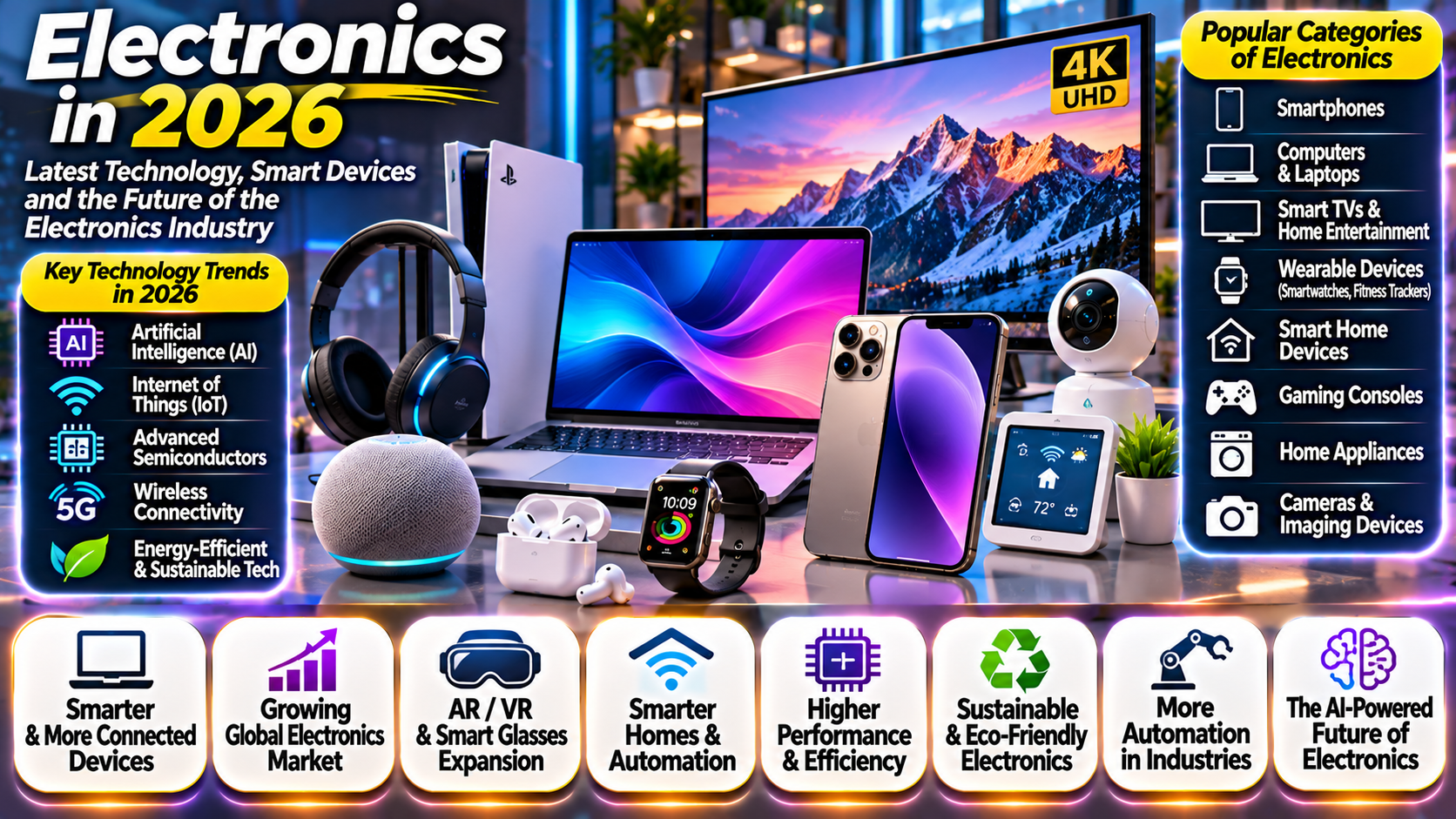
Electronics have become an essential part of modern life. From smartphones and laptops to smart televisions, wearable devices, home appliances, and advanced industrial equipment, electronic products influence how people communicate, work, learn, travel, shop, and entertain themselves.
Over the past decade, the electronics industry has experienced significant transformation through artificial intelligence (AI), wireless connectivity, automation, semiconductor innovation, and smart-device development.
In 2026, electronics are becoming increasingly intelligent and interconnected. Devices are no longer designed only to perform individual tasks. Many now communicate with other products, analyze information, automate activities, and provide personalized experiences.
Businesses are also investing in advanced electronic systems to improve productivity, manufacturing efficiency, communication, and customer experiences.
This comprehensive guide explores the major types of electronics, important technologies, popular product categories, buying considerations, industry challenges, and future opportunities.
1. What Are Electronics?
Electronics refers to the branch of science and technology concerned with controlling the flow of electrical signals through electronic components and circuits.
Electronic devices use components such as semiconductors, resistors, capacitors, integrated circuits, sensors, and processors to perform specific functions.
These components work together to receive, process, store, transmit, or display information.
Common examples of electronic products include:
Smartphones
Laptop computers
Desktop computers
Smart televisions
Digital cameras
Wireless headphones
Smartwatches
Gaming consoles
Home appliances
Networking equipment
Medical monitoring devices
Industrial control systems
Electronics are used in almost every major industry, including healthcare, education, transportation, manufacturing, entertainment, telecommunications, and finance.
2. Major Types of Electronics
The electronics industry includes several product categories, each serving different consumer and business requirements.
A. Consumer Electronics
<IMAGE_PLACEHOLDER>
Consumer electronics are electronic products designed primarily for personal, household, and entertainment use.
Popular examples include:
Smartphones
Televisions
Headphones
Digital cameras
Gaming consoles
Tablets
Smart speakers
Home entertainment systems
These products focus on convenience, communication, productivity, and entertainment.
Manufacturers continuously introduce new features to improve device performance, display quality, battery life, connectivity, and user experience.
B. Computer Electronics
Computer electronics include devices and components used for computing, information processing, and digital communication.
Important products include:
Desktop computers
Laptops
Computer monitors
Processors
Graphics cards
Memory modules
Storage devices
Motherboards
Servers
Networking hardware
Computers are essential for businesses, educational institutions, research organizations, software development, and creative industries.
C. Smart Home Electronics
Smart home electronics allow users to monitor and control household devices through mobile applications, voice assistants, and connected platforms.
Examples include:
Smart lighting
Smart thermostats
Smart security cameras
Video doorbells
Smart locks
Connected refrigerators
Smart washing machines
Intelligent home entertainment systems
These devices can improve convenience, energy management, and household automation.
D. Wearable Electronics
Wearable technology includes electronic products designed to be worn on the body.
Examples include:
Smartwatches
Fitness trackers
Smart rings
Wireless health-monitoring devices
Smart glasses
Fitness-oriented headphones
Wearables can track activity, provide notifications, monitor selected health-related measurements, and connect with smartphones.
E. Industrial Electronics
Industrial electronics are used in manufacturing facilities, factories, warehouses, energy systems, and other commercial environments.
Examples include:
Programmable logic controllers
Industrial sensors
Robotics systems
Motor controllers
Automated inspection equipment
Power management systems
Industrial communication devices
These technologies help businesses automate operations, monitor equipment, and improve production efficiency.
F. Medical Electronics
Medical electronics support healthcare professionals in monitoring patients, diagnosing conditions, and delivering medical care.
Examples include:
Digital blood pressure monitors
Patient monitoring systems
Ultrasound equipment
Electrocardiogram machines
Medical imaging systems
Portable diagnostic devices
Medical electronics must meet relevant safety, accuracy, and regulatory requirements.
3. Latest Electronics Technologies in 2026
Technology innovation continues to reshape the electronics market. Several developments are influencing how manufacturers design and improve electronic products.
Artificial Intelligence in Electronics
Artificial intelligence is becoming increasingly important in electronic devices.
AI-powered features can help products understand user preferences, automate repetitive activities, analyze information, and improve selected device functions.
Examples include:
AI-powered smartphone assistants
Intelligent photo editing
AI-enabled computers
Smart home automation
Voice recognition
Predictive maintenance systems
Intelligent security monitoring
AI is also transforming the hardware industry through demand for advanced processors, memory, networking equipment, and data-center infrastructure.
Deloitte's 2026 hardware and consumer technology outlook identifies AI as a major influence on hardware investment and computing infrastructure. <Cite refs={["turn685412search0","turn685412search5"]}/>
Internet of Things (IoT)
The Internet of Things connects electronic devices through networks so they can exchange information and perform coordinated tasks.
For example, a smart thermostat can communicate with temperature sensors to adjust household heating or cooling.
Common IoT applications include:
Smart homes
Connected vehicles
Industrial automation
Smart agriculture
Environmental monitoring
Energy management
IoT technology is helping create more connected environments in homes, businesses, and cities.
Advanced Semiconductor Technology
Semiconductors are essential components of modern electronics.
They are used in processors, memory chips, sensors, communication systems, and power-management equipment.
Advances in semiconductor manufacturing support improvements in:
Computing performance
Energy efficiency
Device miniaturization
AI processing
Graphics capabilities
Wireless communication
Growing investment in AI infrastructure is also increasing demand for advanced chips and electronic components. <Cite refs={["turn685412search5","turn685412search0"]}/>
5G and Wireless Connectivity
Wireless communication technologies allow electronic devices to exchange information without traditional wired connections.
5G supports applications that require high-speed connectivity, including:
Cloud-based services
Connected vehicles
Smart manufacturing
Video streaming
Remote monitoring
Connected consumer devices
Connectivity improvements are also influencing the development of smartwatches, smart home products, and other connected electronics.
Smart Glasses and Extended Reality
Smart glasses combine traditional eyewear with digital capabilities.
Depending on the product, they may provide:
Hands-free communication
Audio playback
Camera functions
Voice assistance
Navigation support
AI-powered features
Extended reality technologies include virtual reality, augmented reality, and mixed reality.
These technologies have applications in gaming, training, education, design, and professional environments.
Energy-Efficient Electronics
Energy efficiency is becoming an important product consideration.
Manufacturers are working to reduce power consumption through improved processors, displays, batteries, and power-management systems.
Energy-efficient products can help reduce electricity costs and improve battery performance.
4. Popular Electronics Products and Their Uses
Different electronic products support different aspects of everyday life.
Product | Main Purpose | Common Users |
|---|---|---|
Smartphones | Communication and digital services | General consumers |
Laptops | Work, education, and productivity | Students and professionals |
Smart TVs | Entertainment and streaming | Households |
Smartwatches | Notifications and activity tracking | Fitness users and consumers |
Wireless earbuds | Audio and communication | General consumers |
Gaming consoles | Interactive entertainment | Gamers |
Digital cameras | Photography and video | Creators and professionals |
Smart home devices | Household automation | Homeowners and renters |
Servers | Data processing and storage | Businesses |
Networking devices | Internet and communication | Homes and organizations |
5. Best Electronics Brands in the Global Market
The global electronics industry includes many established companies competing through innovation, product quality, design, pricing, and customer service.
Some widely recognized brands include:
Samsung
<Entity value="Samsung" category="brand" disambig="South Korean consumer electronics and technology company"/> produces smartphones, televisions, monitors, memory products, home appliances, and other electronic devices.
Its product portfolio serves both consumer and business markets.
Apple
<Entity value="Apple" category="brand" disambig="American consumer technology and electronics company"/> is known for the iPhone, Mac, iPad, Apple Watch, AirPods, and connected software ecosystem.
Its strategy emphasizes hardware, software integration, design, and customer experience.
Sony
<Entity value="Sony" category="brand" disambig="Japanese consumer electronics, entertainment, and technology company"/> operates across consumer electronics, imaging technology, gaming, and entertainment.
Its products include televisions, cameras, headphones, and PlayStation gaming systems.
LG
<Entity value="LG" category="brand" disambig="South Korean consumer electronics and home appliance company"/> is recognized for televisions, home appliances, monitors, and display technologies.
Lenovo
<Entity value="Lenovo" category="brand" disambig="Global personal computer and technology hardware company"/> manufactures laptops, desktop computers, workstations, tablets, and enterprise technology products.
Xiaomi
<Entity value="Xiaomi" category="brand" disambig="Chinese consumer electronics and smart device company"/> offers smartphones, connected home products, wearable technology, and other consumer electronics.
These companies illustrate the diversity of competition across the global electronics market.
6. How to Choose the Right Electronics
Buying electronics requires careful consideration of product specifications, usability, reliability, and price.
A product with the highest specifications is not necessarily the best choice for every customer.
Identify Your Requirements
Start by deciding what you need the device to accomplish.
For example:
Students may prioritize battery life and portability in a laptop.
Gamers may focus on graphics performance and processing power.
Professionals may need reliability and compatibility with business software.
Families may prioritize energy efficiency and ease of use in home appliances.
Compare Technical Specifications
Review the specifications that directly affect the product's performance.
For smartphones, these may include:
Processor
RAM
Storage
Camera system
Battery capacity
Display quality
Software support
For laptops, consider:
Processor generation
RAM capacity
SSD storage
Graphics capabilities
Display size
Battery life
Build quality
Check Product Reviews
Customer reviews can help identify common problems, performance limitations, and product advantages.
Look for detailed reviews that explain real-world usage rather than relying only on promotional descriptions.
Consider Warranty and After-Sales Support
Warranty coverage, repair availability, and replacement policies are important when purchasing expensive electronics.
Evaluate Long-Term Value
Consider how long the product is expected to remain useful.
A slightly more expensive device may offer better long-term value if it provides stronger performance, durability, repairability, and software support.
7. The Role of Electronics in Modern Businesses
Electronics have become essential infrastructure for modern organizations.
Businesses use electronic systems to improve productivity, communication, customer service, manufacturing, and data management.
Business Communication
Computers, smartphones, networking systems, and video-conferencing equipment allow employees to communicate across different locations.
Manufacturing Automation
Industrial electronics help factories automate repetitive tasks, control machinery, and monitor production processes.
Data Management
Servers, storage systems, and networking equipment support business applications and digital information management.
Retail and E-Commerce
Electronic payment terminals, barcode scanners, inventory systems, and digital displays support modern retail operations.
Healthcare Operations
Medical electronic equipment helps healthcare providers monitor patients and support diagnostic procedures.
Organizations that invest in suitable electronic infrastructure can improve operational efficiency and support digital transformation.
8. Electronics Industry Trends in 2026
The electronics market is evolving as manufacturers respond to new technology, changing customer expectations, and global economic pressures.
1. AI-Enabled Devices
AI features are becoming more common in smartphones, computers, smart home systems, and other consumer electronics.
However, consumers increasingly expect practical benefits rather than AI features that add complexity without improving everyday use.
2. Smart Home Expansion
Connected household devices continue to develop through improvements in interoperability, wireless connectivity, and home automation.
Standards such as Matter are helping compatible smart home products work together across different ecosystems. <Cite refs={["turn685412search1","turn685412search8"]}/>
3. Growing Wearable Technology
Smartwatches, fitness trackers, smart rings, and smart glasses are expanding the range of ways people interact with digital technology.
4. Sustainability and Repairability
Consumers increasingly consider durability, repair options, energy efficiency, and product lifespan when choosing electronics.
Manufacturers face growing pressure to improve product design and reduce electronic waste.
5. More Selective Consumer Spending
Customers are becoming more careful about replacing devices that still work.
Products need to demonstrate meaningful improvements in performance, reliability, and usability to encourage upgrades.
Recent NIQ research highlights the importance of durability, repairability, and energy efficiency in electronics purchasing decisions. <Cite refs={["turn685412search9","turn685412search7"]}/>
6. Advanced Computing Hardware
Demand for AI computing and data-center infrastructure is creating opportunities for semiconductor manufacturers, hardware suppliers, and networking companies.
9. Challenges Facing the Electronics Industry
Despite its growth opportunities, the electronics industry faces several challenges.
Supply Chain Disruptions
Electronics manufacturing depends on international networks of suppliers, component producers, and logistics providers.
Disruptions can affect production schedules, component availability, and product prices.
Semiconductor Shortages and Costs
Semiconductors are essential for nearly every modern electronic device.
Limited manufacturing capacity or rising component prices can increase production costs and affect availability.
Electronic Waste
Discarded smartphones, computers, batteries, and household electronics create environmental concerns.
Improving recycling systems, repairability, and responsible disposal is essential.
Cybersecurity and Privacy
Connected devices may collect personal information and communicate through internet-connected systems.
Weak security can expose users and businesses to privacy violations, unauthorized access, and cyberattacks.
Rapid Technology Changes
Manufacturers must continuously improve products to remain competitive.
However, frequent product launches can create pressure on businesses and consumers to upgrade devices more often.
10. The Future of Electronics Beyond 2026
The future of electronics will likely be shaped by intelligent computing, connected environments, advanced materials, energy efficiency, and improved human-device interaction.
Several developments may influence the next generation of electronic products.
Smarter personal devices: AI-powered smartphones, computers, and wearables may provide more personalized experiences.
Advanced robotics: Electronic sensors, processors, and control systems will support increasingly capable industrial and service robots.
Connected transportation: Electric vehicles and connected mobility systems will require advanced batteries, sensors, processors, and communication hardware.
More efficient semiconductors: Improvements in chip design and manufacturing may support greater computing performance and lower energy consumption.
Flexible electronics: Developments in flexible displays and electronic materials may enable new product designs.
Better device interoperability: Improved standards may make it easier for devices from different manufacturers to work together.
Sustainable product development: Longer-lasting batteries, repairable designs, and improved recycling may become increasingly important.
The companies that successfully combine innovation, reliability, affordability, and customer trust will be well positioned in the future electronics market.
11. How Electronics Affect Everyday Life
Electronics are no longer limited to specialized technical environments. They influence almost every aspect of daily living.
Education
Students use laptops, tablets, digital displays, and online learning platforms to access educational resources.
Communication
Smartphones and internet-connected devices allow people to communicate across international distances.
Entertainment
Televisions, gaming systems, cameras, and audio devices provide digital entertainment.
Healthcare
Electronic monitoring equipment and digital healthcare systems support medical professionals and patient services.
Transportation
Modern vehicles use electronic control systems, navigation equipment, sensors, and connected technology.
Household Management
Smart appliances and connected home systems help people manage lighting, security, temperature, and energy use.
Electronics will continue to shape how individuals and organizations interact with the world.
Frequently Asked Questions About Electronics
1. What are electronics?
Electronics is the field of technology concerned with controlling electrical signals through components and circuits to perform functions such as computing, communication, and information processing.
2. What are the main types of electronics?
Major categories include consumer electronics, computer electronics, industrial electronics, medical electronics, wearable devices, and smart home products.
3. What are examples of consumer electronics?
Smartphones, laptops, televisions, headphones, tablets, gaming consoles, cameras, and smartwatches are common examples.
4. What is the latest technology in electronics in 2026?
Important developments include AI-enabled devices, advanced semiconductors, connected smart home products, wearable technology, and improvements in wireless connectivity.
5. Which electronics brands are popular worldwide?
Samsung, Apple, Sony, LG, Lenovo, and Xiaomi are among the widely recognized electronics brands.
6. Why are semiconductors important in electronics?
Semiconductors are used in processors, memory chips, sensors, and other components that allow electronic devices to process information and perform complex functions.
7. What is smart electronics?
Smart electronics are connected or intelligent devices that can use sensors, software, networks, and sometimes AI to automate tasks or respond to user instructions.
8. How is AI changing the electronics industry?
AI is influencing device capabilities, computing hardware, personalization, automation, and manufacturing operations.
9. What is electronic waste?
Electronic waste, or e-waste, refers to discarded electrical and electronic products such as computers, smartphones, batteries, and televisions.
10. What is the future of the electronics industry?
The industry is expected to continue developing through AI, advanced chips, smart devices, robotics, connectivity, energy efficiency, and sustainable product design.
Conclusion
Electronics are fundamental to modern society, supporting communication, education, healthcare, business operations, entertainment, and industrial development.
In 2026, the industry is moving toward more intelligent, connected, efficient, and personalized devices. Artificial intelligence, semiconductor innovation, smart home technology, and wearable electronics are creating new opportunities for manufacturers and consumers.
At the same time, companies must address challenges involving supply chains, cybersecurity, electronic waste, product durability, and affordability.
For consumers, choosing electronics should involve more than comparing prices or specifications. Reliability, long-term value, repairability, security, and practical usefulness are equally important.
As technology continues to advance, electronics will remain one of the most influential industries shaping the digital future.