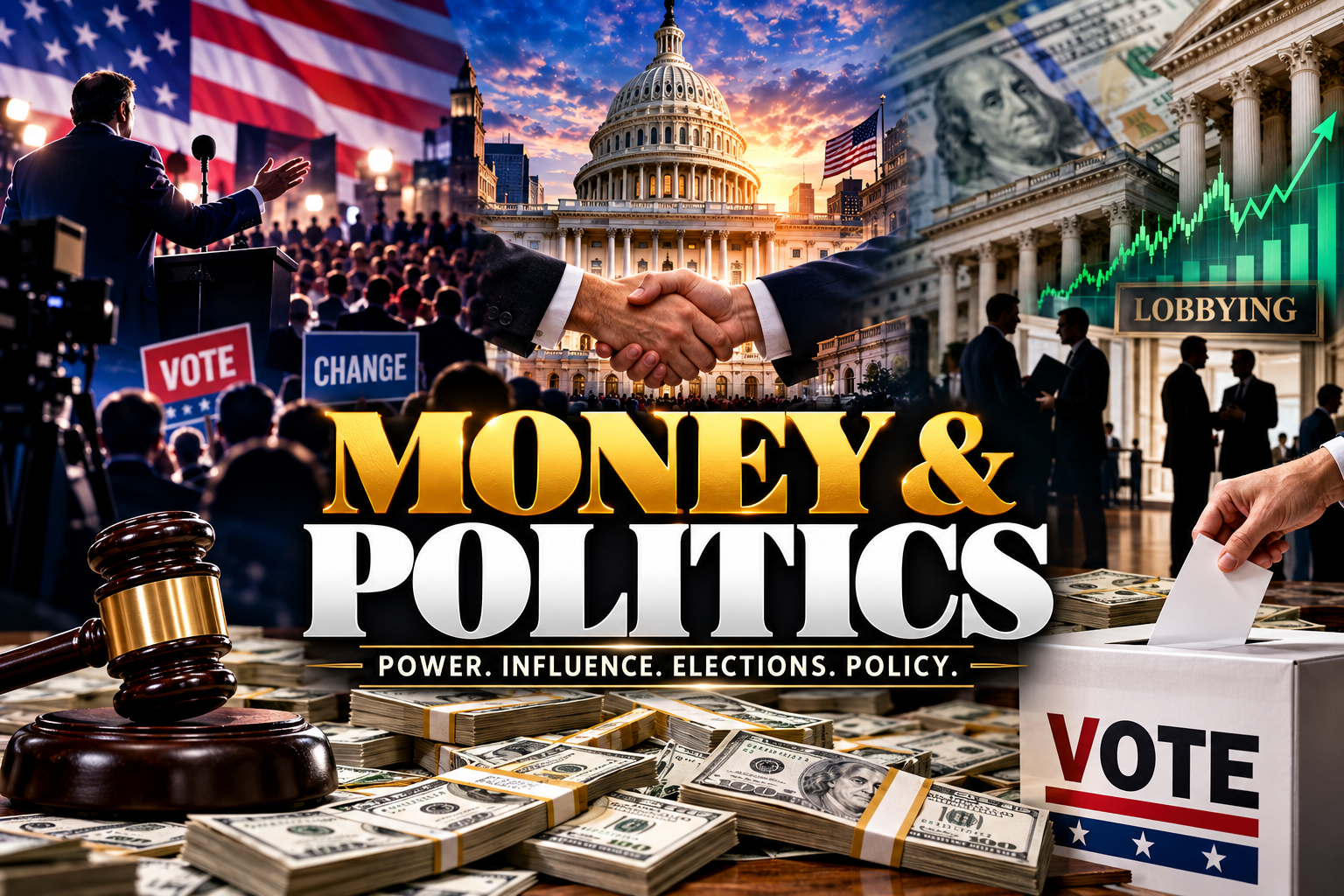
Money and politics are closely connected in modern democratic systems. Political campaigns require funding for advertising, staff, travel, research, technology, events, communications, and voter outreach. At the same time, businesses, trade associations, labor organizations, advocacy groups, and individuals may spend money to communicate their views to policymakers and the public.
The relationship between money and politics is therefore broader than campaign donations alone. It includes campaign finance, political advertising, lobbying, independent expenditures, political parties, political action committees, fundraising networks, and the rules designed to make political financing transparent.
The subject is also highly debated. Supporters of political spending can view financial contributions and advocacy as forms of political participation and free expression, while critics focus on concerns about unequal access, conflicts of interest, transparency, and the possibility that wealthy interests could receive greater political attention.
Understanding the different ways money enters politics can help explain how modern political systems operate without assuming that spending automatically determines a particular political outcome.
What Does Money and Politics Mean?
“Money and politics” refers to the financial resources used in political activities and the relationship between financial interests and government decision-making.
Money can enter politics through several channels, including:
Donations to political candidates
Contributions to political parties
Political action committees
Independent political advertising
Campaign fundraising
Lobbying
Advocacy organizations
Political consulting
Public relations
Grassroots organizing
Digital advertising
Political events and communications
The rules governing these activities vary significantly from one country to another.
Some countries impose strict limits on campaign contributions and political advertising, while others permit broader forms of political spending subject to disclosure requirements.
Why Do Political Campaigns Need Money?
Running a political campaign can require significant financial resources.
Candidates may need money to pay for:
Television and radio advertising
Digital advertising
Websites and technology
Campaign staff
Offices
Travel
Polling and research
Printed materials
Events
Legal and accounting services
Voter communications
Fundraising operations
Large elections can involve thousands of individual financial transactions.
In the United States, Federal Election Commission data for January 1, 2025 through March 31, 2026 showed that congressional candidates reported approximately $2.1 billion in receipts and $1.3 billion in disbursements. Political parties reported $1.1 billion in receipts, while federal political action committees reported approximately $6.3 billion in receipts.
These figures demonstrate the scale of modern campaign finance, although they represent a particular reporting period and should not be treated as the total cost of every election.
Campaign Contributions
Campaign contributions are money or other forms of financial support provided to political campaigns under applicable election laws.
Contributors can include:
Individuals
Political committees
Political parties
Organizations, where permitted
Other legally recognized political entities
Campaign-finance systems typically establish rules concerning who can contribute, how much they can contribute, and what information must be disclosed.
In the U.S. federal system, the Federal Election Commission administers and enforces federal campaign-finance laws covering elections for the presidency, vice presidency, Senate, and House of Representatives.
Political Action Committees
Political action committees, commonly known as PACs, are organizations that participate in political activity under specific legal structures.
PACs can raise and spend money according to the rules that apply to their category.
The Federal Election Commission reported that 8,816 federal PACs reported approximately $6.3 billion in receipts and $4.8 billion in disbursements between January 1, 2025 and March 31, 2026.
PACs can represent a variety of interests, including businesses, professional associations, labor organizations, ideological groups, and other constituencies.
Independent Political Spending
Political spending does not always come directly from a candidate's campaign.
Independent expenditures are spending intended to influence an election without being coordinated with a candidate or political party in the manner prohibited by applicable law.
The U.S. Federal Election Commission reported approximately $252.1 million in independent expenditures through March 31, 2026 during the 2025–2026 election cycle.
Independent spending can include advertisements, communications, digital campaigns, mail, and other forms of political messaging.
The legal distinction between coordinated campaign activity and independent political activity is important because different rules can apply to each.
Political Advertising
Advertising is one of the most visible ways money enters politics.
Political campaigns can spend money on:
Television commercials
Radio advertisements
Newspapers
Websites
Search advertising
Social media
Streaming platforms
Text messages
Email campaigns
Outdoor advertising
Digital platforms have expanded the ability of political organizations to target particular audiences.
Political advertising can also become expensive because campaigns may compete for attention in the same media markets.
Fundraising and Donors
Fundraising is a major part of political campaigns.
Candidates and political organizations may organize:
Fundraising events
Online donation campaigns
Email appeals
Telephone fundraising
Small-donor programs
Major-donor meetings
Membership programs
Political fundraising can come from thousands or millions of people, depending on the campaign.
A campaign supported by many small donors has a different financial structure from one relying heavily on a smaller number of major contributors.
Both models can exist within the same political system.
Money and Political Parties
Money Political parties require funding to maintain organizations, communicate with voters, support candidates, conduct research, organize conventions, and operate between elections.
In the United States, national and state party committees reported approximately $1.1 billion in receipts and $824.8 million in disbursements through March 31, 2026 for the reporting period covered by the FEC's 2026 statistical summary.
Political parties can therefore represent another significant part of the political-finance ecosystem.
What Is Lobbying?
Lobbying involves efforts to communicate with policymakers and influence public policy.
Lobbyists can represent:
Companies
Industry associations
Labor organizations
Nonprofit organizations
Professional groups
Trade associations
Public-interest organizations
Governments
Other institutions
Lobbying can involve providing information, presenting policy arguments, discussing legislation, and communicating the potential effects of government decisions.
The OECD describes lobbying and influence activities as legitimate forms of political participation when conducted within frameworks emphasizing integrity, transparency, and equity.
Does Lobbying Always Mean Political Donations?
No.
Lobbying and campaign contributions are different activities.
A lobbying organization may communicate with policymakers without making campaign contributions, while an individual or organization may make a political contribution without lobbying.
A company might, for example, hire government-relations professionals to explain how proposed regulations could affect its industry.
That activity is distinct from donating money to a candidate.
However, the two activities can exist within the same broader political environment, which is why campaign finance and lobbying transparency are often discussed together.
Why Businesses Participate in Politics
Businesses can be affected by government decisions involving:
Taxes
Trade
Labor regulations
Environmental rules
Healthcare
Infrastructure
Energy
Technology
Financial regulation
Competition policy
Intellectual property
Government procurement
Because public policy can affect business operations, companies and industry associations may seek to communicate their views to policymakers.
This does not necessarily mean that a particular political position will become government policy.
Policy decisions generally involve multiple actors, institutions, legal constraints, political considerations, public opinion, and competing interests.
Why Advocacy Organizations Spend Money
Political advocacy is not limited to wealthy individuals or corporations.
Nonprofit organizations, environmental groups, civil-rights organizations, professional associations, labor groups, consumer organizations, and other advocacy organizations can also spend money on political communications and policy engagement.
Their objectives may include:
Supporting legislation
Opposing legislation
Educating voters
Increasing public awareness
Encouraging civic participation
Communicating research
Supporting particular policy positions
This makes political spending a broader phenomenon than corporate influence alone.
Money and Political Access
One of the central debates surrounding political money concerns access.
Critics of large political spending argue that wealthy donors and organizations may have greater resources to communicate with politicians, organize campaigns, and promote policy preferences.
Supporters of political spending can argue that financial participation allows individuals and organizations to express political views and participate in democratic debate.
The actual relationship between spending and policy outcomes can be difficult to measure.
Spending more money does not automatically guarantee that a candidate will win an election or that a particular policy will become law.
Political outcomes can depend on many other factors, including candidates, issues, voters, economic conditions, political institutions, media coverage, and events.
Transparency and Disclosure
Transparency is one of the main tools used to address concerns about political money.
Disclosure rules can provide information about:
Who contributed money
How much was contributed
Who received the money
How political funds were spent
Which organizations financed advertisements
Which interests are represented by lobbyists
The goal of disclosure is to give voters, journalists, researchers, regulators, and other members of the public more information about political financing.
The OECD notes that transparency in lobbying remains limited across many countries. It reports that 17 of 32 OECD countries with available data had publicly accessible lobbying registers.
Campaign Finance Limits
Some political systems impose limits on campaign contributions.
These limits can apply to:
Individual contributions
Corporate contributions
Political committees
Party contributions
Candidate contributions
Independent expenditures
The purpose of contribution limits can differ by jurisdiction, but common policy goals include preventing corruption, reducing conflicts of interest, and increasing transparency.
The legal rules are complex and can change through legislation and court decisions.
For example, in June 2026, the U.S. Supreme Court ruled in National Republican Senatorial Committee v. FEC that certain federal limits on coordinated party expenditures violated the First Amendment. The FEC noted that the Court identified disclosure and earmarking requirements among other measures available to address circumvention concerns.
Money, Politics, and Social Media
Social media has changed political communication.
Traditional campaigns relied heavily on television, radio, newspapers, direct mail, and in-person events.
Modern political organizations can also use:
Social media advertising
Influencer-style communications
Short-form videos
Search advertising
Email newsletters
Online fundraising
Data analytics
Digital organizing
Digital communication can make political messaging faster and potentially less expensive to distribute.
At the same time, digital campaigns raise questions about privacy, political targeting, misinformation, transparency, and the identification of political advertisers.
The Role of Wealthy Individuals
Wealthy individuals can participate in politics through donations, advocacy organizations, independent expenditures, public statements, philanthropy, and other legal activities.
A wealthy donor may support a political candidate, party, ballot initiative, advocacy campaign, or policy organization.
However, financial support does not necessarily establish that a donor controls a politician's decisions.
Determining influence requires evidence about specific relationships, communications, policy outcomes, and applicable legal frameworks rather than simply observing that money changed hands.
Money and Democracy
The relationship between money and democracy involves competing principles.
Political participation can require resources. Candidates need funding to communicate with voters, and organizations need resources to research and explain policy positions.
At the same time, large differences in financial resources can create concerns about whether citizens and organizations have comparable opportunities to make their voices heard.
This creates an ongoing policy debate over questions such as:
How much campaign spending should be permitted?
Which contributions should be disclosed?
Should contribution limits be increased or reduced?
How should political advertising be regulated?
How should online political advertising be disclosed?
How should lobbying be registered?
How can conflicts of interest be addressed?
What information should voters have about political spending?
Different countries answer these questions in different ways.
How Voters Can Understand Political Money
Citizens can evaluate political-finance information by looking beyond a single donation or spending figure.
Useful questions include:
Who provided the money?
How much was provided?
Who received it?
What was the money spent on?
Was the spending coordinated with a campaign?
Is the organization required to disclose its donors?
What laws apply to the activity?
What evidence exists of an actual policy connection?
Are there competing organizations or interests involved?
What is the relevant time period?
These questions can help distinguish documented financial relationships from assumptions about political influence.
The Future of Money and Politics
Technology is likely to remain one of the biggest forces changing political finance.
Artificial intelligence, digital advertising, online fundraising, data analytics, social media, and automated communications may alter how political organizations reach voters and raise money.
At the same time, governments and regulators are likely to continue examining transparency, political advertising, foreign influence, digital platforms, and campaign-finance reporting.
The balance between political participation, free expression, transparency, and preventing corruption will remain an important policy issue.
Final Thoughts
Money and politics are connected through campaign finance, political parties, PACs, lobbying, advertising, advocacy, and political organizing.
Financial resources can help political organizations communicate with voters and participate in public debate, while differences in financial resources can raise questions about transparency, access, and political influence.
The relationship is complex. Spending money does not automatically determine an election result or guarantee a policy outcome. Understanding the sources, amounts, recipients, purposes, and legal rules surrounding political spending provides a more reliable way to examine the role of money in political systems.
As political communication becomes increasingly digital, campaign-finance laws and transparency systems will continue to evolve alongside the ways individuals, businesses, organizations, and political groups participate in public life.
FAQs
What is money in politics?
Money in politics refers to financial resources used for political campaigns, parties, advertising, lobbying, advocacy, fundraising, and other political activities.
Why is money important in elections?
Campaigns require funding for advertising, staff, research, travel, technology, events, voter outreach, and other operations.
What is campaign finance?
Campaign finance is the system of rules and financial activity surrounding money raised and spent for political campaigns and elections.
What is lobbying?
Lobbying is communication with policymakers intended to provide information, advocate for positions, or influence public policy. The OECD recognizes lobbying as a legitimate form of political participation when conducted under appropriate transparency and integrity frameworks.
Does money determine election results?
Money can affect a campaign's ability to communicate and organize, but spending alone does not establish an election outcome. Election results involve many factors.
What are PACs?
Political action committees, or PACs, are political organizations operating under specific legal structures that govern their fundraising and spending.
Why is political-finance disclosure important?
Disclosure can help the public understand who is financing political activity, how much money is involved, and where political funds are being spent.
Is lobbying the same as making political donations?
No. Lobbying involves communicating with policymakers, while political donations involve providing financial support under applicable campaign-finance rules.
How much money is currently being spent in U.S. federal politics?
For January 1, 2025 through March 31, 2026, the FEC reported $2.1 billion in receipts for congressional candidates, $1.1 billion for political parties, and $6.3 billion for federal PACs.
Is money in politics legal?
Many forms of political fundraising, spending, and lobbying are legal when they comply with applicable laws. The rules differ substantially between countries and can change over time.