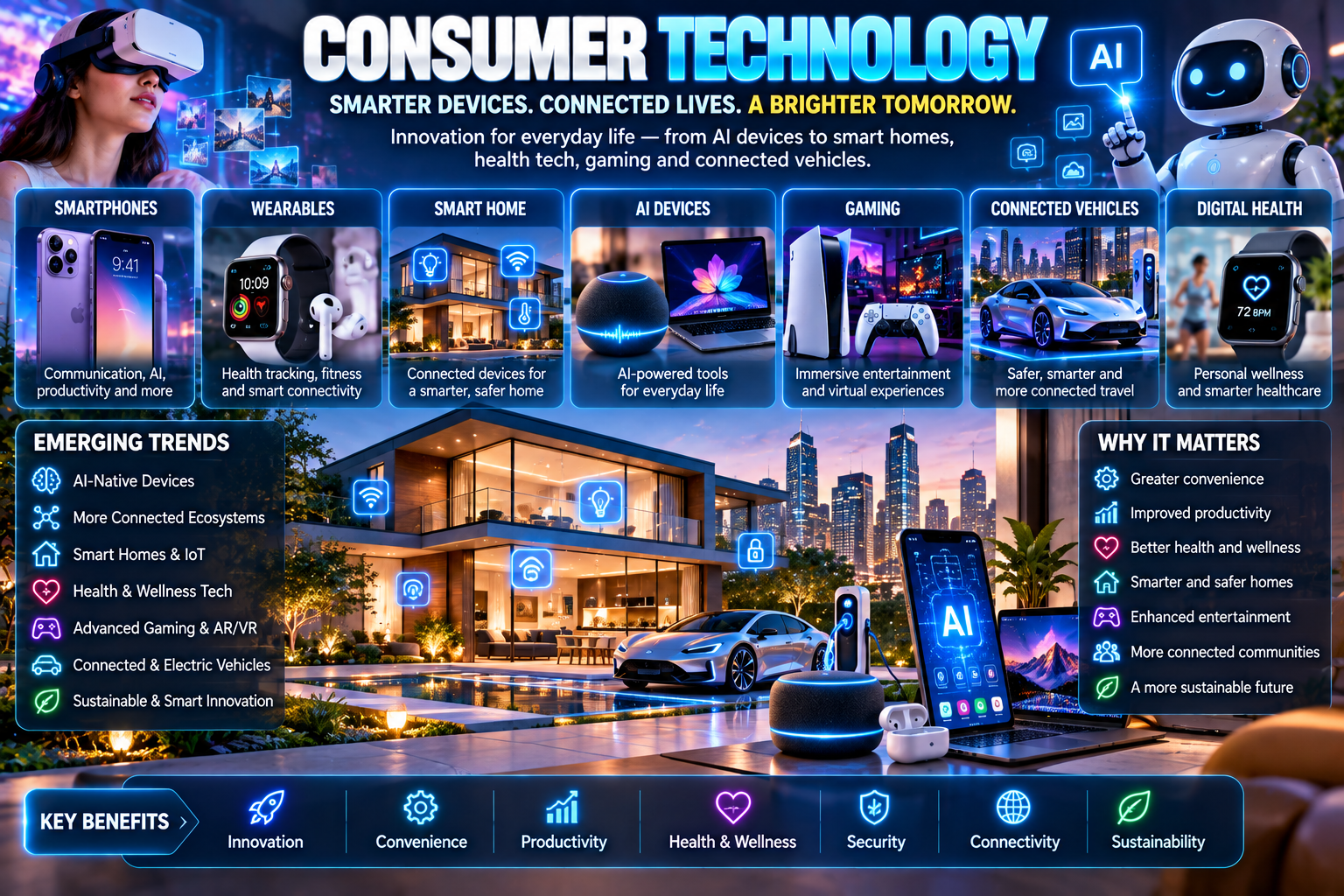
Consumer technology has become an essential part of modern life. Smartphones, laptops, smart TVs, wireless earbuds, gaming consoles, smartwatches, home appliances, connected vehicles, and artificial intelligence tools are changing how people communicate, work, shop, travel, learn, and entertain themselves.
The consumer technology industry is also evolving rapidly. Devices are increasingly connected to cloud services and powered by artificial intelligence, while manufacturers are focusing on creating experiences that work across multiple devices.
The Consumer Technology Association tracks more than 200 consumer technology products and services, including mobile phones, computing hardware, smart home products, wearables, digital health devices, gaming, automotive technology, and software.
In 2026, AI is becoming one of the most important forces shaping consumer devices. GSMA reports that devices are increasingly becoming AI-native platforms spanning smartphones, wearables, smart homes, and automotive environments.
What Is Consumer Technology?
Consumer technology refers to electronic devices, software, applications, and digital services designed primarily for individual consumers and households.
It includes:
Smartphones
Tablets
Laptops
Smart TVs
Wearables
Gaming devices
Smart home products
Wireless audio
Digital cameras
Health technology
Electric and connected vehicles
AI-powered devices
Home networking equipment
Streaming services
Consumer software
Consumer technology is different from enterprise technology because it is generally designed around individual users, households, entertainment, convenience, communication, and personal productivity.
Smartphones Remain at the Center
Smartphones have become one of the most important consumer technology products.
Modern smartphones combine:
Communication
Photography
Video
Navigation
Payments
Entertainment
Social media
Productivity
Gaming
Artificial intelligence
The smartphone is also increasingly becoming a hub connecting other consumer devices.
GSMA describes the smartphone as part of a broader ecosystem in which devices increasingly work together through AI, cloud services, and connected platforms.
AI-Powered Smartphones
Artificial intelligence is becoming an increasingly important smartphone feature.
AI capabilities can support:
Image editing
Translation
Voice assistants
Writing assistance
Search
Personalization
Camera optimization
Summarization
Accessibility
Deloitte's 2026 technology outlook identifies on-device generative AI as an important development, with specialized chips and operating-system integration bringing AI capabilities directly into smartphones.
Wearable Technology
Wearable technology includes devices such as:
Smartwatches
Fitness trackers
Smart rings
Wireless earbuds
Health-monitoring devices
Smart glasses
Wearables are increasingly moving beyond basic notifications and fitness tracking.
They can monitor activity, provide communication features, support navigation, and offer health-related measurements depending on the device.
Deloitte reports that wearables are expanding toward AI-enhanced and health-focused products, while GSMA identifies wearables as part of the broader shift toward AI-native consumer devices.
Smart Home Technology
Smart home technology connects household devices to networks and applications.
Examples include:
Smart lights
Security cameras
Smart locks
Robot vacuums
Smart thermostats
Connected appliances
Smart speakers
Home entertainment systems
The objective is often greater convenience, automation, energy management, security, or remote control.
However, adoption is not uniform across all products. Deloitte's 2026 Saudi consumer research, for example, found that smart-home adoption remained relatively niche, with consumers evaluating devices increasingly on practical utility and price.
Artificial Intelligence and Consumer Technology
AI is changing the way people interact with technology.
Traditional consumer devices generally required users to operate applications through menus, buttons, and touchscreens.
AI enables more natural interactions through:
Voice
Text
Images
Context
Personal recommendations
Automated actions
This can make devices more responsive to individual users.
GSMA reports that AI is increasingly becoming a major differentiator for consumer devices, with AI appearing across smartphones, TVs, wearables, and automotive systems.
On-Device AI
One important development is on-device AI.
Instead of sending every task to a remote cloud server, some AI processing can happen directly on a smartphone, laptop, smartwatch, camera, or other device.
Potential advantages include:
Lower latency
Greater privacy
Reduced dependence on internet connectivity
Lower cloud processing requirements
Deloitte identifies edge AI and on-device processing as significant technology developments, particularly for smartphones, wearables, cameras, and other connected devices.
Consumer Technology and Cloud Computing
Cloud computing remains an important foundation for consumer technology.
Many devices depend on cloud infrastructure for:
Data synchronization
Backups
Streaming
AI processing
Account management
Software updates
Device connectivity
Digital storage
For example, a smartphone may perform some AI processing locally while using cloud computing for more demanding tasks.
This combination of edge computing and cloud computing allows manufacturers to balance performance, privacy, cost, and connectivity.
Smart Entertainment
Consumer technology has transformed entertainment.
People can now access:
Streaming video
Music platforms
Podcasts
Online gaming
Digital books
Virtual events
Social video
Interactive content
Smart TVs and streaming devices have turned televisions into connected entertainment platforms.
AI is also changing content discovery by recommending movies, music, games, and other media based on user behavior.
Gaming Technology
Gaming is another major area of consumer technology.
Modern gaming ecosystems include:
Consoles
Gaming PCs
Mobile games
Cloud gaming
Virtual reality
Augmented reality
Gaming accessories
Online multiplayer platforms
Advances in graphics processors, displays, networking, AI, and cloud computing continue to influence gaming experiences.
Consumer Technology and Digital Health
Consumer technology is increasingly connected to health and wellness.
Examples include:
Fitness trackers
Smartwatches
Sleep monitors
Connected scales
Health applications
Digital fitness platforms
Wearable sensors
These technologies can help users track activity and other measurements.
However, health-related information can be sensitive. Consumers should understand what information devices collect, where it is stored, and how it may be shared.
Connected Vehicles
The automobile is becoming another important consumer technology platform.
Modern vehicles can include:
Connected navigation
Driver-assistance systems
Voice interfaces
Digital dashboards
Smartphone integration
Internet connectivity
Software updates
Advanced sensors
Future vehicles are likely to integrate even more closely with AI, cloud services, smart infrastructure, and connected devices.
GSMA's research on future terminals also highlights AI, sensing, robotics, immersive communications, and advanced computing as technologies that may reshape connected devices and transportation environments.
Consumer Technology and 5G
5G connectivity supports many consumer technology applications.
It can enable faster mobile connections and support connected devices, streaming, gaming, smart homes, and other applications.
GSMA reports that mobile technologies and services generated approximately $7.6 trillion in economic value globally in 2025, equivalent to 6.4% of global GDP, with the mobile ecosystem expected to continue expanding through 2030 as 5G and AI adoption grows.
Privacy and Consumer Technology
As devices become more intelligent, privacy becomes increasingly important.
Connected devices can collect information such as:
Location
Voice recordings
Search activity
Health-related information
Purchasing behavior
Device usage
Contacts
Photos
Personal preferences
Consumers should review privacy settings and understand how companies collect and use information.
AI-powered personal assistants create additional considerations because more useful personalization may require access to more personal information.
Deloitte highlights this tension between AI usefulness and privacy, particularly for personal AI assistants that may require access to calendars, messages, browsing information, and other personal data.
Cybersecurity for Consumer Devices
Connected consumer devices can become targets for cyberattacks.
Potential risks include:
Account theft
Malware
Unauthorized access
Data breaches
Weak passwords
Insecure networks
Outdated software
Consumers can improve security by:
Using strong passwords
Enabling multi-factor authentication
Updating device software
Securing home Wi-Fi
Reviewing application permissions
Avoiding suspicious links
Replacing unsupported devices
Manufacturers also have an important role in providing security updates and responsible device design.
Consumer Technology and Sustainability
Technology products require raw materials, manufacturing, transportation, electricity, and eventual disposal.
Sustainability therefore involves the entire product lifecycle.
Important considerations include:
Energy efficiency
Longer device lifespans
Repairability
Recycling
Responsible manufacturing
Reduced packaging
Efficient charging
Software support
Consumers may increasingly evaluate products based not only on features but also on durability and environmental impact.
Accessibility and Consumer Technology
Consumer technology can make digital services more accessible.
Features such as:
Screen readers
Voice control
Live captions
Magnification
Hearing assistance
Translation
Speech recognition
can help people interact with digital products.
AI may expand these capabilities by improving speech recognition, translation, image descriptions, and personalized interfaces.
Consumer Technology and Digital Inclusion
Technology innovation does not automatically mean everyone benefits equally.
Cost, connectivity, digital literacy, infrastructure, and device availability can affect adoption.
GSMA warned in September 2026 that more than 3.4 billion people still did not use mobile internet despite most living within mobile broadband coverage, highlighting the continuing importance of affordability and digital inclusion.
This means future consumer technology development will involve not only creating more advanced devices but also improving access to useful technology.
The Economics of Consumer Technology
The consumer technology market includes a wide range of products and services.
CTA's 2026 U.S. forecast tracks more than 200 products and services across categories including mobile phones, computing, audio, video, smart home, automotive, gaming, digital health, wearables, accessories, and software.
Deloitte's 2026 outlook estimates global consumer technology spending at approximately $1.3 trillion in 2025 and expects 2026 spending to be broadly flat globally, although conditions vary significantly by market and product category.
This demonstrates the scale and diversity of the consumer technology industry.
Challenges Facing Consumer Technology
The industry faces several challenges.
Rising Costs
Component prices, supply-chain disruptions, and manufacturing costs can affect device prices.
Rapid Product Cycles
New products are released frequently, making it difficult for consumers to determine when an upgrade is worthwhile.
Privacy
Increasingly intelligent devices require careful management of personal data.
Cybersecurity
More connected devices create more potential entry points for attackers.
Electronic Waste
Short product lifecycles can contribute to electronic waste.
Consumer Trust
People increasingly want to know whether new technologies are safe, reliable, private, and genuinely useful.
Deloitte identifies trust and data responsibility as increasingly important factors influencing consumer technology purchasing decisions.
The Future of Consumer Technology
Consumer technology is moving toward a more connected and intelligent ecosystem.
Future devices may increasingly operate together rather than functioning as isolated products.
For example:
Smartphone → Wearable → Smart Home → Vehicle → Cloud → AI Assistant
AI could help coordinate these devices according to user preferences and context.
Future consumer technology may therefore focus less on individual specifications and more on how effectively devices work together.
AI-Native Devices
AI-native devices are being designed around artificial intelligence from the beginning rather than simply adding AI as a software feature.
These devices may understand context, process information locally, communicate with other devices, and perform more personalized tasks.
However, consumer adoption remains uncertain for entirely new form factors. Deloitte notes that consumers may prefer AI capabilities integrated into familiar smartphones and earbuds rather than adopting entirely separate AI devices.
The Role of Smart Glasses
Smart glasses are one example of an emerging consumer technology category.
Potential applications include:
Navigation
Translation
Photography
Notifications
Voice interaction
Accessibility
Augmented reality
However, mainstream adoption remains uncertain. Deloitte's 2026 UK consumer research reported that smart glasses were used by only 2% of consumers surveyed, illustrating the challenge of moving new hardware categories from experimentation to mass adoption.
How Consumers Can Choose Technology Wisely
Consumers do not necessarily need the newest device.
Before purchasing, consider:
What problem does the product solve?
How frequently will it be used?
Is the price justified by the features?
How long will software updates continue?
What personal data does it collect?
Is the device compatible with existing products?
Can it be repaired?
Is the manufacturer trustworthy?
Does the product provide meaningful improvement over an existing device?
This approach can help consumers focus on practical value rather than specifications alone.
Final Thoughts
Consumer technology is evolving from a collection of individual electronic products into an interconnected digital ecosystem.
Smartphones, wearables, smart homes, connected vehicles, gaming systems, health devices, cloud services, and AI tools are increasingly working together.
Artificial intelligence is one of the strongest forces behind this transformation. GSMA describes a shift toward AI-native devices where value increasingly comes from intelligence, context, personalization, and interoperability rather than hardware specifications alone.
At the same time, successful consumer technology depends on more than innovation. Privacy, cybersecurity, affordability, accessibility, sustainability, reliability, and consumer trust will remain essential.
The future of consumer technology will ultimately be shaped by a simple question: Can technology become more useful without becoming unnecessarily complicated, expensive, or intrusive?
FAQs About Consumer Technology
What is consumer technology?
Consumer technology includes electronic devices, software, and digital services designed primarily for individuals and households.
What are examples of consumer technology?
Examples include smartphones, laptops, smart TVs, gaming consoles, smartwatches, wireless earbuds, smart home devices, connected cars, digital health products, and AI-powered applications.
How is AI changing consumer technology?
AI is being integrated into smartphones, wearables, smart homes, entertainment systems, vehicles, and personal assistants to provide personalization, automation, natural-language interaction, and intelligent features.
What is an AI-native device?
An AI-native device is designed around AI capabilities as a fundamental part of its operation rather than treating AI as a separate add-on.
Is consumer technology safe?
Consumer technology can be designed with strong security and privacy protections, but users should still manage passwords, permissions, software updates, network security, and personal-data settings carefully.
What is the future of consumer technology?
The future is likely to involve more AI, connected devices, on-device processing, smart homes, wearables, connected vehicles, digital health, advanced connectivity, and integrated device ecosystems.
Why is consumer trust important?
Consumers increasingly care about privacy, security, reliability, transparency, and how companies use their data. Trust can therefore influence technology adoption and purchasing decisions.