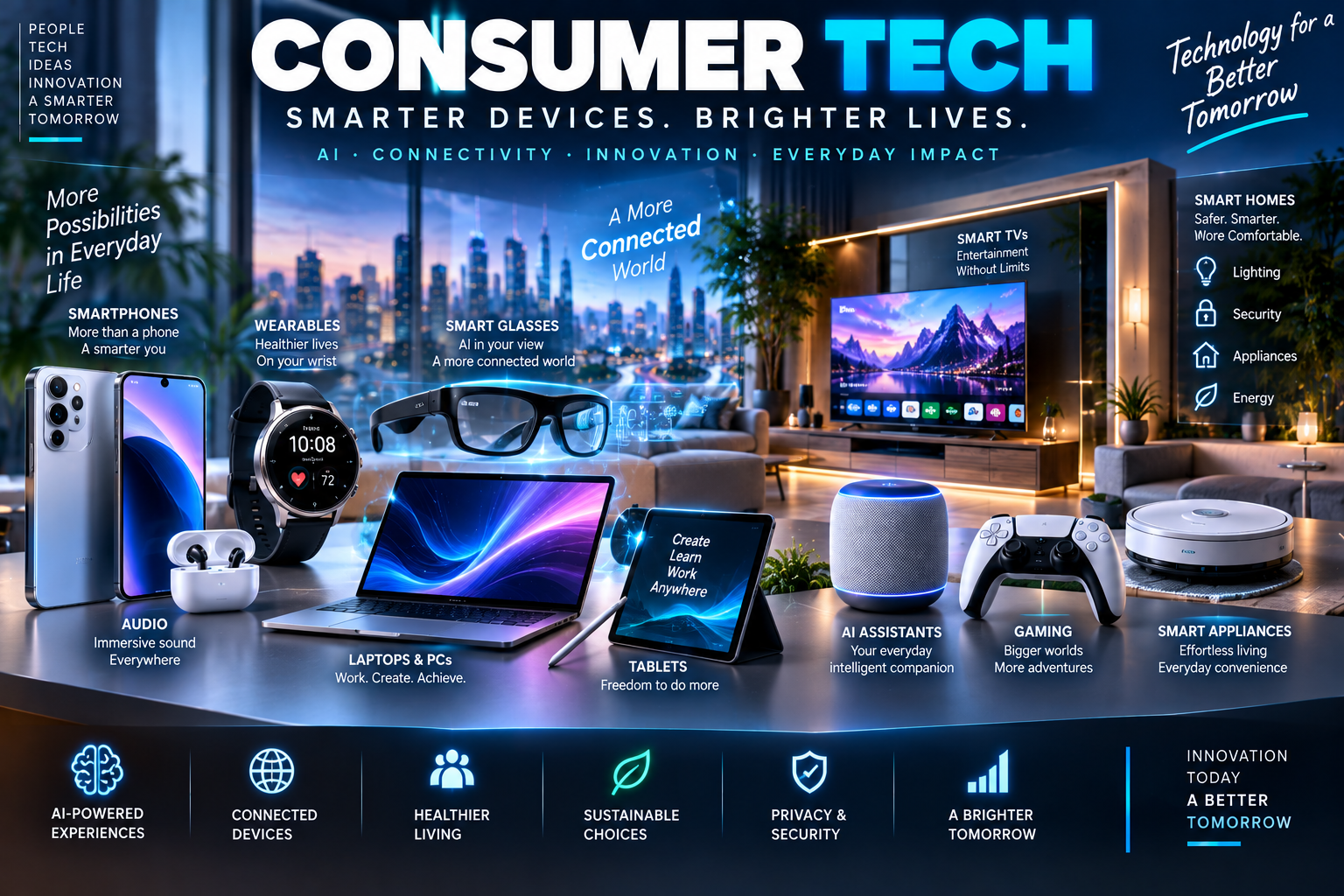
Consumer technology has become an essential part of modern life. From smartphones and laptops to smart TVs, wearable devices, gaming systems, connected appliances, and artificial intelligence, technology is changing how people communicate, work, shop, entertain themselves, and manage their homes.
In 2026, the consumer technology industry is entering a new phase. Artificial intelligence is becoming deeply integrated into everyday devices, while consumers are increasingly looking for technology that delivers practical value rather than simply adding more features. At the same time, rising hardware costs, longer replacement cycles, privacy concerns, and supply-chain challenges are influencing purchasing decisions.
The global consumer technology market remains enormous. NielsenIQ estimates that global Consumer Tech and Durable Goods sales reached approximately $1.3 trillion in 2025, while 2026 is expected to be a year of relatively flat overall growth as consumers become more selective about upgrades and value for money.
What Is Consumer Tech?
Consumer tech refers to technology products and services designed primarily for individual consumers rather than businesses or industrial users.
Major categories include:
Smartphones and tablets
Personal computers and laptops
Smart TVs and home entertainment
Smartwatches and fitness trackers
Wireless headphones and speakers
Smart home devices
Gaming consoles and accessories
Digital cameras
Smart appliances
Virtual and augmented reality devices
AI-powered consumer applications
Smart glasses and emerging wearable technology
Consumer technology increasingly works as part of connected ecosystems rather than as individual products. A smartphone can control a television, smartwatch, smart home, vehicle, headphones, computer, and numerous online services.
Artificial Intelligence Is Transforming Consumer Tech
Artificial intelligence is one of the biggest forces shaping consumer technology.
AI is moving beyond standalone chatbots and becoming an integrated feature inside everyday products. Smartphones can use AI for photography, translation, writing assistance, search, personalization, voice interaction, and image editing.
The GSMA describes modern devices as increasingly AI-native platforms that span smartphones, wearables, smart homes, and automotive environments. AI is also being used through on-device processing, cloud systems, and hybrid approaches that combine both.
This means consumers increasingly interact with technology through natural language and intelligent assistants rather than traditional menus and applications.
Smartphones Remain the Center of Consumer Technology
Despite the emergence of smart glasses, wearables, AI assistants, and other connected devices, smartphones remain one of the most important consumer technology products.
Modern smartphones combine communication, photography, entertainment, banking, shopping, navigation, productivity, social media, and AI capabilities in a single device.
However, consumers are becoming more selective when purchasing new smartphones. Performance, battery life, camera quality, durability, software support, and price continue to matter.
AI is becoming another important differentiator. Manufacturers are integrating AI directly into devices to provide features such as real-time translation, photo editing, personalized assistance, transcription, and contextual search.
The smartphone is also increasingly becoming the central control point for an entire digital ecosystem.
Wearable Technology Continues to Expand
Wearables have evolved from simple fitness trackers into sophisticated technology platforms.
Smartwatches can provide notifications, fitness information, communication features, navigation, payments, and increasingly advanced health-related insights. Other wearable categories are also expanding, including smart rings, wireless earbuds, fitness trackers, and smart glasses.
Deloitte's 2026 hardware and consumer technology outlook highlights continued momentum in wearables, with the category moving toward AI-enhanced, health-focused products and new form factors.
Smart rings and smart glasses are particularly interesting because they offer consumers alternatives to traditional screens.
Smart glasses can potentially provide hands-free photography, audio, translation, navigation, and AI assistance while maintaining the appearance of conventional eyewear.
Smart Homes Are Becoming More Connected
The smart home is another major area of consumer technology.
Consumers can now connect:
Smart televisions
Security cameras
Video doorbells
Thermostats
Lighting systems
Robot vacuum cleaners
Smart speakers
Kitchen appliances
Home entertainment systems
Energy-management devices
AI is making these products more useful by allowing devices to understand patterns and respond more intelligently.
For example, an intelligent home system could adjust lighting, temperature, entertainment, and security settings based on the user's routines.
Interoperability is also becoming increasingly important. Consumers do not necessarily want every device to come from the same manufacturer. They increasingly expect different products to work together smoothly.
Consumer Technology and Entertainment
Entertainment remains one of the biggest drivers of consumer technology.
Streaming platforms, gaming consoles, smart TVs, wireless audio devices, projectors, and immersive technologies are transforming how people consume content.
Television technology is also advancing through OLED, Mini LED, higher refresh rates, improved gaming performance, and AI-powered image processing.
NielsenIQ expects television demand to receive support from replacement cycles and major sporting events in 2026, while innovations such as RGB Mini LED are contributing to premium TV demand.
Gaming is similarly becoming more sophisticated, with powerful hardware, cloud gaming, virtual reality, artificial intelligence, and social features creating increasingly immersive experiences.
The Rise of AI-Powered Personal Assistants
One of the most important developments in consumer tech is the evolution of digital assistants.
Traditional voice assistants primarily responded to commands such as setting alarms, checking weather, or playing music. AI-powered assistants can potentially understand more complex requests, maintain context, analyze information, and help users complete multi-step tasks.
Consumer discussions around personal AI assistants have also increased significantly. Brandwatch reported that conversations about AI and smart assistants rose year over year heading into 2026.
The long-term goal is to make technology feel less like a collection of applications and more like an intelligent personal assistant.
Smart Glasses and Screenless Technology
Smart glasses represent another emerging consumer technology category.
Unlike smartphones, glasses can provide information without requiring users to hold a device. Potential applications include navigation, photography, communication, translation, audio, accessibility, and AI assistance.
The category is still developing, and adoption depends heavily on comfort, battery life, privacy, appearance, price, and practical everyday benefits.
Recent industry research suggests smart glasses are gaining momentum in some markets, particularly when products combine familiar designs with useful AI features.
Consumer Tech and Privacy
As consumer devices become smarter, privacy is becoming increasingly important.
Smartphones, watches, cameras, speakers, vehicles, televisions, and home devices can collect significant amounts of information.
Consumers are therefore paying greater attention to:
Data collection
Device permissions
Location tracking
Voice recordings
Camera access
Cloud storage
Account security
AI data usage
Software updates
Technology companies that provide transparent privacy controls and strong security can build greater consumer trust.
Privacy is likely to become an increasingly important part of product design rather than simply a legal requirement.
Cybersecurity in Consumer Technology
More connected devices also mean more potential security risks.
Smart homes, smartphones, computers, cameras, and wearable devices can become targets for cybercriminals if they are poorly secured.
Consumers should use strong passwords, multi-factor authentication, updated software, secure Wi-Fi networks, and trusted applications.
Manufacturers also have an important role to play by providing long-term security updates and making secure configurations easier for ordinary users.
Sustainability and Longer Product Lifecycles
Sustainability is becoming another important issue in consumer technology.
Electronic waste continues to be a concern as consumers replace smartphones, computers, televisions, appliances, and other devices.
Manufacturers are increasingly focusing on:
Longer-lasting products
Energy efficiency
Repairability
Refurbished devices
Recycling programs
Sustainable materials
Longer software support
Consumers are also becoming more conscious of whether upgrading to a new product provides enough value to justify replacing an existing device.
The Consumer Tech Market Is Becoming More Value-Conscious
Innovation alone does not guarantee consumer success.
Today's buyers increasingly ask whether a new product solves a real problem.
NielsenIQ's latest research highlights a growing focus on "justified consumption," with consumers becoming more selective about when and why they upgrade. Sales value can rise even when product volumes decline, indicating that consumers may be purchasing fewer products but choosing higher-value technology.
This creates an important challenge for technology companies: new products need to offer clear benefits.
Longer battery life, better performance, useful AI, improved durability, seamless connectivity, and lower operating costs can be more persuasive than simply adding another feature.
Rising Hardware Costs Could Affect Consumers
Consumer technology prices are also being affected by the broader semiconductor and memory market.
Recent industry reporting has highlighted significant pressure on memory supply as AI infrastructure competes with consumer electronics for advanced memory capacity. This can increase costs for smartphones, computers, and other devices.
Deloitte also expects memory-related cost and supply pressures to influence smartphones and PCs during 2026.
Higher prices could encourage consumers to keep devices longer, buy refurbished products, or prioritize products with stronger long-term value.
The Future of Consumer Tech
The future of consumer technology will likely be defined by intelligence, connectivity, personalization, and convenience.
Instead of simply creating more powerful hardware, technology companies are increasingly trying to create products that understand users and work together seamlessly.
Future consumer technology could include:
AI-native smartphones
Advanced smart glasses
AI-powered wearables
Intelligent homes
Personalized health technology
More capable personal AI assistants
Connected vehicles
Advanced robotics
Immersive entertainment
AI-powered computers
Screenless interfaces
More interoperable device ecosystems
The biggest change may be the transition from device-centric technology to experience-centric technology.
Consumers may care less about owning the most powerful individual device and more about whether their entire technology ecosystem works together effortlessly.
Conclusion
Consumer technology is entering a new era in which artificial intelligence, connectivity, personalization, and practical value are becoming more important than ever.
Smartphones remain central, but the consumer technology ecosystem is expanding through wearables, smart homes, AI assistants, smart glasses, connected entertainment, and intelligent appliances.
At the same time, consumers are becoming more selective. Price, performance, battery life, privacy, security, sustainability, and long-term usefulness increasingly influence purchasing decisions.
The companies that succeed in the next generation of consumer technology will be those that transform complex technology into simple, useful, trustworthy experiences.
Frequently Asked Questions
1. What is consumer technology?
Consumer technology includes electronic devices and digital services designed primarily for individual users, including smartphones, computers, wearables, smart TVs, gaming products, smart home devices, and AI-powered applications.
2. What is the biggest consumer technology trend in 2026?
Artificial intelligence is one of the most significant trends, with AI increasingly integrated into smartphones, computers, wearables, smart home devices, and digital assistants.
3. Are smartphones still important in consumer tech?
Yes. Smartphones remain a central part of the consumer technology ecosystem because they combine communication, entertainment, photography, productivity, payments, navigation, and AI features.
4. What are examples of wearable technology?
Examples include smartwatches, fitness trackers, smart rings, wireless earbuds, and smart glasses.
5. Why is AI important for consumer technology?
AI can make devices more personalized, intelligent, automated, and convenient. It can support functions such as translation, photography, search, recommendations, voice interaction, and content creation.
6. What is the future of smart homes?
Smart homes are expected to become more interconnected and intelligent, allowing devices such as lighting, security systems, appliances, entertainment systems, and thermostats to communicate and respond to user needs.
7. Is consumer technology becoming more expensive?
Some categories are facing higher costs due to supply-chain conditions, memory prices, semiconductor demand, and increasing component costs. This may encourage consumers to extend device lifecycles.
8. Will smart glasses replace smartphones?
Smart glasses are unlikely to completely replace smartphones in the near future. However, they could become an important complementary device for communication, AI assistance, audio, navigation, photography, and hands-free computing.
9. Why is privacy important in consumer tech?
Connected devices can collect personal information such as location, voice, activity, and usage data. Strong privacy controls and security practices are therefore essential for consumer trust.
10. What will define the future of consumer technology?
AI, seamless connectivity, personalization, privacy, sustainability, better battery life, and practical everyday usefulness are likely to be major factors shaping the next generation of consumer technology.