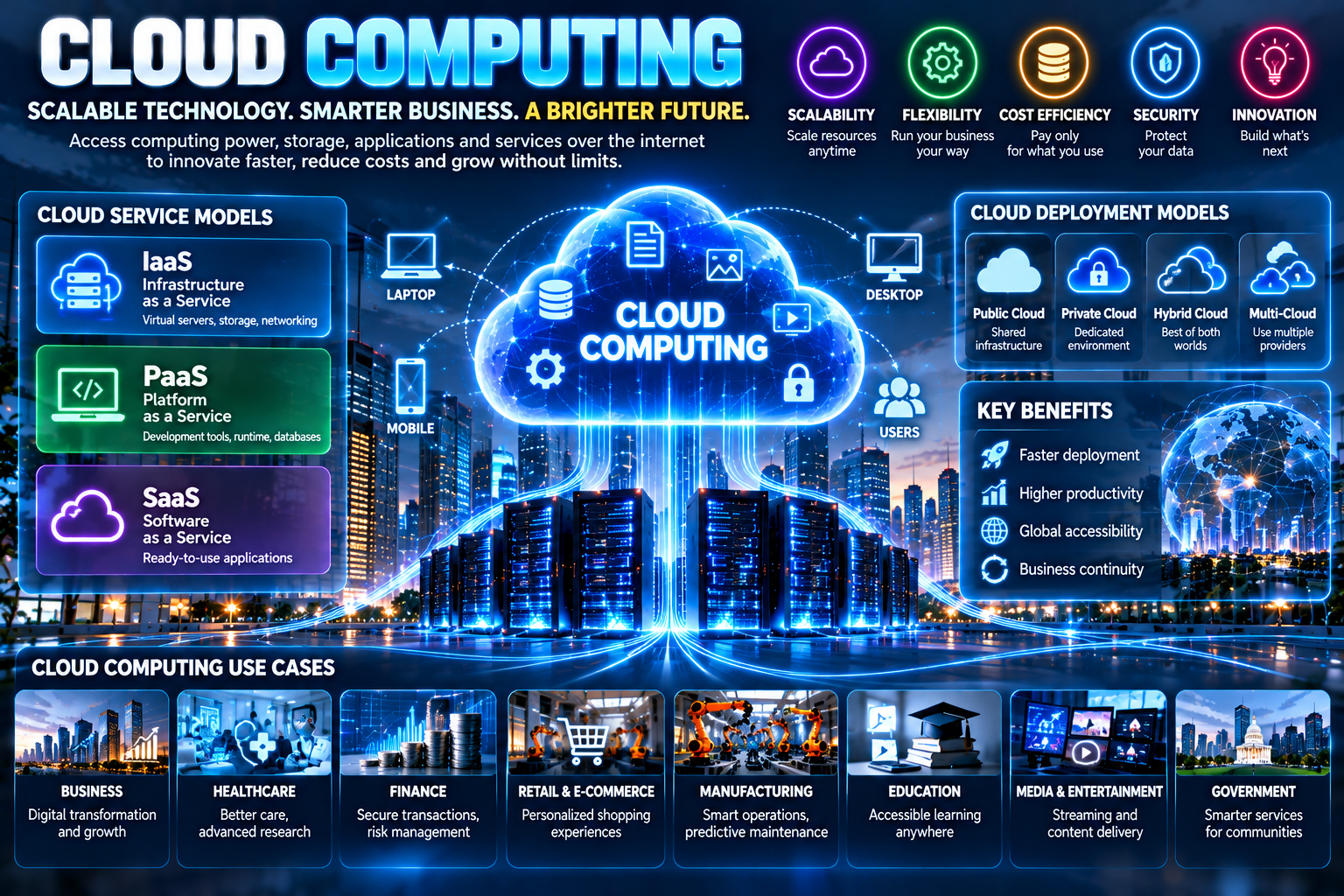
The cloud computing industry has evolved from a market focused primarily on online software and infrastructure into one of the foundations of the modern technology economy. Today, cloud companies support artificial intelligence, cybersecurity, financial technology, enterprise software, data analytics, collaboration, digital commerce, and countless other applications.
One of the most recognized ways to follow this private technology ecosystem is the Forbes Cloud 100.
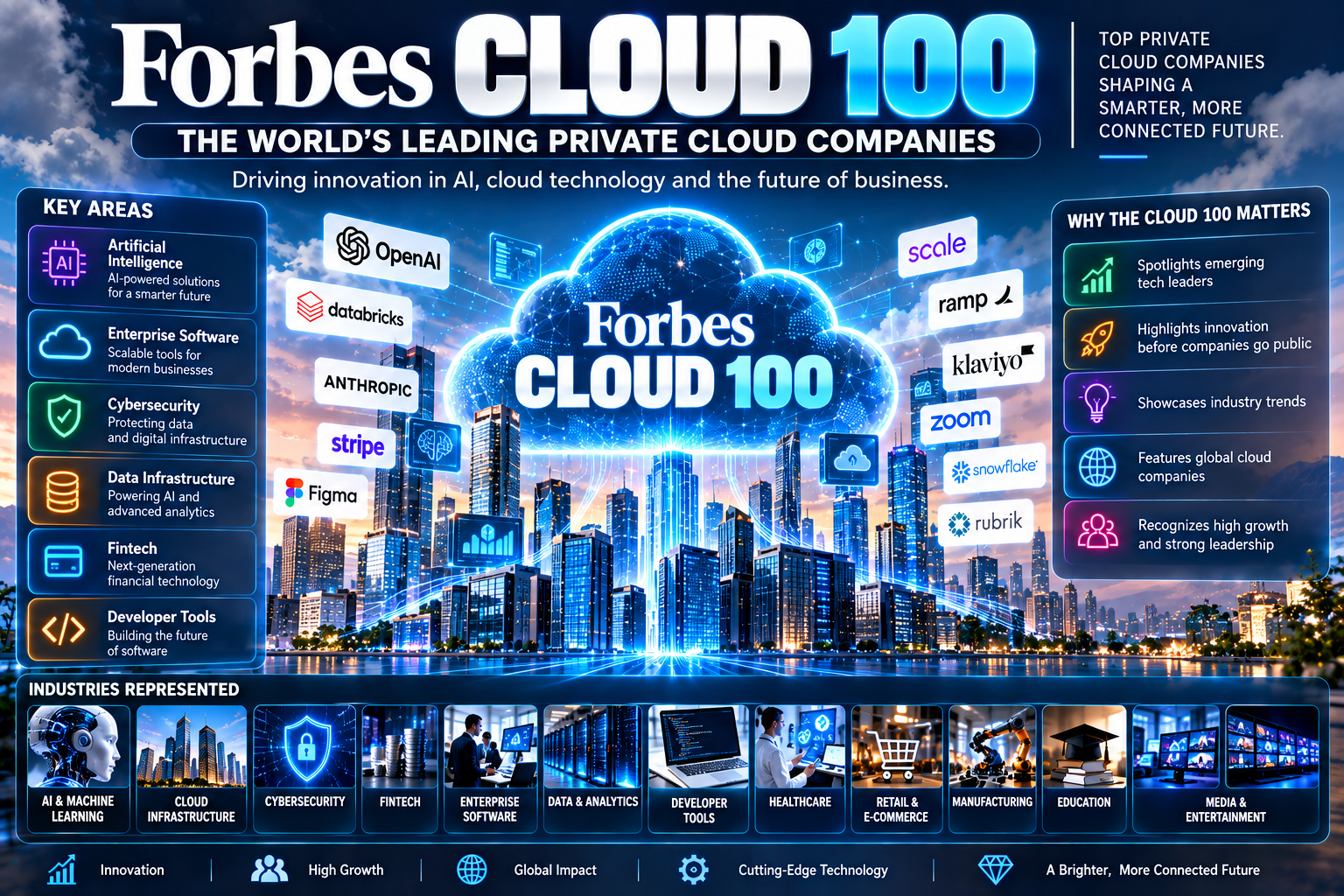
The Cloud 100 recognizes leading private cloud companies around the world and has become an important snapshot of emerging technology businesses before they become publicly traded companies or household names. Forbes produces the list in partnership with Bessemer Venture Partners and Salesforce Ventures.
The evolution of the Cloud 100 also reflects a major shift in the technology industry: artificial intelligence has become deeply connected with cloud software, infrastructure, and enterprise technology.
What Is the Forbes Cloud 100?
The Cloud 100 is an annual Forbes list recognizing leading private cloud companies.
The program evaluates companies using quantitative and qualitative information. Forbes says nominees provide confidential financial metrics, including information related to valuation, revenue, and growth. These factors contribute to a financial score, which is combined with assessments involving people and culture and market leadership.
Companies do not pay a fee for placement or consideration, according to Forbes.
The list is particularly significant because many companies enter the Cloud 100 while they are still privately held.
Some companies that appeared on previous Cloud 100 lists later became major public technology companies.
Forbes has highlighted alumni such as Dropbox, Snowflake, Zoom, Klaviyo, and Rubrik.
Why the Cloud 100 Matters
The Cloud 100 provides a way to observe emerging trends across the private technology sector.
The companies recognized through the program can represent different parts of the cloud economy, including:
Enterprise software
Artificial intelligence
Cybersecurity
Fintech
Data infrastructure
Developer tools
Collaboration software
Marketing technology
Design software
Cloud infrastructure
Business automation
The list therefore provides more than a collection of technology companies. It offers a view of where private technology businesses are developing and where venture-backed innovation is concentrated.
The Rise of AI in the Cloud 100
Artificial intelligence has become one of the most significant forces shaping the cloud technology market.
Forbes reported that the 2024 Cloud 100 included a record 17 AI-focused companies, approximately twice the number from the previous year. OpenAI was No. 1, Databricks No. 2, Anthropic No. 5, and Scale AI No. 7 on that year's list.
This shift demonstrates how cloud companies are increasingly building AI directly into their products.
AI is being used for:
Enterprise automation
Software development
Data analysis
Cybersecurity
Customer service
Content creation
Financial analysis
Business intelligence
Search
Design
Healthcare applications
OpenAI and the Cloud Economy
OpenAI's appearance at the top of the 2024 Cloud 100 reflected the growing importance of AI companies within the cloud ecosystem.
Generative AI has changed how businesses interact with software.
Instead of simply clicking through menus and forms, employees can increasingly interact with software through natural-language interfaces.
Enterprise AI can assist with:
Research
Writing
Coding
Data analysis
Customer support
Document processing
Workflow automation
The development of AI applications is also increasing demand for cloud infrastructure capable of supporting model training and inference.
Databricks and Data Infrastructure
Data has become increasingly important as companies adopt AI.
Databricks is an example of a company operating at the intersection of cloud computing, data analytics, and artificial intelligence.
Modern AI applications depend on organizations being able to collect, process, govern, and analyze data effectively.
This makes data infrastructure an important part of the broader Cloud 100 ecosystem.
Anthropic and AI Models
Anthropic is another example of how AI companies have become important participants in the cloud economy.
AI model developers require substantial computing infrastructure for training and serving models.
This creates demand for cloud computing, specialized chips, storage, networking, and data-center capacity.
The relationship between AI companies and cloud infrastructure providers is therefore becoming increasingly interconnected.
Cloud Infrastructure Is Changing
Traditional cloud computing was dominated by large-scale infrastructure providers.
However, the growth of AI is creating new requirements.
AI workloads can require:
Specialized accelerators
High-speed networking
Large amounts of memory
Significant electricity
Advanced cooling
High-performance storage
Large-scale data pipelines
Forbes reported in 2026 that a category often referred to as neoclouds is emerging around infrastructure designed specifically for AI workloads. Companies mentioned in this emerging category include CoreWeave, Crusoe, TensorWave, Lambda, and Genesis Cloud.
This development illustrates how AI is influencing the architecture of cloud infrastructure.
Cloud 100 and Cybersecurity
Cybersecurity is another major part of the private cloud economy.
As organizations move more applications and data into cloud environments, security companies are developing tools to protect:
Cloud applications
Identity systems
Data
Networks
Endpoints
APIs
AI systems
Cloud-native security can help businesses monitor digital environments and identify suspicious activity.
AI is also being incorporated into cybersecurity tools to analyze large quantities of security information and identify potential threats.
Cloud 100 and Fintech
Financial technology has remained an important category within the cloud ecosystem.
Cloud-based fintech companies can provide services involving:
Payments
Banking
Financial management
Corporate cards
Expense management
Fraud detection
Financial analytics
Forbes' 2024 Cloud 100 coverage highlighted companies such as Stripe, Ramp, and Brex among cloud-based fintech businesses.
Cloud infrastructure allows fintech companies to develop digital financial products without relying exclusively on traditional physical infrastructure.
Enterprise Software
Enterprise software remains one of the core areas of cloud computing.
Cloud-based business applications can help companies manage:
Human resources
Finance
Sales
Marketing
Customer relationships
Collaboration
Project management
Operations
Software-as-a-Service has made it possible for businesses to subscribe to applications instead of purchasing and maintaining traditional software installations.
Cloud 100 and Developer Tools
Developers are another important market for cloud companies.
Modern software development increasingly relies on cloud-based tools for:
Code repositories
Testing
Deployment
Monitoring
Databases
APIs
Infrastructure management
Collaboration
The rise of AI coding assistants and AI-powered development environments is further changing this market.
AI can help developers generate code, identify errors, write tests, explain existing software, and automate repetitive development tasks.
Cloud 100 Rising Stars
The Cloud 100 program also has a Rising Stars category for younger cloud startups.
Forbes describes the Rising Stars as companies that may develop into major private cloud businesses. The 2025 cohort included companies working in AI-powered education, healthcare, cybersecurity, retail, legal technology, industrial AI, and other areas.
Examples from the 2025 Rising Stars list include:
Brisk Teaching
Day AI
Vapi
Juna AI
Twine
Sauron
Genlogs
Netic AI
Assort Health
Many of these startups apply AI to specialized industries rather than building general-purpose technology.
Vertical AI and the Next Generation of Cloud Companies
One important trend is the development of vertical AI.
Vertical AI focuses on specific industries or professional tasks.
Examples include AI systems designed for:
Healthcare
Law
Education
Manufacturing
Finance
Retail
Cybersecurity
Logistics
This approach allows companies to combine AI with specialized industry knowledge and workflows.
The 2025 Cloud 100 Rising Stars list illustrates this trend, with startups applying AI to areas such as healthcare administration, factories, cybersecurity, education, legal services, and logistics.
Cloud Companies and Business Transformation
Cloud companies are helping organizations change how they operate.
Businesses can increasingly move from manually managed systems toward automated digital workflows.
For example, a company might use cloud software to connect:
Customer Data → Analytics → AI → Automation → Business Decision
This can reduce repetitive work and give employees faster access to information.
However, automation also requires organizations to consider security, data quality, employee training, governance, and system reliability.
Cloud 100 and Venture Capital
Private cloud companies often receive significant venture capital investment.
Investors may provide capital to companies that demonstrate:
Revenue growth
Strong customer demand
Product differentiation
Large market opportunities
Technology advantages
Experienced leadership
The Cloud 100 can therefore serve as a reference point for understanding companies that have attracted significant attention within the private technology ecosystem.
How Cloud 100 Companies Are Evaluated
The Cloud 100 methodology incorporates multiple dimensions.
According to Forbes, companies submit financial information such as valuation, revenue, and growth rate. These contribute to the financial assessment.
Forbes also considers people and culture, including information related to employees, diversity, and employee satisfaction.
Market leadership is another component and incorporates feedback from public-cloud CEOs and executives.
This means the Cloud 100 is not based on a single financial measurement.
From Private Startup to Public Company
One of the interesting aspects of the Cloud 100 is that it often identifies companies before they become publicly traded.
A typical technology company's development may look like:
Startup → Venture Funding → Rapid Growth → Cloud 100 Recognition → Expansion → IPO or Acquisition
This is not the path every company follows, but previous Cloud 100 alumni demonstrate that private cloud companies can eventually become major public businesses.
Forbes has specifically identified companies such as Dropbox, Snowflake, Zoom, Klaviyo, and Rubrik among Cloud 100 alumni.
The Global Cloud Economy
Cloud companies are not limited to one geographic region.
The 2024 Cloud 100 included companies headquartered in locations ranging from the San Francisco Bay Area and New York to London, Paris, Tel Aviv, Singapore, Sydney, Bavaria, and British Columbia.
This reflects the increasingly global nature of software development.
Cloud infrastructure allows technology companies to serve customers across borders without necessarily building physical operations in every market.
Challenges Facing Cloud Companies
Despite the rapid growth of cloud and AI technology, private cloud companies face several challenges.
Competition
Technology markets can become highly competitive as established companies and startups develop similar products.
Infrastructure Costs
AI companies in particular can face significant costs associated with computing power, data centers, specialized hardware, and energy.
Cybersecurity
Cloud companies must protect customer information and infrastructure from increasingly sophisticated threats.
Regulation
Technology companies may need to comply with privacy, AI, financial, cybersecurity, and industry-specific regulations.
Customer Adoption
A technically advanced product still needs to demonstrate practical value to customers.
Profitability
High revenue growth does not necessarily mean a company is profitable. Cloud businesses may invest heavily in infrastructure, research, employees, and customer acquisition.
Cloud 100 and the Future of Technology
The future of the Cloud 100 is likely to reflect the continued convergence of cloud computing and artificial intelligence.
Several areas are particularly important:
AI Infrastructure
Demand for computing infrastructure is increasing as AI models become more capable and widely used.
AI Agents
AI systems are moving beyond simple question-and-answer interactions toward systems capable of performing multi-step tasks.
Data Platforms
Organizations need increasingly sophisticated systems to manage the data required by AI applications.
Cybersecurity
As more systems become cloud-based and AI-enabled, security will remain a major priority.
Industry-Specific AI
AI companies are increasingly targeting specific industries and professional workflows.
Developer Platforms
Software developers are becoming an important audience for AI-powered cloud tools.
What the Cloud 100 Says About Technology
The Cloud 100 provides a useful lens for understanding how private technology businesses are evolving.
Earlier generations of cloud companies helped businesses move software and infrastructure online.
The current generation is increasingly focused on intelligence, automation, data, and AI.
The result is a technology landscape where cloud infrastructure is no longer simply a place to host software.
It has become the foundation for:
AI applications
Digital businesses
Data platforms
Cybersecurity
Financial technology
Enterprise automation
Developer tools
Industry-specific software
Final Thoughts
The Forbes Cloud 100 represents an important part of the private technology ecosystem.
Its companies demonstrate how cloud computing has expanded from basic infrastructure and software delivery into a much broader technology platform involving artificial intelligence, data, cybersecurity, fintech, automation, and enterprise applications.
The evolution of the Cloud 100 also shows how quickly technology categories can change. AI has become one of the strongest forces influencing private cloud businesses, while new infrastructure providers and specialized AI startups are emerging alongside established cloud companies.
As cloud computing and AI continue to develop, the companies entering future Cloud 100 lists will likely reflect the next generation of software, infrastructure, data, and intelligent technology.
FAQs About the Cloud 100
What is the Cloud 100?
The Forbes Cloud 100 is an annual list recognizing leading private cloud companies around the world. It is produced in partnership with Bessemer Venture Partners and Salesforce Ventures.
Is the Cloud 100 only about cloud infrastructure?
No. The Cloud 100 includes companies across areas such as enterprise software, AI, cybersecurity, fintech, data, developer tools, and other cloud-based technologies.
Is OpenAI a Cloud 100 company?
OpenAI was ranked No. 1 on Forbes' 2024 Cloud 100 list.
What is Cloud 100 Rising Stars?
Cloud 100 Rising Stars is a companion program highlighting promising early-stage cloud startups. Forbes' 2025 Rising Stars included startups working across AI, healthcare, education, cybersecurity, manufacturing, retail, and other sectors.
How are Cloud 100 companies evaluated?
Forbes says the methodology combines financial information, people and culture considerations, and market leadership assessments.
Why is AI important to the Cloud 100?
AI requires cloud infrastructure, data platforms, specialized computing, and enterprise software. At the same time, AI is being integrated into many existing cloud products.
What is the future of the Cloud 100?
Future Cloud 100 companies are likely to reflect developments in AI, cloud infrastructure, cybersecurity, data platforms, enterprise software, automation, developer tools, and specialized industry applications.