
Cloud technology has become one of the most important foundations of the modern digital economy. Businesses of every size increasingly depend on cloud platforms to store information, run applications, analyze data, support artificial intelligence, communicate with customers, and scale their operations.
As the cloud industry has grown, a new generation of technology companies has emerged around cloud software, cybersecurity, data analytics, artificial intelligence, infrastructure, collaboration, and enterprise technology.
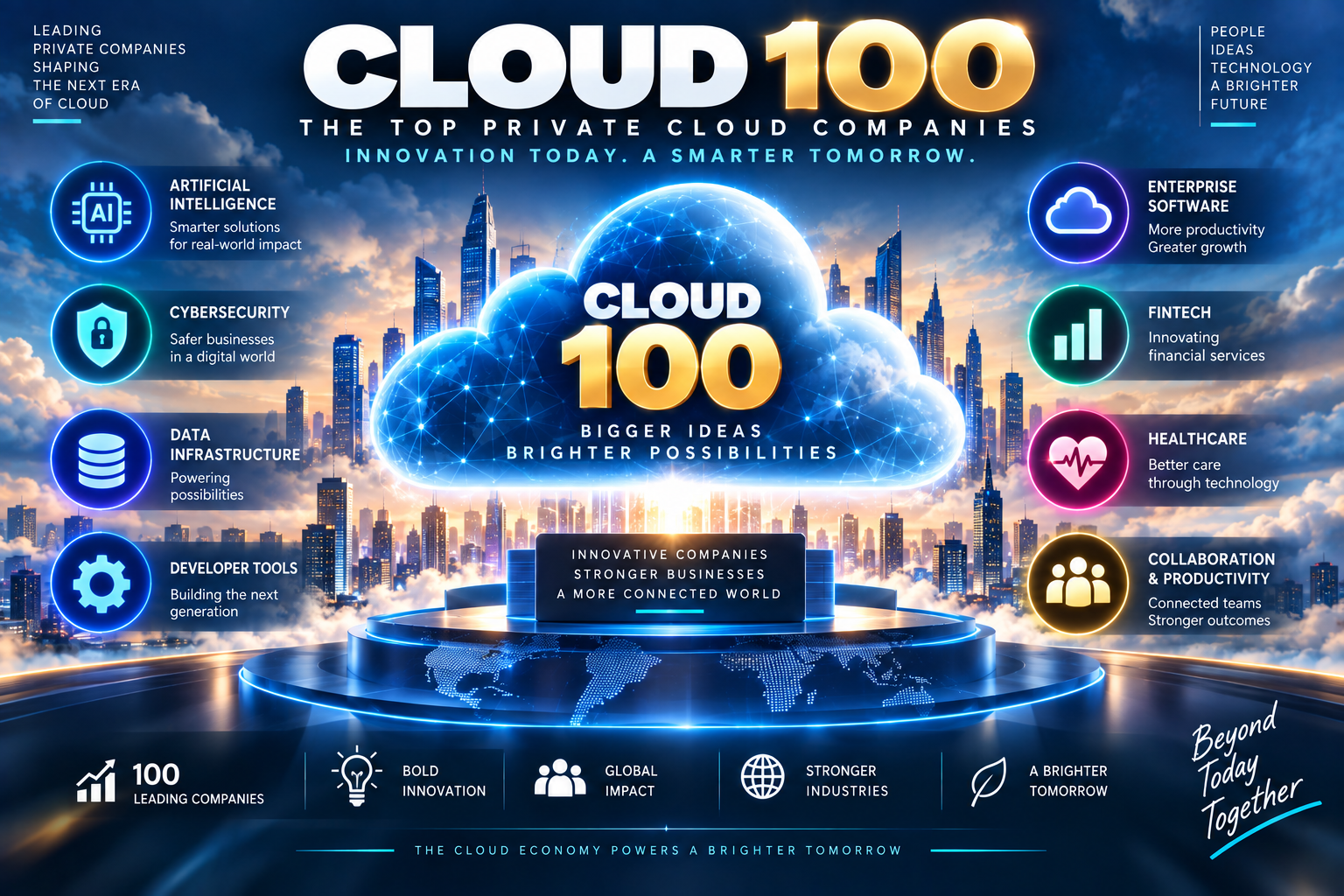
The Cloud 100 has become one of the most recognized rankings for identifying leading private cloud companies. The annual list highlights companies that are helping shape the future of cloud technology and the broader software industry.
The Cloud 100 is produced through a collaboration involving Forbes, Bessemer Venture Partners, and Salesforce Ventures. Since its launch, the ranking has recognized private companies that have demonstrated strong growth, innovation, and potential within the cloud economy.
What Is the Cloud 100?
The Cloud 100 is an annual ranking focused on the world's top private cloud companies.
Rather than ranking traditional public technology giants, the list focuses on privately held businesses that are building important products and services around cloud computing.
These companies operate across a wide range of categories. Some provide enterprise software, while others focus on cybersecurity, artificial intelligence, financial technology, data infrastructure, developer tools, collaboration, marketing technology, and other areas.
The ranking provides investors, entrepreneurs, technology professionals, and business leaders with a way to understand which private companies are making a significant impact on the cloud industry.
Why the Cloud 100 Matters
The cloud industry is highly competitive. Thousands of startups and technology companies are developing cloud-based products, but only a relatively small number achieve exceptional levels of growth and market influence.
The Cloud 100 provides a snapshot of companies that have reached a notable level of success.
For startups, being included can provide credibility and visibility. Recognition can help companies attract customers, employees, investors, and additional business opportunities.
For investors, the list can offer insight into emerging technology categories and companies that may become major players in the future.
For established businesses, the ranking can reveal technologies and trends that may influence their industries.
The Growth of Cloud Technology
Cloud computing has changed how organizations build and operate technology.
Traditional businesses often needed to purchase physical servers, storage systems, networking equipment, and software before launching digital services.
Cloud computing introduced a more flexible approach. Organizations can access computing resources over the internet and scale those resources according to their needs.
Cloud technology can include infrastructure, platforms, software applications, databases, analytics, security services, and artificial intelligence capabilities.
This flexibility has helped create an enormous market for cloud-based software companies.
Cloud 100 and Artificial Intelligence
Artificial intelligence has become one of the most important forces influencing the cloud industry.
AI requires computing power, data infrastructure, software platforms, and specialized tools. Cloud companies are increasingly incorporating AI into their products and services.
AI can improve productivity, automate business processes, analyze information, enhance cybersecurity, and create new customer experiences.
The rise of generative AI has accelerated this transformation.
Companies can now build AI-powered products that generate text, images, software code, analysis, recommendations, and other forms of digital content.
As a result, the boundary between cloud computing and AI is becoming increasingly interconnected.
AI-Native Cloud Companies
A growing number of technology companies are being built around AI from the beginning.
These businesses may use cloud infrastructure to deliver intelligent software services to customers without requiring those customers to build their own AI systems.
AI-native companies can focus on specific industries or business problems.
For example, one company may develop AI tools for financial analysis, another may focus on healthcare, while another may create AI-powered cybersecurity products.
This specialization can allow startups to compete with larger companies by solving specific problems more effectively.
Cloud Software and Enterprise Technology
Enterprise software is a major part of the cloud economy.
Businesses use cloud applications for accounting, customer relationship management, human resources, marketing, communication, project management, data analysis, and many other functions.
Cloud-based enterprise software can make it easier for organizations to deploy new tools without installing and maintaining every application on local infrastructure.
Companies recognized by the Cloud 100 often operate in these markets, developing software designed to improve business productivity and efficiency.
Cybersecurity and the Cloud
As businesses move more systems and information into cloud environments, cybersecurity has become increasingly important.
Cloud companies are developing technologies designed to protect applications, data, identities, networks, and users.
Modern cybersecurity platforms may use artificial intelligence and machine learning to identify unusual behavior and detect potential threats.
Cloud security companies can also help businesses manage access permissions, monitor systems, identify vulnerabilities, and protect sensitive information.
The growth of cloud computing therefore creates opportunities not only for cloud software companies but also for cybersecurity businesses.
Data Infrastructure
Data is another important component of the cloud economy.
Businesses generate enormous quantities of information through transactions, customer interactions, applications, websites, connected devices, and internal systems.
Companies need reliable infrastructure to store, process, analyze, and secure this information.
Cloud data platforms can provide organizations with scalable tools for managing large datasets.
Data infrastructure companies therefore play an important role in the development of artificial intelligence and modern business analytics.
Without reliable data systems, many AI and digital applications would be difficult to operate at scale.
Developer Tools and Cloud Innovation
Software developers are another important market for cloud companies.
Developers need tools for writing, testing, deploying, monitoring, and maintaining applications.
Cloud platforms can provide development environments, databases, APIs, security tools, analytics, and deployment services.
Startups focused on developer tools can help software teams become more productive.
The increasing popularity of AI-assisted software development is creating another major opportunity.
AI coding systems can help developers generate code, identify errors, write documentation, and automate certain parts of the development process.
Cloud 100 and Fintech
Financial technology has also benefited from cloud computing.
Fintech companies can use cloud infrastructure to build digital banking services, payment platforms, financial management tools, insurance applications, and other products.
Cloud infrastructure can provide the scalability needed to support growing customer bases.
However, financial companies also face strict requirements around security, privacy, reliability, and compliance.
Cloud technology therefore needs to be combined with strong risk management and cybersecurity.
Cloud Companies and Healthcare
Healthcare is another sector experiencing significant cloud transformation.
Healthcare organizations generate large amounts of information through medical records, research, imaging, laboratory systems, and administrative processes.
Cloud platforms can support data storage, collaboration, analytics, research, and digital healthcare applications.
AI can further expand these capabilities by helping analyze large datasets and support research.
However, healthcare companies must pay particular attention to privacy and security because medical information is highly sensitive.
The Importance of Private Cloud Companies
One reason the Cloud 100 attracts attention is its focus on private companies.
Private companies can remain outside public stock markets while they develop their products, expand their customer bases, and build their businesses.
Some private cloud companies eventually become public companies through initial public offerings.
Others may be acquired by larger technology organizations.
The Cloud 100 can therefore provide a view of companies that may influence the next generation of the technology industry.
What Makes a Successful Cloud Company?
Being successful in the cloud industry requires more than having an innovative product.
Companies need strong leadership, talented employees, reliable technology, customer demand, effective sales strategies, and the ability to scale.
Customer retention is particularly important for cloud software businesses.
Because many cloud companies operate through subscription models, long-term customer relationships can be essential to sustainable growth.
A successful cloud company must continually improve its product while maintaining security, reliability, and customer trust.
The Subscription Economy
Cloud computing helped accelerate the growth of subscription-based software.
Instead of purchasing software once and installing it permanently, customers can subscribe to cloud applications and receive continuous updates.
This model can provide predictable recurring revenue for software companies while giving customers access to continually improving services.
Subscription businesses must, however, demonstrate ongoing value.
If customers do not believe a service is useful, they can often cancel their subscriptions more easily than with traditional software purchases.
Cloud 100 and Startups
Startups are central to innovation in the cloud industry.
A small company can identify an underserved market and develop a specialized cloud product for it.
If the product succeeds, the company can expand rapidly because cloud infrastructure makes it easier to serve customers across different regions.
This scalability is one of the reasons cloud technology has become such an attractive environment for startups.
Entrepreneurs can focus on developing products while relying on cloud infrastructure for much of the underlying computing capacity.
Challenges Facing Cloud Companies
The cloud industry also faces significant challenges.
Competition is intense. Large technology companies have enormous resources and can enter new markets quickly.
Security is another major concern. A significant security incident can damage customer trust and a company's reputation.
Cloud companies also need to manage infrastructure costs carefully, particularly when their products depend heavily on computing resources.
AI introduces additional challenges because advanced models can require substantial computing power and specialized infrastructure.
Regulation and data privacy are also becoming increasingly important as cloud companies handle more sensitive information.
The Future of the Cloud 100
The future of the Cloud 100 will likely reflect the continued convergence of cloud computing and artificial intelligence.
AI infrastructure, AI-powered applications, cybersecurity, data platforms, developer tools, and enterprise automation are likely to remain important areas of innovation.
Agentic AI could also influence the next generation of cloud companies.
AI agents can potentially interact with software, databases, and business tools to complete multi-step workflows.
This could create entirely new categories of cloud applications built around autonomous or semi-autonomous digital workers.
Cloud Technology and Global Business
Cloud computing has made it easier for technology companies to reach customers around the world.
A cloud application can potentially serve customers in multiple markets without requiring a traditional physical presence in every location.
This has helped create a more global technology economy.
Startups from different countries can compete for international customers and investment, while businesses can adopt cloud applications developed anywhere in the world.
The result is an increasingly interconnected digital ecosystem.
What Businesses Can Learn From Cloud 100 Companies
Businesses can learn several important lessons from successful cloud companies.
First, solving a genuine customer problem is more important than simply adopting the latest technology.
Second, scalability matters. Products should be designed to grow as customer demand increases.
Third, security and reliability are essential. Customers expect cloud applications to protect their information and remain available.
Finally, innovation must be continuous.
Cloud technology evolves quickly, and companies that stop improving their products can quickly lose their competitive position.
Conclusion
The Cloud 100 represents an important part of the evolving technology landscape.
The companies recognized through the ranking demonstrate how cloud computing has expanded beyond basic infrastructure into a much broader ecosystem involving artificial intelligence, cybersecurity, enterprise software, data, fintech, healthcare, developer tools, and automation.
The cloud has changed how businesses build technology, and AI is now accelerating that transformation.
As cloud platforms become more intelligent and AI becomes more deeply integrated into software, a new generation of technology companies will continue to emerge.
For entrepreneurs, investors, businesses, and technology professionals, the Cloud 100 offers a valuable window into the companies and ideas shaping the next stage of digital innovation.
The future of cloud computing will not simply be about storing information online. It will increasingly be about creating intelligent, scalable, connected systems that help organizations work faster, make better decisions, and build new products.
The companies leading this transformation today could become some of the defining technology businesses of tomorrow.
Frequently Asked Questions About Cloud 100
1. What is the Cloud 100?
The Cloud 100 is an annual ranking recognizing leading private cloud companies around the world.
2. Who publishes the Cloud 100?
The Cloud 100 is a collaboration between Forbes, Bessemer Venture Partners, and Salesforce Ventures.
3. Why is the Cloud 100 important?
The ranking highlights private companies that are making a significant impact on cloud technology and can provide insight into emerging technology trends.
4. What types of companies appear on the Cloud 100?
Companies can operate across areas such as enterprise software, artificial intelligence, cybersecurity, data infrastructure, fintech, developer tools, collaboration, and other cloud-related technologies.
5. How is AI changing the Cloud 100?
AI is becoming increasingly important across cloud technology, from AI-native software and infrastructure to cybersecurity, analytics, automation, and enterprise applications.
6. Are Cloud 100 companies public or private?
The Cloud 100 focuses on private companies rather than publicly traded technology companies.
7. Can a Cloud 100 company become public?
Yes. Some successful private cloud companies eventually pursue an IPO or are acquired by larger companies.
8. Why do startups benefit from cloud computing?
Cloud infrastructure allows startups to access computing resources without building extensive physical infrastructure, making it easier to develop and scale digital products.
9. What industries are being transformed by cloud companies?
Cloud technology is transforming industries including finance, healthcare, retail, manufacturing, cybersecurity, education, transportation, marketing, and enterprise services.
10. What is the future of Cloud 100 companies?
The future is likely to be shaped by artificial intelligence, agentic AI, cybersecurity, data infrastructure, automation, developer tools, and increasingly intelligent cloud applications.