Malaysia has produced some of Southeast Asia’s most influential entrepreneurs, investors, industrialists, property developers, retailers, and business families. From commodities and palm oil to aluminum, property, retail, banking, healthcare, telecommunications, and technology, the country’s wealthiest people have built businesses that operate across Malaysia and international markets.
According to Forbes’ 2026 Malaysia’s 50 Richest list, the combined wealth of the country’s 50 richest rose nearly 30% to approximately US$116 billion, compared with US$90 billion a year earlier. Forbes attributed the increase to Malaysia’s economic expansion, a stronger ringgit, and an active initial public offering market.
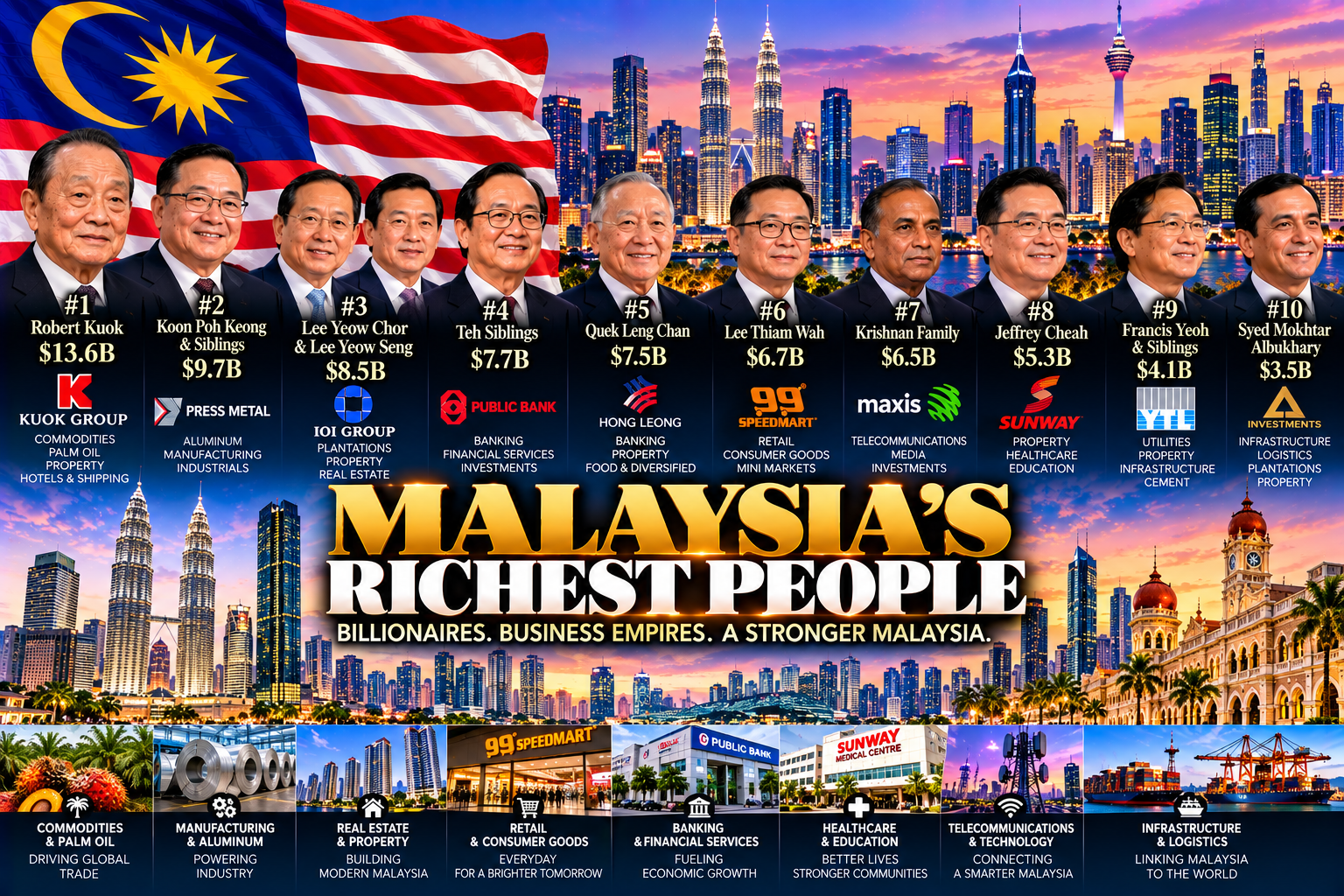
Robert Kuok retained the No. 1 position with an estimated US$13.6 billion on Forbes’ 2026 annual list. Koon Poh Keong and his siblings ranked second with US$9.7 billion, while brothers Lee Yeow Chor and Lee Yeow Seng ranked third with US$8.5 billion.
Who Are Malaysia’s Richest People?
The 2026 Forbes Malaysia list highlights a diverse group of entrepreneurs and business families. Their fortunes come from industries ranging from commodities and aluminum to retail, property, finance, healthcare, telecommunications, and infrastructure.
Malaysia’s Top 10 Richest People and Families in 2026
Rank | Name | Estimated Wealth |
|---|---|---|
1 | Robert Kuok | US$13.6 billion |
2 | Koon Poh Keong & siblings | US$9.7 billion |
3 | Lee Yeow Chor & Lee Yeow Seng | US$8.5 billion |
4 | Teh siblings | US$7.7 billion |
5 | Quek Leng Chan | US$7.5 billion |
6 | Lee Thiam Wah | US$6.7 billion |
7 | Krishnan family | US$6.5 billion |
8 | Jeffrey Cheah | US$5.3 billion |
9 | Francis Yeoh & siblings | US$4.1 billion |
10 | Syed Mokhtar Albukhary | US$3.5 billion |
These figures are from Forbes’ 2026 annual Malaysia list, which used stock prices and exchange rates as of March 27, 2026, with private companies valued using comparable publicly traded businesses.
1. Robert Kuok: Malaysia’s Wealthiest Businessman
Robert Kuok retained the top position on Malaysia’s 2026 rich list with an estimated fortune of US$13.6 billion.
His business empire, Kuok Group, has interests in commodities, property, hotels, shipping, logistics, and other businesses. Kuok also founded the Shangri-La Hotels and Resorts chain in 1971.
His business career began in commodity trading, including rice, sugar, and wheat flour. Over the decades, his interests expanded into a multinational network of businesses.
Forbes identifies palm oil, shipping, property, and commodities as major sources of his wealth. His family has also remained active in international investments, including property and newer areas such as AI data centers.
2. Koon Poh Keong and His Siblings: Aluminum and Manufacturing
Koon Poh Keong and his siblings ranked second in Malaysia in 2026 with a combined estimated fortune of US$9.7 billion.
The family controls Press Metal Aluminium Holdings, which Forbes describes as Southeast Asia’s largest integrated aluminum producer.
The company has benefited from demand connected to industries such as electric vehicles and AI data centers. Forbes reported that Press Metal’s shares rose strongly during the period used for the 2026 wealth calculations, helping the brothers become the largest dollar gainers on the Malaysian list.
Koon Poh Keong serves as group CEO, while other members of the family hold executive roles within the company.
3. Lee Yeow Chor and Lee Yeow Seng: Property and Plantations
Brothers Lee Yeow Chor and Lee Yeow Seng ranked third with an estimated combined wealth of US$8.5 billion.
They are associated with IOI Group, a major Malaysian business involved in property development and plantations.
Their rise in the 2026 ranking was linked partly to developments surrounding IOI’s real estate investment trust plans. Forbes reported that their wealth increased significantly during the year measured for the list.
Their businesses demonstrate how Malaysia’s traditional plantation sector can intersect with modern property development and capital markets.
4. Teh Siblings: Banking and Financial Services
The Teh siblings ranked fourth on Forbes’ 2026 Malaysia list with a combined estimated fortune of US$7.7 billion.
Their wealth is associated with the banking and financial-services sector, highlighting the importance of Malaysia’s financial institutions in the country’s billionaire economy.
Banking fortunes can be particularly sensitive to share prices, interest-rate conditions, economic growth, credit demand, and changes in investor expectations.
5. Quek Leng Chan: Banking, Property and Diversification
Quek Leng Chan ranked fifth with approximately US$7.5 billion on Forbes’ 2026 Malaysia list.
He is executive chairman of privately held Hong Leong Co. (Malaysia), which has interests in finance, food, and property. Forbes identifies banking and property as major sources of his wealth.
The Hong Leong business network illustrates the role of diversification in Malaysia’s corporate landscape, with interests extending across multiple industries rather than depending on one business sector.
6. Lee Thiam Wah: The 99 Speedmart Retail Empire
Lee Thiam Wah ranked sixth with an estimated US$6.7 billion.
He is the founder and CEO of 99 Speed Mart Retail Holdings, one of Malaysia’s largest mini-market operators by number of stores.
Lee opened his first shop in 1987 and later developed the 99 Speedmart chain. The company expanded dramatically and went public on Bursa Malaysia in 2024, raising approximately US$532 million through its IPO. Forbes says the chain has expanded to more than 3,000 outlets.
His story demonstrates the potential for large-scale wealth creation through everyday consumer retail and nationwide distribution.
7. Krishnan Family: Telecommunications and Investments
The Krishnan family ranked seventh with an estimated US$6.5 billion.
The family name has historically been associated with telecommunications, media, energy, and investment businesses. Malaysia’s telecommunications industry has been particularly important in the development of large corporate fortunes.
It is important to distinguish the current 2026 Forbes listing from older references to Malaysian billionaire Ananda Krishnan personally. Ananda Krishnan died in 2024, and his wealth and business interests have since transitioned into the broader family context.
8. Jeffrey Cheah: Property, Healthcare and Education
Jeffrey Cheah ranked eighth on Forbes’ 2026 Malaysia list with an estimated US$5.3 billion.
He is the founder and executive chairman of Sunway Group. What began as a tin-mining business developed into a diversified group with interests in property, healthcare, education, infrastructure, hospitality, and other sectors.
Sunway Healthcare raised approximately US$736 million through its March 2026 IPO, according to Forbes. The group operates hospitals and continues to expand its healthcare activities.
Cheah’s wealth illustrates the transformation of Malaysia’s property-development industry into broader integrated ecosystems combining residential communities, shopping centers, hospitals, universities, hotels, and infrastructure.
9. Francis Yeoh and Siblings: Utilities, Property and Infrastructure
Francis Yeoh and his siblings ranked ninth with a combined estimated fortune of US$4.1 billion.
The family controls interests associated with YTL Corporation, a diversified Malaysian conglomerate involved in utilities, property, hotels, cement, and infrastructure.
YTL has also expanded internationally. Forbes has reported that YTL Cement expanded its cement operations across Asia, Europe, and the Middle East, while YTL Corporation has invested in technology infrastructure and data centers.
The group’s interests demonstrate how Malaysia’s established conglomerates are adapting to infrastructure and technology-related opportunities.
10. Syed Mokhtar Albukhary: Diversified Business Interests
Syed Mokhtar Albukhary ranked tenth with an estimated fortune of US$3.5 billion.
His business interests have included infrastructure, logistics, ports, transportation, plantations, property, and other strategic industries.
Diversified business groups such as this can benefit from exposure to multiple areas of the Malaysian economy, while also facing different risks across sectors.
Malaysia’s Billionaire Economy Is Highly Diverse
Malaysia’s wealthiest people are not concentrated in just one industry.
Several major sectors contribute to the country’s billionaire economy.
Commodities and Palm Oil
Palm oil remains an important part of Malaysia’s economy. Large business groups have developed interests in plantations, processing, trading, and related industries.
Robert Kuok’s business history is one example of how commodity trading can become the foundation for a much broader multinational enterprise.
Aluminum and Industrial Manufacturing
The rise of Koon Poh Keong and his siblings highlights Malaysia’s role in industrial manufacturing.
Press Metal has become a major aluminum producer, and demand from electric vehicles, renewable-energy infrastructure, construction, and data centers can influence the outlook for aluminum producers.
Retail and Consumer Businesses
Retail has created another important source of billionaire wealth.
Lee Thiam Wah’s 99 Speedmart demonstrates how a large physical retail network can become a major publicly traded business. The company's expansion reflects continuing demand for affordable everyday consumer products.
New businesses are also entering Malaysia’s rich list. Forbes reported that Eco-Shop cofounder Lee Kar Whatt debuted on the 2026 list after the company’s 2025 IPO.
Real Estate
Property remains a major wealth-creation sector in Malaysia.
Major fortunes are connected to residential developments, commercial buildings, shopping centers, hotels, integrated townships, and other property assets.
Jeffrey Cheah’s Sunway is an example of a diversified property-centered business that has expanded into healthcare, education, infrastructure, and hospitality.
Banking and Finance
Banking has produced several Malaysian billionaire families.
Financial institutions can generate wealth through equity ownership, lending, investment management, insurance, and other financial services.
However, bank-related fortunes can also change as interest rates, loan growth, economic conditions, and financial-market valuations change.
Healthcare and Education
Healthcare and education are becoming increasingly important components of Malaysia’s diversified business landscape.
Sunway’s expansion into healthcare and education shows how established property groups can build integrated business ecosystems around growing consumer needs.
Technology and AI Infrastructure
Artificial intelligence is beginning to influence traditional industries as well.
Forbes highlighted how demand from AI data centers has contributed to opportunities for aluminum producers and infrastructure companies. The technology boom can therefore affect wealth beyond traditional technology companies.
Malaysia’s location in Southeast Asia also makes it relevant to data centers, electronics manufacturing, logistics, and regional technology infrastructure.
Why Malaysia’s Richest People Rankings Change
Billionaire rankings are not fixed.
Most publicly traded billionaires own substantial amounts of company stock. If the share price rises, their estimated wealth can increase. If the stock falls, their estimated wealth can decline.
Currency movements can also have a significant effect because Forbes calculates wealth in U.S. dollars.
Private companies introduce another layer of uncertainty because their estimated values are generally based on comparable publicly traded companies and other financial information.
Forbes’ 2026 Malaysia list used market prices and exchange rates from March 27, 2026, meaning the annual ranking represents a specific valuation date rather than a permanent measure of wealth.
Malaysia’s Richest People and Global Business
Many Malaysian billionaires have business interests that extend beyond the country.
Robert Kuok’s business network includes international property, hospitality, commodities, shipping, and other investments.
YTL has expanded into international cement, utilities, hotels, property, and technology infrastructure.
Other Malaysian business groups operate across Southeast Asia and global supply chains.
This international exposure means that Malaysian billionaire fortunes can be influenced by global commodity prices, international trade, foreign exchange movements, technology investment, tourism, and regional economic growth.
The Role of IPOs in Malaysia’s Wealth Creation
Initial public offerings have become an important factor in Malaysia’s billionaire landscape.
Forbes reported that Malaysia had around 60 new listings in 2025, contributing to a strong IPO environment. The 2026 rich list also included entrepreneurs whose wealth increased after their companies entered the public markets.
Public listings can provide founders and early investors with liquidity while also creating a transparent market valuation for their ownership stakes.
However, publicly traded wealth can fluctuate considerably because market capitalization changes every trading day.
Family Businesses and Generational Wealth
Family ownership remains a significant feature of Malaysia’s corporate economy.
Several of the country’s richest fortunes involve siblings, children, or multiple generations participating in business operations.
Robert Kuok’s family, for example, remains active across several companies and investment areas. Forbes notes that members of the next generation have leadership roles in businesses connected with the broader Kuok network.
Family businesses can provide continuity, but they also require effective succession planning, professional management, and adaptation to changing markets.
Malaysia’s Wealthiest People and the Future
Malaysia’s billionaire economy is likely to remain connected to several major themes: industrial manufacturing, infrastructure, property, consumer spending, technology, healthcare, data centers, energy, and international trade.
AI and digital infrastructure could create new opportunities for businesses supplying power, aluminum, construction, data-center equipment, telecommunications, and real estate.
At the same time, established sectors such as commodities, plantations, banking, retail, and property will continue to influence the country's business landscape.
New entrepreneurs can also enter the billionaire rankings as companies grow, attract investment, or list on public exchanges.
Final Thoughts
Malaysia’s richest people represent a diverse collection of entrepreneurs, investors, families, and corporate leaders.
Robert Kuok remains the leading name on Forbes’ 2026 Malaysia 50 Richest list, while Koon Poh Keong and his siblings, the Lee brothers, the Teh family, Quek Leng Chan, Lee Thiam Wah, Jeffrey Cheah, Francis Yeoh and others demonstrate the diversity of Malaysian wealth.
Their fortunes span commodities, aluminum, plantations, retail, banking, property, healthcare, infrastructure, technology, and international business.
Forbes’ 2026 list estimates that Malaysia’s 50 richest collectively hold around US$116 billion, showing the significant role that large private and public businesses play in the Malaysian economy.
FAQs
Who is the richest person in Malaysia in 2026?
Robert Kuok is No. 1 on Forbes’ 2026 Malaysia’s 50 Richest list, with an estimated fortune of US$13.6 billion at the list’s valuation date.
How much are Malaysia’s 50 richest people worth?
Forbes estimates that Malaysia’s 50 richest collectively held approximately US$116 billion in 2026.
What industries create the most billionaire wealth in Malaysia?
Major sources include commodities, plantations, aluminum, property, banking, retail, infrastructure, healthcare, telecommunications, manufacturing, and technology.
Is Robert Kuok still Malaysia’s richest person?
Yes. Forbes’ 2026 Malaysia list retained Robert Kuok at No. 1. His wealth was estimated at US$13.6 billion for the annual ranking.
Who are Malaysia’s richest entrepreneurs?
The 2026 list includes Robert Kuok, Koon Poh Keong and siblings, Lee Yeow Chor and Lee Yeow Seng, Lee Thiam Wah, Jeffrey Cheah, Francis Yeoh and other major Malaysian business figures and families.
How does Forbes calculate billionaire wealth?
Forbes generally uses publicly traded share prices and exchange rates on a specified valuation date. Private businesses can be valued using comparable publicly traded companies and other financial information.
Can billionaire rankings change?
Yes. Changes in stock prices, currency exchange rates, private-company valuations, business performance, acquisitions, IPOs, and other factors can significantly change estimated fortunes.
What is Malaysia known for in billionaire business?
Malaysia’s wealthiest business groups have major interests in commodities, palm oil, property, retail, banking, manufacturing, aluminum, infrastructure, healthcare, telecommunications, hospitality, and technology.