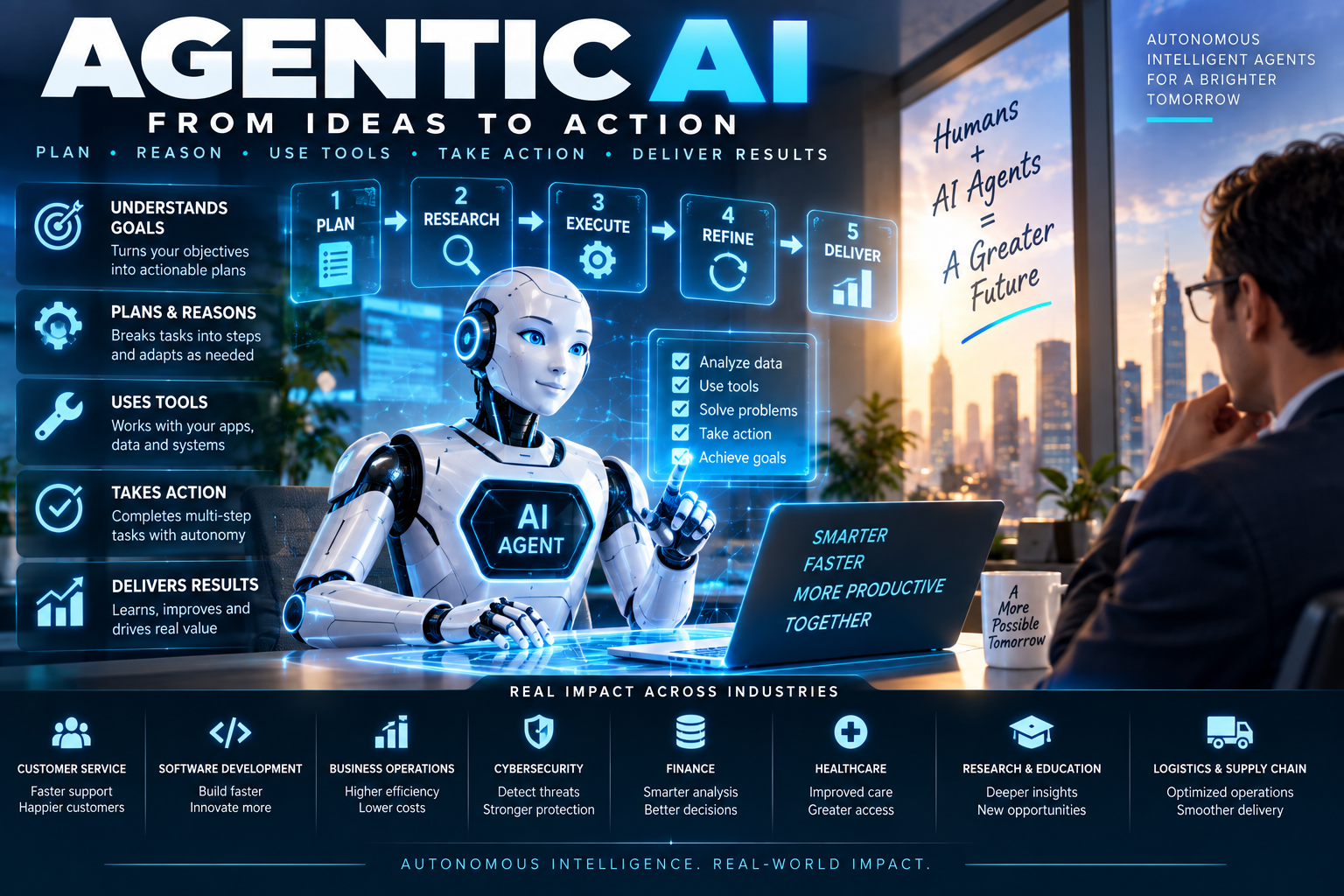
Artificial intelligence is entering a new phase. Traditional AI systems are primarily designed to answer questions, analyze information, make predictions, or generate content. A newer approach, known as Agentic AI, aims to go further by enabling AI systems to plan, make decisions, use tools, and complete multi-step tasks with a greater degree of autonomy.
Agentic AI has attracted growing attention because it could change how people interact with software and how businesses organize their operations. Instead of simply asking an AI system to provide information, users may increasingly give an AI agent a goal and allow it to determine the steps required to accomplish that goal.
This shift could transform customer service, software development, finance, research, marketing, cybersecurity, logistics, and many other industries.
What Is Agentic AI?
Agentic AI refers to AI systems designed to pursue goals by taking actions across multiple steps rather than simply producing a single response.
An AI agent may receive an objective, analyze the available information, create a plan, use connected tools, evaluate results, and adjust its approach when necessary.
For example, a traditional AI assistant might answer a question about a business report. An agentic AI system could potentially analyze the report, identify important trends, compare them with other approved data sources, prepare a summary, and organize the findings into a presentation.
The key idea is action-oriented intelligence.
Agentic AI does not necessarily mean completely independent AI. In many practical applications, agents operate within clearly defined permissions, rules, and approval systems.
How Does Agentic AI Work?
Agentic AI generally combines several technologies and capabilities.
Goal Understanding
The system first needs to understand what the user or organization wants to accomplish.
A goal might be finding information, resolving a customer request, analyzing business data, managing a workflow, or completing a software task.
Planning
Instead of immediately producing an answer, an AI agent can break a larger objective into smaller steps.
For example, if the goal is to prepare a market report, the agent may determine that it needs to collect relevant data, analyze the information, identify trends, and produce a final report.
Tool Use
One of the most important characteristics of agentic AI is the ability to interact with external tools.
Depending on its permissions, an AI agent may work with databases, business software, search systems, APIs, documents, calendars, or other digital services.
Reasoning and Decision-Making
Agents can evaluate information and determine what action should come next.
If one approach fails, an agent may attempt an alternative route rather than simply stopping.
Memory and Context
Some agentic systems can maintain relevant information throughout a task or workflow.
This allows the system to understand previous actions and avoid repeatedly starting from the beginning.
Feedback and Adaptation
An agent can evaluate the results of its actions and modify its plan when necessary.
This makes agentic AI different from simple automation, where a predefined sequence usually executes without significant adaptation.
Agentic AI vs Traditional AI
Traditional AI and agentic AI can both be useful, but they serve different purposes.
A conventional AI chatbot may respond to a question with an explanation. A generative AI system may create an article, image, or piece of code.
An agentic system is designed to take the next step.
For example:
Traditional AI: "Here are five potential suppliers."
Agentic AI: "I identified five approved suppliers, compared their available information, organized the options according to your criteria, and prepared a shortlist for your review."
The distinction is not simply intelligence. It is the ability to plan and act toward a goal.
Agentic AI and Business Automation
Business automation has existed for years, but many traditional automation systems rely on predefined rules.
Agentic AI could make automation more flexible.
For example, an organization may have a customer-service workflow involving emails, databases, internal documentation, and ticketing systems.
Instead of creating a separate rigid automation for every possible situation, an AI agent could potentially interpret the customer's request, retrieve relevant information, determine the appropriate workflow, and escalate unusual cases to an employee.
This could reduce repetitive work while allowing employees to focus on complex problems.
Agentic AI in Customer Service
Customer service is one of the areas where agentic AI could have a major impact.
A basic chatbot may answer frequently asked questions. An AI agent could potentially handle a more complete workflow.
For example, an agent could understand a customer's request, check an approved order system, identify the problem, suggest an appropriate solution, update a support ticket, and escalate the case if human intervention is required.
This can create a more seamless customer experience.
However, businesses need to establish clear boundaries. AI agents should not automatically make sensitive decisions or access information beyond what is necessary.
Human escalation remains important for complex or high-impact situations.
Agentic AI in Software Development
Software development is another promising area.
AI coding assistants already help developers generate code, explain programming concepts, identify potential bugs, and create documentation.
Agentic AI can extend these capabilities by working across multiple steps.
For example, a software development agent could receive a task, inspect an existing codebase, identify relevant files, propose changes, generate code, run tests, analyze failures, and refine the implementation.
Developers can then review the work rather than manually performing every repetitive step.
This does not eliminate the need for software engineers. Human developers remain important for architecture, requirements, security, quality assurance, and final decision-making.
Agentic AI in Research
Research often involves collecting information from multiple sources, organizing evidence, comparing findings, and producing structured conclusions.
Agentic AI could assist with these workflows by breaking a research objective into smaller tasks.
An agent might identify relevant sources, organize information, compare findings, and prepare a structured research brief.
Human review remains essential because AI systems can misunderstand information, rely on weak evidence, or produce inaccurate conclusions.
The greatest value may come from using AI to accelerate information-heavy work while keeping humans responsible for important judgments.
Agentic AI in Finance
Financial organizations can potentially use agentic AI for tasks such as data analysis, reporting, customer support, compliance workflows, and operational processes.
For example, an agent could gather information from approved financial systems, identify unusual patterns, prepare a report, and send the findings to an authorized employee for review.
Financial applications require particularly strong safeguards because mistakes can have serious consequences.
Access controls, audit logs, approval requirements, and human oversight can help reduce the risks associated with autonomous actions.
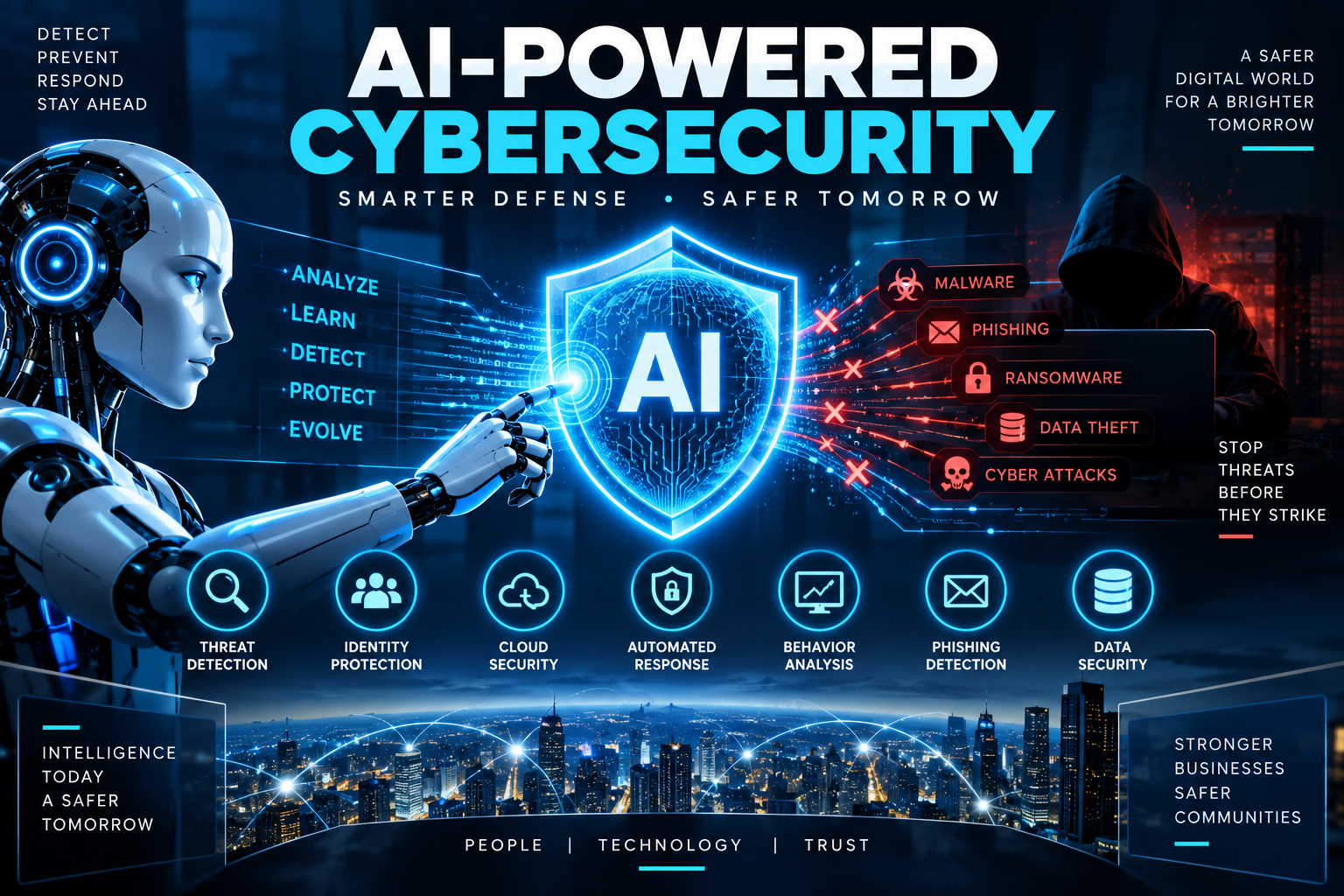
Agentic AI in Cybersecurity
Cybersecurity teams face enormous quantities of alerts and security information.
Agentic AI could help analysts investigate potential threats by collecting relevant information, correlating security events, examining system activity, and preparing incident summaries.
In carefully controlled environments, agents may also be able to recommend or execute certain defensive actions.
However, cybersecurity agents themselves must be protected. If an attacker gains control of an AI agent, the system could potentially become a security risk.
For this reason, permissions, authentication, monitoring, and strict tool access are essential.
Agentic AI and Healthcare
Healthcare contains many administrative and information-intensive workflows that could benefit from AI assistance.
Agentic systems could potentially help coordinate administrative tasks, organize information, assist with scheduling, summarize approved documents, or support research workflows.
High-stakes medical decisions require additional caution. AI agents should not be treated as independent replacements for qualified healthcare professionals.
Privacy, accuracy, security, and regulatory requirements are particularly important in healthcare environments.
Agentic AI and the Future of Work
Agentic AI could change how employees interact with software.
Instead of opening several applications and manually moving information between them, employees may increasingly communicate with AI agents that coordinate multiple tools.
This could create a shift from software as individual applications toward software as intelligent services that work together.
Employees may spend less time navigating interfaces and more time defining goals, reviewing results, solving complex problems, and making decisions.
This could also create new roles involving AI supervision, agent management, workflow design, governance, and AI security.
Benefits of Agentic AI
Agentic AI has several potential advantages.
Greater Productivity
Agents can potentially handle multi-step workflows and reduce repetitive manual work.
Faster Execution
AI systems can operate quickly and process information across multiple sources.
Better Scalability
Organizations may be able to automate large volumes of routine workflows without expanding teams at the same rate.
Personalized Experiences
Agents can potentially adapt workflows based on individual customer or employee needs.
Continuous Operation
AI systems can operate outside traditional working hours, depending on the application and organizational requirements.
Improved Employee Focus
By handling repetitive tasks, agents may allow employees to spend more time on strategic and creative work.
Challenges and Risks
Agentic AI also introduces significant challenges.
Hallucinations and Errors
AI agents can make incorrect assumptions or generate inaccurate information. If an agent can take actions, an incorrect assumption could have greater consequences than a simple wrong answer.
Excessive Autonomy
Giving an AI system too many permissions can create unnecessary risks.
Agents should only have access to the tools and information required for their assigned tasks.
Security
AI agents connected to business systems can become potential targets for attackers.
Strong authentication, access controls, monitoring, and security testing are essential.
Privacy
Agents may process sensitive business or personal information. Organizations must establish clear rules for data access and handling.
Lack of Transparency
Businesses may find it difficult to understand why an agent made a particular decision if workflows are not properly logged and monitored.
Human Oversight
Important actions may require human approval, particularly when they involve financial transactions, sensitive information, legal matters, or significant customer impact.
Agentic AI vs Automation
Traditional automation generally follows predefined instructions.
For example:
"If an email arrives, move it to this folder."
Agentic AI can operate with a broader objective:
"Review incoming customer requests, identify their category, gather relevant information, resolve standard cases, and escalate unusual cases."
The first system follows fixed rules. The second has greater flexibility in deciding how to achieve a goal.
However, traditional automation remains valuable. Predictable processes may be better handled through conventional automation because it can be easier to test, control, and audit.
The future may involve both approaches working together.
How Businesses Can Adopt Agentic AI
Organizations should begin with specific, measurable use cases rather than attempting to automate everything at once.
A company might start with internal research, document processing, customer-service assistance, or workflow coordination.
Before deploying an agent, organizations should define:
What the agent is allowed to do
Which data it can access
Which tools it can use
Which actions require approval
How its decisions will be monitored
What happens when something goes wrong
How performance will be measured
Testing in controlled environments can help organizations identify problems before an agent receives broader permissions.
The Future of Agentic AI
The development of agentic AI could represent an important shift in computing.
For decades, people have learned how to operate software applications. In the future, people may increasingly describe what they want accomplished while AI systems determine how to coordinate the necessary tools.
This could make technology more accessible and dramatically change workplace productivity.
AI agents may eventually work together, with specialized agents handling research, analysis, customer service, software development, finance, and other tasks.
However, greater autonomy also requires greater responsibility.
The future of agentic AI will depend on reliable models, secure infrastructure, effective governance, clear permissions, and meaningful human oversight.
Conclusion
Agentic AI represents a significant evolution in artificial intelligence.
Instead of simply generating responses, agentic systems are designed to pursue goals, plan tasks, use tools, evaluate results, and take actions within defined boundaries.
The technology has potential applications across business, customer service, software development, research, finance, cybersecurity, healthcare, and many other industries.
Its greatest value may come from combining machine speed and scalability with human judgment and responsibility.
Agentic AI will not eliminate the need for people. Instead, it may change how people work by allowing employees to focus less on repetitive processes and more on creativity, strategy, relationships, and decision-making.
As organizations experiment with AI agents, the central question will not simply be how much autonomy technology can achieve, but how much autonomy should be given, under what conditions, and with what safeguards.
The companies that answer those questions carefully will be better positioned to benefit from the next generation of artificial intelligence.
Frequently Asked Questions About Agentic AI
1. What is Agentic AI?
Agentic AI refers to AI systems that can pursue goals by planning tasks, using tools, making decisions, evaluating results, and taking multiple actions within defined boundaries.
2. How is Agentic AI different from generative AI?
Generative AI primarily creates content such as text, images, or code. Agentic AI can use generative models as part of a broader system designed to plan and execute multi-step tasks.
3. Can Agentic AI work independently?
Agentic AI can perform tasks with varying levels of autonomy. The degree of independence depends on the system's design, permissions, safeguards, and human oversight.
4. What are AI agents used for?
Potential applications include customer service, research, software development, data analysis, business automation, cybersecurity, finance, logistics, and workflow management.
5. Can Agentic AI replace employees?
Agentic AI may automate certain tasks, but many jobs require human judgment, creativity, communication, accountability, and expertise. AI is more likely to change many roles than simply eliminate all human involvement.
6. What are the benefits of Agentic AI?
Potential benefits include increased productivity, faster workflows, reduced repetitive work, scalable automation, improved information processing, and more personalized services.
7. What are the risks of Agentic AI?
Risks include inaccurate decisions, excessive autonomy, privacy problems, cybersecurity vulnerabilities, unintended actions, poor-quality outputs, and inadequate oversight.
8. Is Agentic AI the same as automation?
No. Traditional automation usually follows predefined rules, while agentic AI can interpret goals, plan steps, adapt to changing circumstances, and select actions within its available tools and permissions.
9. Why is human oversight important?
Human oversight helps ensure that important decisions and actions are reviewed appropriately, especially when errors could have financial, legal, security, or personal consequences.
10. What is the future of Agentic AI?
Agentic AI is likely to become increasingly integrated into business software and digital workflows. AI agents may increasingly coordinate tools and complete complex tasks while operating under organizational rules and human supervision.