Big Data has become one of the most important technologies in the modern digital economy. Businesses generate enormous amounts of information through websites, mobile applications, social media platforms, online transactions, connected devices, and customer interactions. When analyzed effectively, this information helps organizations understand customer behavior, improve operational efficiency, identify market opportunities, and make better business decisions.
Traditional data processing tools may struggle to manage datasets that are extremely large, complex, or generated at high speed. Big Data technologies help organizations collect, store, process, and analyze these datasets to uncover meaningful patterns and actionable insights.
In 2026, Big Data continues to play a significant role in artificial intelligence (AI), machine learning, predictive analytics, digital marketing, cybersecurity, financial services, healthcare, and supply chain management. Companies that develop effective data strategies can use information to improve performance, respond to market changes, and build stronger relationships with customers.
What Is Big Data?
Big Data refers to extremely large, complex, and rapidly generated datasets that require specialized technologies and analytical methods to process effectively. These datasets may include structured information, such as financial records and spreadsheets, as well as unstructured information, such as videos, emails, images, customer reviews, and social media posts.
The primary goal of Big Data is not simply to collect large amounts of information. It is to transform that information into useful knowledge that supports business decisions, innovation, and problem-solving.
For example, an e-commerce company can analyze millions of customer interactions to identify popular products, understand purchasing patterns, forecast demand, and personalize product recommendations.
Similarly, financial institutions can analyze transaction patterns to identify suspicious activity, while manufacturers can examine equipment data to anticipate maintenance requirements.
Big Data combines data storage, distributed computing, cloud platforms, analytics, and machine learning to help organizations process information at scale.
The Five Vs of Big Data
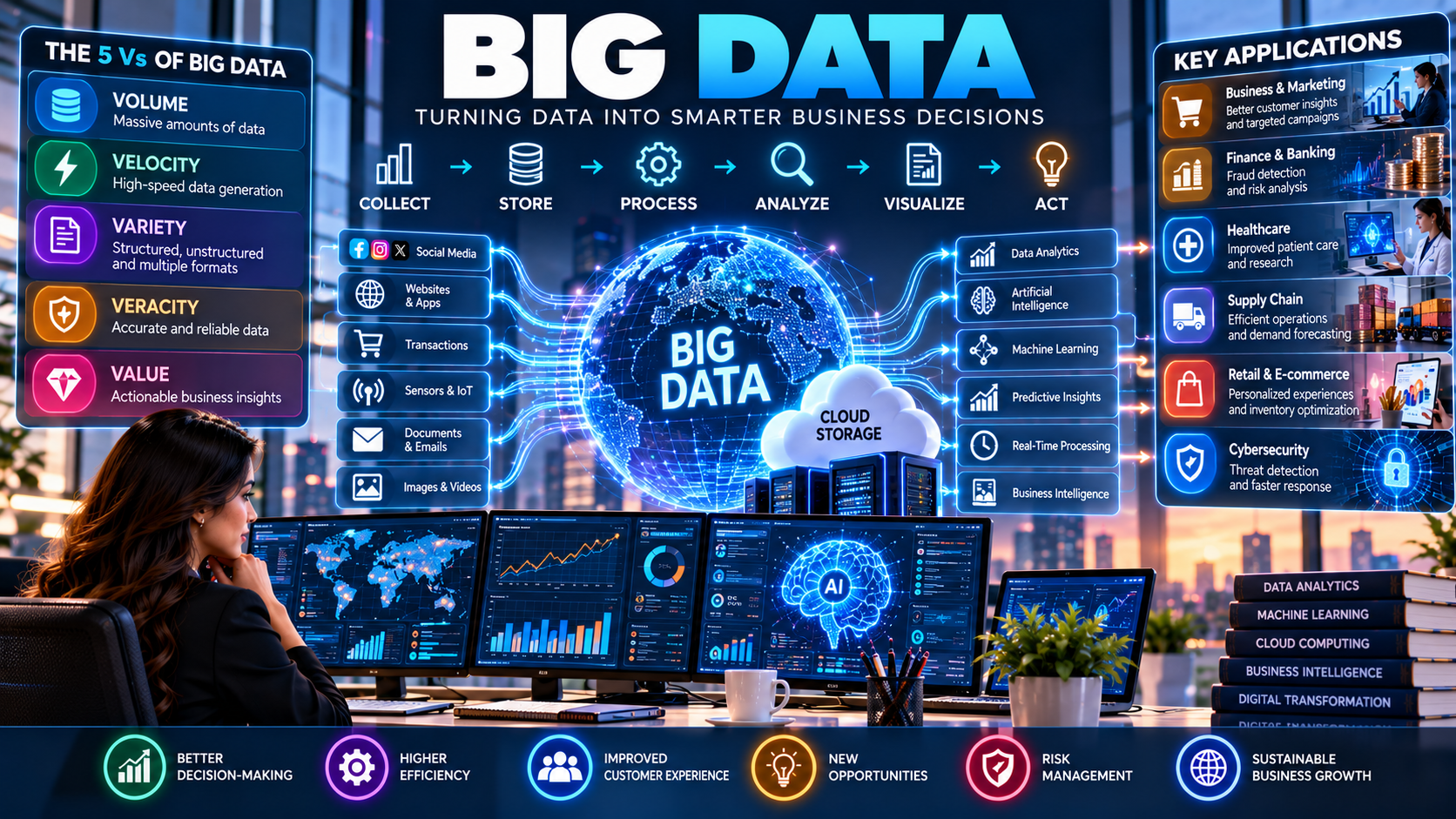
Big Data is commonly explained through five key characteristics known as the Five Vs. These characteristics help businesses understand why large datasets require specialized management and analytical techniques.
1. Volume
Volume refers to the enormous quantity of data generated and collected by organizations. Businesses may manage millions of transactions, customer records, website visits, and digital interactions every day.
Cloud storage, distributed databases, and data lakes help organizations store and manage these growing datasets.
2. Velocity
Velocity describes how quickly data is generated, transmitted, and processed. Online payments, connected devices, stock market activity, and website interactions can produce information continuously.
Real-time analytics enables businesses to respond to important events quickly. For instance, a payment provider may analyze a transaction immediately to identify potential fraud.
3. Variety
Variety refers to the different formats and sources of information. Big Data can include:
Structured data from databases and spreadsheets.
Semi-structured data from JSON files, application logs, and event records.
Unstructured data from images, videos, documents, audio recordings, and social media posts.
Combining these different data types can provide a more complete understanding of business performance and customer behavior.
4. Veracity
Veracity concerns the accuracy, reliability, completeness, and consistency of data. Incorrect, duplicated, outdated, or biased information can lead to misleading conclusions.
Organizations need data validation, quality controls, governance policies, and regular monitoring to improve the reliability of their analysis.
5. Value
Value represents the practical benefit organizations obtain from their data. Collecting information is useful only when it contributes to better decisions or measurable outcomes.
Businesses can create value by reducing costs, improving customer experiences, identifying risks, increasing efficiency, and discovering new revenue opportunities.
How Big Data Works
Big Data systems generally follow a process that transforms raw information into useful insights.
Step 1: Data Collection
Organizations collect information from websites, mobile applications, sales systems, customer relationship management platforms, connected devices, and external data sources.
The information collected should be relevant to a defined business objective and handled according to applicable privacy requirements.
Step 2: Data Storage
Large datasets may be stored in cloud platforms, data lakes, data warehouses, distributed databases, or other suitable storage systems.
The choice depends on factors such as data volume, processing requirements, security needs, accessibility, and budget.
Step 3: Data Processing
Raw data is cleaned, organized, transformed, and prepared for analysis. Processing can occur in batches or continuously through streaming systems.
This stage helps remove inconsistencies and prepares information for reliable analytical work.
Step 4: Data Analysis
Analysts use statistical techniques, dashboards, data mining, and machine learning to identify patterns, relationships, trends, and unusual activity.
The appropriate method depends on the question the business wants to answer.
Step 5: Visualization and Decision-Making
Results are presented through reports, charts, dashboards, forecasts, and recommendations. Business leaders can then use these insights to improve operations and develop strategies.
Step 6: Continuous Improvement
Organizations monitor outcomes and update their data models, processes, and strategies as new information becomes available.
This ongoing process helps businesses evaluate whether their decisions are producing the intended results.
Major Applications of Big Data in Business
Big Data supports a wide range of business activities. Its value depends on how effectively organizations connect data analysis to specific goals.
1. Big Data in Artificial Intelligence
Artificial intelligence systems rely on data to recognize patterns, generate predictions, and support automated decision-making. Large, relevant, and high-quality datasets can help improve the performance of many AI applications.
Businesses use data analytics to support customer service automation, demand forecasting, recommendation systems, document processing, and intelligent workflow management.
When combined with appropriate governance and human oversight, Big Data can help organizations develop more useful AI solutions.
2. Big Data in Digital Marketing
Digital marketers use data from website analytics, advertising campaigns, email engagement, and customer interactions to understand audience behavior.
Big Data analytics can help businesses:
Identify promising customer segments.
Measure advertising performance.
Understand customer journeys.
Personalize marketing messages.
Discover high-performing content topics.
Improve campaign targeting.
Measure conversion rates and customer acquisition costs.
For example, an online retailer can compare product views, purchases, and abandoned shopping carts to identify opportunities for improving its website and marketing campaigns.
3. Big Data in Customer Experience
Understanding customers is essential for building long-term relationships. Businesses can analyze feedback, support requests, purchase history, and service interactions to identify recurring problems and customer preferences.
These insights can help organizations improve support processes, personalize recommendations, and identify issues that contribute to customer dissatisfaction.
However, customer data should be collected and used transparently, with appropriate access controls and privacy safeguards.
4. Big Data in Finance and Banking
Financial organizations use Big Data analytics to examine transactions, assess risks, detect suspicious activity, and improve financial forecasting.
Common applications include fraud detection, credit risk assessment, transaction monitoring, cash-flow forecasting, and customer service optimization.
For example, a financial institution can identify transactions that differ significantly from an account's usual activity and send them for further review.
Analytical systems should be regularly evaluated to reduce false alarms and avoid unfair outcomes.
5. Big Data in Healthcare
Healthcare organizations can use data analytics to study patient records, operational performance, medical research, and resource utilization.
Potential applications include disease research, hospital capacity planning, patient flow analysis, medical imaging research, and identifying patterns in population health data.
Healthcare analytics must prioritize patient confidentiality, data security, informed consent where applicable, and clinical oversight.
Big Data can support medical decision-making, but it does not replace qualified healthcare professionals.
6. Big Data in Supply Chain Management
Supply chains involve suppliers, manufacturers, warehouses, transportation providers, and retailers. Analyzing data across these activities can help organizations understand inventory levels, delivery performance, and changing demand.
Businesses can use Big Data to:
Forecast product demand.
Optimize inventory levels.
Identify delivery delays.
Improve warehouse operations.
Evaluate supplier performance.
Plan transportation routes.
Reduce avoidable operational costs.
These improvements can help organizations respond more effectively to supply disruptions and changing customer needs.
7. Big Data in Cybersecurity
Cybersecurity teams process information from network traffic, access logs, security alerts, applications, and endpoint devices.
Big Data analytics can help security professionals identify unusual patterns, detect potential threats, investigate incidents, and prioritize security alerts.
For example, repeated login failures across multiple accounts may indicate suspicious activity that requires investigation.
Effective cybersecurity analytics combines reliable data, suitable detection methods, skilled security personnel, and clear incident response procedures.
8. Big Data in Retail and E-Commerce
Retailers can analyze purchasing histories, inventory records, product searches, customer reviews, and seasonal trends to understand market demand.
These insights support product recommendations, pricing analysis, stock planning, merchandising, and customer retention strategies.
A retailer may discover that demand for a particular product increases during certain months and adjust its purchasing plans accordingly.
Data-driven planning can reduce stock shortages and excess inventory while helping businesses serve customers more effectively.
Big Data Technologies and Tools
A modern Big Data environment may include several technologies that perform different roles.
Technology | Primary purpose |
|---|---|
Apache Hadoop | Distributed storage and processing of large datasets |
Apache Spark | Large-scale data processing and analytics |
Apache Kafka | Data streaming and event pipelines |
Snowflake | Cloud data warehousing and analytics |
Google BigQuery | Managed cloud data warehousing and SQL analytics |
Amazon S3 | Scalable object storage for data and files |
Microsoft Azure | Cloud infrastructure and data analytics services |
Tableau | Data visualization and business intelligence |
Microsoft Power BI | Reporting, dashboards, and business analytics |
Python | Data analysis, automation, and machine learning |
The best technology stack depends on organizational needs, technical expertise, existing systems, data sensitivity, and total operating costs. Not every business needs a complex Big Data platform; smaller organizations may achieve their goals with conventional databases and business intelligence tools.
Big Data vs. Traditional Data Analytics
Traditional data analytics and Big Data analytics share the same fundamental objective: turning information into useful insights. They differ mainly in the scale, complexity, and processing requirements of the information involved.
Feature | Traditional Data Analytics | Big Data Analytics |
|---|---|---|
Data scale | Often smaller or moderate datasets | Very large or rapidly growing datasets |
Data types | Commonly structured data | Structured, semi-structured, and unstructured data |
Processing | Conventional databases and analytical tools | May require distributed and specialized systems |
Infrastructure | Individual servers or standard cloud databases | Often scalable cloud or distributed infrastructure |
Analysis | Reports, historical analysis, and business metrics | May include streaming, predictive, and advanced analytics |
Typical use | Small business sales reports | Large-scale customer, sensor, or transaction analysis |
These categories can overlap. Modern traditional analytics platforms can handle substantial volumes of information, while Big Data systems may still use familiar SQL queries and standard reporting tools.
Benefits of Big Data for Businesses
A well-planned Big Data strategy can provide several advantages.
Improved Decision-Making
Data-driven insights help managers evaluate performance, identify trends, and make decisions based on evidence rather than assumptions alone.
Greater Operational Efficiency
Analyzing workflows, resource utilization, and operational delays can reveal opportunities to streamline processes and reduce waste.
Better Customer Understanding
Customer data can help businesses identify preferences, improve service quality, and deliver more relevant experiences.
Predictive Insights
Historical patterns and machine learning models can help organizations estimate future demand, anticipate equipment problems, and identify emerging risks. Predictions are not guaranteed outcomes and should be evaluated against real-world results.
Competitive Advantage
Organizations that translate reliable data into useful action can identify market opportunities, respond to changing conditions, and improve their products and services.
Innovation and New Revenue Opportunities
Data analysis may reveal unmet customer needs, opportunities for new services, and ways to improve existing business models.
Challenges of Big Data
Despite its benefits, Big Data introduces important technical, financial, and organizational challenges.
Data Privacy and Security
Large datasets may contain personal, financial, or confidential information. Organizations need suitable encryption, access controls, retention policies, security monitoring, and compliance procedures.
Data Quality
Inaccurate, incomplete, or inconsistent data can reduce the reliability of analytical results. Businesses should establish data quality standards and validation procedures.
High Implementation Costs
Infrastructure, software, cloud usage, security, and specialist staff can increase operating costs. Organizations should evaluate expected benefits before investing in complex systems.
Skills and Expertise
Big Data projects may require data engineers, analysts, data scientists, cloud specialists, and security professionals. Smaller businesses may need training or carefully selected external support.
Integration Difficulties
Information stored in separate applications and legacy systems can be difficult to combine. Clear data standards and suitable integration tools help address this challenge.
Ethical Concerns and Bias
Data and analytical models can reflect existing biases. Organizations should test their systems, document limitations, and provide human review where decisions significantly affect individuals.
Data Governance
Businesses need clear rules defining who can access information, how it should be used, who is responsible for its quality, and when it should be deleted.
Addressing these challenges early can help organizations build more reliable, secure, and sustainable data systems.
How Small Businesses Can Start Using Big Data
Big Data is not limited to multinational corporations. Small businesses can begin with affordable analytics tools and expand their capabilities as their needs grow.
1. Define a clear business objective. Decide whether the priority is increasing sales, improving customer retention, reducing advertising costs, or forecasting demand.
2. Identify relevant data sources. Start with information already available in website analytics, sales records, customer relationship management systems, and marketing platforms.
3. Improve data quality. Remove duplicate records, correct inconsistencies, and establish clear rules for collecting and maintaining information.
4. Choose suitable tools. Use spreadsheets, business intelligence platforms, cloud databases, or more advanced technologies according to the scale of the problem.
5. Build useful reports. Track a small number of meaningful performance indicators rather than collecting information without a clear purpose.
6. Test data-driven decisions. Run small experiments, compare results, and identify which actions produce measurable improvements.
7. Protect customer information. Apply appropriate privacy, security, and access-control practices from the beginning.
For example, a small e-commerce business could combine website traffic data with sales information to identify which marketing channels generate the most profitable customers. It could then adjust its advertising budget based on measured results.
The Future of Big Data in 2026 and Beyond
Big Data is evolving alongside artificial intelligence, cloud computing, automation, and connected devices.
AI-Powered Data Analytics
AI-assisted analytics tools can help users summarize datasets, identify unusual patterns, generate queries, and explore business questions more efficiently. Their outputs still require verification, especially when used for important decisions.
Real-Time Analytics
Organizations increasingly need timely information to manage digital transactions, monitor equipment, identify security threats, and respond to changes in demand.
Edge Computing and the Internet of Things
Connected devices can generate large volumes of information. Edge computing allows some data processing to happen near the source, potentially reducing delays and network usage.
Data Democratization
Modern analytics platforms are making data more accessible to employees outside specialist technical teams. Clear definitions, training, and governance remain essential to prevent misinterpretation.
Privacy-Focused Data Practices
Businesses are placing greater emphasis on data minimization, controlled access, responsible data sharing, and privacy-enhancing techniques.
Unified Data Platforms
Organizations are seeking ways to connect information from different systems so that teams can work with more consistent and accessible datasets.
The future of Big Data will depend not only on processing more information but also on ensuring that data is trustworthy, secure, relevant, and useful.
Conclusion
Big Data has become an important part of modern business strategy. By collecting, processing, and analyzing large and complex datasets, organizations can better understand customers, improve operations, manage risks, and identify new opportunities.
Its applications span artificial intelligence, marketing, finance, healthcare, retail, cybersecurity, and supply chain management. However, successful implementation requires more than advanced technology. Businesses must also invest in data quality, privacy, security, governance, and the skills needed to interpret analytical results.
For organizations of every size, the most effective approach is to begin with a clear business objective, select appropriate tools, and measure the results. When used responsibly, Big Data can turn information into practical insights that support long-term growth and innovation.
Frequently Asked Questions About Big Data
1. What is Big Data in simple words?
Big Data refers to very large or complex collections of information that require suitable technologies and methods to store, process, and analyze effectively.
2. What are the five Vs of Big Data?
The five Vs are Volume, Velocity, Variety, Veracity, and Value. They describe the amount of data, its speed, its different formats, its reliability, and the benefits it can provide.
3. Why is Big Data important for businesses?
Big Data helps businesses understand customers, improve decision-making, forecast demand, detect risks, optimize operations, and identify growth opportunities.
4. What are some examples of Big Data?
Examples include online shopping transactions, website activity, financial records, social media interactions, healthcare datasets, connected-device readings, and transportation information.
5. Is Big Data the same as data analytics?
No. Big Data describes datasets with significant scale, complexity, or processing demands. Data analytics refers to the methods used to examine information and generate insights. Big Data analytics applies those methods to large or complex datasets.
6. Which tools are used for Big Data?
Common tools and platforms include Apache Hadoop, Apache Spark, Apache Kafka, Snowflake, Google BigQuery, Amazon S3, Microsoft Azure, Python, Tableau, and Power BI.
7. How does Big Data support artificial intelligence?
Big Data can provide the information used to train, evaluate, and operate AI systems. Data quality, relevance, privacy, and appropriate evaluation are essential to reliable AI performance.
8. Can small businesses use Big Data?
Yes. Small businesses can start with website analytics, sales reports, customer records, and affordable cloud or business intelligence tools. More advanced systems can be introduced when justified by business needs.
9. What are the main challenges of Big Data?
Common challenges include privacy and security risks, poor data quality, infrastructure costs, integration difficulties, skills shortages, and potential bias in analytical models.
10. What is the difference between Big Data and business intelligence?
Business intelligence focuses on reporting, dashboards, and analyzing business performance. Big Data refers to the scale and complexity of information being managed. The two often work together, with Big Data platforms supplying information for business intelligence tools