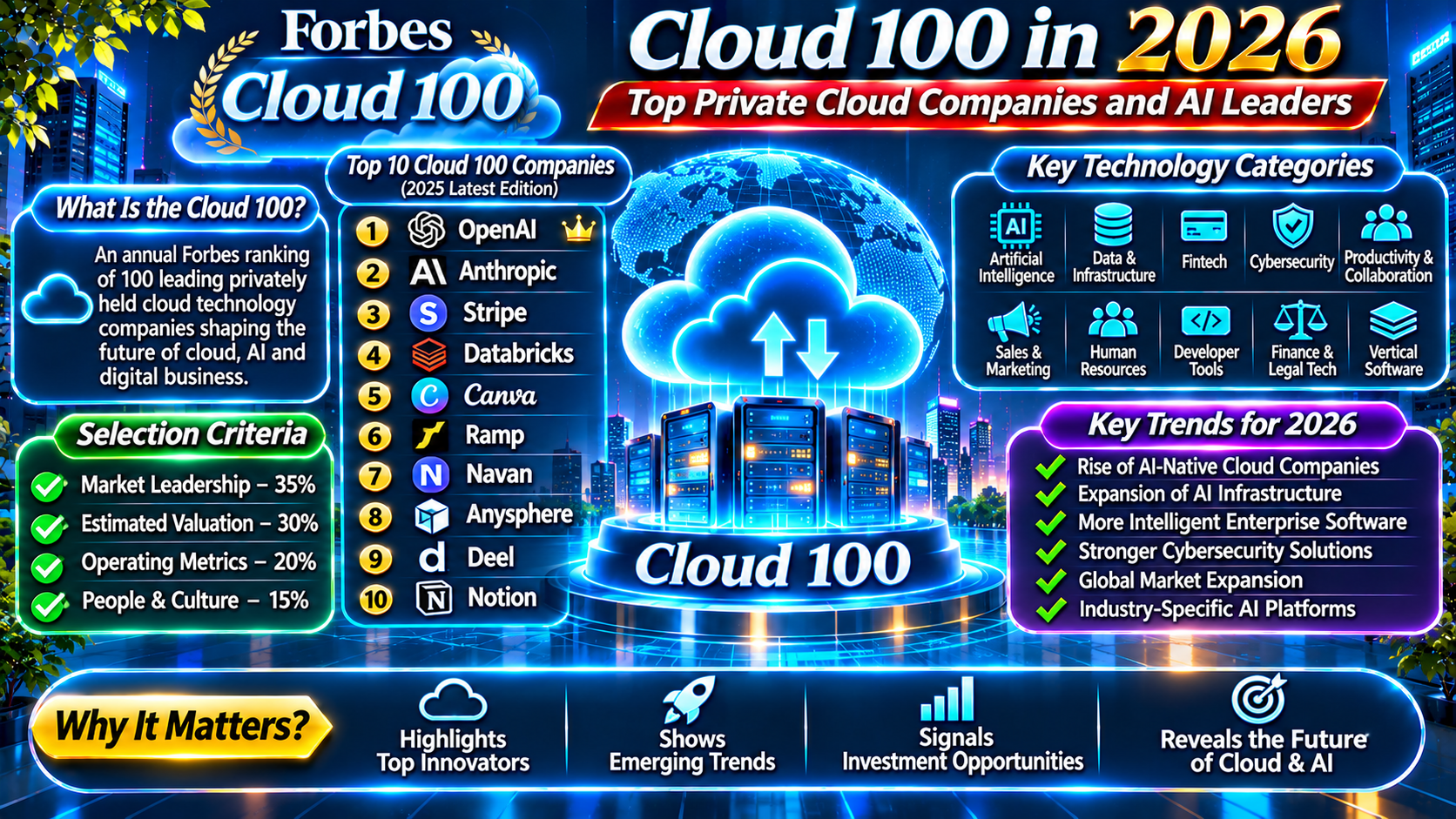
The Cloud 100 is an annual ranking that recognizes 100 of the world's leading privately held cloud technology companies. The ranking is produced by Forbes in collaboration with Bessemer Venture Partners and Salesforce Ventures.
Since its launch in 2016, the Cloud 100 has highlighted innovative businesses developing technologies across artificial intelligence, cloud infrastructure, cybersecurity, fintech, enterprise software, data analytics, and digital collaboration.
Unlike rankings focused exclusively on public technology companies, the Cloud 100 concentrates on privately held businesses that are building influential products and services. Many companies featured in previous editions have subsequently become major industry players, expanded internationally, or entered public markets.
The latest verified edition available for this article is the 2025 Cloud 100, published on September 3, 2025. It placed OpenAI at number one, followed by Anthropic and Stripe. The 2026 edition should be treated separately once its official ranking is published.
The Cloud 100 provides an interesting picture of where private technology investment, innovation, and business growth are concentrated.
How Are Companies Selected for the Cloud 100?
The Cloud 100 uses a combination of financial information, industry expertise, operating performance, and company culture to evaluate nominees.
According to the published 2025 methodology, companies are assessed using four major factors.
1. Market Leadership – 35%
Market leadership carries the highest weighting in the evaluation.
Judges, including executives from established public cloud companies, assess each nominee's position within its market. They consider product differentiation, competitive strength, industry reputation, and the company's potential to influence its sector.
2. Estimated Valuation – 30%
Valuation is another important part of the ranking.
Third-party data providers help estimate the value of privately held businesses. Since private companies do not have publicly traded shares, their valuations may be based on funding rounds, financial information, and other available market evidence.
These estimates are not necessarily equivalent to a confirmed market price.
3. Operating Metrics – 20%
The ranking also considers business performance.
Relevant operating indicators include revenue, growth rates, and other financial measures. These help evaluators understand whether a company is expanding its business and building a sustainable position.
4. People and Culture – 15%
The final component evaluates the company's workforce and organizational culture.
Factors include company size, workforce composition, diversity, and inclusion-related efforts.
This approach means that the Cloud 100 is not simply a list of companies ranked by valuation. It combines several measures to identify influential private cloud businesses.
Top 10 Companies in the Latest Verified Cloud 100 Ranking
The following companies occupied the top ten positions in the 2025 Forbes Cloud 100.
1. OpenAI
OpenAI secured the number-one position in the 2025 Cloud 100.
The company develops artificial intelligence models and products used for writing, research, programming, reasoning, and business automation. Its products include ChatGPT and its developer-focused AI technologies.
OpenAI has played a major role in bringing generative AI into mainstream business and consumer applications.
Its position reflects the growing importance of AI-powered software within the private technology market.
2. Anthropic
Anthropic ranked second in the 2025 edition.
The company develops Claude, a family of artificial intelligence models designed for reasoning, writing, coding, research, and enterprise applications.
Anthropic focuses on AI safety and reliable model development. Its technology is used by individuals, developers, and organizations seeking AI capabilities for complex tasks.
The company's position highlights the growing importance of advanced AI models in the cloud software industry.
3. Stripe
Stripe ranked third.
Stripe develops financial infrastructure and payment technology for businesses operating online and across international markets.
Its services help companies accept payments, manage subscriptions, handle billing, and support financial operations.
The company is an important example of how cloud-based software can simplify complex financial processes for businesses of different sizes.
4. Databricks
Databricks ranked fourth.
The company provides a data and AI platform that helps organizations manage, process, analyze, and use large datasets.
Its technologies support data engineering, analytics, machine learning, and AI development.
As businesses increasingly rely on data-driven decisions and AI applications, platforms that connect data infrastructure with artificial intelligence have become particularly important.
5. Canva
Canva secured the fifth position.
Canva is a visual communication and design platform that enables individuals and businesses to create presentations, graphics, marketing materials, videos, and other digital content.
Its cloud-based model allows teams to collaborate and access creative tools through the internet.
Canva's continued development of AI-assisted design capabilities demonstrates how traditional software categories are evolving through artificial intelligence.
6. Ramp
Ramp ranked sixth.
The company develops financial automation software designed to help businesses manage spending, corporate cards, expense reporting, and financial operations.
Its platform helps organizations gain visibility into company expenses and simplify administrative processes.
Ramp's rise in the ranking reflects the growing demand for digital financial management and automation tools.
7. Navan
Navan ranked seventh.
Navan provides business travel and expense management technology.
Its platform helps organizations coordinate employee travel, manage expenses, and simplify corporate travel administration.
The company demonstrates how cloud software can bring multiple business processes together within a connected platform.
8. Anysphere
Anysphere entered the top ten at number eight.
The company is known for Cursor, an AI-powered coding environment designed to help software developers write, understand, and modify code.
AI coding tools are changing software development by helping programmers complete routine tasks, explore codebases, and work more efficiently.
Anysphere's high debut highlights the growing demand for AI-assisted development software.
9. Deel
Deel ranked ninth.
The company provides global payroll, human resources, and workforce management services.
Its platform helps businesses manage employees and contractors across different countries, supporting international hiring and administrative processes.
Deel represents the growing importance of cloud-based platforms for managing globally distributed workforces.
10. Notion
Notion completed the top ten.
The company provides a digital workspace for notes, documents, project management, knowledge management, and team collaboration.
Organizations use Notion to organize information, manage projects, and coordinate work across teams.
Its development of AI-powered productivity features reflects the broader movement toward intelligent workplace software.
Major Categories Represented in the Cloud 100
The Cloud 100 includes companies from multiple technology categories. The 2025 methodology identifies ten broad areas of the cloud industry.
1. Artificial Intelligence
Artificial intelligence has become one of the most influential categories.
Companies in this sector develop AI models, enterprise assistants, coding tools, automation platforms, and applications that help organizations process information and perform tasks.
OpenAI and Anthropic are prominent examples from the 2025 ranking.
2. Data and Infrastructure
Data and infrastructure companies provide the technologies needed to store, process, manage, and analyze information.
Their products support cloud databases, data integration, AI infrastructure, analytics, and large-scale computing.
Databricks is a leading example.
3. Fintech
Financial technology companies develop digital tools for payments, financial management, business spending, and banking-related services.
Stripe and Ramp demonstrate how cloud software can transform financial operations.
4. Design, Collaboration and Productivity
This category includes platforms that help people create content, organize projects, communicate, and work together.
Canva and Notion are examples of companies operating in this area.
5. Sales, Marketing and Customer Experience
These companies develop platforms that help businesses manage customer relationships, marketing campaigns, sales processes, and customer support.
Their software can include automation, analytics, communication, and customer engagement capabilities.
6. Cybersecurity
Cybersecurity companies develop tools to protect digital systems, networks, applications, and sensitive information.
As businesses move more operations to cloud environments, security software has become increasingly important.
7. Finance and Legal Software
Companies in this category develop tools for financial administration, legal workflows, compliance, and business documentation.
Cloud platforms can simplify complex professional processes and make specialized services more accessible.
8. Human Resources
HR technology companies provide solutions for payroll, recruitment, workforce management, employee records, and global hiring.
Deel and other workforce software providers demonstrate the importance of this category.
9. Developer Tools
Developer-focused companies create software that supports programming, application testing, deployment, monitoring, and collaboration.
Anysphere's Cursor illustrates how AI is becoming part of the software development process.
10. Vertical Software
Vertical software companies build specialized applications for particular industries or professional markets.
Examples include software for healthcare, construction, education, retail, and other sectors.
These platforms address industry-specific requirements rather than trying to serve every type of business with the same general-purpose product.
Why Is AI Becoming So Important in the Cloud 100?
Artificial intelligence has become a major driver of innovation among private cloud companies.
In earlier stages of cloud computing, many businesses focused on moving applications and data away from local infrastructure. The industry later expanded into collaboration, analytics, automation, and specialized business software.
Today, AI is increasingly integrated into these products.
For example:
AI assistants help users complete tasks and retrieve information.
Coding agents support software development.
AI analytics platforms help organizations understand complex datasets.
Customer service agents assist with routine customer requests.
Financial automation tools help businesses organize transactions and expenses.
AI security systems help identify suspicious activities.
A Forbes analysis of the 2025 Cloud 100 reported that AI-focused businesses represented approximately 42% of the list's combined valuation, illustrating the growing importance of artificial intelligence in the private cloud economy.
This trend suggests that successful cloud companies are increasingly competing through intelligent features, specialized AI capabilities, and measurable business value.
The Role of Cloud Computing in Modern Business
Cloud computing provides the foundation for many of the services developed by Cloud 100 companies.
Businesses use cloud technology to access computing resources, store information, manage applications, and support digital operations.
Its importance can be understood through several major business applications.
Business Automation
Cloud platforms allow businesses to connect applications and automate repetitive workflows.
Companies can use these systems to manage approvals, process information, organize customer records, and coordinate business activities.
Data Analytics
Cloud-based analytics tools help organizations examine large datasets and identify useful patterns.
This information can support sales forecasting, customer analysis, financial planning, and operational improvements.
Remote Collaboration
Digital workspaces allow employees to communicate, share documents, and manage projects from different locations.
Cloud-based collaboration has become an important part of modern business operations.
Cybersecurity
Cloud security platforms help organizations monitor systems, manage access, protect information, and respond to potential threats.
As businesses become more dependent on digital infrastructure, cybersecurity remains an essential investment.
Artificial Intelligence Development
Cloud providers and software companies offer computing resources and AI services that support model development, deployment, and operation.
These services make it easier for organizations to experiment with AI without building all the necessary infrastructure themselves.
Cloud 100 and the Future of Technology Startups
The Cloud 100 provides insight into how technology startups develop and compete in global markets.
Many companies begin by solving a specific problem for a particular group of customers. As their products improve, they may expand into new industries, countries, and customer segments.
Several factors can contribute to their growth.
Product Innovation
Companies that develop useful and differentiated products can build stronger relationships with customers.
Innovation may involve improving existing software, introducing new AI capabilities, or solving problems that traditional platforms have not addressed effectively.
Recurring Revenue Models
Many cloud software businesses operate through subscriptions or usage-based pricing.
These models can create recurring revenue opportunities when customers continue using the services.
However, sustainable growth also depends on customer retention, operating costs, and the ability to deliver ongoing value.
Global Market Access
Cloud-based products can often reach customers across international markets without requiring a physical office in every location.
This creates opportunities for startups to expand beyond their original markets.
Strategic Investment
Venture capital and strategic investors can provide funding, expertise, and business connections.
Investment can help companies expand their teams, develop products, enter new markets, and improve infrastructure.
Customer Trust
Businesses increasingly depend on software platforms to manage important operations.
Reliable performance, security, privacy, customer support, and transparent business practices are therefore essential to long-term success.
Challenges Facing Cloud and AI Companies
Although cloud technology offers significant opportunities, companies operating in this industry face several challenges.
1. Intense Competition
Cloud companies compete with established technology providers, emerging startups, and specialized software businesses.
Maintaining a competitive advantage requires continuous product development and a strong understanding of customer needs.
2. Data Privacy and Security
Cloud platforms may handle sensitive personal, financial, and business information.
Companies must protect this data through strong access controls, encryption, monitoring, and appropriate governance practices.
3. Infrastructure Costs
AI and cloud infrastructure can require significant investment in computing resources, storage, networking, and specialized hardware.
Companies must balance infrastructure spending with revenue growth and operational efficiency.
4. Regulatory Requirements
Cloud and AI businesses operate across different countries and regulatory environments.
Privacy, cybersecurity, financial services, and AI-related rules can affect how companies develop and deliver their products.
5. AI Reliability
AI-powered software can generate incorrect information or make unsuitable recommendations.
Companies must invest in testing, monitoring, safeguards, and human oversight to improve the reliability of their products.
6. Customer Retention
Attracting customers is only one part of building a successful software business.
Companies must continue providing value, improving their products, and maintaining strong customer relationships to encourage long-term use.
Cloud 100 vs. Cloud Service Provider Rankings
The Cloud 100 should not be confused with rankings of the world's largest cloud infrastructure providers.
The Cloud 100 focuses on privately held cloud technology and software companies.
By contrast, infrastructure market rankings commonly compare providers such as Amazon Web Services, Microsoft Azure, and Google Cloud based on cloud infrastructure services, market share, revenue, or capacity.
These are different categories of rankings.
For example, OpenAI is a leading private AI company featured in the Cloud 100, while AWS is a major public cloud infrastructure provider.
Understanding this distinction helps readers interpret the ranking correctly.
What Is the Future of the Cloud 100?
The future of the Cloud 100 will likely reflect continued changes in artificial intelligence, cloud infrastructure, cybersecurity, enterprise software, and financial technology.
Several trends may influence future editions.
1. Growth of AI-Native Companies
More businesses are being designed around AI as a central part of their products rather than adding it as a minor feature.
These companies may develop specialized models, AI agents, automated workflows, and intelligent software platforms.
2. Expansion of AI Infrastructure
The demand for computing power, storage, networking, and specialized AI hardware is creating opportunities for infrastructure businesses.
Companies that help organizations train, deploy, and operate AI systems may become increasingly important.
3. More Intelligent Enterprise Software
Business software is evolving from traditional systems that mainly store information into platforms that can analyze data and assist with tasks.
This could create new opportunities in human resources, finance, marketing, customer service, and operations.
4. Stronger Cybersecurity Technologies
As organizations adopt more cloud applications and AI systems, the need for digital protection will continue to grow.
Companies developing identity security, data protection, threat detection, and cloud security tools may benefit from this demand.
5. Global Expansion
Private cloud companies will continue exploring international markets.
Expansion may create new opportunities while also introducing challenges related to regulations, localization, infrastructure, and customer support.
6. Industry-Specific AI Platforms
Specialized AI applications may become more important in sectors such as healthcare, legal services, finance, education, and manufacturing.
These systems can combine industry knowledge with cloud software and AI capabilities.
Frequently Asked Questions About Cloud 100
1. What is the Cloud 100?
The Cloud 100 is an annual ranking of 100 leading privately held cloud technology companies. It is produced by Forbes in partnership with Bessemer Venture Partners and Salesforce Ventures.
2. Who publishes the Cloud 100?
The ranking is produced by Forbes in collaboration with Bessemer Venture Partners and Salesforce Ventures.
3. Which company ranked number one in the latest verified edition?
OpenAI ranked number one in the 2025 Cloud 100.
4. Is the Cloud 100 the same as a cloud computing provider ranking?
No. The Cloud 100 focuses on private cloud technology companies, while infrastructure rankings generally evaluate providers of cloud computing capacity and services.
5. How are Cloud 100 companies selected?
Companies are evaluated using market leadership, estimated valuation, operating metrics, and people and culture.
6. What are the main industries represented in the Cloud 100?
The ranking includes artificial intelligence, data infrastructure, fintech, cybersecurity, enterprise software, productivity, developer tools, HR technology, and specialized industry software.
7. Why is OpenAI included in the Cloud 100?
OpenAI develops privately held AI technology and cloud-delivered products. Its position reflects the growing role of AI in the cloud software industry.
8. Can a startup qualify for the Cloud 100?
Yes. Privately held cloud companies can be nominated for consideration if they meet the eligibility requirements. Early-stage businesses may also be considered for the separate Rising Stars list.
9. What is the Cloud 100 Rising Stars list?
Rising Stars is a separate recognition program for promising early-stage cloud companies. It highlights businesses that may eventually become candidates for the main Cloud 100 ranking.
10. Why is the Cloud 100 important?
The ranking provides insight into leading private technology companies, emerging business models, industry innovation, and the direction of the global cloud and AI economy.
Conclusion
The Cloud 100 has become an important reference point for understanding the private cloud technology industry.
By recognizing leading companies across artificial intelligence, cybersecurity, fintech, enterprise software, data infrastructure, and productivity, the ranking highlights businesses developing technologies that influence the modern digital economy.
The latest verified 2025 edition placed OpenAI, Anthropic, and Stripe in its top three positions, demonstrating the importance of AI and cloud-based business services.
As technology continues to develop, future Cloud 100 editions will offer further insight into emerging companies, new business models, and the growing relationship between cloud computing and artificial intelligence.
For entrepreneurs, investors, technology professionals, and business leaders, the Cloud 100 provides a useful perspective on the companies helping shape the next generation of digital innovation.