Hong Kong has long been one of Asia’s most important centers for finance, real estate, trade, investment, technology, and international business. The city has also produced some of Asia’s most prominent billionaires, with fortunes built across property development, infrastructure, consumer products, technology, hospitality, gaming, finance, and investment.
The 2026 Forbes Hong Kong 50 Richest list highlights the scale of wealth concentrated in the territory. The combined estimated wealth of the 50 richest people and families reached $366 billion, up 22% from $301 billion the previous year. Forbes linked the increase partly to a stronger stock market, renewed initial public offering activity, and a gradual recovery in the property sector.
Li Ka-shing retained the No. 1 position with an estimated fortune of $45.1 billion based on Forbes' January 23, 2026 valuation date.
Who Are Hong Kong’s Richest People?
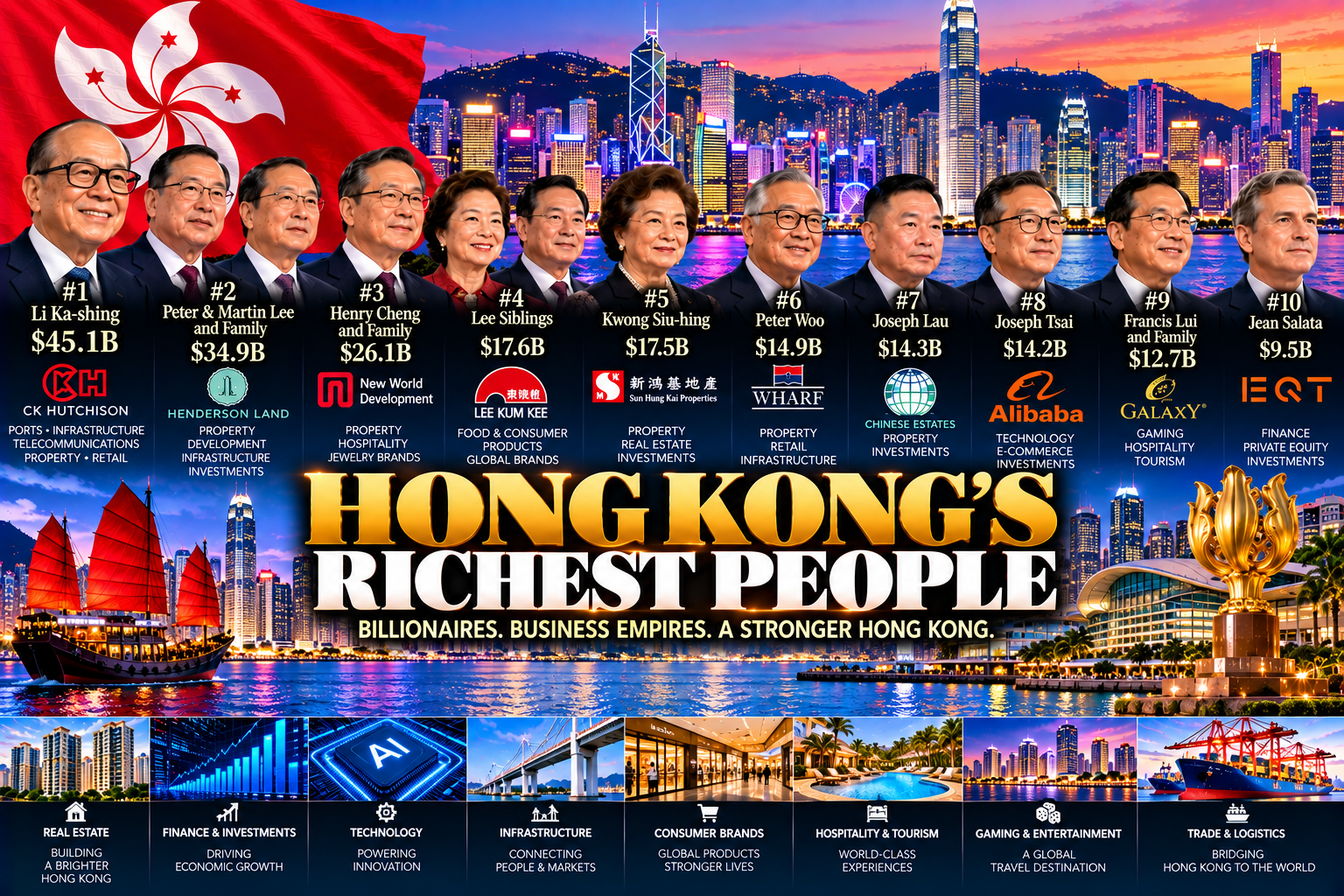
The top 10 on Forbes' 2026 Hong Kong 50 Richest list were:
Li Ka-shing — $45.1 billion
Peter & Martin Lee and family — $34.9 billion
Henry Cheng and family — $26.1 billion
Lee siblings — $17.6 billion
Kwong Siu-hing — $17.5 billion
Peter Woo — $14.9 billion
Joseph Lau — $14.3 billion
Joseph Tsai — $14.2 billion
Francis Lui and family — $12.7 billion
Jean Salata — $9.5 billion
Forbes based the 2026 figures on stock prices and exchange rates as of the close of markets on January 23, 2026. Family fortunes are included, and private companies are valued using financial information and comparisons with similar publicly traded businesses.
1. Li Ka-shing: A Diversified Global Empire
Li Ka-shing remains the most prominent name among Hong Kong's wealthiest people.
Forbes estimated his fortune at $45.1 billion for its 2026 Hong Kong ranking. He built his business empire through companies including CK Hutchison Holdings and CK Asset Holdings, with interests extending across infrastructure, ports, telecommunications, retail, property, and other international businesses.
Li began his entrepreneurial career in plastics before expanding into real estate and eventually building a highly diversified international group.
Although he retired as chairman of CK Hutchison and CK Asset in 2018, his son Victor Li became a key leader of the businesses. Forbes notes that the wider group operates across more than 50 countries.
Li's career illustrates how Hong Kong entrepreneurs have used the city as a financial and commercial base while expanding into international markets.
2. Peter and Martin Lee: Property and Infrastructure
Peter and Martin Lee, sons of the late property billionaire Lee Shau Kee, ranked second with their family fortune estimated at $34.9 billion.
The brothers are co-chairmen of Henderson Land Development, a major Hong Kong property developer. Their appearance near the top of the 2026 list reflects the transfer of wealth and business leadership to the next generation following their father's death.
Henderson Land has major interests in residential and commercial property, while the broader family business also has exposure to infrastructure and energy.
Their business strategy demonstrates how established Hong Kong families are combining traditional property assets with newer areas such as energy and sustainability.
3. Henry Cheng and Family: Property, Jewelry, and Hospitality
Henry Cheng and his family ranked third with an estimated $26.1 billion.
Cheng is associated with New World Development and the wider Cheng family business empire.
The group's interests have included property development, hotels, infrastructure, retail, and other businesses. The Cheng family's wealth illustrates the close relationship between Hong Kong's property sector and its broader consumer and hospitality industries.
Hong Kong's high-density urban environment has historically created substantial opportunities for developers that can combine residential, commercial, retail, and hospitality projects.
4. Lee Siblings: Lee Kum Kee and Consumer Products
The Lee siblings ranked fourth with an estimated family fortune of $17.6 billion.
Their wealth is associated with Lee Kum Kee, the internationally recognized Hong Kong food company known for sauces and condiments.
The company demonstrates how a consumer brand can expand from a regional business into an international enterprise through manufacturing, distribution, branding, and global retail networks.
Consumer-product fortunes differ from property fortunes because value is often linked to brand strength, product demand, manufacturing capabilities, and international distribution.
5. Kwong Siu-hing: Sun Hung Kai Properties
Kwong Siu-hing ranked fifth with an estimated fortune of $17.5 billion.
She is the widow of Kwok Tak-seng, one of the founders of Sun Hung Kai Properties.
The Kwok family's business empire is closely associated with Hong Kong real estate, including residential developments, offices, shopping centers, hotels, and other commercial properties.
The family's position on the Forbes list demonstrates the importance of generational ownership in Hong Kong's property sector.
6. Peter Woo: Property, Retail, and Infrastructure
Peter Woo ranked sixth with an estimated fortune of $14.9 billion.
Woo has been closely associated with Wheelock & Co. and Wharf-related businesses.
His business interests have historically covered property, retail, infrastructure, telecommunications, and other assets.
The combination of property and consumer businesses demonstrates another characteristic of Hong Kong's largest fortunes: diversification across industries can reduce dependence on a single economic sector.
7. Joseph Lau: Property and Investments
Joseph Lau ranked seventh with an estimated fortune of $14.3 billion.
He is associated with Chinese Estates Holdings, a Hong Kong property company.
Real estate has historically been one of the most important sources of wealth in Hong Kong because of the city's limited land availability, high population density, and substantial commercial property market.
Property-related fortunes can be influenced by:
Residential prices
Commercial rents
Interest rates
Development costs
Land prices
Occupancy
Property-company share prices
Consequently, changes in the property cycle can have a significant impact on billionaire wealth estimates.
8. Joseph Tsai: Technology and E-Commerce
Joseph Tsai ranked eighth with an estimated fortune of $14.2 billion.
Tsai is chairman of Alibaba Group and has played an important role in the development of one of China's largest technology and e-commerce businesses.
His wealth represents the technology side of Hong Kong's billionaire economy.
Technology fortunes can be affected by factors such as stock-market performance, digital commerce growth, cloud computing, artificial intelligence, consumer spending, and international expansion.
Tsai's presence among Hong Kong's wealthiest people also highlights the city's connection to mainland China's technology and investment ecosystem.
9. Francis Lui and Family: Gaming and Hospitality
Francis Lui and his family ranked ninth with an estimated fortune of $12.7 billion.
The family is associated with Galaxy Entertainment Group, a major gaming and hospitality business in Macau.
Macau's tourism, gaming, hotels, restaurants, entertainment, and luxury retail industries have generated significant business opportunities for Hong Kong-connected entrepreneurs and families.
The performance of gaming and hospitality businesses can depend on tourism flows, consumer spending, regulations, travel conditions, and broader economic trends.
10. Jean Salata: Finance and Private Equity
Jean Salata ranked tenth with an estimated fortune of $9.5 billion.
Salata is associated with private equity and investment management, representing another major source of wealth outside traditional Hong Kong property businesses.
Investment firms can create substantial fortunes through company acquisitions, asset management, capital allocation, and long-term ownership stakes.
His position among the top 10 demonstrates the importance of financial services to Hong Kong's economy.
Real Estate and Hong Kong's Billionaire Economy
Real estate remains one of the defining industries behind Hong Kong's wealth.
The city has limited land, a highly urbanized population, major commercial districts, and a sophisticated property market.
Major property businesses can generate revenue from:
Residential developments
Office buildings
Shopping centers
Hotels
Mixed-use developments
Industrial properties
Land holdings
Infrastructure projects
The Henderson Land, New World Development, Sun Hung Kai Properties, Wheelock, and Chinese Estates businesses all illustrate different approaches to property ownership and development.
However, property wealth can fluctuate substantially when interest rates, financing costs, rental demand, construction expenses, or property prices change.
Finance and Investment
Hong Kong's role as an international financial center has helped create fortunes in banking, investment management, insurance, private equity, and wealth management.
The city provides access to:
International capital markets
Stock exchanges
Global banks
Investment funds
Private equity
Insurance
Wealth management
Corporate finance
Jean Salata's fortune represents the investment-management side of Hong Kong's economy, while Joseph Tsai demonstrates the connection between technology businesses and international capital.
Technology and Digital Business
Technology is becoming increasingly important to Hong Kong's wealth landscape.
Joseph Tsai's connection with Alibaba demonstrates how digital commerce can create significant business value.
Other areas with potential to influence future wealth include:
Artificial intelligence
Fintech
E-commerce
Cloud computing
Digital payments
Cybersecurity
Data centers
Software
Technology investment
Forbes' 2026 coverage also noted that Hong Kong's renewed IPO activity helped contribute to a broader increase in billionaire wealth.
Consumer Brands and Food Businesses
The Lee family's Lee Kum Kee fortune shows another route to substantial wealth: consumer brands.
Food and beverage companies can build large businesses through strong brands, manufacturing networks, international distribution, and recurring consumer demand.
Hong Kong's location has also helped companies use the city as a bridge between mainland China and international markets.
Gaming, Tourism, and Hospitality
Tourism and hospitality are important parts of the wider Hong Kong and Macau business ecosystem.
Francis Lui's Galaxy Entertainment illustrates how gaming businesses can connect with:
Hotels
Resorts
Restaurants
Entertainment
Tourism
Luxury retail
Transportation
These industries can be highly sensitive to tourism levels, regulatory changes, consumer spending, and economic conditions.
Infrastructure and Global Trade
Hong Kong's position as an international trade and logistics hub has created opportunities in ports, transportation, telecommunications, and infrastructure.
Li Ka-shing's business empire is a prominent example, with CK Hutchison maintaining interests in infrastructure and other international operations. Forbes describes the wider group as operating in more than 50 countries.
Infrastructure businesses can produce long-term revenue streams but often require substantial capital investment.
Family Businesses and Generational Wealth
Family ownership is a defining feature of Hong Kong's billionaire landscape.
Several of the highest-ranked fortunes on the 2026 Forbes list are associated with families rather than a single individual.
Examples include:
Peter and Martin Lee and family
Henry Cheng and family
Lee siblings
Kwong Siu-hing and the Kwok family
Francis Lui and family
Generational businesses can benefit from established brands, accumulated assets, business relationships, and decades of industry experience.
Succession can also introduce challenges involving ownership, governance, leadership, and long-term strategy.
Hong Kong's Billionaire Wealth Reaches a Record
The 2026 Forbes ranking showed a substantial increase in the collective wealth of Hong Kong's richest people.
The combined wealth of the 50 richest reached $366 billion, compared with $301 billion in the previous year. Forbes said 36 members of the list recorded wealth gains.
The minimum fortune required to enter the list also increased to $1.6 billion, compared with $1.4 billion previously.
Forbes attributed the broader increase partly to a nearly 30% rise in the Hang Seng Index during the relevant period, along with IPO activity and improving property conditions.
Why Billionaire Rankings Change
Billionaire rankings are constantly affected by changes in asset values.
Important factors include:
Stock prices
Property values
Exchange rates
Company earnings
Acquisitions
Private-company valuations
Debt
Ownership changes
Interest rates
Economic conditions
This is why a person's estimated wealth can differ between an annual Forbes ranking and a real-time Forbes profile.
For example, Forbes' current real-time profile for Li Ka-shing shows a different valuation from the $45.1 billion figure used for the 2026 Hong Kong ranking because the valuation dates differ.
How Billionaire Wealth Is Calculated
Billionaire net worth is an estimate of the value of assets minus liabilities.
For publicly traded companies, researchers can calculate the approximate value of a person's ownership stake using the company's share price.
Private businesses require additional valuation methods, including financial ratios, comparable companies, transaction data, and other available information.
Therefore, a billionaire's reported net worth should not be interpreted as the amount of cash they have available.
The Future of Hong Kong's Wealth
Hong Kong's wealth landscape is likely to continue changing as traditional industries interact with technology and global investment.
Potential areas of future growth include:
Artificial intelligence
Fintech
Digital commerce
Green technology
Healthcare
Data infrastructure
Private equity
Renewable energy
International investment
Luxury and consumer brands
Property is likely to remain an important part of Hong Kong's business environment, while technology and financial services may play an increasingly important role in new wealth creation.
Final Thoughts
Hong Kong's richest people represent a broad range of industries and business models.
Li Ka-shing's diversified international empire, the Lee family's property interests, Henry Cheng's business holdings, Lee Kum Kee's global consumer brand, the Kwok family's property assets, Joseph Tsai's technology wealth, Francis Lui's gaming business, and Jean Salata's investment activities demonstrate the diversity of Hong Kong's billionaire economy.
The 2026 Forbes data also shows how closely billionaire fortunes are linked to financial markets. The combined wealth of Hong Kong's 50 richest reached a record $366 billion, supported by stronger stock-market performance, IPO activity, and improving property conditions during the measurement period.
Understanding Hong Kong's richest people therefore involves more than looking at net-worth figures. Their fortunes are connected to companies, property assets, global markets, family businesses, financial systems, and changing economic conditions.
FAQs
Who is the richest person in Hong Kong in 2026?
Li Ka-shing was No. 1 on Forbes' 2026 Hong Kong 50 Richest list, with an estimated fortune of $45.1 billion based on the January 23, 2026 valuation date.
How much are Hong Kong's 50 richest people worth?
The combined estimated wealth of Hong Kong's 50 richest people and families reached approximately $366 billion on Forbes' 2026 list.
What is Li Ka-shing's main source of wealth?
Li Ka-shing built his fortune through a diversified business empire involving property, infrastructure, ports, telecommunications, retail, and other international businesses.
Who are Peter and Martin Lee?
Peter Lee Ka-kit and Martin Lee Ka-shing are the sons of the late property billionaire Lee Shau Kee. They are associated with Henderson Land Development and ranked second with their family on Forbes' 2026 Hong Kong list.
Is Hong Kong's billionaire wealth mainly based on real estate?
Real estate is a major source of wealth, but Hong Kong's richest people also have fortunes connected to technology, finance, infrastructure, consumer products, gaming, hospitality, and investment management.
Who is Joseph Tsai?
Joseph Tsai is chairman of Alibaba Group and ranked eighth on Forbes' 2026 Hong Kong 50 Richest list with an estimated fortune of $14.2 billion.
Why do billionaire net-worth figures change?
Net-worth estimates change because stock prices, property values, exchange rates, private-company valuations, ownership stakes, and other assets change over time.
When were the 2026 Hong Kong fortunes measured?
Forbes' 2026 Hong Kong 50 Richest ranking used stock prices and exchange rates as of the close of markets on January 23, 2026.